
How to Improve Profit Margins: A Merciless Guide to Operational Flow (2026)

Your top line is growing, but your bottom line is flatlining. It's a common trap in 2026. You're likely chasing more sales to fix a leak that's actually located in your operational engine. Most leaders think they know how to improve profit margins by cutting the coffee budget or squeezing vendors. They're wrong. In a landscape where the California exempt salary threshold has hit $70,304 and federal interest rates sit at 3.50% to 3.75%, you can't afford to be sloppy with your internal structure.
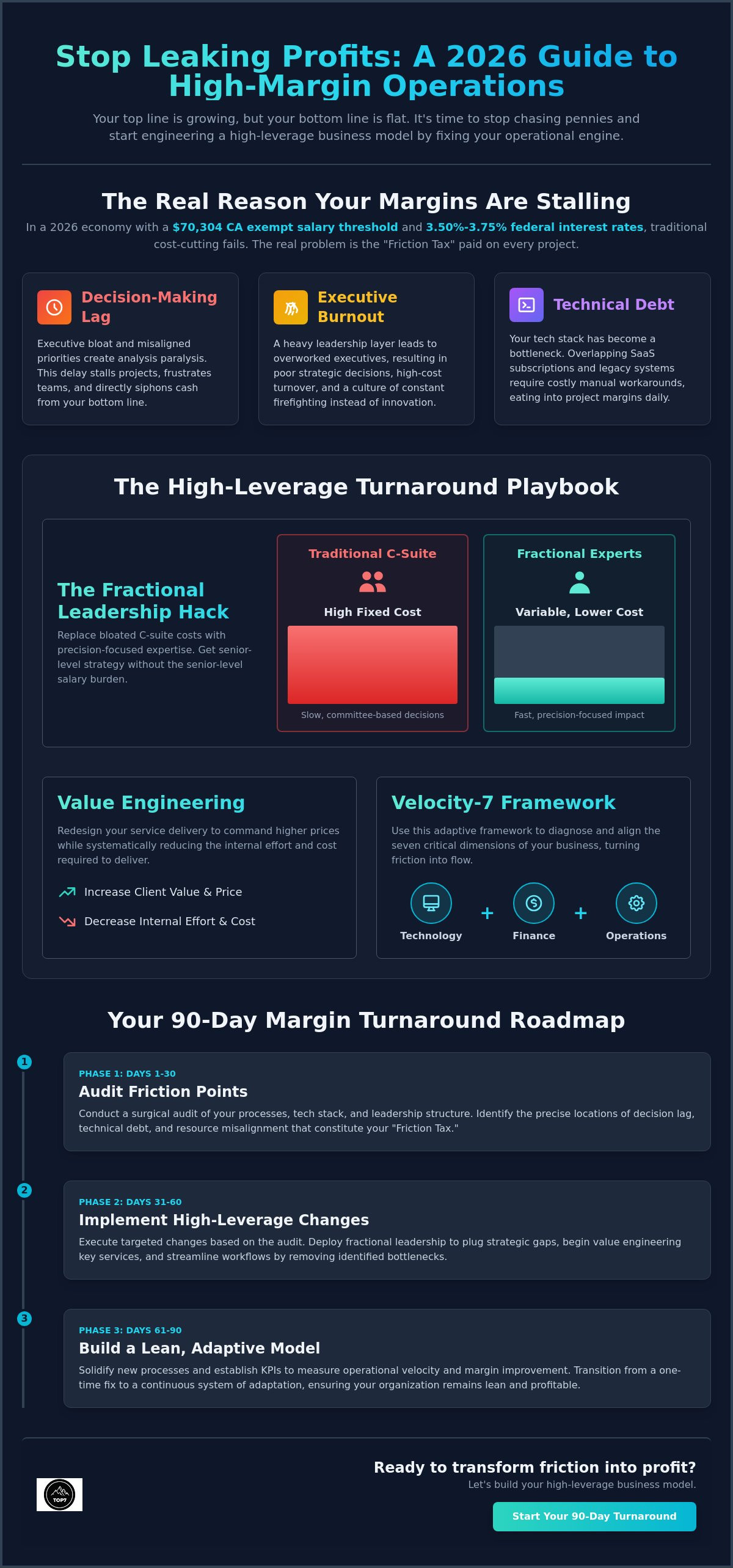
You feel the friction every day. It's the executive bloat slowing down decisions and the technical debt eating your project margins. We agree that "growth at all costs" is a dead strategy. This guide promises to show you how to stop chasing pennies and start engineering a high-leverage business model. We are dissecting the Velocity-7 Adaptive Framework to show you how surgical leadership transforms a bloated organization into a profit machine. It's time to turn your operational friction into pure, bottom-line profit.
Key Takeaways
Identify the invisible margin killers, such as decision-making lag and executive burnout, that are siphoning cash from your business.
Master the Velocity-7 Adaptive Framework to align tech, finance, and operations into a single, high-output engine.
Discover exactly how to improve profit margins by replacing bloated executive salaries with precision-focused Fractional C-suite experts.
Redesign your service delivery through value engineering to command higher prices while reducing the internal effort required to deliver.
Execute a 90-day turnaround strategy that moves your organization from an audit of friction points to a lean, high-leverage model.
Table of Contents
Beyond the Spreadsheet: Why Your Margins Are Actually Stalling
The Velocity-7 Framework: Plugging the Leaks in Your Operational Flow
Strategic Pricing and Value Engineering: The High-Leverage Playbook
The Fractional Leadership Hack: Cutting Executive Bloat Without Losing Brainpower
Implementing the Margin Turnaround: Your 90-Day Execution Roadmap
Beyond the Spreadsheet: Why Your Margins Are Actually Stalling
Stop looking at your P&L as a static report. In 2026, your profit margin is a real-time diagnostic of how much friction your leadership team is tolerating. If you're operating in high-cost hubs like Boston or Chicago, you already know that traditional cost-cutting is a fool's errand. Labor costs are fixed at record highs, and inflation has baked itself into every vendor contract. To understand how to improve profit margins today, you must stop viewing them as a pricing result and start seeing them as a measure of organizational velocity.
Many executives fall into the "Scale Trap." They believe that adding another $5M in revenue will magically fix their bottom line. Instead, they find that scaling a broken process only scales the losses. This happens because of "Invisible Margin Killers": decision-making lag that stalls delivery, executive burnout that leads to expensive churn, and technology that creates more work than it automates. Gaining a deep understanding profit margins requires looking past the revenue line and into the gears of your operation.
To better understand this concept, watch this helpful video:
The Difference Between Gross and Net in a Service-First Economy
In 2026, the definition of COGS has shifted. It no longer just covers raw materials or direct labor. It now includes the massive weight of technical debt and software sprawl that slows your team down. You also need to audit your "Shadow Payroll." These are the expensive contractors and "special projects" teams you've hired simply to bridge the gaps between your broken internal systems. Net margin is the ultimate KPI that reveals exactly how effective your leadership layer is at converting effort into value.
The High Cost of Operational Friction
Every project in your pipeline is currently paying a "Friction Tax." This tax is the cost of misaligned C-suite priorities and the time wasted in meetings that should've been automated workflows. While traditional consultants will tell you to optimize your funnel, they usually ignore the root cause: your executive layer is too heavy and your delivery engine is too slow. Fixing this isn't about minor tweaks; it's about a surgical removal of the friction that bleeds your cash before you even close a sale. This is the first step in learning how to improve profit margins in a competitive, high-interest environment where the federal funds rate remains at 3.50% to 3.75%.
The Velocity-7 Framework: Plugging the Leaks in Your Operational Flow
Identifying your margin killers is only half the battle. You need a system to neutralize them. Most "growth" consultants offer generic advice that fails because it doesn't account for the friction between your departments. The Velocity-7 Adaptive Framework is different. It's a diagnostic tool built for 2026 that forces alignment across seven critical dimensions, including technology, finance, and operations. When these areas are out of sync, you aren't just losing time; you're bleeding cash. Learning how to improve profit margins requires moving from this state of chaos into a state of efficient flow.
This transition isn't a one-time event. It's an agile-based transformation. In a volatile market where consumer behavior shifts overnight, your operational model must be adaptive. If your processes are rigid, your margins will crumble under the weight of the next market pivot. By implementing a framework that prioritizes "flow," you turn your internal structure into a competitive advantage rather than a cost center. Understanding the nuances of how to improve your profit margin starts with this systemic audit.
Audit Your Technology Leadership (Fractional CTO perspective)
Is your tech stack an asset or a bottleneck? By 2026, tech debt has become the single largest "hidden" expense for mid-market firms. It's common to find overlapping SaaS subscriptions and legacy systems that require manual workarounds. A Fractional CTO doesn't just manage IT; they align your product roadmap with your highest-margin revenue streams. It's not unusual for a surgical audit to identify over $100,000 in redundant software spend within the first 30 days. That is pure profit returned to your bottom line without selling a single new contract.
Financial Strategy Beyond Bookkeeping
If your CFO is only "reporting what happened," they are failing you. A Fractional CFO focuses on capital strategy and proactive cash flow management. They move you from reactive accounting to engineering what will happen next. Strategic planning isn't just a document; it's a weapon. For example, Dallas-based firms utilizing this level of precision in their financial planning have seen margin jumps of 15% by simply optimizing their working capital and debt structures. This is how you win in a high-interest environment. Stop chasing pennies and start how to improve profit margins through high-level financial engineering.
Strategic Pricing and Value Engineering: The High-Leverage Playbook
If you're still competing on price in 2026, you've already lost. In the shark tank of East Coast markets like New York and Boston, price-matching is a suicide pact. There's always a competitor willing to go broke faster than you. To survive, you must position your service as a "must-have" strategic asset. This shift requires more than just a marketing rebrand. It demands value engineering: the process of redesigning your offering to deliver maximum impact with minimum operational drag. It's about working smarter at a structural level to ensure every billable hour carries its weight.
Stop rewarding your sales team for volume. If you pay commissions on top-line revenue, your reps will sell low-margin, high-friction junk just to hit their numbers. You need to pivot to margin-based incentives. This forces your sales force to seek out high-leverage deals that fit your operational flow. It's a merciless "pruning" strategy. You must have the courage to eliminate low-performing products and fire toxic, high-maintenance clients who eat your team's time. This isn't just about being "lean." It's about efficient resource and financial management that protects your bottom line from the inside out.
Dynamic Pricing Models for 2026
Cost-plus pricing is a relic of the industrial age. It ignores the actual value you provide and ties your profit to your expenses. In 2026, value-based pricing is the only way to capture the "premium" you deserve. When communicating a price increase to your New England clients, don't apologize. Frame it around the increased complexity of the market and the superior results you deliver. Use data-driven sales guidance to identify which customer segments are actually profitable and which ones are just "busy work." Knowing how to improve profit margins means knowing exactly who to say "no" to.
Maximizing Customer Retention and Lifetime Value (LTV)
Acquisition is a vanity metric. Retention is a profit metric. In a high-interest environment, spending 5x more to acquire a new client than to keep an old one is financial malpractice. Your goal should be turning one-off projects into recurring monthly retainer fees. This creates a predictable cash flow and reduces the "friction tax" of constant onboarding. Lifetime Value (LTV) is the only metric that justifies high acquisition costs. If your LTV doesn't dwarf your CAC, your business model is a ticking time bomb. This is how you master the art of how to improve profit margins without constantly chasing the next lead.
The Fractional Leadership Hack: Cutting Executive Bloat Without Losing Brainpower
Stop hiring for prestige and start hiring for profit. In 2026, a full-time COO commanding a $300,000 salary plus benefits is often a liability, not an asset. When you factor in payroll taxes, executive perks, and the 21% federal corporate income tax rate, that single seat becomes a massive anchor on your bottom line. If you're wondering how to improve profit margins, the answer isn't "more staff." It's smarter access to expertise. Fractional leadership allows you to inject C-suite intelligence into your business without the soul-crushing overhead of a permanent hire.
Top7 professionals don't act like traditional consultants who drop a slide deck and disappear. We provide embedded execution. This means your Fractional CEO, CFO, or CTO is inside your systems, neutralizing technical debt and streamlining operations from the cockpit. They bridge the gap during transitions through interim management, ensuring you don't lose operational momentum when a key player exits. With the federal funds rate holding at 3.50% to 3.75%, capital is too expensive to waste on "executive bloat" that doesn't produce a measurable return on investment.
Fractional CTOs and COOs: The Margin Power Couple
In Chicago-based mid-market firms, we often see a disconnect between what the tech can do and how the business actually runs. A Fractional COO fixes this by ruthlessly streamlining delivery pipelines. When paired with a strategic tech lead, they create a synergy that eliminates redundant processes. This "power couple" approach reduces executive burnout by offloading complex strategic planning to seasoned pros who have seen your specific problems ten times before. You get the results of a veteran leadership team at a fraction of the cost.
Reducing burnout also means creating space for high-quality social and networking experiences. For leaders looking to host strategic dinners or reward their teams in a sophisticated setting, you can discover G7 Rooftop, a premier kosher Japanese-fusion destination in the Miami area.
Variable vs. Fixed Costs in Your C-Suite
The most agile companies in 2026 are converting high fixed salaries into flexible, project-based expenses. This shift is a fundamental pillar of how to improve profit margins. It gives you the tactical advantage to scale your leadership layer up or down based on market demand. Why pay for a full-time CTO during a maintenance phase when you only need their high-level vision during a pivot? You can gain this strategic edge today by leveraging a Fractional CTO to audit your tech stack and reclaim your lost margins. It's time to stop paying for potential and start paying for performance.
Implementing the Margin Turnaround: Your 90-Day Execution Roadmap
Theory is cheap. Execution is where the winners separate themselves from the casualties. If you're serious about how to improve profit margins, you need a timeline, not a wish list. This 90-day roadmap is designed to move you from a state of operational friction to a high-velocity flow. It's a surgical strike on inefficiency that starts the moment you decide to stop tolerating mediocrity.
The first 30 days are dedicated to the Velocity-7 Audit. You must identify every friction point and cash leak within your core growth dimensions. By day 60, you execute the Leadership Pivot. This involves replacing bloated, fixed-cost executive roles with high-impact Fractional experts who deliver results without the benefits package. Finally, by day 90, you implement process automation and your pricing reset. This is where you turn the value engineering we discussed earlier into a live, revenue-generating reality. Margin optimization isn't a one-time project. It's a permanent discipline for those who want to dominate their market.
Advanced Project Management as a Margin Tool
In high-pressure tech hubs like Austin or the West Coast, project overruns aren't just annoying. They're fatal. Agile transformation is your primary weapon for reclaiming billable hours and reducing waste. Every single project in your pipeline must meet a minimum 40% gross margin threshold. If it doesn't, you prune it. Reclaiming your "Velocity" means ensuring your team is focused on high-leverage delivery, not fixing the same broken processes repeatedly. This is a core pillar of how to improve profit margins in a service-first economy where technical debt can easily consume your gains.
Your Next Move: Friction to Flow
Is your organization ready for a Velocity-7 transformation? Most leaders wait until the crisis hits. That's a mistake. A 2% margin dip today isn't a fluctuation. It's an early warning sign of a 20% deficit coming by next year. In a 2026 economy where the federal funds rate is 3.50% to 3.75% and labor costs are rising, you don't have the luxury of slow moves. The gap between your current friction and your future flow is a choice. You can continue chasing pennies, or you can Schedule a Velocity-7 Audit with a Top7 Executive today and start engineering a model that actually scales.
Stop Chasing Revenue and Start Engineering Profit
Revenue is a vanity metric. If you're a mid-market organization between $10M and $100M, you can't afford to hide behind top-line growth while your operational engine leaks cash. We've shown you that the real battle for margin is won in the trenches of your workflow, not just on your invoice. By ditching executive bloat and adopting our proprietary Velocity-7 Adaptive Framework, you transform your cost centers into profit drivers.
Knowing how to improve profit margins isn't a secret; it's a structural choice. You either tolerate the friction that burns your capital, or you bring in seasoned professionals to neutralize it. Our experts don't just advise from the sidelines; they embed directly into your team to execute the turnaround. The 90-day roadmap is your path from chaos to precision. Don't let another quarter slip away to technical debt and decision lag.
Stop the Bleeding: Get Your Fractional Leadership Roadmap
Your business has the potential for massive leverage. It's time to stop guessing and start winning. You have the roadmap; now you need the execution.
Frequently Asked Questions
What is a good profit margin for a mid-market company in 2026?
A healthy net profit margin for a mid-market firm in 2026 typically sits between 10% and 20%. Given the 21% federal corporate tax rate and current interest environments, anything below double digits leaves your organization vulnerable to market shocks. You aren't just looking for survival. You're looking for the capital required to reinvest in strategic growth and weather economic volatility.
How does a Fractional CTO actually help improve profit margins?
A Fractional CTO attacks the technical debt and software sprawl that bloats your operating expenses. They realign your technology roadmap with your highest-margin products and eliminate redundant SaaS subscriptions. It's common to identify six figures in savings within the first 30 days by simply removing tools your team doesn't use or need to deliver value.
Can I improve margins without raising my prices?
Yes, you can discover how to improve profit margins by focusing on value engineering. This process involves redesigning your internal delivery systems to provide more value with significantly less manual effort. Reducing operational friction allows you to keep your prices stable while lowering your cost of goods sold, directly boosting your bottom line without alienating your customer base.
What is the most common cause of margin erosion in scaling businesses?
The "Scale Trap" is the primary killer of profitability. Businesses often add expensive, full-time executive roles too early, creating a heavy fixed-cost structure that outpaces revenue growth. This executive bloat leads to decision-making lag. It stalls projects and bleeds cash through "Shadow Payroll" and inefficient processes before you've even delivered the final product to the client.
How long does it take to see results from the Velocity-7 Framework?
Diagnostic clarity arrives within the first 30 days of the Velocity-7 Audit. Measurable bottom-line impact usually hits by the 90-day mark. We prioritize the leaks that are easiest to plug first. This creates immediate cash flow that funds the deeper structural changes required for long-term margin expansion and organizational agility in a competitive landscape.
Is Fractional Leadership better than traditional business consulting?
Consultants sell advice; Fractional leaders sell execution. A traditional consultant leaves you with a slide deck and a list of things to fix. A Fractional leader embeds in your C-suite to actually fix them. It's the difference between buying a map and hiring a driver who already knows the terrain and has the keys to the car.
How do I identify operational friction in my sales process?
Audit your client roster for high-maintenance accounts that yield the lowest profit. If your sales team is chasing volume over margin, they're likely selling complex, custom work that breaks your standard delivery flow. Understanding how to improve profit margins requires identifying where sales promises exceed your current operational capacity, creating a "Friction Tax" on every new deal.
What are the benefits of interim management during a profit crisis?
Interim management provides immediate stabilization without the long-term baggage of a permanent hire. It brings a seasoned hand to navigate a profit crisis, ensuring you don't lose operational momentum during a leadership transition. This allows you to stabilize the ship and pivot toward a leaner, high-leverage leadership model without the risk of making a desperate, permanent hiring mistake.



Comments