
Outsourced Chief Product Officer: A Buyer’s Guide for 2026

Will an outsourced chief product officer make the hard product decisions, or just add another voice to the room? If priorities keep shifting, decision ownership is blurred, and customer needs aren’t translating into business outcomes, that distinction matters. Advice alone won’t close the execution gap.
Before bringing in senior product leadership, define the mandate, decision rights, and connection between product choices and business goals. This guide explains how to assess an outsourced CPO, compare engagement models, and choose leadership that fits your company’s needs without paying for a full-time role you don’t need.
You’ll learn what a CPO should own, how fractional, outsourced, and interim arrangements differ, and which selection criteria show whether a candidate can turn strategy into action. Top7’s embedded Fractional CPO leadership connects strategic guidance with execution support. The aim is to replace scattered priorities with clear ownership and disciplined execution.
Table of Contents
When an Outsourced Chief Product Officer Makes Business Sense
Product work is underway. Teams are shipping, customers are asking for changes, and executives are setting priorities. But who decides what comes first, what gets delayed, and why? When ownership is unclear, the roadmap becomes a collision of opinions. Teams stay busy while key decisions wait for someone with the authority to make them.
An outsourced chief product officer can be a fit when the gap is executive leadership, not simply a shortage of people to do the work. The role focuses on setting product direction and aligning choices with customer needs and company goals. A Chief Product Officer (CPO) typically works at this strategic level, connecting product leadership with broader business priorities.
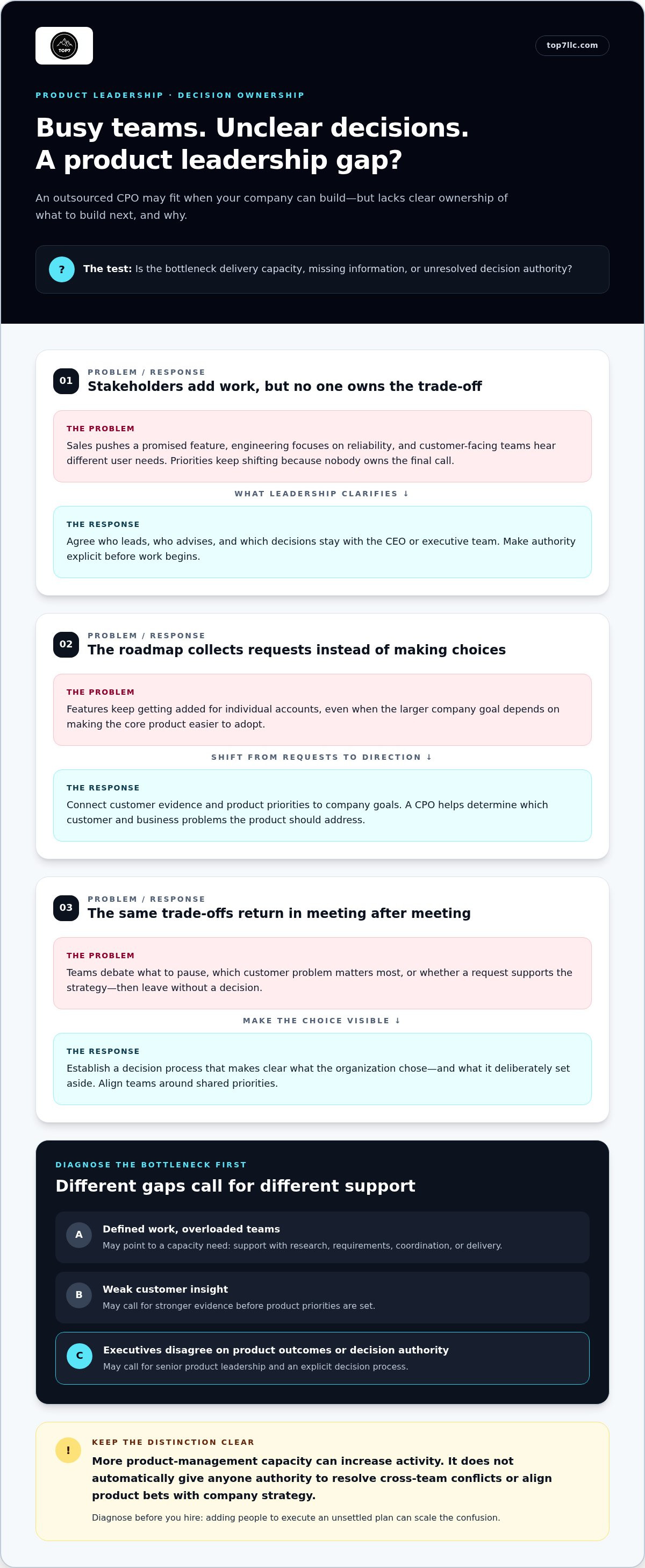
Senior product leadership is needed when the company can build, but lacks clear ownership of what to build next and why. That’s the test. A delayed release or messy roadmap doesn’t automatically call for a CPO. First identify whether the bottleneck is delivery capacity, missing information, or unresolved decision authority.
Signals the product function needs executive ownership
Look for recurring conflicts that teams can’t resolve themselves. Sales may push for a feature promised to a prospect, engineering may be focused on reliability, and customer-facing teams may hear a different problem from users. If every stakeholder can add work but nobody owns the final trade-off, priorities will keep changing.
Check whether the roadmap reflects customer needs and company strategy or simply collects requests. For example, a team might keep adding features for individual accounts while the company’s larger goal depends on making its core product easier to adopt. The issue may not be poor effort. It may be the absence of a decision process that connects customer evidence to business direction.
Another signal is seeing the same trade-offs return in meeting after meeting. Teams debate what to pause, which customer problem matters most, or whether a request supports the strategy, then leave without a decision. Work continues, but progress is hard to assess if nobody can explain what the organization has chosen and what it has deliberately set aside.
When adding another product manager will not solve the gap
More product-management capacity can help when direction is clear and the team needs support with research, requirements, coordination, or delivery. But adding an individual contributor doesn’t automatically give anyone authority to resolve cross-team conflicts or align product bets with company strategy. More hands can increase activity without clarifying who makes the call.
Separate the symptoms before deciding what support fits. Are teams overloaded with defined work? Is the roadmap blocked by weak customer insight? Or do executives disagree about which outcomes the product should drive? The first may point to a capacity need. The others may call for clearer leadership, stronger evidence, or an explicit decision process.
Diagnose before you hire. If the core issue is decision ownership, adding people to execute an unsettled plan will only scale the confusion.
What an Outsourced Chief Product Officer Owns
An outsourced chief product officer is an external executive engaged to lead product direction and the decisions that shape it. The role provides product leadership, not simply extra hands to manage tickets, write requirements, or coordinate delivery. The CPO helps determine which customer and business problems the product should address, then aligns teams around those choices. The mandate depends on the company’s needs and the decision rights agreed with its leadership.
That distinction matters. A consultant may recommend a direction, while an outsourced CPO may be accountable for leading product decisions within an agreed scope. Neither the title nor the word “outsourced” settles who has authority. Define that explicitly with the CEO and relevant leaders before work begins.
Product strategy, priorities, and decision rights
The CPO translates company objectives into product priorities. If leadership wants to improve retention, for example, the product function needs to determine which customer problems are most relevant to that goal and how to weigh them against competing requests. ProductPlan’s overview of the responsibilities of a Chief Product Officer also frames the position around strategic product direction, not just delivery oversight.
Before the engagement, agree on where the CPO leads, where they advise, and which decisions remain with the CEO or executive team. Clarify authority over areas such as:
How product priorities are set when customer needs, commercial requests, and technical considerations conflict.
How major product trade-offs are brought to leadership for a decision.
How product choices connect to company goals and customer evidence.
These are useful topics for defining the mandate, not a universal checklist of deliverables. Decision rights should fit the company’s structure, current product function, and appetite for delegated authority. Without agreement, even a capable leader can end up advising on decisions they’re expected to own.
How the CPO aligns teams around product choices
Product decisions rarely stay within the product team. Technology needs a clear view of priorities and constraints. Sales needs to understand which customer requests fit the direction. Executives need to see how product choices support company goals. A CPO helps these groups work from shared priorities rather than competing versions of the roadmap.
Consider a feature request that could satisfy one large prospect but divert effort from a recurring problem affecting existing users. The CPO makes the trade-off visible: what each choice serves, what it displaces, and who has authority to decide. The goal isn’t to eliminate disagreement. It’s to turn disagreement into a clear decision teams can act on.
For a company that needs strategic guidance connected to execution, Top7’s Fractional CPO leadership embeds product leadership within the organization.
Outsourced CPO vs. Fractional CPO, Consultant, or Full-Time Hire
Labels don’t tell you who owns the product call. “Outsourced” and “fractional” can describe overlapping arrangements, so compare the actual scope. Is the leader directing product decisions, advising the people who make them, or adding capacity to carry out a plan? An external executive can take meaningful ownership, but only when authority, access to decision-makers, and accountability are agreed upfront.
External executive leadership versus product consulting
Consulting can fit a narrow, time-bound need, such as reviewing a product strategy or assessing a prioritization challenge. Executive leadership addresses a broader, more continuous mandate: setting direction, aligning stakeholders, and carrying decisions into the organization. Neither label guarantees follow-through. Specify who makes the final call, who communicates it, and who is accountable for putting it into practice.
If the engagement is advisory, say so. If the external leader is expected to own decisions, define the boundaries of that authority and how it works with the CEO and existing executives. Ambiguity can turn a leadership engagement into a stream of recommendations nobody is empowered to act on.
Fractional or outsourced leadership versus a full-time CPO
A fractional or outsourced arrangement may suit a company that needs senior product leadership but doesn’t require a dedicated executive working full time. A full-time CPO may be a better fit when product decisions demand sustained daily involvement across a complex organization, or when the company needs a permanent executive presence in its leadership structure. Part-time leadership isn’t a universal substitute.
Assess the actual workload. How many teams need alignment? How often do product trade-offs require executive attention? Does the CEO have the bandwidth to stay involved, or does the role need to carry broad internal responsibility? The answers help define the level of involvement required, not just the job title.
Before choosing a model, write down the decisions the role should influence, the people it must work with, and where final authority sits. Then compare each option against those needs. The right arrangement gives product direction enough ownership and continuity to move forward, without assuming every company needs the same structure.
How to Scope and Evaluate an Outsourced CPO Engagement
A strong engagement starts with a business problem, not a list of activities. Before hiring an outsourced chief product officer, identify where the product function is stuck and what kind of leadership could address it. Is the challenge unclear product direction, competing executive priorities, a weak connection to customer insight, or difficulty turning decisions into coordinated action? Don’t mistake a visible symptom for the root cause.
Use this sequence to scope the role:
Diagnose the gap. Identify the recurring decisions that stall, the teams affected, and the business objective at stake.
Define authority. Specify which product decisions the CPO can make, which they can recommend, and which remain with the CEO or leadership team.
Set collaboration expectations. Agree how the leader will work with executives, product and technology teams, and other stakeholders.
Review progress. Choose relevant indicators and a regular process for examining progress and revisiting priorities.
Set the mandate before discussing activities
Name the decisions that need an owner. These might include resolving priority conflicts, connecting product choices to company objectives, or deciding how customer evidence informs investment. Then separate executive responsibilities from delivery tasks. A CPO may guide product direction and align teams; that doesn’t mean the role automatically covers every project task or software development. Record how the leader will work with existing executives and product teams, including who makes the final call when priorities conflict.
Access is part of the scope, not an administrative detail. The CPO needs appropriate access to leaders involved in product decisions, relevant teams, customer context, and existing product information. Without that access, the person is being asked to lead with incomplete visibility. Agree what information and relationships are needed to understand the current situation and contribute effectively.
Before engagement, answer this: Which decisions need an owner, what authority will the CPO hold, who must they work with, what information will they access, and how will progress be reviewed?
Define progress without inventing performance promises
Choose indicators that reflect the company’s objectives and starting point. If the priority is improving customer retention, for example, agree which retention measures are relevant and how product decisions connect to them. If the issue is stalled prioritization, progress might initially be assessed by whether decisions are made and communicated clearly. These are evaluation criteria, not promised results.
Set a review rhythm that fits the engagement and gives leaders a useful opportunity to examine decisions, blockers, and changing assumptions. Include a way to revisit priorities when customer evidence or business needs shift. The point isn’t to lock a roadmap in place; it’s to keep decisions visible and aligned as conditions change.
Top7’s Fractional CPO professionals embed directly with clients, connecting strategic guidance with execution support. Top7’s Fractional CPO leadership brings that combination of strategic guidance and execution support to the engagement.
How Top7 Connects Fractional CPO Leadership to Execution
You’ve defined the leadership gap, clarified decision authority, and identified what progress should look like. Next, determine whether the product leader can work closely enough with the organization to connect direction with action. Top7 offers Fractional CPO leadership, with professionals who embed directly with clients. This approach links strategic guidance with execution support, rather than leaving product direction detached from the teams responsible for carrying it forward.
Embedding doesn’t remove the need for clear expectations. The organization still needs to establish the CPO’s mandate, access to relevant leaders and teams, and relationship with existing product decision-makers. Direct integration keeps priorities connected to the context in which teams make and carry out product choices. The objective is focused leadership, not another layer of detached advice.
Embedded leadership for product and organizational alignment
Product priorities compete with other business demands. An embedded leader can work within the organization’s context, connecting strategic guidance to the people and decisions involved in execution. Clear ownership helps leadership teams focus on which product choices matter and how those choices support company direction. It doesn’t guarantee a particular result; it gives the organization a defined product leadership role to work through its priorities.
Top7 also uses its proprietary Velocity-7 Adaptive Framework, an agile-based framework for organizational transformation. It focuses on moving organizations from operational friction toward more efficient flow. In a product leadership context, the framework addresses broader operating conditions around execution. It doesn’t replace the need to define the CPO’s specific authority or mandate. Those boundaries should remain explicit.
Use the first conversation to define the real product gap
Bring the current challenge, not just a job title. Explain where product choices are getting stuck, which business direction the product needs to support, and which leaders must align. Then define the mandate: what the CPO should lead, which decisions remain with company leadership, and how the role connects strategic direction to execution support.
A useful discussion should sharpen the problem before prescribing a solution. Is the core need clearer product ownership, stronger alignment between leadership and teams, or a more effective path from strategy into execution? The answer shapes the right next step. Be specific about the decisions that need attention and the context the leader will need to understand.
For an organization ready to define its product leadership gap, Top7’s Fractional CPO leadership connects strategic guidance with execution support. Start with the mandate, clarify decision rights, and focus the conversation on what leadership needs to move forward.
Turn Product Ambition Into a Clear Next Move
The next step isn’t choosing a title. It’s deciding what must change inside your product organization and who needs authority to make that change happen. Put the unresolved decisions on the table and name the business direction they should serve. That gives a leadership discussion a sharper starting point than a generic request for more product support.
For companies considering an outsourced chief product officer, the value lies in making leadership useful inside the organization, not keeping strategy at arm’s length. Top7’s Fractional CPO professionals embed directly with clients, connecting strategic guidance with execution support. Its proprietary Velocity-7 Adaptive Framework supports agile-based organizational transformation, helping address operational friction and work toward more efficient flow.
Bring your product challenge and the direction you want the business to pursue. A focused conversation can clarify the leadership need, the decisions that require ownership, and an appropriate next step. Discuss your Fractional CPO needs with Top7 and take the next step toward product leadership that moves with purpose.
Frequently Asked Questions
What does an outsourced chief product officer do?
An outsourced chief product officer provides external executive leadership for a company’s product function. The mandate can include setting product direction, guiding major product choices, and aligning product work with business objectives. For example, they may help leaders decide whether to prioritize improving an existing customer experience or pursuing a new market opportunity. The exact scope depends on company needs, existing leadership, and the authority agreed for the role.
Is an outsourced chief product officer the same as a fractional CPO?
The terms often overlap, but they don’t guarantee the same arrangement. “Fractional” commonly describes a part-time executive role, while “outsourced” can describe external leadership provided directly or through a firm. Neither label tells you how much authority the CPO has, how they work with internal teams, or what decisions they own. Compare the mandate, involvement, continuity, and decision rights before deciding whether a model fits.
Can an outsourced CPO work with an existing product manager?
Yes. An outsourced CPO can provide executive direction while an existing product manager handles defined work such as coordinating discovery, refining requirements, or managing delivery. The roles complement each other when responsibilities are clear. For instance, the CPO might set the strategic priority while the product manager translates it into team-level plans. Agree who owns customer research, roadmap communication, and day-to-day trade-offs to prevent overlap or gaps.
How much does an outsourced chief product officer cost?
Fees depend on the engagement’s scope, expected involvement, and structure. A focused advisory assignment differs from ongoing executive leadership that requires deeper integration across teams and decisions. Before comparing proposals, define the problem to address, the level of access and participation needed, and whether the work is ongoing or tied to a specific project. Compare those details, not just headline fees, so you understand what each engagement covers.
When should a company hire a full-time CPO instead of an outsourced one?
A full-time CPO may make sense when product leadership requires sustained, day-to-day executive involvement across a complex organization. Consider whether product decisions regularly demand immediate attention, whether multiple teams need continuous alignment, and whether the leadership team needs a permanent internal counterpart. An external arrangement may still suit some companies, but it shouldn’t be treated as a universal replacement. Match the role to the actual workload and organizational context.
What happens if the CEO and outsourced CPO disagree on product priorities?
Disagreement should trigger a defined decision process, not a stalemate. Before the engagement, agree which decisions the CPO can make, which require CEO approval, and how unresolved issues move to the appropriate leadership forum. Then compare each position against shared business objectives and available customer or market evidence. The CEO may retain final authority, but the rationale and resulting decision should be clear to the teams expected to act.
How can a company assess whether an outsourced CPO engagement is working?
Assess it against objectives agreed at the outset, using a review cadence that fits the work. Look for observable signs such as decisions being resolved at the right level, priorities staying connected to business objectives, and teams understanding what has changed and why. Pair these indicators with relevant business measures, using the company’s starting point as context. Review what’s progressing, what’s blocked, and whether the mandate needs adjustment.



Comments