
Optimizing Your Sales Funnel: A Practical, Data-Led Guide

Buying another tool won’t fix a funnel you haven’t diagnosed. If leads keep entering but fail to become qualified opportunities or customers, optimizing your sales funnel starts with a harder question: where, exactly, are prospects getting stuck, and why?
You may already track clicks, calls, and campaign activity. But if sales and marketing define funnel stages differently, those numbers can create noise instead of direction. More campaigns or discounts won’t solve friction you haven’t identified.
This guide shows you how to trace drop-offs, separate symptoms from root causes, and prioritize fixes using evidence, potential impact, and implementation effort. You’ll also learn how to build a repeatable optimization cycle with shared stage definitions, clear ownership, and regular follow-through.
Expect a practical process, not a shopping list of tools or tactics. From aligning sales and marketing on useful conversion metrics to turning findings into accountable action, the goal is simple: optimize the constraint you can prove. Clear revenue leadership can help keep those decisions focused and moving.
Table of Contents
What Optimizing Your Sales Funnel Actually Means
Sales funnel optimization is the evidence-based process of improving how buyers progress between clearly defined stages, from first awareness to purchase and beyond. The focus is movement, not motion. More leads, sales calls, or campaign activity can increase workload without fixing the point where qualified buyers stall.
Effective optimization starts with a business-specific goal. A company with a considered B2B buying process may need to improve the transition from qualified lead to sales opportunity. A transactional business may focus on the path from product interest to purchase. The right target depends on the business model, how customers buy, and the company’s own baseline. A conversion rate isn’t meaningful in isolation.
Which stages belong in a sales funnel?
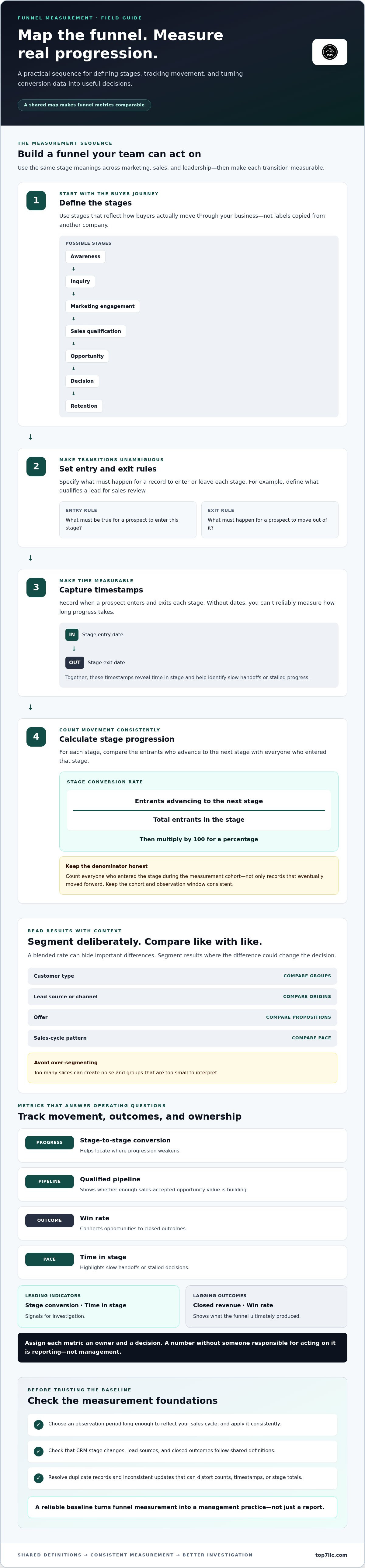
A useful funnel might track awareness, inquiry, marketing engagement, sales qualification, opportunity, decision, and retention. The traditional purchase funnel offers a foundational view of the customer journey toward the purchase, but your operating model should reflect how buyers actually move through your business.
Keep the distinctions clear. Marketing engagement shows a prospect’s interaction with your content or campaigns. Sales qualification indicates whether they fit agreed criteria and merit active sales attention. Customer outcomes begin after the purchase, with measures such as onboarding or retention. Stage names can vary; shared meanings and consistent rules matter more. Don’t force every team into a generic template.
What does a healthy funnel reveal?
A funnel is a diagnostic model, not proof of why buyers act. Three measures help show where to investigate:
Stage conversion: Shows what share advances. A sharp drop may point to friction, but it doesn’t identify the cause by itself.
Time in stage: Reveals where progress slows. Long delays might reflect unclear next steps, buyer complexity, or inconsistent follow-up.
Progression: Shows whether prospects move forward, remain stalled, or exit. The pattern helps teams ask sharper questions about the experience and handoffs.
Benchmarks can provide context, but they aren’t universal targets. Conversion varies with traffic source, audience, deal complexity, and the stage being measured. Compare like with like, then start with your own historical performance. If a metric changes, investigate what happened in the buyer experience and the process before declaring a cause.
That’s the discipline behind optimizing your sales funnel: define meaningful stages, measure movement, and use the evidence to decide what deserves attention. Activity is easy to count. Progress is what the funnel is there to reveal.
How to Map Your Funnel and Measure Conversion
A funnel only helps if every stage means the same thing to marketing, sales, and leadership. Treat the map as a visual roadmap of the customer journey, then make each transition measurable. Use this sequence to build a view your team can act on:
Define the stages. Use the stages that reflect your actual buying process, not labels copied from another company.
Set entry and exit rules. Specify what must happen for a record to enter or leave each stage. For example, define what qualifies a lead for sales review.
Capture timestamps. Record when a prospect enters and exits each stage. Without dates, you can’t reliably measure how long progress takes.
Calculate progression. For each stage, divide the number of entrants who advance to the next stage by the total number who entered that stage, then multiply by 100 for a percentage.
Stage conversion rate = entrants advancing to the next stage ÷ total entrants in the stage. The denominator is everyone who entered that stage during the measurement cohort, not just records that eventually moved forward. Keep the cohort and observation window consistent so the calculation compares like with like.
Then segment results where differences could change the decision: customer type, lead source or channel, offer, and sales-cycle pattern. A blended rate can hide the fact that one channel creates strong-fit opportunities while another generates leads that rarely progress. Segment deliberately, though. Too many slices create noise and small groups that are hard to interpret.
Which sales funnel metrics should you track?
Choose metrics to answer operating questions. Stage-to-stage conversion helps locate where progression weakens. Qualified pipeline shows whether enough sales-accepted opportunity value is building. Win rate connects opportunities to closed outcomes. Time in stage highlights slow handoffs or stalled decisions.
Assign each metric an owner and a decision. Stage conversion and time in stage are leading indicators for investigation; closed revenue and win rate are lagging outcomes that show what the funnel ultimately produced. Tracking a number without deciding who acts on it is reporting, not management.
How do you establish a reliable baseline?
Choose an observation period long enough to reflect your sales cycle, then apply it consistently. Check that CRM stage changes, lead sources, and closed outcomes follow shared definitions. Duplicate records can inflate counts; inconsistent updates can distort timestamps and stage totals. Resolve those issues before treating a dashboard as evidence.
A disciplined baseline makes optimizing your sales funnel a management practice, not a reporting exercise. Top7’s fractional CRO leadership can help connect revenue measurement to priorities, ownership, and execution.
How to Find Funnel Leaks and Choose the Right Fix
A weak conversion rate tells you where to investigate, not what to buy. More leads can pour into a funnel and still leave the same constraint untouched. New software can even automate a broken handoff. Start with the baseline from the previous section, identify where progression or time in stage has changed, then inspect what buyers and teams experienced at that point.
Treat every explanation as a hypothesis until pipeline or customer evidence supports it. A stalled opportunity might reflect unclear ownership, a qualification mismatch, weak follow-up, confusing value, or a difficult buyer experience. Don’t mistake a plausible story for a proven cause. A disciplined approach to optimizing your sales process begins with examining the work and evidence behind the result.
How can you tell where prospects are dropping off?
Compare stage conversion and time-in-stage patterns with your established baseline. Then review lost-deal notes, buyer questions, handoff records, and opportunities that stopped moving. Segment the pattern by channel, offer, or buyer type. If the drop clusters in one segment, investigate that path before changing the entire funnel.
Should you change the process, message, or technology?
Match the intervention to the evidence. Clarify the process when stage criteria, ownership, or handoffs vary by person. Review messaging when qualified prospects repeatedly misunderstand the value or their next step. Consider technology only when a verified workflow or data gap cannot be solved through clearer rules and execution. A tool is an intervention, not a diagnosis.
Test one plausible cause at a time where practical, and define what evidence would support or reject it. If the pattern changes, check whether the proposed fix plausibly influenced it; don’t claim causation from a coincidental shift. That’s how you stop treating symptoms and start addressing the constraint you can actually prove.
How to Prioritize and Test Sales Funnel Improvements
A funnel can show several weak spots. Don’t treat them as equal, and don’t let the loudest opinion set the agenda. Start with a consequential bottleneck supported by more than anecdotes, then weigh four factors: potential revenue impact, confidence in the evidence, execution effort, and dependencies on other teams or decisions. A high-impact issue with weak evidence may call for more investigation before a costly intervention.
Use a repeatable sequence to turn diagnosis into action:
Rank the leak: Identify the stage constraint with the clearest business relevance and evidence.
State a hypothesis: Describe the suspected cause and the change you expect to affect buyer behavior. For example, “If the next step is made explicit after qualification, more suitable prospects will accept a discovery meeting.”
Select an intervention: Choose a process, messaging, follow-up, or experience change that directly tests the hypothesis. Don’t buy a tool simply because it’s available.
Assign an owner: Name one person accountable for implementation, data quality, and reporting back. Identify cross-team dependencies up front.
Review and decide: Compare the result with the baseline and apply the decision rule set before launch.
Before starting, define one primary outcome and guardrail metrics. If the test aims to improve qualified-meeting progression, the primary outcome might be the share of eligible prospects who advance. A guardrail could track whether lead quality or later-stage progression worsens. When practical, change one meaningful variable at a time. If several changes must happen together, document them and treat the result as evidence about the combined intervention, not proof that one element caused the shift.
How should a funnel experiment be reviewed?
Write down the baseline, target behavior, test window, owner, and decision rule before the change goes live. Choose a window that fits the sales cycle and gives the affected prospects time to progress. Record context that could shape the result, such as shifts in lead source, offer, staffing, or sales process.
At review, compare the observed outcome with the original hypothesis. Did the intended behavior change? Did a guardrail move in the wrong direction? Is the evidence strong enough to act, or does the test need refinement? A change that happens after an intervention doesn’t automatically prove the intervention caused it. Be precise about what the data supports.
Then choose: adopt the change if evidence supports it, adapt it if the signal is mixed or execution needs adjustment, or stop if the hypothesis isn’t supported. This is the operating discipline behind optimizing your sales funnel: prioritize what matters, test with intent, and make decisions you can explain.
Top7’s fractional CRO leadership combines strategic guidance with execution support to help teams set revenue priorities and keep improvement work accountable.
How to Make Funnel Optimization an Operating System
A funnel review shouldn’t be a one-off cleanup after a disappointing quarter. Make it part of how the business runs. Sales, marketing, and leadership need shared stage definitions, clear handoff expectations, and agreement on which improvement matters most. Otherwise, teams can report different versions of the same buyer journey and optimize for conflicting outcomes.
Set a recurring review cadence that fits your sales cycle. Keep the agenda operational: funnel movement against baseline, active experiments, blockers, decisions required, and named owners with next steps. Record decisions and revisit them at the next review. The goal isn’t another meeting. It’s to turn evidence into coordinated action and follow-through.
Who should own sales funnel optimization?
Name an accountable executive who can resolve cross-functional priorities and resource conflicts. Distribute the work: marketing owns agreed engagement and source data, sales maintains qualification and opportunity records, and operations or analytics supports consistent measurement. Assign decision rights too. Specify who approves stage definitions, who authorizes experiments, and who allocates resources.
Funnel performance can’t sit solely with marketing or analytics. Those teams can surface patterns, but they may not control sales handoffs, capacity, or broader revenue priorities. Shared accountability connects measurement to the people who can change the process.
When can fractional leadership help improve the funnel?
Look beyond the tactic when revenue ownership is unclear, experiments repeatedly stall, or sales and marketing pursue disconnected priorities. The constraint may be leadership capacity: no one has the authority or time to align teams, make trade-offs, and keep execution moving. More dashboards won’t fill that gap.
Fractional CRO leadership can help establish revenue priorities and clarify accountability across the funnel. Fractional CMO leadership can align marketing activity with shared stage definitions, sales handoffs, and business goals. The right focus depends on where ownership and execution are breaking down. In either case, the work is strategic and operational: make decisions, assign responsibility, and review progress together.
Top7 provides fractional CRO and CMO leadership alongside strategic guidance and execution support, using the Velocity-7 Adaptive Framework to help organizations move from operational friction to efficient flow.
Turn Funnel Insight Into Consistent Action
A stronger funnel doesn’t come from chasing every dip in conversion. It comes from agreeing on what each stage means, measuring how buyers move, and investigating the evidence before choosing a fix. Then prioritize the constraint with the clearest business impact, test a focused improvement, and assign someone to own the follow-through.
That’s the discipline of optimizing your sales funnel: a repeatable cycle, not a one-time project. When sales and marketing can’t align priorities or keep execution moving, the gap may be leadership capacity, not another tactic.
Top7 brings strategic guidance and execution support together through fractional CRO and CMO leadership, supported by the Velocity-7 Adaptive Framework. Explore how Top7 can help align your sales funnel priorities with accountable action.
Start with the evidence you have, make the next decision clear, and keep improving one constraint at a time. Consistent action turns funnel insight into forward momentum.
Frequently Asked Questions
What does optimizing your sales funnel mean?
Optimizing your sales funnel means using evidence to improve how buyers move from one defined stage to the next. It’s not simply generating more leads or increasing sales activity. First, establish consistent stage criteria and measure progression. Then investigate where qualified prospects stall and test a focused change. For example, if suitable leads aren’t becoming opportunities, review qualification rules and handoffs before increasing campaign volume.
How do you identify leaks in a sales funnel?
Compare stage-to-stage conversion and time in each stage with your historical baseline to spot where movement weakens or slows. Then investigate the records behind the pattern: lost-deal notes, buyer questions, handoffs, and stalled opportunities. Segment by relevant factors such as lead source, offer, or buyer type. Treat each suspected cause as a hypothesis until the evidence supports it. A drop-off shows where to investigate, not automatically why it happened.
Which sales funnel metrics should a business track?
Track stage-to-stage conversion, qualified pipeline, win rate, and time in stage. Each metric should answer a decision: conversion can point to a transition that needs investigation, pipeline can show whether qualified opportunities are building, win rate measures closed outcomes, and time in stage can flag delays. Assign an owner to each metric and keep definitions consistent. Focus on a small set your team can act on, not a dashboard full of numbers without clear decisions.
How can you improve sales funnel conversion rates?
Find the specific stage where progression is weak, then use buyer and pipeline evidence to identify a plausible cause. Match the fix to the problem: clarify handoffs when ownership is inconsistent, review messaging when qualified buyers misunderstand value, or adjust follow-up when next steps are missed. Set one primary outcome and guardrail metrics before testing. Where practical, change one meaningful variable at a time, then compare results with the baseline before deciding what to adopt.
Should you buy sales funnel software to improve conversion?
Buy software only when a verified workflow or data gap requires it. A new platform won’t resolve unclear stage definitions, inconsistent ownership, or messaging that fails to address buyer concerns. First map the process and locate the constraint. If the evidence shows that a specific task can’t be completed or measured reliably with the current setup, define the requirement before choosing a tool. Don’t let software selection replace the work of diagnosing the funnel.
How often should you review your sales funnel?
Set a recurring review cadence that fits your sales cycle and the pace of your active experiments. Review funnel movement, changes in stage conversion or time in stage, experiment results, blockers, decisions, and accountable owners. Fast-moving processes may call for more frequent operational reviews, while longer buying cycles need enough time for prospects to progress before results are judged. Keep the cadence consistent, and investigate material changes between reviews rather than waiting for a scheduled meeting.
Can a fractional CRO help optimize a sales funnel?
Yes. A fractional CRO can help establish shared revenue priorities, clarify accountability, and align sales and marketing around funnel definitions, handoffs, and improvement decisions. This can be useful when revenue ownership is unclear, initiatives stall, or teams work toward disconnected goals. Top7 provides fractional CRO and CMO leadership, pairing strategic guidance with execution support and its Velocity-7 Adaptive Framework. The focus is on turning funnel evidence into coordinated decisions and accountable action.



Comments