
Managing Company Restructuring: A Guide for Leaders

What if the restructuring meant to fix your business is making the real problem harder to see? If delivery is slipping, costs are rising, or accountability is blurred, changing roles may feel decisive. But how to manage a company restructuring starts with a tougher question: does the business need a structural reset, or a targeted operational correction?
That uncertainty is justified. A poorly scoped change can disrupt delivery, weaken morale, and leave leaders with a new org chart but the same performance problem. Restructuring succeeds when leaders turn diagnosis into sequenced execution, with clear ownership and business outcomes in view.
This guide explains how to identify the underlying issue, choose a restructuring path that fits it, and build a practical execution plan. You’ll learn how to communicate role changes, set checkpoints, track results, and adjust when assumptions shift. The goal isn’t change for its own sake. It’s a business that keeps operating while the restructuring delivers measurable progress.
Table of Contents
What Does Company Restructuring Mean, and When Is It Necessary?
Company restructuring is a deliberate change to an organization’s structure, responsibilities, processes, or business configuration to address a defined strategic or operational issue. The right scope depends on the cause of the problem, not on whether leaders call the response a “restructure.” A new org chart cannot fix a broken decision process by itself.
Planned restructuring connects a diagnosis to coordinated changes. It differs from a routine reporting-line update or an isolated process fix, which may solve a local issue without changing how the wider business operates. A company restructuring overview also distinguishes organizational change from financial and debt restructuring, which require different analysis.
For a useful perspective on organization design, watch this overview:
Which business problems can restructuring address?
Symptoms are evidence, not a diagnosis. Repeated decision delays might point to unclear decision rights. Duplicated work could reflect overlapping responsibilities, or a process without one accountable owner. Integration friction after combining teams may signal mismatched workflows, reporting relationships, or systems. Find the cause before choosing an intervention.
Start with an explicit objective, such as clarifying ownership of customer handoffs, reducing approval bottlenecks, or aligning capacity with a strategic priority. Then examine where work stalls, where responsibilities overlap, and which decisions lack a clear owner. Restructuring should support that objective. If a proposed change cannot be linked to an observable business need, the case for changing roles or structure is weak.
Is a restructure the right response?
Before deciding how to manage a company restructuring, test whether the issue comes from the structure, decision rights, available capacity, or the way work is done. A narrow problem may need a targeted correction, such as documenting a handoff or clarifying approval authority. A broader redesign may be warranted when the same obstacles appear across teams or prevent the business from delivering on its priorities.
Structure: Are teams and reporting relationships aligned with the work?
Decision rights: Is it clear who decides, who contributes, and who owns the result?
Capacity: Do teams have the people and leadership attention needed for their responsibilities?
Processes: Are repeatable workflows creating avoidable delays or duplicated effort?
Don’t treat every performance problem as an org-design problem. A process correction may be enough; a structural issue may require broader change. Financial or legal restructuring involves context-specific considerations, so leaders should seek appropriate professional advice rather than treating it as a routine organizational redesign.
How to Diagnose the Problem and Choose the Right Restructuring Scope
A restructure built on a hunch can add complexity without fixing performance. Before moving roles or teams, build a diagnosis that connects observable evidence to a specific business objective. The aim isn’t to collect every available metric. It’s to identify what blocks the work, test why it happens, and choose the smallest intervention that can credibly address the cause.
Build an evidence-based restructuring diagnosis
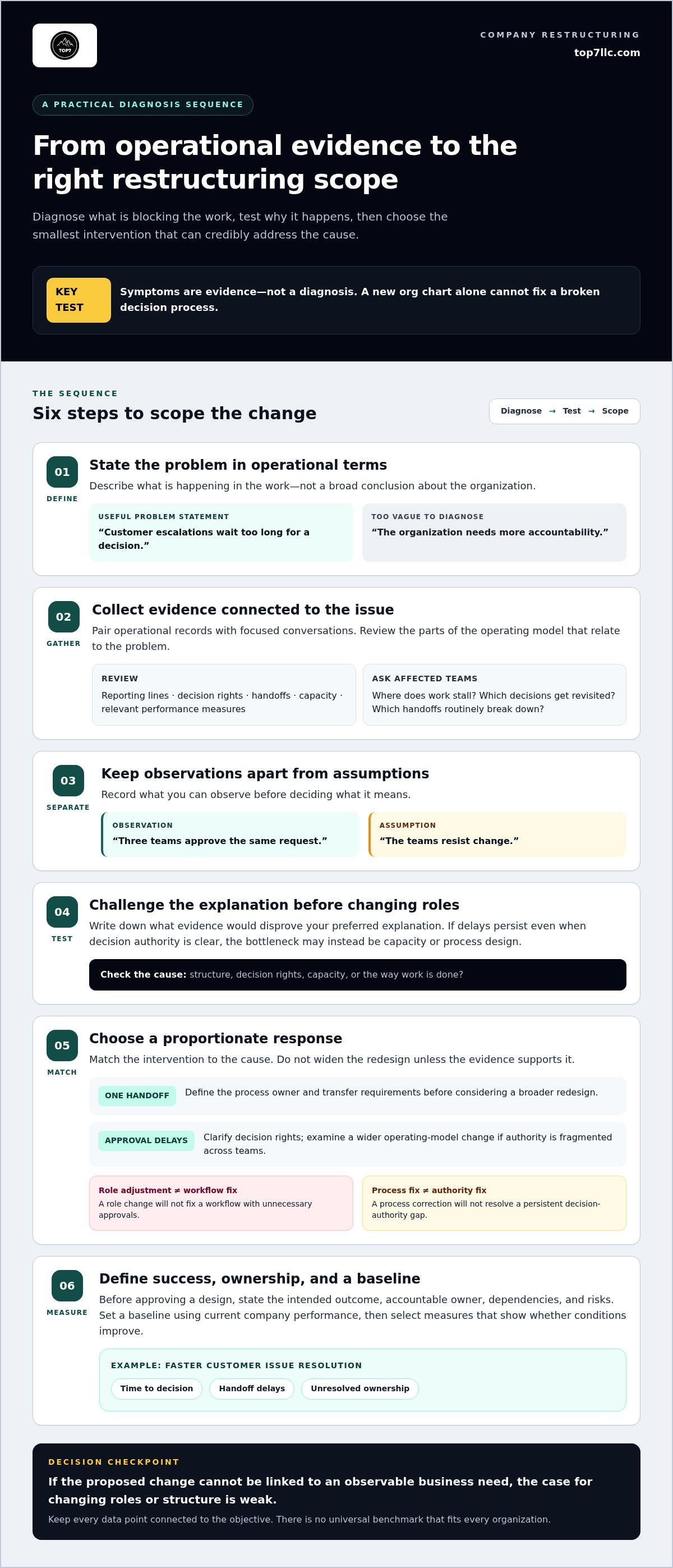
Use a disciplined sequence. First, state the problem in operational terms. For example, write “customer escalations wait too long for a decision” rather than “the organization needs more accountability.” Then gather relevant evidence, identify constraints, compare interventions, and define the scope. Review reporting lines, decision rights, handoffs, capacity, and performance measures tied to the problem.
Pair operational records with focused conversations. Ask affected leaders and teams where work stalls, which decisions get revisited, and which handoffs routinely break down. Separate facts from interpretation: “three teams approve the same request” is an observation; “the teams resist change” is an assumption. Record what evidence would disprove your preferred explanation. If approval delays persist even when decision authority is clear, the bottleneck may instead be capacity or process design.
Keep every data point connected to the objective. If the goal is faster customer issue resolution, examine time to decision, handoff delays, and unresolved ownership. Avoid pulling in metrics simply because they’re easy to access. They can distract from the decision leaders need to make.
Choose a proportionate scope and define success
Compare potential changes with the diagnosed cause. A role adjustment won’t fix a workflow that sends work through unnecessary approvals. A process fix won’t resolve a persistent gap in decision authority. Before approving a design, state the intended outcome, accountable owner, dependencies, and risks. Set a baseline using the company’s current performance, then choose measures that show whether conditions improve. There’s no universal benchmark that fits every organization.
Use this issue-to-response map to challenge the proposed scope:
One unclear handoff: Define the process owner and transfer requirements before considering a broader redesign.
Repeated approval delays: Clarify decision rights; examine a wider operating-model change if authority is fragmented across teams.
Duplicated work across roles: Map responsibilities and workload, then adjust roles or processes where the overlap is confirmed.
Capacity constraints across several functions: Assess priorities, workload, and leadership capacity before deciding whether broader structural or business-configuration changes are warranted.
Finally, test the scope against constraints such as customer commitments, critical workflows, and dependencies between teams. If the diagnosis points to an ongoing operating-model or ownership gap, fractional COO leadership can provide embedded leadership capacity for org design, capacity planning, and change execution.
How to Design the Restructure and Communicate the Change
A chosen design is only a proposal until people know who owns the work, which decisions they can make, and how responsibilities move. Compare realistic alternatives before committing. Make the trade-offs visible, including what each option depends on and how it could affect delivery. A cleaner org chart means little if approvals, handoffs, or critical processes still run the old way.
Use the diagnosis to choose among these paths, not the appeal of a dramatic redesign. Define how you’ll know the selected design is working, and identify what must be in place before changes take effect.
Turn the chosen design into an operating plan
Translate the approved structure into practical working rules. For each critical responsibility, name the owner, decision-maker, contributors, and escalation route. Map handoffs between teams and dependencies that could interrupt delivery. If reporting lines change but approvals remain unclear, the new design hasn’t solved the problem.
Update processes alongside roles where needed. Assign a leader to communicate each decision, resolve open questions, and manage transition responsibilities. Specify what transfers, when it transfers, and who covers the work in the interim. This turns an organizational design into an operating plan people can follow.
Communicate restructuring with clarity and consistency
Build messages around five points: what changes, why it changes, when it takes effect, who is affected, and where questions go. Employees need clear information about roles and transition steps. Managers need enough detail to explain those impacts consistently. Customers and other stakeholders need to understand relevant changes to their points of contact or the way work is handled.
Separate confirmed decisions from items still being worked through. Don’t present an unresolved detail as settled or leave people guessing about what happens next. Prepare managers with shared talking points, an escalation path, and a process for capturing unanswered questions. Consistent communication builds credibility and keeps the work moving.
Before communicating: Align leaders on decisions, timing, and what remains open.
During the transition: Give managers role-specific guidance and a route for escalating concerns.
After changes begin: Share updates when decisions or responsibilities change.
For leadership support in translating change into clear ownership and execution, Explore how Top7 supports leadership through change.
How to Execute a Company Restructuring and Track Progress
An approved design is not the finish line. During execution, dependencies collide, decisions get delayed, and essential work can fall between old and new owners. Treat the restructure as coordinated operational work, not a sequence of announcements. Each change needs an accountable owner, a clear dependency map, a decision point, and a route for escalating obstacles before they disrupt delivery.
Coordinate workstreams, decisions, and transition risks
Group connected changes into manageable workstreams, such as role transitions, process updates, systems access, or customer handoffs. Assign an executive owner to each workstream and one person to track its actions. Before changes take effect, identify critical operations that must continue, temporary coverage needs, and the risks of moving responsibilities too early.
Use a shared execution log. Keep it concise and current:
Workstream and owner: What must change, and who is accountable for completion?
Dependencies: Which decisions, teams, tools, or handoffs must be ready first?
Risk and mitigation: What could interrupt service or delivery, and who will reduce that risk?
Decision point: What needs leadership approval, by whom, and by when?
Escalation route: Where does an unresolved blocker go, and who makes the call?
Sequence the work around real dependencies. For example, transfer ownership of a customer process only after the receiving team has the information, authority, and capacity required to run it. Set a review rhythm that matches the scale and pace of the change. A focused redesign may need a lighter cadence than a multi-team transition, but every review should resolve blockers and confirm next decisions, not just report activity.
Measure outcomes and adapt the plan
Track progress against the baseline and intended outcomes established during diagnosis. If the goal is clearer decision ownership, monitor whether decisions reach the assigned owner and whether unresolved items follow the agreed escalation route. If the goal is smoother handoffs, review the relevant operational measure alongside feedback from the teams handling the work.
Activity counts can show whether tasks are moving, but they don’t prove the restructure is working. Pair implementation milestones with outcome measures and context from employees and customers. If a metric worsens, investigate before declaring success or failure. The cause could be a flawed assumption, an unaddressed dependency, or a transition issue that needs mitigation.
At each review, decide whether to continue as planned, resolve a blocker, revise a dependency, or adjust the design. Record the evidence, decision, owner, and follow-up point. That record keeps leaders aligned and helps teams distinguish a deliberate course correction from shifting priorities. A setback is a signal to examine the plan, not a reason to ignore the facts.
If your leaders need focused execution ownership to coordinate restructuring workstreams, bring in leadership support for execution.
When Leadership Support Helps a Restructuring Move from Plan to Execution
A restructuring can stall even when the diagnosis and design are sound. A common cause is a leadership-capacity gap: executives are juggling daily operations and change work, a key seat is vacant, or no one owns coordination across workstreams. The plan may be approved, but who is driving decisions, clearing dependencies, and keeping delivery on track?
Additional leadership capacity can close that execution gap. Choose a model based on the work and coverage needed, not a vague desire for “more support.” The right fit gives the restructuring a clear owner while existing leaders continue running the business.
Match leadership coverage to the restructuring need
There are Three ways to engage, each suited to a different need. Fractional provides ongoing, part-time leadership embedded in the client team. Interim provides full-time, defined-term coverage when a leadership seat opens unexpectedly. Project delivers scoped, time-boxed support with a clear deliverable and end date. Match the model to the leadership gap and the work that must move.
Choose Fractional when change needs continuing senior ownership alongside the existing leadership team. A Fractional COO, for example, can support org design, capacity planning, change management, process documentation, and KPI/OKR implementation.
Choose Interim when a leadership seat is vacant and the organization needs defined-term coverage while responsibilities continue.
Choose Project when the need is contained: a specific scope of work, a defined deliverable, and a clear end date.
Top7 provides Six seats: CFO, CRO, CTO/CIO, COO, CMO, and CISO. Whichever model fits, establish decision authority, responsibilities, and escalation routes at the start. Each engagement has one primary point of contact, giving the client a consistent channel for coordination. The approach is outcome-based, not hour-based. Define the work around agreed objectives and deliverables rather than treating time spent as the measure of progress.
Use a staged framework to move from diagnosis to handoff
The Velocity-7 Framework structures an engagement through Three stages. It moves from diagnosis and stabilization to planning, execution, and handoff, while keeping attention on what the business needs next.
Basecamp, Days 0-30, Assess & Stabilize: Establish an honest diagnostic and rank the blockers that need attention.
Ascent, Days 30-60, Plan & Execute: Build a sequenced plan, assign ownership, and pursue early wins aligned with business priorities.
Summit, Days 60-90, Systematize & Hand Off: Document playbooks, support a self-sustaining team, and clarify the leadership coverage needed going forward, including a clear hire decision.
Use this structure to keep the work moving, not to force every restructuring into the same sequence of decisions. Leaders still need to review evidence, manage dependencies, and adjust when assumptions change. If you’re weighing how to manage a company restructuring with the leadership capacity available, start with the gap: ongoing execution ownership, coverage for a vacant seat, or a defined project deliverable.
Book 15 minutes, no pitch deck, to discuss the leadership support your restructuring requires.
Make the Next Move Count
A restructure doesn’t prove its value on the day a new design is approved. Its value shows up in what the business can now do, decide, and deliver. Set a near-term leadership priority, name the decision that must move first, and make progress visible. That gives your team a practical starting point instead of another plan waiting for attention.
Ask yourself: what is the cost of leaving the current obstacle in place while leaders debate the perfect design? The answer should sharpen your next step. If the evidence supports change, assign ownership and move. If it doesn’t, correct course before disruption grows. That discipline is central to managing a company restructuring without losing sight of business outcomes.
When execution needs focused leadership capacity, make the next conversation specific: identify the business problem, the decision or workstream that’s stalled, and the support needed to move it forward. Discuss your restructuring’s execution needs and take the next step with clarity.
Frequently Asked Questions
Can a company restructure without laying off employees?
Yes. A company can restructure by changing reporting relationships, decision authority, team responsibilities, or workflows without eliminating roles. For example, it might combine overlapping approval steps or move ownership of a customer handoff while keeping the same employees. The design still needs to account for workload, role clarity, and employee impact. If workforce reductions are being considered, get appropriate legal and HR advice before communicating or implementing those decisions.
How do you keep customers informed during a company restructuring?
Tell customers what affects them, not every internal detail. If their account contact or service process is changing, explain who will handle requests, when the change takes effect, and where to direct urgent questions. Give customer-facing teams a shared response guide so they don’t provide conflicting explanations. Set a trigger for proactive updates, such as a change to a delivery commitment. Be candid about confirmed impacts, and don’t promise continuity you can’t support.
What happens if a restructuring plan is not working?
Revisit the evidence and determine where the plan is breaking down before adding more changes. For instance, if a new approval structure hasn’t reduced delays, check whether decision-makers have clear authority and enough capacity to act. Leaders can adjust sequencing, strengthen ownership, or revise an assumption that no longer holds. Record the reason for each change, its owner, and the next review point. A course correction is responsible management, not automatic proof of failure.
How should a board be involved in a company restructuring?
The board’s role depends on the company’s governance documents, delegated authority, and the decisions under consideration. Management should give directors a clear view of the business case, material risks, expected effects, and decisions that require board input. Keep routine implementation choices with the executives authorized to make them, while escalating matters that fall within board oversight. Document key approvals and consult legal counsel when governance responsibilities or disclosure obligations are in question.
How can a company retain key employees during restructuring?
Reduce uncertainty where you can. Explain how decisions are being made, what employees are expected to own, and when unresolved role questions will be addressed. Ask critical contributors what would prevent them from doing their work through the transition, then act on practical barriers such as unclear priorities or overloaded handoffs. Managers should check in individually, listen without making promises they can’t keep, and recognize the expertise needed to maintain essential operations.
Does a company need outside leadership to manage a restructuring?
No. Outside leadership isn’t necessary if internal executives have the capacity, authority, and operational knowledge to lead the work alongside daily responsibilities. It may help when a senior seat is vacant, competing priorities leave no clear execution owner, or the organization needs focused experience for a defined initiative. If you’re deciding how to manage a company restructuring, compare the internal leadership gap with the work’s scope, then choose the support that fits rather than adding capacity by default.



Comments