
Leadership Gap Analysis: Find the Missing Capacity Before It Costs You

What if the decisions slowing your business down aren’t a strategy problem, but a leadership capacity problem? When every important call returns to the CEO, teams can have clear responsibilities on paper and still lack the ownership or senior judgment to execute. A leadership gap analysis helps expose where that capacity is missing before the bottleneck becomes a bigger business cost.
You may already feel the friction: decisions stall, priorities drift, and execution depends on a handful of people stepping in to keep things moving. The challenge is identifying what’s driving it. Without connecting the gap to observable consequences, it’s easy to mistake a leadership issue for a process problem or make an expensive hire before you know what the business needs.
This article will help you identify the leadership capacity your strategy requires, link missing ownership or judgment to operational impact, and choose an accountable next step. You’ll learn how to distinguish a genuine seat-level gap from a temporary workload issue, then assess whether the need calls for ongoing, urgent, or scoped leadership support. Diagnose the constraint first. Then act on the evidence.
Table of Contents
What a Leadership Gap Analysis Reveals About Execution
The strategy is clear. The priorities are approved. Yet decisions keep climbing back to the CEO, teams wait for direction, and execution loses momentum. That pattern doesn’t automatically mean people lack skill. It may mean the business has more leadership responsibility than its current structure can reliably carry.
A leadership gap analysis compares the leadership capacity required to execute the strategy with the capacity currently available. Put simply, it identifies where the capacity needed for strategic execution exceeds what the business can reliably access. Like any gap analysis, it compares a required state with the current one. The crucial question is what’s missing: capability, decision authority, or an accountable owner?
For a concise overview of the underlying method, watch this explanation of gap analysis:
Leadership capability gap or empty executive seat?
A capable team can still lack the senior judgment, authority, or ownership a particular decision demands. Imagine a high-stakes investment choice that moves from finance to operations, then returns to the CEO because no one has clear authority to assess the trade-offs and commit the business. The delay may look like indecision. The underlying issue could be an unowned executive responsibility.
That differs from an individual development need. If a manager owns the decision but needs stronger financial judgment, development may help. If nobody has the mandate to make the call, improving one person’s skill won’t fix the ownership gap. Treating both problems as training needs can leave the decision stuck. Treating both as vacancies can misread the real need. Diagnose the cause before choosing a response.
Which business signals point to a leadership gap?
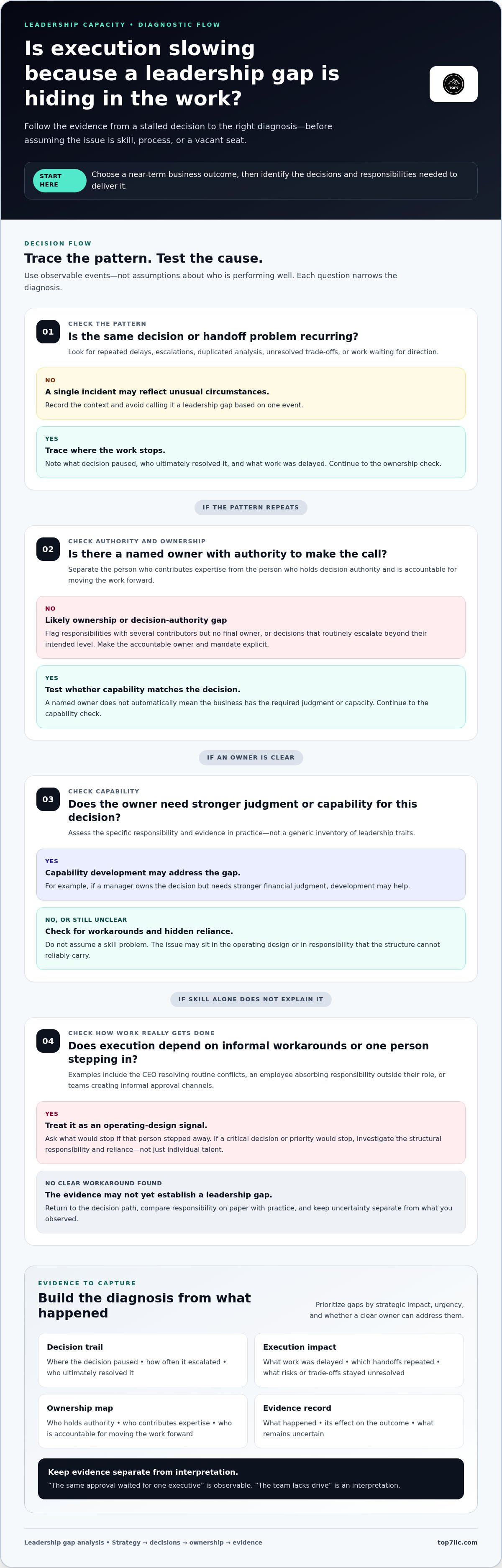
Look for patterns in how work moves, not assumptions about who is performing well. Do the same approvals repeatedly wait for one executive? Do teams duplicate analysis because decision rights are unclear? Are strategic priorities announced but not translated into funded, owned work? These are observable signals. “The team lacks drive” is an interpretation, not evidence.
Track where a decision pauses, how often it gets escalated, who ultimately resolves it, and what work is delayed while it waits. Also note recurring handoffs, unresolved trade-offs, and commitments without a named owner. A single incident might reflect unusual circumstances; a repeated pattern across decisions or projects deserves investigation.
Workarounds can hide the structural issue. The CEO may personally resolve routine conflicts, a high-performing employee may quietly absorb responsibility outside their role, or teams may create informal approval channels. The business keeps moving, but relies on invisible effort and individual availability. Ask what would stop if that person stepped away. If the honest answer is “a critical decision or priority,” the gap is in the operating design, not necessarily in someone’s talent.
How to Run a Leadership Gap Analysis That Starts With Strategy
Start with the outcomes the business must deliver next, not a generic inventory of leadership traits. A competency checklist may show who communicates well; it won’t necessarily reveal who can authorize a critical decision, resolve a cross-functional trade-off, or own execution from start to finish.
In short: move from strategic demand to required decisions, map accountable ownership, test capacity against evidence, and prioritize the gaps that put execution at risk. This sequence keeps a leadership gap analysis grounded in the work ahead rather than an idealized picture of leadership.
Clarify the strategy. Choose the near-term outcomes that matter most, such as launching a new offering, improving retention, or stabilizing delivery. Define what progress would look like and which decisions could accelerate or block it.
Identify required decisions. For each outcome, list the calls leaders must make: setting priorities, allocating resources, resolving dependencies, or changing course when results fall short. Focus on real decisions, not broad competency labels.
Map ownership. Name who holds decision authority, who contributes expertise, and who is accountable for moving the work forward. Flag responsibilities with several contributors but no final owner, as well as decisions that routinely escalate beyond their intended level.
Assess evidence. Compare the responsibility on paper with how it works in practice. Review decision delays, missed handoffs, unresolved risks, and repeated escalations. Record what happened, its effect on the outcome, and any uncertainty separately.
Prioritize the gaps. Rank issues by their effect on strategic progress, urgency, and whether a clear owner can address them. A capability that can be developed differs from an executive responsibility with no accountable owner. Choose the response only after establishing which problem you actually have.
Map business priorities to leadership responsibilities
Keep the map specific. If the priority is to improve delivery reliability, identify the decisions needed to set operating priorities, resolve resource conflicts, and track follow-through. Then name the responsibility attached to each decision and its current owner. Ownership may sit with one leader, be split across teams, or remain vacant. The point isn’t to design a perfect org chart; it’s to see whether today’s responsibilities match today’s business demands.
Test the gap with observable evidence
Check both formal ownership and actual behavior. A role description may assign accountability to one person, while meeting records show decisions repeatedly made elsewhere or left open. Capture the specific event, its effect on delivery, and what remains unknown. For example, “approval waited through two planning meetings” is evidence; “the executive avoids decisions” is an assumption. Keep those separate, and validate recurring patterns before treating them as findings.
Once the priority gaps are visible, turn them into a decision-ready brief: the outcome at risk, the missing responsibility or capacity, the evidence, and the person accountable for the next review. If translating strategic priorities into clear ownership is the sticking point, strategic planning support can connect the diagnosis to execution.
How to Assess the Cost and Priority of a Leadership Gap
A gap’s cost isn’t only a line item. It can show up as delayed decisions, duplicated work, unresolved risks, missed priorities, or leadership overload. Assess what the business can observe before attaching a financial estimate. If you calculate a monetary impact, use company-specific data and label assumptions clearly. A precise-looking figure built on guesses won’t improve the decision.
Use a comparison table to make gaps visible side by side. The examples below are illustrative, not findings about your business. Replace them with documented evidence and name the person accountable for addressing each issue.
Use the same comparison for each candidate gap, then ask what becomes harder if it remains unresolved. Gap priority depends on strategic impact, urgency, and ownership, not title alone. A senior-sounding vacancy may be less pressing than an unowned decision that blocks a critical outcome. Conversely, a recurring risk with no accountable owner may need immediate attention even if it hasn’t yet caused a visible setback.
Separate costly symptoms from root causes
Trace repeated escalations or slippage backward. Is a decision waiting because no executive owns it, because a process requires too many approvals, because the team lacks capacity, or because the strategy keeps changing? Those causes call for different fixes. Don’t label the issue a leadership gap after one incident. Compare multiple examples, identify what they share, and distinguish documented patterns from hypotheses.
Rank gaps by consequence and urgency
Compare each gap against strategic priorities, operational continuity, and exposure to unresolved risks. Mark urgency as high when a time-sensitive outcome or essential operation is already threatened; lower when the impact is limited or contained. Then identify whether anyone has the authority and capacity to act. A serious consequence with no clear owner should rise in priority. Record assumptions separately so estimates don’t masquerade as facts.
To sharpen the assessment, keep four records for every gap: the observed event, the affected business outcome, the consequence if it continues, and the accountable owner. Where data supports an estimate, show the source and calculation. Where it doesn’t, describe the impact plainly, such as a delayed launch decision or repeated work. That gives leaders a defensible priority order without manufacturing a dollar figure.
Turn Analysis Into a Leadership Gap Action Plan
A diagnosis only creates value if someone acts on it. Turn each priority gap into a defined response, a single accountable owner, evidence of progress, and a review point. Make the action specific enough that the team can tell whether it addresses the cause, not just the symptom. “Improve leadership” is too vague. “Assign decision authority for product investment reviews and track whether decisions move forward” gives the work a clear direction.
Match the response to the root cause. Develop capability when the role exists and the person can build the needed skill. Clarify decision rights when current leaders share responsibility without clear authority. Redesign work when the process itself creates unnecessary handoffs. Add senior leadership capacity when critical judgment or execution ownership is missing. A leadership gap analysis should lead to the right intervention, not automatically to training or a new role.
Choose a response that matches the actual gap
Don’t prescribe development before confirming that a capable role owner exists. If the person has the mandate but needs a skill, use development tied to real decisions. If ownership is fragmented, make authority explicit among current leaders. If a critical responsibility has no senior judgment or execution owner, consider adding leadership capacity. The intervention should close the diagnosed gap, not simply create activity around it.
Make follow-through visible
Assign one accountable owner to each action, even when several people contribute. Define the evidence before work begins: for example, a decision record, a completed handoff, or an existing operating measure moving in the intended direction. Set a review point that gives the owner time to act, then assess whether the original business problem is changing. Activity completed is not proof that the gap is closing.
Use existing business measures as the baseline. If the issue is delayed approvals, record the current pattern from available decision logs; if it’s missed handoffs, use the measures already tracking delivery. Don’t invent targets or promise a result before you have evidence. At review, compare the new operating evidence with the baseline, note what remains unresolved, and adjust the response if the cause was misdiagnosed.
If the action plan shows that a critical responsibility needs senior leadership capacity, learn how Top7 connects leadership capacity to accountable execution.
Close the Leadership Gap With the Right Top7 Engagement
Your analysis should point to a responsibility, not just a senior title. Match the gap to the seat with the relevant leadership remit. Top7’s Six seats are CFO, CRO, CTO/CIO, COO, CMO, and CISO. For example, a gap involving financial decision-making may point to the CFO seat, while a technology direction or delivery gap may point to CTO/CIO. The right match depends on which responsibility is missing and what business outcome it affects.
Then choose the engagement model that fits the need. Top7 offers Three ways to engage, each with one primary client contact and a focus on outcomes, not hours billed.
Fractional: Ongoing, part-time leadership embedded with your team when the business needs sustained senior capacity.
Interim: Full-time, defined-term coverage when a leadership seat opens unexpectedly and continuity is needed while the organization responds.
Project: Scoped, time-boxed leadership work with a defined deliverable and end date when the need is specific rather than ongoing.
Move from diagnosis through the Velocity-7 stages
The Velocity-7 Framework gives every engagement a structured path from assessment to execution and handoff. Its Three stages are:
Basecamp, Days 0-30: Assess the situation, stabilize priority work, and deliver an honest diagnostic with a ranked list of blockers.
Ascent, Days 30-60: Plan and execute, pursue early wins, and establish an accountable leader for the work.
Summit, Days 60-90: Systematize what’s working, prepare documented playbooks for handoff, and make a clear decision about future leadership coverage.
The stages make progress and responsibility visible. The primary contact connects the diagnosed gap to the broader leadership picture, helping keep the engagement focused on the business outcome rather than a collection of disconnected tasks. For an operations need, that work can include a 100-Day Operational Plan. In a healthcare services case study, Top7 delivered an independent report formatted for the Attorney General’s Office: 8 Weeks FROM ENGAGEMENT START TO AN AG-READY FINAL REPORT.
Take the next step without adding another report
Bring the gap into a practical discussion: which responsibility is uncovered, what outcome is blocked, and what evidence shows the issue is affecting execution? The aim is to move from diagnosis to an accountable next step, whether the need is ongoing, urgent, or scoped. Start with a 15 minutes, no pitch deck.
Put the Next Decision in Motion
A leadership gap analysis matters only if it changes what happens next. Choose one stalled business outcome and make its missing leadership responsibility visible. What decision is waiting? Who can own it? What evidence would show that execution is moving?
That clarity gives you a stronger starting point than another broad assessment or a rushed hire. It helps distinguish a capability to develop from a responsibility that needs clearer ownership or additional senior capacity. From there, you can choose a response that fits the actual constraint and keep attention on the outcome the business needs.
Top7’s engagements are structured around accountable execution, with one primary point of contact connecting the diagnosed need to the work. Bring the business outcome that’s stuck and explore a practical next step. Discuss your leadership capacity needs and move from diagnosis toward deliberate action.
You don’t need every answer before you start. You need a clear view of the constraint and the discipline to address it. Take that first step with confidence.
Frequently Asked Questions
What is the difference between a leadership gap analysis and a skills gap analysis?
A leadership gap analysis examines whether the business has the capacity and accountability its strategy demands; a skills gap analysis focuses more narrowly on abilities an individual needs to perform specific work. They can overlap. For example, a leader may need stronger financial forecasting skills, or the organization may lack a clear executive owner for financial decisions. The first may call for development; the second requires an ownership solution.
What are the first signs that a company has a leadership gap?
Recurring patterns are stronger signals than isolated problems. Watch for decisions that repeatedly escalate to the same person, priorities that lose momentum at team handoffs, or important responsibilities with no clear owner. Check meeting records or project updates for repeated examples, then connect the pattern to a business priority. One delayed decision alone doesn’t establish a structural gap; look for evidence that the same constraint keeps returning.
Who should be involved in a leadership gap analysis?
Involve the CEO or business owner, leaders accountable for strategic priorities, and people close enough to describe how decisions and work actually move. A useful mix might include an executive sponsor and the teams responsible for delivering a priority. One perspective can miss informal decision-makers or hidden workarounds. Keep discussion anchored to business requirements and documented examples, not personal popularity, communication style, or a generic ranking of personalities.
How can a company estimate the cost of a leadership gap without inventing numbers?
Use the company’s own records to describe consequences, such as delayed approvals, repeated work, missed milestones, unresolved risks, or management time diverted from priorities. Link each pattern to the outcome it affects, and show how any estimate was calculated from internal evidence. Keep assumptions separate from confirmed facts. External averages shouldn’t be presented as your company’s actual cost.
How often should a business repeat a leadership gap analysis?
There’s no universal interval; revisit the analysis when strategy, responsibilities, or operating conditions change. A new growth priority, a reorganization, or a shift in who holds decision authority can change what leadership capacity is needed. Use an existing business review to check whether previously identified gaps still affect execution. Close findings that no longer apply, and keep unresolved ones only when they still have an owner and a decision attached.
Can a fractional executive help close a leadership gap without a permanent hire?
Yes. A fractional executive provides ongoing, part-time senior leadership embedded in the client team. Top7 also offers Interim coverage for a defined term and Project engagements for scoped work with a clear deliverable and end date. Choose based on the gap’s scope and duration. Each engagement has one primary client contact and focuses on outcomes, not hours billed; these models aren’t permanent full-time hires.



Comments