
Interim Executive for Crisis Management: Buyer's Guide

How much damage can a business absorb while everyone waits for someone to own the next decision? An interim executive for crisis management can provide experienced leadership, clarify decision-making authority, and help protect essential operations while the disruption is addressed. But speed alone won’t steady a business. The mandate must connect decision rights, continuity priorities, and a clear handoff.
If revenue, cash flow, operations, or stakeholder confidence are slipping, it’s reasonable to worry that a temporary leader may add another layer instead of resolving the problem. The difference is execution: an interim executive leads teams and owns operational outcomes, rather than handing over recommendations and leaving implementation to you.
This buyer’s guide explains when interim leadership makes sense, what to evaluate before appointing a leader, and how to shape a controlled recovery plan. You’ll learn how to restore accountability and a workable decision rhythm, protect critical operations, and plan the transition to permanent leadership. Top7 embeds interim leaders with clients and uses its Velocity-7 Adaptive Framework to connect priorities with coordinated action, not another report left on a desk.
Table of Contents
When an Interim Executive for Crisis Management Is the Right Move
Leadership uncertainty can turn a serious disruption into a wider business crisis. When nobody has clear authority to make cross-functional decisions, teams wait, priorities compete, and essential work can lose focus. An interim executive for crisis management is a temporary senior leader with an explicit mandate to stabilize operations, make accountable decisions, and guide the organization toward recovery. The appointment is temporary, but the decisions still carry real weight.
The test isn’t whether a problem feels urgent. It’s whether resolving it requires executive authority that the current team can’t provide or sustain. A contained process issue with a clear owner may not need an interim leader. A leadership vacancy or disruption that spans finance, operations, people, and customers may. This aligns with the broader role of Interim Management: placing an experienced leader in a senior role to address a transition, crisis, or strategic change.
To see how interim executive roles differ from other leadership paths, watch this short video:
Which business crises call for interim executive leadership?
Consider interim leadership when a sudden executive departure leaves important decisions without an owner, or when a sustained operating breakdown crosses departmental lines. Urgent financial pressure can also call for executive-level action, particularly when leaders lack a shared view of cash, spending priorities, or the decisions needed to protect the business.
Disruptions involving technology, customers, employees, or suppliers may raise the stakes, but the trigger is the same: the business needs accountable executive decisions and no current leader can effectively own them. Ask: who can set priorities across teams, make trade-offs, and be responsible for execution? If that answer is unclear, the leadership gap itself is part of the crisis.
What should stabilize before the permanent solution?
Stabilization doesn’t mean every issue is fixed. It means creating enough control to keep essential work moving while the business investigates causes and decides what comes next. Start by identifying immediate threats, then clarify who owns each decision and what information leaders need to act.
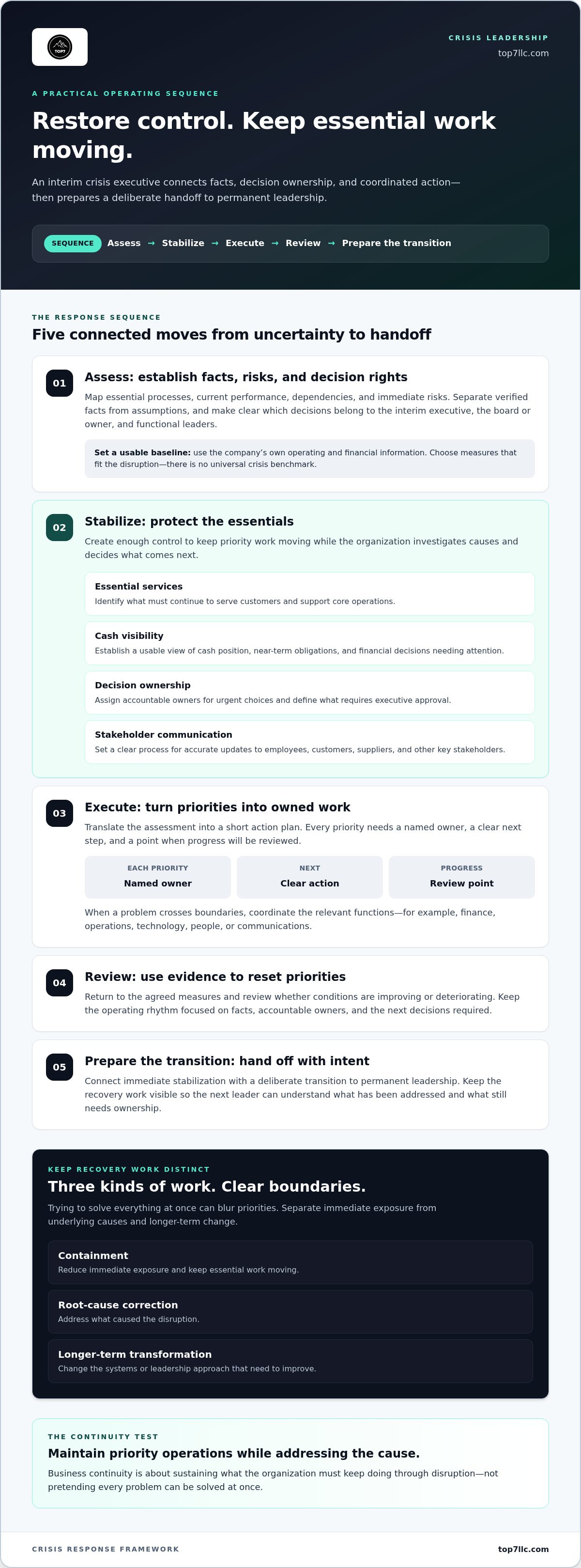
Essential services: Identify what must continue to serve customers and support core operations.
Cash visibility: Establish a usable view of cash position, near-term obligations, and financial decisions requiring attention.
Decision ownership: Assign an accountable owner for urgent choices and define which issues need executive approval.
Stakeholder communication: Set a clear process for sharing accurate updates with employees, customers, suppliers, and other key stakeholders.
Keep the phases distinct. Containment reduces immediate exposure. Root-cause correction addresses what caused the disruption. Longer-term transformation changes the systems or leadership approach that need to improve. Trying to do all three at once can blur priorities. An interim leader can first establish a controlled operating rhythm, then coordinate corrective action and prepare a deliberate transition to permanent leadership.
How an Interim Crisis Executive Restores Control and Business Continuity
Control doesn’t come from issuing more instructions. It comes from establishing what’s true, assigning decisions to named owners, and connecting priorities to action. An interim executive for crisis management turns that work into a disciplined sequence: assess, stabilize, execute, review, then prepare the transition. The leader is embedded in the work, not standing outside it with recommendations.
Business continuity means maintaining priority operations through disruption while the organization addresses what caused it. That definition keeps the focus on what the business must sustain, not on pretending every problem can be solved at once.
Assess: establish facts, risks, and decision rights
Start with a working map of essential processes, current performance, dependencies, and immediate risks. Separate verified facts from assumptions, and identify where incomplete information could lead to a costly decision. Then make authority explicit: which calls belong to the interim executive, which require the board or owner, and which functional leaders can make within agreed limits?
Set a baseline using the company’s own operating and financial information. Agree on which measures will show whether conditions are improving or deteriorating. There’s no universal crisis benchmark. Useful measures depend on the disruption and the operation.
Stabilize and execute: turn priorities into owned work
Translate the assessment into a short action plan. Each priority needs a named owner, a clear next step, and a point when progress will be reviewed. Keep immediate containment distinct from deeper fixes. For example, a technology interruption may require a temporary operating workaround while the team investigates the cause and plans a durable correction.
Coordinate functions when the problem crosses boundaries. Finance may need to clarify constraints, operations may identify critical dependencies, and technology, people, or communications leaders may own specific actions. The interim executive connects these workstreams, resolves conflicts, and escalates decisions outside delegated authority. This hands-on coordination reflects the Strategic Role of Interim Talent in Crisis Management: leadership must help the organization act, not just diagnose the challenge.
Review and prepare the transition
A short, predictable operating cadence keeps the plan active. Use each review to compare evidence with the baseline, surface blockers, confirm decision owners, and adjust priorities. Keep the discussion focused: What changed? What is stuck? Which decision is needed, and who has authority to make it? This rhythm reduces drift without imposing a one-size-fits-all crisis playbook.
As control improves, document open risks, active workstreams, key decisions, and the reasoning behind them. Identify which responsibilities can transfer to existing leaders and which require a permanent executive mandate. Recovery depends on evidence-led adjustments, not a fixed script. Top7 provides interim leadership support, combining strategic guidance with execution to connect immediate action to an intentional handoff.
How to Compare Interim Executives for Crisis Management
A senior title isn’t proof of crisis fit. Compare candidates against the work your business needs done, the authority required to do it, and the handoff you expect at the end. Relevant crisis experience must match the mandate, not merely the executive title. An interim executive for crisis management should be able to explain how they’ve handled comparable challenges, which decisions they owned, and what outcomes they helped deliver.
Ask for specific examples, not broad claims about being decisive. What was unstable? What information was missing? Which choices did the executive make, and how did they coordinate implementation? A useful reference on Interim Management in Crisis and Transition also highlights the value of bridging leadership gaps with relevant experience and a fresh perspective.
Use a consistent scorecard for each candidate. It makes trade-offs visible and helps prevent confidence or résumé prestige from outweighing the mandate.
What experience and authority should the mandate require?
Match the role to the crisis’s center of gravity. A breakdown in delivery may call for deep operational leadership. Urgent financial pressure may require strong financial oversight. A technology disruption may demand a leader who can coordinate technical and business decisions. For a crisis spanning the company, assess whether the mandate needs enterprise-wide leadership.
Define access to decision-makers, teams, and relevant data before work begins. Clarify what the executive can decide independently, what needs owner or board approval, and how escalation works. Ask the candidate to explain how they’d test assumptions, manage uncertainty, and sequence decisions. Specific reasoning matters more than a polished crisis story.
Which measures reveal whether leadership is working?
Agree on a small set of indicators tied to continuity and the mandate’s priorities. Depending on the situation, these might track visibility into essential operations, ownership of critical actions, unresolved blockers, or the time needed to reach a decision. Set the baseline from the company’s actual starting point. Universal targets can mislead.
Review the indicators alongside evidence of execution. Are owners clear? Are priority actions moving? Do leaders have a more reliable picture of risk? Top7’s interim leadership approach combines embedded leadership with execution support, connecting strategic decisions to coordinated work and a deliberate handoff.
How to Prepare Your Company for an Interim Crisis Executive
A capable leader can’t make sound decisions with scattered information, unclear sponsorship, or delayed access. Preparation doesn’t mean waiting until every detail is perfect. It means organizing what you know, labeling what you don’t, and clearing the path for accountable action. That helps an interim executive for crisis management focus on the pressure points instead of spending valuable time searching for basic context.
Before the engagement begins, assign someone to coordinate the handover and assemble a practical briefing pack. Keep it current, concise, and honest. If a number is incomplete or a risk is still an assumption, say so directly. A clear picture of uncertainty is more useful than false confidence.
Information and access to assemble before the start
Prepare the materials and introductions the executive will need to understand the business, its constraints, and its people. Prioritize information that affects current decisions over background detail that can wait.
Business context: Current priorities, organization structure, key roles, existing decision forums, and unresolved commitments.
Financial and operating visibility: Relevant financial reports, cash information, operating reports, service or delivery priorities, and known performance issues.
Risks and dependencies: A list of known risks, critical processes, key suppliers or partners, and dependencies that could affect essential work.
People and access: Names of key stakeholders, system access needs, and the internal contact who can coordinate permissions and introductions.
Evidence quality: Clear labels for verified facts, estimates, open questions, and assumptions, with sources where available.
Don’t mistake volume for readiness. A large folder of unfiltered documents can bury the facts that matter. Give the interim leader a short orientation to the business, then make supporting detail easy to locate. Flag missing information rather than quietly filling gaps with guesses.
How to establish a workable leadership cadence
Name an executive sponsor before the start. This person should explain the mandate, clarify which decisions the interim leader owns, and make sure issues outside that authority have a defined escalation path. Without a visible sponsor, employees may receive conflicting signals about who is leading and which priorities take precedence.
Agree on concise check-ins focused on decisions, risks, action owners, and changes in operating conditions. Set the first review point in advance and identify what information should be ready for it. The cadence should make blockers visible and decisions easier to track, not create another meeting that delays the work.
Communication matters as much as access. Tell employees why the interim leader is joining, what the mandate covers, how decisions will be made, and where questions should go. Give customers, owners, and other affected stakeholders accurate updates through appropriate channels. Don’t promise outcomes the business can’t yet substantiate. Consistent, direct communication reduces rumor and gives people a clearer basis for action.
For hands-on support turning an agreed mandate into coordinated execution, explore Top7’s interim leadership approach.
Choose a Crisis Leadership Mandate Built for Recovery and Handoff
An interim appointment needs a defined finish line, not just a start date. Without agreed outcomes, authority, and transition criteria, the leader can become a temporary fix with no clear path to lasting accountability. Build the handoff into the mandate from day one. The goal is to stabilize the business, make progress on the causes of disruption, and leave the next leadership team equipped to continue the work.
Put five elements in writing before execution begins:
Outcomes: State what the interim leader is accountable for, such as maintaining priority operations, improving visibility into a critical risk, or coordinating a recovery workstream. Make outcomes specific to the situation and the company’s starting point.
Authority: Define decisions the leader can make, decisions that require approval, and how urgent issues are escalated.
Operating scope: Identify the functions, teams, and processes in scope. Clarify where the leader directs work and where existing executives retain ownership.
Review cadence: Set regular points to assess evidence, adjust priorities, and resolve blockers. The mandate should adapt as the organization learns more.
Exit criteria: Describe what must be true for responsibilities to transfer. This may include stable ownership of critical work, documented decisions, and leaders ready to manage ongoing priorities.
Define outcomes, scope, and a clear end condition
Keep the mandate concrete enough to guide decisions, but flexible enough to respond to new information. For example, if a disruption affects customer delivery, specify which services or commitments need leadership attention, who owns corrective actions, and how progress will be reviewed. Avoid defining success as “fix the crisis.” That phrase can mean anything, and it gives no one a reliable basis for evaluating progress.
Review points keep the mandate useful. The sponsor and interim executive can use them to confirm whether priorities still match the evidence, whether authority needs clarification, and whether the organization is ready to take on more responsibility. Base transition readiness on documented responsibilities and leadership continuity, not an assumed calendar date.
Build the handoff into the engagement from day one
Keep working records usable throughout the assignment. A permanent leader shouldn’t have to reconstruct the crisis from scattered updates or private conversations. Maintain a decision log with rationale, a current risk list, workstream status, named owners, and outstanding actions. Record what changed and what still needs attention. This turns the handoff into a managed transfer of context and accountability, not a last-minute briefing.
Plan knowledge transfer to the leaders who will own the work next, whether they’re existing executives or permanent appointments. Timing may shift, so build for continuity rather than a fixed hiring date. Top7’s embedded interim leadership connects strategic guidance with direct execution. Where it fits the organization’s needs, the proprietary Velocity-7 Adaptive Framework supports movement from operational friction toward more coordinated flow.
If your business needs accountable leadership that connects crisis priorities with execution and transition planning, explore Top7’s interim leadership approach.
Make the Next Leadership Decision Deliberate
A crisis doesn’t pause while the organization debates who owns the response. Turn uncertainty into a clear leadership decision: identify the outcomes that matter now, the authority required to pursue them, and how accountability will continue after the interim mandate ends. That clarity helps your team act without confusing temporary leadership with a permanent solution.
An interim executive for crisis management can provide focused ownership while your business works through disruption and shapes its longer-term leadership plan. The value depends on a mandate grounded in your actual risks and operating needs, not a generic promise to fix everything.
Top7 embeds leaders with clients and pairs interim leadership with strategic guidance and execution support. Its proprietary Velocity-7 Adaptive Framework can help align priorities and action when it fits the organization’s needs. The starting point is a direct conversation about where decisions are stuck and what accountable leadership must own.
Talk with Top7 about interim leadership for your crisis. Set a clear mandate, establish ownership, and give your business a stronger basis for its next decisions.
Frequently Asked Questions
What does an interim executive do during a business crisis?
An interim executive takes an active leadership role, directing people and decisions within an agreed mandate. For example, if a supplier failure threatens product delivery, the executive can coordinate operations, finance, and customer-facing teams around priorities, trade-offs, and follow-through. The role is to create accountable action while the situation is still evolving, not simply deliver an assessment. The executive also keeps decision-makers informed about risks that need their attention.
When should a company bring in an interim executive for crisis management?
Bring one in when the crisis demands senior decisions that current leaders can’t make clearly, consistently, or with enough capacity. Signs may include unresolved executive-level choices, teams receiving conflicting direction, or a leadership vacancy overlapping with a serious disruption. An interim executive for crisis management can be especially relevant when the organization needs someone to take ownership while it works out the longer-term leadership structure.
Can an interim executive help maintain business continuity?
Yes. An interim executive can help keep essential work moving by identifying which processes are most exposed, assigning accountable owners, and coordinating practical contingencies. If a technology outage affects customer service, for instance, the leader may align teams around available ways to handle urgent customer needs while technical staff address the disruption. Review the response as conditions change, since a workaround that helps initially may create new risks if left unmanaged.
How is an interim executive different from a crisis management consultant?
An interim executive assumes an operating leadership role and is accountable for directing work within the agreed mandate. A consultant typically provides analysis or recommendations without taking over day-to-day executive responsibility. The distinction matters after the initial diagnosis: who assigns actions, resolves competing priorities, and follows up when work stalls? A company may use advice as an input, but an executive mandate places an identifiable leader in charge of implementation and decisions.
What should an interim crisis leadership agreement define?
It should spell out what the leader is expected to own and how the organization will work with them. Beyond the core mandate, clarify reporting relationships, access to relevant people and information, approval limits, escalation routes, and how changes in scope are handled. Include expectations for documenting decisions and transferring active work. These details prevent confusion between the interim executive’s responsibilities and those retained by owners, directors, or functional leaders.
How do you measure an interim executive’s crisis management progress?
Use indicators tied to the actual disruption, then compare them with the company’s starting position. A business facing delayed fulfillment might track whether priority orders are moving and whether unresolved blockers have owners. A company under financial pressure might review the usefulness and consistency of cash visibility. Pair operational measures with evidence that decisions are being acted on, and revise the measures if they stop reflecting the most urgent risks.
What happens when the interim executive’s assignment ends?
The work and decision history should transfer to the leaders who will own them next, whether that’s an incoming executive or the existing team. A practical closeout can include a briefing on unresolved risks, current commitments, key decisions, and any actions that still need approval. Have each incoming owner confirm what they’re taking forward. The assignment ends with responsibilities understood and active work accounted for, not simply when the interim leader leaves.



Comments