
Interim COO for Mid-Market Companies: Stop Filling Seats and Start Fixing Friction

Why are you treating a leadership vacancy like a hole that just needs plugging? Most mid-market CEOs think hiring an interim coo for mid-market companies is about finding a warm body to keep the lights on. They're wrong. If your sales delivery is stalling and your remaining executives are burning out, you don't need a placeholder; you need a catalyst. You're losing momentum every hour that friction goes unaddressed.
We know the pressure you're under. It's the silent agony of watching growth hit a ceiling because your internal systems can't keep up with your ambition. This isn't just about survival; it's about transformation. You can turn this leadership gap into your greatest competitive advantage by deploying a strategic interim leader who fixes the engine while the car is moving.
In this guide, we'll show you how to move from operational friction to scalable flow. You'll learn how the Velocity-7 Adaptive Framework identifies bottlenecks, provides immediate stability, and builds a precise roadmap for your permanent successor. Stop filling seats. Start fixing the friction that's holding your profit hostage.
Table of Contents
The Mid-Market Growth Trap: Why Operations Break at Scale
You hit $20M through sheer force of will. Congratulations. But the manual hacks and tribal knowledge that fueled your early success are now the very things strangling your EBITDA. This is the Mid-Market Ceiling. It's where growth stops being a victory and starts being a liability. Without the strategic oversight of a Chief Operating Officer (COO), you're paying a "Complexity Tax" on every single transaction. This tax is the hidden cost of inefficiency, redundant meetings, and correcting errors that should've never happened in the first place.
The $20M to $100M Revenue Chasm
Scaling from $10M to $50M isn't just doing more of the same. It's a fundamental shift in DNA. The systems that got you here will break you at scale. You aren't just "doing the work" anymore; you're building a machine. In the mid-market, your product is no longer what you sell; it is the process by which you deliver it. If that process relies on your memory or a "hero culture" where individuals save the day through overtime, you're one resignation away from a collapse. An interim coo for mid-market companies doesn't just manage the chaos. They replace it with a repeatable, automated engine that functions without constant executive intervention.
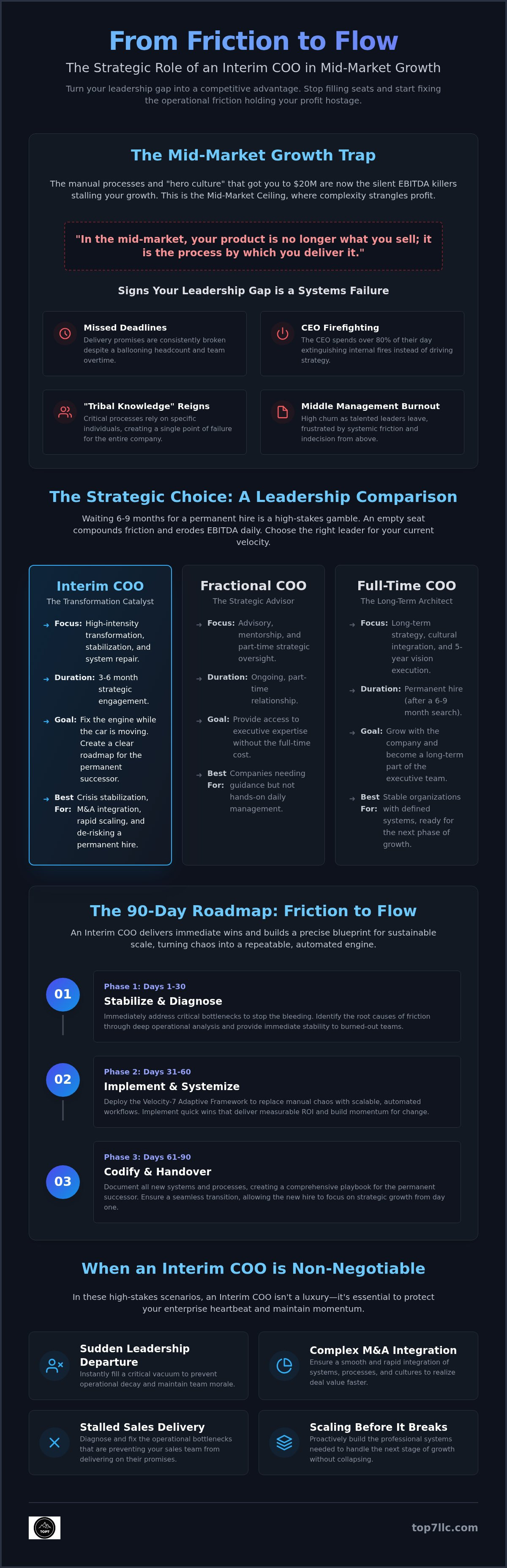
Signs Your Leadership Gap is Actually a Systems Failure
How do you know if you're trapped? Look at your people. High churn in middle management isn't usually a "culture problem." It's a symptom of operational chaos. When smart people can't get things done because of friction, they leave. If you're experiencing these symptoms, your systems have already failed:
Missed delivery deadlines despite a ballooning headcount.
The CEO spending 80% of their day extinguishing internal fires instead of driving strategy.
"Tribal knowledge" being the only way anything gets finished.
Middle management burnout because they're shielding teams from executive indecision.
You don't have a talent problem. You have a friction problem. Every time a process requires a manual workaround, your profit bleeds. Founder-led chaos got you off the ground, but only process-led flow will take you to $100M. Bringing in an interim coo for mid-market companies isn't a sign of failure; it's a strategic move to professionalize before the weight of your own growth crushes the enterprise. If your organization can't run without you in every Slack channel, you don't own a business. You own a very expensive, high-stress job. Transitioning to a process-led model is the only way to reclaim your time and your profit.
Interim COO vs. Fractional vs. Full-Time: Making the Strategic Choice
Waiting for a permanent executive savior is a high-stakes gamble that most mid-market firms lose. A standard search for a high-quality Chief Operating Officer takes between 6 and 9 months. During that time, your operational friction doesn't just sit still; it compounds. Every day that seat remains empty, your team loses direction, your processes degrade, and your EBITDA takes a hit. This is the true opportunity cost of a vacancy. You aren't just missing a leader; you're missing the revenue that leader would have unlocked.
Hiring an interim coo for mid-market companies isn't about finding a temporary manager to watch the clock. It's about deploying a high-intensity "Bridge Leader" who can stabilize the enterprise today. While a permanent hire focuses on a five year horizon, an interim leader focuses on the next 180 days of survival and optimization. They don't need six months to "learn the culture"; they're there to fix the systems that are making your culture toxic in the first place.
The Hidden Costs of the Permanent Executive Search
The price of a permanent hire goes far beyond recruitment fees and base salary. There's the onboarding lag, the risk of a cultural mismatch, and the potential for a "bad hire" to set your operations back by years. If you drop a new COO into a fractured system, they'll spend their first six months just trying to figure out where the friction is buried. An interim leader de-risks this entire process by cleaning the house first. We define the "Bridge Period" as a 3-6 month strategic window where operational debt is paid down and systems are professionalized before a permanent successor ever steps foot in the building. This ensures your new hire can focus on growth instead of fixing your old mistakes.
Choosing Based on Organizational Velocity
Not every operational gap requires the same level of intensity. You need to choose your leadership model based on the speed of change your company is currently facing. Use an interim coo for mid-market companies when you're in a crisis, a turnaround, or navigating a complex M&A integration. These scenarios require a full-time, hands-on presence to maintain the enterprise heartbeat. Conversely, fractional leadership is better suited for steady-state environments where you need high-level strategic guidance without the overhead of a full-time executive.
Interim: Full-time, 3-9 month duration, execution-focused, crisis or transformation.
Fractional: Part-time, ongoing, advisory-focused, steady-state growth.
Top7 provides the flexibility your velocity demands. Whether you require a daily rate model for intense, short-term transformation or a monthly retainer for ongoing fractional support, we align our presence with your specific friction points. If you're ready to stop the bleeding and start building, consider how Top7's interim leadership can bridge the gap between your current chaos and future stability.
Beyond Seat-Filling: Operational Transformation via Velocity-7
Most organizations treat an interim role as a temporary holding pattern. They're wrong. If you're just filling a seat, you're subsidizing stagnation. Top7 doesn't just "manage" your mess; we use the Velocity-7 Adaptive Framework to rewire your organization for flow. An interim coo for mid-market companies should be a catalyst, not a placeholder. We don't sit on the sidelines giving advice; we embed directly into your leadership team, taking full accountability for the operational results. We're there to turn the leadership gap into a period of aggressive professionalization.
The 7 Dimensions of Mid-Market Growth
Mid-market companies often fail when they try to apply rigid, Fortune 500 playbooks to their agile environments. Velocity-7 is different. It's an adaptive framework designed to address the seven critical dimensions of your business: strategy, finance, technology, sales, marketing, people, and operations. We apply agile-based transformation to physical operations and sales delivery, ensuring your "machine" can pivot as fast as the market does. This isn't a static manual. It's a living system that identifies where friction is hiding and replaces it with measurable velocity. We focus on building a process-led culture that doesn't crumble the moment a key individual leaves the room.
Solving Complex Problems in Real-Time
A true interim coo for mid-market companies must be a polymath capable of handling high-stakes complexity from day one. While we're stabilizing your daily production, we're also plugging financial strategy leaks that are draining your EBITDA. We identify the manual bottlenecks that your current team has "learned to live with" and deploy technology leadership to automate them. This isn't just about doing things faster; it's about doing the right things with precision.
Sales and Ops Alignment: We integrate sales guidance with actual operational capacity to ensure sustainable growth without breaking your delivery team.
Financial Clarity: We audit your reporting systems to ensure you're making strategic decisions based on hard data rather than founder's intuition.
Technology Integration: We identify where manual spreadsheets are killing your productivity and replace them with automated, scalable workflows.
We don't wait for a 90-day review to start fixing things. We find the friction on day one and remove it by day ten. This direct embedding process means we aren't just consultants; we're part of the team. When we eventually hand the keys to your permanent successor, they aren't inheriting a disaster. They're inheriting a high-performance engine built on the Velocity-7 framework. You aren't just buying time; you're buying a superior version of your own company.
High-Stakes Scenarios: When an Interim COO is Non-Negotiable
In the mid-market, "wait and see" is a death sentence. When your operation hits a crisis point, you don't have six months to vet a permanent executive. You need a battle-tested leader who can walk into the room and stop the bleeding on day one. Choosing an interim coo for mid-market companies isn't a luxury during these high-stakes moments; it's a survival tactic. Whether you're facing a sudden leadership vacuum or a profit-killing growth stall, the cost of hesitation is higher than the cost of action.
Consider the sudden departure. When your operations head walks out, they take tribal knowledge and institutional momentum with them. The enterprise "heartbeat" falters. Without immediate stabilization, your middle management will drift, and your delivery will suffer. Similarly, in a turnaround situation, you don't need a consensus builder. You need an operator who can perform aggressive restructuring to save your EBITDA and cash flow before the market moves past you.
M&A and Post-Merger Integration
Mid-market mergers fail at an alarming rate because of operational friction. You're trying to merge disparate cultures, conflicting tech stacks, and redundant processes without losing revenue. It's a recipe for chaos. An interim coo for mid-market companies acts as the objective arbiter of "Best-in-Class" processes. They don't care about internal politics or "how we've always done it." Their only goal is ensuring the velocity of the acquired company isn't strangled by corporate bloat or integration lag.
Rapid Scaling and Infrastructure Stress
Success can be just as dangerous as failure. When your sales outpace your delivery, you're facing a "Success Crisis." Your supply chain snaps, your logistics fail, and your CEO becomes the ultimate bottleneck through micromanagement. You need to implement professionalized discipline before the infrastructure breaks. We focus on building a robust middle-management layer that functions with precision. This allows the CEO to step back from the fires and return to high-level strategy, knowing the machine is built to handle 2x or 3x scale-up without collapsing.
Don't let operational friction dictate your company's future. If you're navigating a high-stakes transition, contact Top7 to secure interim leadership that transforms chaos into a scalable roadmap for success. We don't just fill seats; we fix the friction that holds your profit hostage.
Implementing Interim Leadership: From Friction to Flow in 90 Days
You don't have time for a ninety day onboarding period. In the mid-market, three months is an eternity of lost revenue and compounding inefficiency. When you bring in an interim coo for mid-market companies from Top7, the execution starts in hour one. Our seasoned professionals arrive with no learning curve. We don't spend weeks learning the culture; we spend days identifying the friction points that are bleeding your cash flow. This is a ninety day sprint from chaos to a professionalized, scalable machine.
The First 30 Days: Stopping the Bleeding
Phase 1 focuses on the Operational Audit and immediate Friction Identification. We don't just look at spreadsheets. We look at the heartbeat of the enterprise. We perform an immediate assessment of cash flow, supply chain vulnerabilities, and key personnel performance. By establishing a daily operational rhythm, we immediately reduce executive anxiety and reclaim your time. You'll see ROI through the removal of low-hanging fruit friction points before the first month is over. We stop the bleeding so we can start the transformation.
Phase 2, covering days 31 to 60, is where the Velocity-7 Adaptive Framework takes control. We move from identifying problems to executing solutions. This isn't about theoretical best practices; it's about agile-based transformation that delivers quick wins in sales delivery and operational capacity. We're re-engineering your processes to support that 2x scale up without breaking the infrastructure. By day 60, the shift from manual chaos to process-led flow is visible in your EBITDA.
Transitioning to Permanent Leadership
Phase 3 is about systematization and preparing for your permanent successor. Most permanent COO hires fail because the job description was a work of fiction. An interim leader defines the role based on the hard reality of your operations. We tell you exactly what skills your permanent hire needs to maintain the flow we've built. We don't just leave a manual; we leave a machine that functions with precision.
The Top7 Hand-off protocol ensures the new hire inherits a documented, high-velocity organization instead of a mess. By integrating Strategic Planning and Advanced Project Management into the transition, we ensure the momentum we've built doesn't stall on our last day. You aren't just filling a seat; you're fixing the engine for good. We provide the bridge to long-term stability, ensuring your permanent COO can focus on future growth instead of past failures. Stop settling for placeholders and start demanding transformation.
Reclaiming Your Operational Flow
Operational friction is a choice, not an inevitable tax on growth. You've seen how the $20M to $250M revenue chasm swallows companies that rely on tribal knowledge instead of scalable systems. By deploying an interim coo for mid-market companies, you aren't just buying time; you're buying a professionalized infrastructure. Our seasoned C-suite veterans don't offer generic advice. They embed into your team to execute the Velocity-7 Adaptive Framework, turning your operational bottlenecks into a clear roadmap for a permanent successor.
Don't let a leadership gap become a permanent growth stall. You need operators who have sat in the chair, not career consultants who have only watched from the sidelines. It's time to stop the fire-fighting and start the transformation that your EBITDA deserves. Your next level of growth is waiting on the other side of flow. We're ready to help you build the machine that delivers the results you've worked for.
Stop the operational friction. Schedule a Velocity-7 diagnostic call with Top7 today.
Frequently Asked Questions
What is the difference between an interim COO and a business consultant?
Consultants give advice; interim COOs take the wheel. A consultant leaves you with a PowerPoint deck and a bill. Our interim leaders embed into your team and own the results. They use the Velocity-7 Adaptive Framework to execute changes in real-time. While a consultant might identify friction, an interim leader removes it and builds the machine to keep it gone. It's the difference between a map and a driver.
How quickly can an interim COO start at my company?
Top7 professionals are ready to deploy within days, not months. We understand that mid-market companies usually call us when the house is already on fire. Because our seasoned veterans have no learning curve, they can begin an operational audit immediately. We don't need a month of discovery to find your friction points; we're built for speed and high-velocity execution from hour one.
What are the typical daily or weekly rates for an interim COO?
We charge daily or weekly rates for interim management to ensure full-time, high-intensity leadership during your transition. These rates reflect the level of expertise and the immediate ROI provided by a C-suite veteran. While a fractional interim coo for mid-market companies might operate on a monthly retainer for part-time work, an interim role is a full-time commitment. We'll discuss specific structures based on the complexity and urgency of your operational friction.
Can an interim COO help with a permanent executive search?
While Top7 doesn't offer executive recruitment services, we are essential in defining what you actually need. We help you draft a job description based on the operational reality we've fixed, not a theoretical wishlist. By cleaning the house and implementing the Velocity-7 framework first, we ensure your permanent successor inherits a high-performance machine rather than a chaotic mess that they'll likely quit within six months.
What industries do your interim COOs specialize in?
Our expertise spans companies generating $20M to $250M across diverse sectors, including manufacturing, logistics, technology, and professional services. We focus on the "machine" of the business rather than niche industry jargon. If your company relies on delivery, supply chains, or complex team structures, our interim coo for mid-market companies frameworks apply. We solve the universal friction points that kill EBITDA regardless of what product you're shipping.
Does an interim COO manage the entire staff or just the department heads?
An interim COO typically focuses on professionalizing the middle-management layer and department heads. We build the systems that allow these leaders to function without CEO micromanagement. While we embed directly into the team, our goal is to empower your existing leadership to own their processes. We create a process-led culture where every department head understands their role in the overall operational flow and scalable growth.
How do you measure the ROI of an interim COO engagement?
We measure success through hard data: increased EBITDA, reduced delivery lag, and the removal of operational bottlenecks. Using the Velocity-7 framework, we track the shift from manual friction to automated flow. You'll see the ROI in your cash flow and the sudden drop in executive burnout. If the CEO is no longer spending 80% of their day fighting fires, the interim leader has already paid for themselves.
What happens if we want to hire the interim COO permanently?
Our interim leaders are career professionals who specialize in transformation and bridge leadership, not permanent placement. They're built for the high-intensity sprint of a 90-day turnaround or a 6-month transition. While the leader themselves might move to the next challenge, the systems they build stay behind. We focus on making the organization so healthy that you can attract and retain the best permanent talent in the market.


Comments