
Integrating a Fractional Leader with Your Team: The No-Fluff Execution Guide

Treating a fractional leader like a glorified consultant is the fastest way to set your capital on fire. Successfully integrating a fractional leader with your team isn't about "blending in"; it's about a tactical injection of authority to kill operational friction. If you hire an executive just to "advise" while your operations continue to grind to a halt, you're just subsidizing someone else's portfolio career. You're likely already feeling the burn of bottlenecks and a team that's drowning in reporting line confusion. You need elite leadership to survive, but you don't need a $300,000 salary dragging down your margins.
We agree that the traditional hiring model is broken for mid-market growth. This no-fluff guide promises to transform how you deploy strategic assets like a Fractional COO or CTO to achieve rapid strategic execution. We'll show you how to stop the executive burnout and start generating measurable ROI through the Velocity-7 Adaptive Framework and precise internal process alignment. It's time to stop treating leadership as a luxury and start using it as a weapon for market dominance.
Key Takeaways
Transfer explicit decision rights to your fractional executive immediately or prepare for continued operational paralysis and team confusion.
Escape the "Consultant Trap" by integrating a fractional leader with your team as a strategic asset with the authority to drive real change.
Deploy a disciplined 90-day execution roadmap that replaces vague alignment with measurable, high-velocity results and friction removal.
Leverage the Velocity-7 Adaptive Framework to systematically map your growth dimensions and automate the leadership integration process.
Table of Contents
Why Most Fractional Integrations Fail (And How to Avoid It)
Hiring elite talent is easy. Getting that talent to actually move the needle is where most CEOs fail. If you think a monthly retainer buys you a magic wand, you are mistaken. Integration is the only bridge between hiring a high-level professional and seeing a measurable ROI. Without a tactical plan, your new executive is just a high-priced spectator. We define fractional integration as the systematic embedding of executive authority into existing workflows. It is not a "get to know you" phase. It is a structural takeover of specific responsibilities designed to kill bottlenecks. Successfully integrating a fractional leader with your team requires you to stop treating them like a vendor and start treating them like the boss of their domain.
The "Consultant Trap" is the most common killer of strategic momentum. In this trap, the Fractional executive is kept at arm's length, appearing only for weekly meetings to give "advice" that no one follows. Your team sees this. They recognize when a leader has no real teeth, and they will wait them out. To avoid this, you must identify the "Friction Points" in your current C-suite before the very first onboarding call. Are decisions stalling in marketing? Is the tech stack a chaotic mess? Pinpoint the pain, then hand over the keys.
To better understand how complex variables must be integrated into a functional whole, watch this tactical breakdown of integration principles:
The High Cost of Poor Onboarding
Wasted retainer fees are the least of your worries. The real cost of poor integration is the "spinning wheels" phenomenon. When goals aren't explicitly communicated from day one, your team grows resentful of the "new person" asking questions they've already answered. You lose strategic momentum during critical growth phases, and your best people start looking for the exit because they don't see a clear path forward. If you don't integrate with precision, you aren't just losing money; you're losing your competitive edge.
Friction vs. Flow: The Top7 Perspective
Operational friction is the #1 enemy of fractional success. Most businesses operate in a state of constant stuttering because no one has the authority to say "no" to bad ideas. We focus on moving from "checking in" to "executing against a roadmap." In our world, operational flow is the absolute absence of decision-making bottlenecks. When you are integrating a fractional leader with your team, you are essentially installing a high-performance engine component. If the rest of the machine refuses to connect, the engine explodes. You don't need more meetings; you need a roadmap that everyone is forced to follow.
Establishing Authority: The Foundation of Fractional Success
Authority is not a feeling. It is a documented set of tactical decision rights. If you are integrating a fractional leader with your team and you fail to explicitly transfer power, you are sabotaging your own investment. Your team needs to know exactly what this person can approve, change, or kill. Without this clarity, you're just inviting a turf war that will paralyze your operations. Managers will protect their silos. Employees will ignore directives. The result is total stagnation. Authority is not a "vibe" you hope people pick up on; it is a hard boundary that you must enforce from the top down.
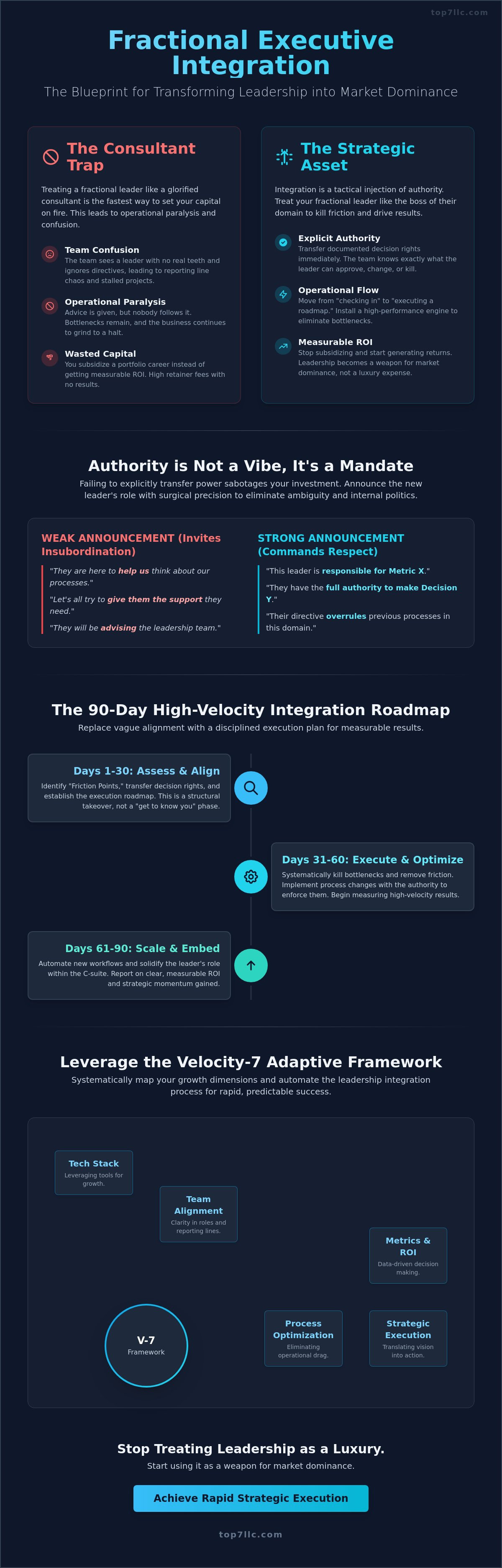
The announcement to your staff must be surgical. Do not use soft language like "they are here to help us." That signals weakness and invites insubordination. Instead, state clearly: "This leader is responsible for [Metric X] and has the authority to make [Decision Y]." This removes the ambiguity that breeds internal politics. You must define "No-Go Zones" immediately to prevent friction with existing managers. If your Fractional COO owns process optimization, your department heads need to know that their old ways of working are now subject to that leader’s veto. Clarity is the only antidote to the hidden agendas that kill growth.
The "Sponsor" Model: Why the CEO Cannot Disengage
The CEO is the ultimate sponsor. You cannot simply hire a Fractional CEO or COO and disappear into the sunset. You must provide a direct line to the top. This bypasses mid-level resistance and proves the new leader has your full backing. Stop wasting hours on status meetings. Implement weekly 15-minute "Alignment Sprints" instead. These are high-intensity sessions focused on removing roadblocks, not reciting spreadsheets. When long-term employees push back, your job is to reinforce the new hierarchy. If you don't defend the authority you granted, no one else will.
Defining Key Performance Indicators (KPIs) Early
Stop measuring activity. Start measuring outcomes. When integrating a fractional leader with your team, tie their success to two or three "North Star" metrics. If you've brought in a Fractional CTO Philadelphia, their KPIs should focus on deployment velocity or system security, not the number of Slack messages they posted. Demand outcome-based reporting that shows a direct line to profit maximization. If they aren't hitting the numbers, the integration has failed. Results are the only currency that matters in a high-growth environment. If you're ready to stop the bleeding and start scaling, you need to look at our Strategic Planning solutions.
The 90-Day Fractional Integration Roadmap
A 90-day plan isn't a suggestion; it's a requirement for survival. Most executives fail because they treat the first month like a corporate orientation. They spend weeks "getting to know" people while the business bleeds cash and opportunities. When integrating a fractional leader with your team, you need a timeline that prioritizes speed over sentiment. This roadmap is designed to move from initial audit to total operational flow in three distinct phases. If you aren't seeing a shift in the first 30 days, you've hired a spectator, not a leader. Success depends on a disciplined execution of these three stages:
Phase 1 (Days 1-30): The Audit and Alignment Stage. We find the leaks and identify the "Quick Wins" that prove the leader's value to the staff immediately.
Phase 2 (Days 31-60): The Execution and Friction-Removal Stage. This is the heavy lifting where we dismantle broken processes and install new ones.
Phase 3 (Days 61-90): The Operational Flow Stage. This is where the systems take over and the leader moves from fixing to scaling.
The first 30 days are critical for building team trust. If a leader doesn't solve a visible problem quickly, the staff will view them as another useless layer of management. You don't need a cheerleader; you need someone who can identify a bottleneck and kill it before the first month's invoice is due. This is the foundation for integrating a fractional leader with your team effectively.
Days 1-30: Listening, Learning, and Plugging Leaks
We start with a Velocity Audit. This isn't a polite review of your files; it’s a kriegspiel-style analysis of your financials, tech stack, and sales pipeline. We find exactly where the friction is. We establish a brutal communication cadence using Slack, email, and stand-ups that actually serve a purpose. The goal is simple: find the leaks and plug them. If the team sees immediate relief from a bottleneck, they will follow that leader into the fire. If you need this level of technical oversight, our Fractional CTO services are designed for this exact type of rapid stabilization.
Days 31-90: From Stability to Scaling
By day 31, the audit is over and the heavy lifting begins. We implement the first major strategic shift identified in the audit. This might mean firing a failing vendor or restructuring a sales process that has been stagnant for years. The team must be empowered to own these new processes without constant hand-holding from the CEO. The 90-day flip marks the decisive moment where the fractional leader moves from learning your mess to leading your growth. Once the "part-time" stigma is gone, the leader becomes a permanent fixture of your success. To see how this fits into a broader growth strategy, explore our Velocity-7 Adaptive Framework for more details.
Embedded Leadership: Moving Beyond the "Part-Time" Stigma
Stop calling them "part-time." That label is a psychological trap that signals to your employees that this leader is temporary, disposable, and ultimately ignorable. If your team treats a fractional executive like a guest, they will act like one. Successful execution depends on integrating a fractional leader with your team as a permanent fixture of your hierarchy, regardless of how many hours they bill. They aren't here to "fit in" with a mediocre culture; they are here to elevate it through high-velocity results. Do not let your existing culture hold your growth hostage. If your current culture is the reason you have operational friction, you need a leader who is willing to break things to fix them.
We believe in total immersion. A Top7 leader doesn't sit on the sidelines sending occasional emails from a generic Gmail account. They are embedded directly into your Slack channels and your company email domain. They own their department. When integrating a fractional leader with your team, the goal is for your staff to view them as their boss, period. This requires a shift in psychological ownership. The fractional executive must have the same level of accountability as a full-time hire, backed by the authority to fire underperformers or kill failing projects. If they don't have the power to make people uncomfortable, they don't have the power to lead.
Managing Remote and Hybrid Integration
Distance is no excuse for a lack of discipline. We use tools like Loom and Notion alongside our proprietary Velocity-7 tools to maintain a relentless "Velocity of Communication." Async collaboration shouldn't slow you down; it should automate your decision-making. We also mandate occasional "On-Site Intensives." These are high-stakes, face-to-face planning sessions where we strip away the digital noise and focus on raw strategic execution. If you can't communicate at the speed of the market, you've already lost. You need a system that ensures information flows without bottlenecks, regardless of where your team is sitting.
The Exit Strategy: When Integration Leads to Permanent Hires
The ultimate sign of a successful fractional engagement is when the role grows so large that it demands a full-time successor. A true fractional leader isn't looking for a forever job; they are building a bridge. They document every process, stabilize every system, and identify exactly what a full-time hire needs to look like to maintain the momentum they've built. If you are currently in a transition phase, our Interim Leadership services provide the tactical planning necessary to ensure no strategic ground is lost during the handoff. We help you identify the exact moment the role has scaled beyond the fractional scope so you can hire with confidence. Ready to stop guessing and start scaling? Secure your growth with our Advanced Project Management expertise today.
Leveraging the Velocity-7 Framework for Rapid Integration
Standard consulting methodologies are a relic of a slower era. They rely on bloated "discovery phases" that last months while your competitors eat your market share. When you're integrating a fractional leader with your team, you don't have time for a traditional learning curve. You need a system that identifies failures before the first meeting ends. That's why we use the Velocity-7 Adaptive Framework. It's a proprietary tool designed to automate the integration process by mapping the seven critical dimensions of business growth. We don't guess where the problems are; we use a tactical map to find them.
This isn't about "feeling out" the culture. It's about data-driven dominance. Our executives use this framework to bypass the traditional executive onboarding lag that kills momentum. While other firms are still trying to find the breakroom, a Top7 leader is already dismantling the operational friction that keeps your margins thin. We move from chaos to efficient flow in record time because the framework tells us exactly where the engine is smoking. It makes integrating a fractional leader with your team a precise tactical maneuver rather than a hopeful experiment.
The 7 Dimensions of Growth
The Velocity-7 Adaptive Framework analyzes your business across seven distinct vectors: Financial, Technology, Operations, Sales, Marketing, Product, and People. Most consultants look at these in silos. We look at the friction between them. If your sales team is outrunning your operations, the framework flags the leak immediately. It's specifically engineered for the US mid-market, where agility is your only real defense against larger, slower competitors. We don't just give you a report; we give you a roadmap for strategic superiority.
Ready to Stop Guessing and Start Scaling?
There is a chasm between a "consultant" who gives advice and a Top7 fractional executive who takes ownership. A consultant leaves you with a PowerPoint; we leave you with a high-performance machine. If you're tired of executive burnout and operational bottlenecks, the solution isn't another meeting. It's a tactical injection of leadership.
Your first step is simple. Stop guessing about your growth and start measuring it. You can Schedule a Call with a Top7 Executive today to begin your initial Velocity Audit. We'll strip away the fluff and show you exactly where your integration is failing and how to fix it. Don't let another quarter slip away in a fog of confusion. Secure your market position now.
Stop Managing Friction and Start Scaling Results
Market dominance isn't about finding a part-time helper; it's about a tactical takeover of your operational bottlenecks. You now have the roadmap to move from executive burnout to total operational flow. By establishing clear decision rights and following a disciplined 90-day execution plan, you transform your C-suite from a source of stress into a high-performance growth engine. Successfully integrating a fractional leader with your team means moving beyond the consultant trap and deploying a strategic asset with the authority to win.
Our team consists of seasoned C-suite professionals who don't need a learning curve. We leverage the Velocity-7 Adaptive Framework to map your specific growth dimensions and deliver proven mid-market results that show up on your bottom line. Stop settling for "good enough" when you can have strategic dominance. Your business deserves executive-level precision without the full-time bloat. It's time to stop guessing and start winning.
Stop the friction. Deploy a Top7 Fractional Leader today.
Frequently Asked Questions
How many hours a week does a fractional leader actually work?
A fractional leader typically dedicates 10 to 20 hours per week to your business. We don't sell hours; we sell outcomes. If you're counting minutes, you're missing the point of executive level talent. The focus is on high impact strategic execution that moves the needle. You're paying for decades of experience applied in surgical bursts, not someone to sit in a cubicle for 40 hours a week.
Will my existing team feel threatened by a fractional executive?
Your team will only feel threatened if you fail to communicate the leader's purpose. Frame the arrival of a Fractional COO or CMO as a strategic resource to remove their roadblocks. If a team member remains resistant to improved processes, they're likely the bottleneck. Excellence shouldn't be scary to high performers. It's only a threat to those hiding behind operational friction.
How do I measure the ROI of a fractional leader after 90 days?
ROI is measured by the successful removal of the bottlenecks identified in your initial Velocity Audit. Look at your North Star metrics. Is your deployment velocity up? Are your margins healthier? By day 90, integrating a fractional leader with your team should result in documented process improvements and a clear strategic roadmap. If the data doesn't show progress, the integration failed.
Can a fractional leader manage full-time employees effectively?
Yes, a fractional leader can and must manage full-time employees to be effective. They need the authority to hire, fire, and restructure their department. If you keep them in a consultant box, your team will ignore them. Integrating a fractional leader with your team requires you to empower them as a legitimate boss. Without that authority, they're just a high priced advisor with no teeth.
What systems do I need to have in place before they start?
You need to provide full transparency into your financials, tech stack, and current sales pipeline. We can't fix what we can't see. Ensure your communication tools like Slack or Notion are ready for immediate onboarding. Don't waste the first week hunting for passwords. The more prepared you are on day one, the faster we can start plugging the leaks in your growth engine.
Is fractional leadership better than hiring a full-time executive?
For mid-market companies, fractional leadership is often superior because it provides elite expertise without the $300,000 salary and equity burden. You get the brainpower of a veteran executive at a cost that protects your margins. It allows you to scale your leadership team as your revenue grows. Why pay for a full-time seat when you only need a fraction of the time to get results?
How does Top7 handle sensitive company data and confidentiality?
We treat your data with the same level of security as a full-time executive. This includes standard NDAs and using your internal company email and Slack domains. We operate within your existing security protocols to ensure total confidentiality. Our focus is on strategic dominance, and that requires a foundation of absolute trust and data integrity. Your proprietary secrets are safe with us.
What happens if the fractional leader isn’t a good fit for our culture?
If the fit isn't right, the model allows for a clean break. Unlike a full-time hire with a massive severance package, a fractional engagement is built for agility. We don't aim for culture fit in the sense of being liked; we aim for results fit. If the leader is moving the needle on profit and efficiency, the culture will naturally adapt to that success.



Comments