

How to Structure a Marketing Team for Growth: The Velocity-7 Blueprint (2026)
- Robert Fitzgerald
- Jul 10
- 12 min read

Updated: 2 days ago
Why is your marketing payroll exploding while your growth remains stagnant? Most mid-market leaders mistake a high headcount for a high-performance engine. It's a fatal error. If you want to know how to structure a marketing team for growth, you have to stop collecting resumes and start designing for throughput. You're likely drowning in "busy work" that produces zero ROI because your team is built on legacy titles rather than operational flow. Your high-priced leadership shouldn't be a glorified project management layer; they should be growth architects.
You've felt the friction between sales and marketing. You're tired of paying for executive-level salaries that deliver junior-level results. We agree that marketing should be a revenue engine, not a black hole for capital. This article delivers the no-BS Velocity-7 Blueprint to transform your department into a lean, agile machine. We'll show you how to stop hiring for vanity and start architecting for revenue. It's time to bridge the gap between strategy and execution with clear, unyielding accountability.
Table of Contents
Why Your Current Marketing Structure is Killing Your Growth
Most mid-market companies are operating with a 1990s organizational structure while trying to compete in a 2026 digital economy. It doesn't work. Your rigid hierarchy is a bottleneck, not a foundation. A growth-ready structure is an adaptive network designed for speed, not a pyramid designed for ego. When leaders ask how to structure a marketing team for growth, they usually start with an empty org chart and a list of fancy titles. That's the first step toward failure. You don't need more managers; you need more flow.
You fall into the "Title Trap" when you hire a high-salaried Director of Marketing to fix a strategy that doesn't exist. You're effectively buying a driver for a car that has no engine. Bloated departments are rapidly becoming liabilities. In 2026, the winners are replacing heavy internal headcounts with agile, fractional-led pods that focus on output over attendance. If your team is more worried about approval loops than revenue, you're already losing the market share battle.
To better understand how modern teams are actually being built, watch this helpful video:
The Symptoms of a Broken Org Chart
Is your team busy? Probably. Is that "busy-ness" moving the needle? Unlikely. If your marketing department produces endless social posts and emails but your pipeline remains bone-dry, your structure is broken. You'll see frequent friction between the CRO and the CMO because their targets aren't just misaligned; they're in different universes. When market conditions shift or a new algorithm drops, a rigid team takes six months to pivot. By then, the opportunity is dead and your competitors have already moved on. Efficiency isn't just about doing things faster; it's about doing the right things without internal friction.
Strategy vs. Execution: The Great Disconnect
You likely have "doers" who can execute tasks but no "thinker" to architect the system. This leads to expensive, random acts of marketing that feel productive but lack a cohesive direction. Outsourcing this entirely to an agency is a dangerous gamble. Agencies are great at execution, but letting them dictate your internal growth strategy is like letting the contractor design your house without an architect. You need internal strategic dominance to maintain control over your own destiny. Structural Friction is the invisible tax you pay every time an approval loop stalls or a siloed department fails to communicate, effectively strangling your ability to scale.
The Velocity-7 Framework: Architecting for Flow, Not Friction
Marketing is not an island. If your current strategy treats your marketing department as a siloed creative shop, you're burning capital. The Velocity-7 Adaptive Framework isn't just another org chart; it's a nervous system for your business. It moves your organization from friction to efficient flow by ensuring that every marketing dollar spent is tethered to a specific growth dimension. When you consider how to structure a marketing team for growth, you must look beyond the creative output. You are building a revenue factory, not an art gallery.
Scaling a marketing team in 2026 requires an adaptive approach that integrates with Finance, Sales, Tech, Operations, Product, and Customer Success. This isn't about adding layers of management. It's about removing the barriers that prevent data from turning into decisions and leads from turning into revenue. If your structure can't pivot in a single sprint, it's already obsolete. You need a system that thrives on change rather than being paralyzed by it.
Embedding Strategy into the Org Chart
Most mid-market companies suffer from a massive disconnect between their technical capabilities and their market messaging. The Velocity-7 framework bridges this gap by forcing a unified front between the CMO, CTO, and COO. This triad ensures that your tech stack actually supports your growth goals instead of creating more work for your team. We identify lead-to-revenue bottlenecks by auditing the entire path, not just the top of the funnel. By implementing Advanced Project Management as a core marketing function, you ensure that high-level strategy actually reaches the execution phase without getting lost in translation.
From Operational Friction to Efficient Flow
Why do teams in hyper-competitive hubs like Austin or Boston move faster? They've ditched the hierarchy for agile pods. These pods operate in short, aggressive sprints that prioritize high-impact wins over long-term "planning" sessions. This structure creates a permanent feedback loop where real-time data dictates the next move. You don't need a massive headcount to dominate your market; you need a lean, adaptive structure that maximizes the output of every specialist. Silos are where revenue goes to die. Flow is where it grows. By adopting the Velocity-7 Adaptive Framework, you transform your marketing from a slow-moving cost center into a high-velocity growth engine that responds to the market in hours, not months.
Fractional CMO vs. Full-Time Hire: The Strategic Math
Why are you paying a $400,000 total compensation package for a full-time CMO when you only need twenty hours of high-level strategy per month? It's a math problem that most mid-market CEOs are failing. In 2026, the average base salary for a CMO in the US has climbed to $225,908, but the total cost including benefits, equity, and recruiting fees often exceeds $500,000. For an organization struggling with how to structure a marketing team for growth, this is an enormous capital commitment to a single point of failure. You're betting your entire growth trajectory on one person who might spend half their time in internal meetings rather than moving the needle.
Fractional leadership is the strategic upgrade that mid-market firms are using to bypass this overhead. It's about accessing Tier-1 expertise that has already solved your specific problems ten times over at other companies. If you've hit a growth plateau, hiring another full-time manager usually just adds more noise to the system. You need a growth architect who can build the engine, not more overhead that just sits in the passenger seat. Fractional leaders provide the precision you need without the long-term payroll burden.
The ROI of Fractional Leadership
A Fractional CMO pays for themselves by ruthlessly cutting wasteful ad spend and optimizing your team for throughput. While internal hires often get blinded by "the way we've always done it," a fractional leader brings a kíméletlenül őszinte outside-in perspective. They analyze common marketing organization structures to find exactly where your revenue is leaking. Instead of a six-month executive search that leaves your team rudderless, you get a 90-day impact that resets your entire trajectory. We don't just identify the friction; we eliminate it.
Bridging the Leadership Gap
Top7's leaders don't just drop a strategy PDF and disappear. We embed directly with your existing "doers" to ensure that every tactic is executed with precision. By aligning a Fractional CRO with your marketing efforts, we synchronize the entire revenue engine from lead to close. This isn't just about interim leadership as a placeholder during a transition. It's about building a bridge that actually strengthens the company's foundation. We've seen this move firms from operational friction to total flow in less than one quarter by simply putting the right strategic brain in the right room. If you want to see how this works in the real world, our Strategic Planning services show you the exact blueprint for a unified revenue engine.
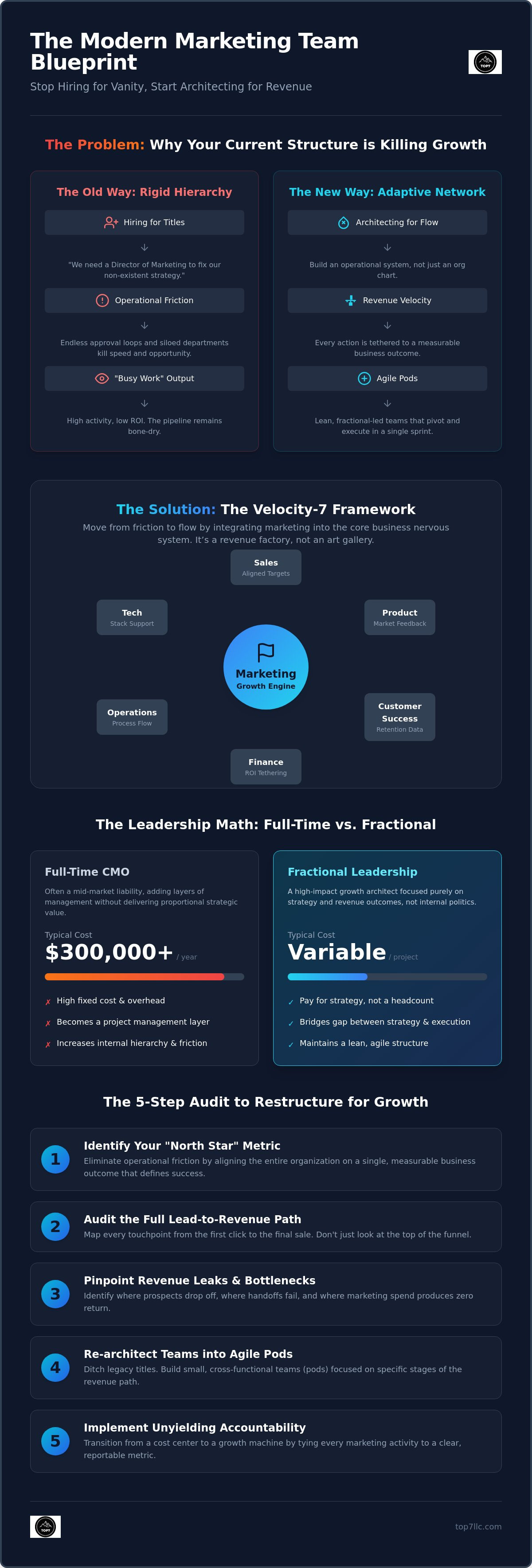
5 Steps to Restructuring Your Team for 2026 Growth
Stop tinkering with your org chart. If your revenue has stalled, you don't need a "tweak" or a new social media manager. You need a total structural rebuild. Most leaders fail because they hire for today's fire instead of tomorrow's scale. If you want to know how to structure a marketing team for growth, you must follow a precision-engineered sequence that prioritizes revenue over comfort. This isn't a suggestion; it's a survival guide for the 2026 market where AI-driven efficiency has made bloated teams obsolete.
Step 1: Audit for Friction. You can't fix what you haven't measured. Identify exactly where your revenue leaks are happening. Is it the lead handoff? Is it the content bottleneck? Find the friction and kill it.
Step 2: Define the 'North Star' Metric. Ditch the vanity metrics. Your team needs one singular growth goal, like Pipeline Velocity or CAC-to-LTV ratio. If an activity doesn't move this number, stop doing it.
Step 3: Deploy Fractional Leadership. Insert a strategic "brain" to lead your existing "muscles." A Fractional CMO provides the Tier-1 experience you need to architect the system without the $500k payroll drag.
Step 4: Adopt the Velocity-7 Framework. Standardize your execution rhythm. Move from chaotic "random acts of marketing" to a disciplined, dimension-based growth engine.
Step 5: Optimize and Automate. Use a Fractional CTO to scale your human efforts. If a machine can do it, a human shouldn't be touching it.
Conducting an Organizational Audit
You need to be kíméletlenül őszinte during this phase. Ask your team: "What is the single biggest obstacle preventing you from doubling your output?" and "Where does our data go to die?" You'll likely find that the Sales-Marketing handoff is a disaster zone of manual entries and missed follow-ups. A successful transformation follows a compressed 90-day trajectory: 30 days for the friction audit, 30 days for framework deployment, and 30 days to achieve full operational flow. If you aren't seeing measurable shifts in 90 days, you aren't restructuring; you're just moving chairs on the Titanic.
Building the 'Pod' Structure
Ditch the "Department" model. It creates silos and breeds politics. Instead, move to Growth Pods focused on specific customer segments or revenue streams. A pod is a hybrid strike team: your internal core talent, led by Top7's Fractional Leadership, augmented by specialist agencies for specific execution tasks. This model ensures total accountability through clear, agile-based KPIs. When everyone in the pod is responsible for the same North Star metric, the internal friction disappears and the revenue starts to flow. If your current team structure feels heavy and slow, it's because you're still building for 2019 while your competitors are architecting for 2026.
Ready to stop the payroll bleed and start architecting for revenue? Schedule a Strategic Planning session to see how the Velocity-7 framework fits your specific business model.
Beyond the Org Chart: Execution with Top7’s Fractional Leadership
Structure is just a drawing on a whiteboard. You can spend weeks obsessing over how to structure a marketing team for growth, but if you don't have the seasoned execution to back it up, you've just created a prettier version of a failing system. Growth isn't a byproduct of a nice org chart. It's the result of a high-performance engine where strategy and technology are fused at the core. At Top7, we don't just hand you a blueprint and wish you luck. We embed our experts directly into your operations to ensure the Velocity-7 Adaptive Framework actually takes root and produces measurable ROI.
In 2026, marketing is a technical discipline. If your Fractional CMO isn't in constant, high-speed alignment with a Fractional CTO, you're building on sand. This collaboration ensures that your data pipelines, automation stacks, and customer journeys are built for scale, not just for show. Stop building isolated departments that talk past each other. Start building a unified growth engine where every technical decision serves a marketing goal and every marketing campaign is backed by robust technical execution.
The Top7 Advantage: From Strategy to Flow
Our seasoned professionals don't sit on the sidelines. We solve complex problems by embedding directly within your team, bringing a level of expertise that mid-market companies usually can't afford on a full-time basis. The Velocity-7 difference lies in our ability to apply agile-based transformation to traditionally rigid, non-tech roles. We break the silos between marketing, sales, and operations to create a singular, focused path to revenue. Schedule a call with a Top7 Executive to audit your growth potential and see exactly where your structure is failing you.
Ready for Action: Your 90-Day Transformation
You don't have months to wait for results. In the first 30 days of a fractional engagement, we conduct a kíméletlenül őszinte audit to identify the friction points killing your ROI. By day 60, we've deployed the framework and begun standardizing your execution rhythm. By day 90, your organization has moved from operational friction to efficient flow. We replace the "busy work" with high-impact sprints that show you exactly how to structure a marketing team for growth through real-world execution rather than theoretical slides. Growth isn't a roll of the dice or a stroke of luck. It's a deliberate choice of structure and execution. Stop gambling with your payroll and start architecting for profit.
Stop Hiring Titles and Start Architecting Revenue
Your org chart is either an engine or a bottleneck. If you've spent the last year watching your marketing payroll climb while your revenue stays flat, the problem isn't your talent; it's your architecture. You've now seen how to structure a marketing team for growth by ditching rigid hierarchies in favor of agile pods and fractional leadership. Growth in 2026 requires a lean, tech-enabled system that prioritizes throughput over headcount. It's about moving from a collection of "doers" to a synchronized revenue machine led by strategic architects.
Top7 provides the seasoned C-suite veterans you need to bridge the gap between high-level strategy and daily execution. We don't send junior consultants to learn on your dime. Instead, we embed experts across major hubs like Boston, Chicago, and Dallas who use our proprietary Velocity-7 Adaptive Framework to eliminate operational friction. You can continue to pay for "busy-ness" or you can start paying for results. The choice to scale is yours, but it starts with a kíméletlenül őszinte look at your current structure.
Ready to remove the friction? Get a Fractional Executive Audit from Top7.
Your market share won't wait for you to fix a broken system. Let's build a structure that actually wins.
Frequently Asked Questions
What is the best marketing team structure for a mid-market company?
The most effective structure for a mid-market company is an adaptive, pod-based network rather than a traditional functional hierarchy. You must align your talent around specific revenue streams or customer segments to eliminate the silos that strangle speed. This model focuses on how to structure a marketing team for growth by ensuring every role has a direct, measurable line of sight to a revenue metric.
How do I know if I need a Fractional CMO or a full-time hire?
You need a Fractional CMO when your current team is busy but your revenue is stagnant. If you are facing a $500,000 total compensation package for a full-time hire but only need twenty hours of elite strategy per month, the fractional model is the only logical business decision. It is about buying the strategic brain and the result, not the expensive headcount and the overhead.
What are the common signs of operational friction in a marketing team?
Operational friction shows up as slow approval loops and constant finger-pointing between Sales and Marketing teams. If your marketing department is hitting "activity" targets like social posts or email sends but your pipeline remains empty, your structure is fundamentally broken. You are currently paying for motion instead of progress, which is a fast way to lose market share.
How does the Velocity-7 framework differ from traditional consulting?
Traditional consulting leaves you with a strategy deck and a bill; the Velocity-7 Adaptive Framework leaves you with an embedded leadership engine. We don't just tell you what is wrong with your business. We embed C-suite veterans directly into your team to execute the transformation and manage the change. It is the difference between receiving a map and hiring a driver who has already been to the destination.
Can a Fractional CMO work with my existing marketing agency?
A Fractional CMO is often the best thing that can happen to your agency relationship. We act as the strategic architect, managing external vendors to ensure their creative output aligns strictly with your profit goals. We hold agencies accountable for real-world ROI rather than letting them hide behind vanity metrics like "brand awareness" or "engagement."
How long does it take to restructure a marketing team for growth?
A full restructuring takes approximately 90 days to achieve total operational flow. We spend the first 30 days auditing for friction, the next 30 days deploying the Velocity-7 framework, and the final 30 days optimizing the execution rhythm. Speed is a competitive advantage in 2026. We don't believe in multi-year "transformations" that never actually end.
What is the role of a Fractional CTO in marketing team structure?
A Fractional CTO ensures your marketing tech stack actually supports your growth instead of creating more manual work for your team. They automate the lead-to-revenue path and integrate data flows between siloed departments. Without technical leadership at the core, your marketing structure is just a collection of disconnected tools and wasted data.
Does Top7 provide interim leadership during a CEO transition?
Top7 provides comprehensive Interim Leadership, including Fractional CEO and Fractional CFO roles, to stabilize organizations during executive transitions. We maintain strategic momentum so your growth doesn't stall while you search for long-term hires. We don't just fill a seat; we protect your market position and ensure the revenue engine keeps humming.


Comments