

How to Get the Most from a Fractional Engagement: The CEO’s Guide to C-Suite ROI
- Robert Fitzgerald
- 3 days ago
- 11 min read

Why are you paying a premium for a "strategic" leader who spends their time fixing basic spreadsheets? Most CEOs treat fractional hires like luxury consultants, then wonder why the needle doesn't move. If your high-tier talent is stuck on low-tier tasks, you aren't leading; you're burning cash. Knowing how to get the most from a fractional engagement isn't about luck. It's about building a system where expertise can actually execute.
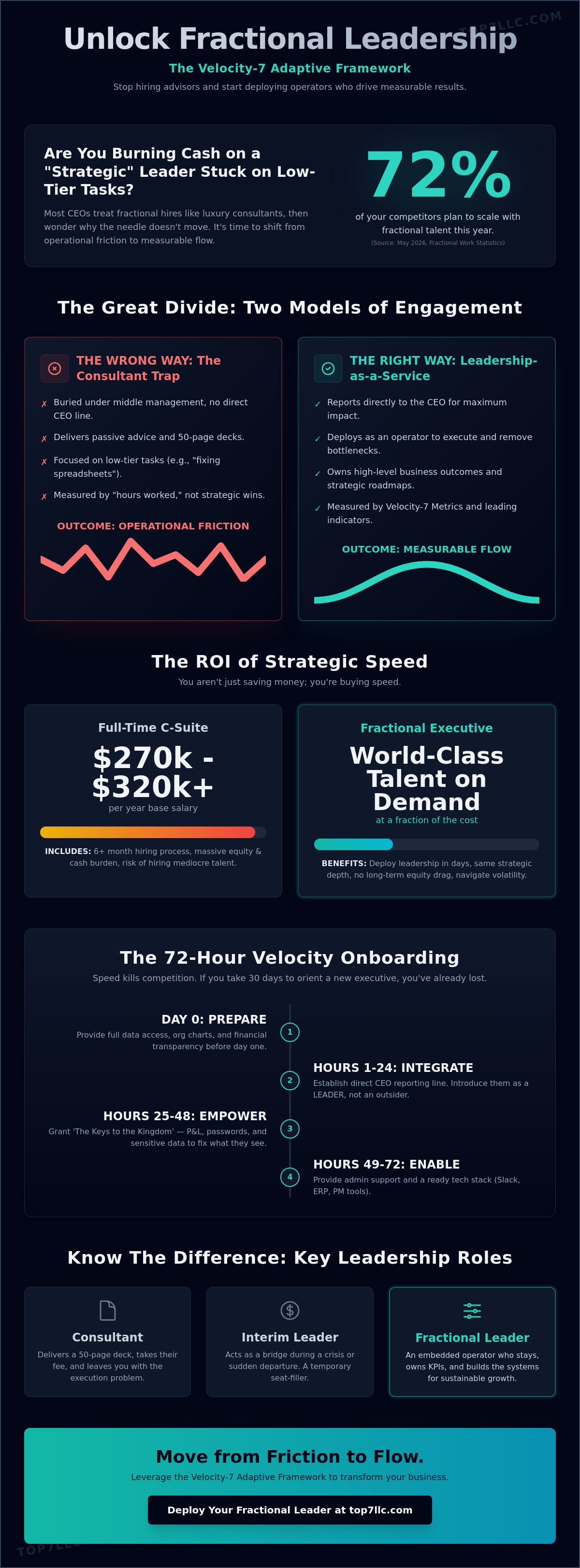
You feel the friction. Your staff is defensive. Your ROI is a question mark. It's a common trap, but 72% of your competitors are already planning to scale with fractional talent this year according to May 2026 data from Fractional Work Statistics. You can't afford to get this wrong. We're moving past the "advisor" phase and into the era of Leadership-as-a-Service.
This guide breaks down the exact framework to integrate and scale with fractional executives using our Velocity-7 Adaptive Framework. We'll show you how to move from operational friction to measurable flow. Stop hiring advisors. Start deploying operators.
Key Takeaways
Stop hiring part-time "task-doers" and start integrating strategy-drivers who are accountable for specific, high-level business outcomes.
Master the 72-hour onboarding protocol to learn how to get the most from a fractional engagement by establishing direct CEO reporting lines from day one.
Replace useless "hours worked" reports with the Velocity-7 Metric Framework to focus exclusively on leading indicators and strategic wins.
Eliminate the "consultant trap" by empowering fractional operators to make decisions and remove bottlenecks rather than just offering passive advice.
Leverage the Velocity-7 Adaptive Framework to transform operational friction into a scalable engine for mid-market growth and profit.
Table of Contents
What is a Fractional Engagement (And Why Most CEOs Get It Wrong)?
Most CEOs treat fractional hires like expensive freelancers. It's a fatal mistake that leaks profit every single day. A true fractional engagement is about high-level strategic leadership, not just filling a seat for twenty hours a week. If you're hiring a Fractional CFO just to balance books, you're failing. You need a strategy-driver who owns the financial roadmap, not a task-doer who waits for instructions. If you want to understand how to get the most from a fractional engagement, you must stop viewing these leaders as outside help and start viewing them as internal engines.
To better understand this concept, watch this helpful video on the fractional model's structure and earning power:
The math is simple. A full-time C-suite executive in 2026 costs between $270,000 and $320,000 when you factor in benefits and taxes. For mid-market companies, that's a massive equity and cash burden that often leads to hiring too late or settling for mediocre talent. A Fractional executive is an operator, not a spectator. They provide the same strategic depth as a full-time hire but without the $300k+ base salary and the long-term equity drag. When you learn how to get the most from a fractional engagement, you aren't just saving money; you're buying speed.
Fractional vs. Interim vs. Consulting: Know the Difference
Don't confuse these roles or you'll sabotage your ROI. Interim leaders are the bridge during a crisis or a sudden departure. Consultants give you a 50-page deck, take their fee, and leave you to figure out the execution. Fractional leaders stay. They are embedded in your culture, they own the KPIs, and they report directly to you. They don't just advise on the plan; they build the team and the systems to make that plan a reality.
The ROI of Strategic Speed in the US Mid-Market
In hyper-competitive hubs like Boston or Chicago, waiting six months to find a permanent hire is business suicide. Mid-market firms fail because they hire too late and get stuck in "Operational Friction." Our Velocity-7 Adaptive Framework turns that friction into flow by deploying leadership in days. The Fractional Advantage in 2026 is the ability to rent world-class strategic brains to navigate volatility without the permanent overhead of a legacy C-suite.
The 72-Hour Onboarding: How to Embed a Fractional Leader at Velocity
Speed kills competition. If you take thirty days to "orient" a new executive, you've already lost. High-velocity onboarding isn't a luxury; it's the baseline for survival. To understand how to get the most from a fractional engagement, you have to realize that "Day One" actually starts a week before they sign on. We call this Day Zero. You need data access, org charts, and full financial transparency ready to go. If your new leader spends their first week hunting for a Slack login, you're burning capital for no reason.
Hierarchy dictates impact. A fractional executive is not a vendor. If you bury a Fractional CTO under a VP of Operations, you've just hired an expensive developer. They must report directly to the CEO. This Direct Line ensures that strategic decisions aren't filtered through middle management egos or operational bottlenecks. Introduce them to the team as a leader, not an outsider. If the staff thinks they're just a temporary consultant, they'll ignore the directives and wait for the engagement to end. Establish a communication cadence immediately. Slack for daily tactical moves, weekly syncs for progress, and monthly deep dives for strategic pivots.
Granting 'The Keys to the Kingdom'
You can't fix what you can't see. Withholding sensitive data out of misplaced security concerns is a recipe for failure. Give them the passwords. Give them the P&L. Maximize their high-value hours by providing administrative support for scheduling and basic coordination. Your tech stack must be ready. Slack channels, ERP access, and project management seats should be live before their first cup of coffee. Anything less is just amateur hour.
The Velocity-7 Integration Audit
The first 72 hours are for hunting bottlenecks. Using our Velocity-7 Adaptive Framework, a fractional leader performs a deep-dive audit across the seven dimensions of growth. A Fractional CTO should identify tech-debt within three days, not three months. By the end of the first week, you should have a 90-day roadmap in your hands. If you're still "figuring things out" in week four, you've already failed. Demand a roadmap before the first month's retainer is even processed. That is how to get the most from a fractional engagement without wasting time on pleasantries.
Defining Success: KPIs and the Velocity-7 Metric Framework
Stop counting hours. If your primary metric for a fractional executive is a timesheet, you aren't running a business; you're managing a shift at a coffee shop. At the C-suite level, time is irrelevant. Outcomes are everything. Learning how to get the most from a fractional engagement requires a radical shift from tracking presence to measuring performance. You don't pay for forty hours of work. You pay for the strategic leverage that prevents a million-dollar mistake or unlocks a ten-million-dollar opportunity.
Leading indicators are your heartbeat. For a Fractional CMO, this isn't just about "brand awareness." It's about pipeline volume and cost per lead. For a Fractional CRO, it's about win rates and sales cycle velocity. Lagging indicators like quarterly revenue are merely the autopsy of past decisions. Our Velocity-7 Adaptive Framework identifies profit leaks in real-time. Monthly audits must replace annual reviews. If a fractional leader isn't moving the needle every thirty days, they are just another line item on your overhead.
Setting Hard Targets for Fractional Leaders
Each role needs a kill-switch metric. If they don't hit it, the engagement is failing. You need operators who own the following targets:
Fractional CFO: Focus on cash conversion cycles, forecast accuracy, and EBITDA growth. They should be finding money, not just counting it.
Fractional COO: Measure the reduction in operational cycle time. Their job is to eliminate the friction that slows your team down.
Fractional CTO: Track platform uptime, security compliance, and product delivery speed. They turn technical debt into technical equity.
The 'Velocity Score': A Proprietary Top7 Metric
Most organizations are busy, but very few are fast. There's a difference. The Velocity Score determines if your team is actually moving toward a goal or just spinning wheels in a Slack channel. The Velocity-7 framework quantifies C-suite impact by measuring the rate of successful strategic execution against your 90-day roadmap. This eliminates the "Consultant Trap" by tying the engagement to measurable transformation phases rather than a never-ending retainer. You win when the system works without constant intervention. That is how to get the most from a fractional engagement. You buy the result, not the clock.
Avoiding the 'Consultant Trap': Maintaining Strategic Momentum
The biggest excuse CEOs make for failing engagements is the claim that "they aren't here enough to understand our nuances." It's a lie. Nuance is usually just a polite word for undocumented chaos. If your business depends on a leader being physically present forty hours a week to "get it," your systems are already broken. To master how to get the most from a fractional engagement, you must demand systems, not presence. A fractional leader shouldn't be a bottleneck for every minor decision. Their job is to build the framework so your full-time team can execute without them.
Middle management often views fractional executives as "part-time outsiders." This stigma kills momentum. You must frame them as elite specialists brought in to win a specific war. If your staff thinks they can wait out the clock, you've failed to set the tone from the top. Use Advanced Project Management to ensure that strategic initiatives move forward even when the executive is off-clock. Momentum isn't about hours; it's about the velocity of the system they leave behind.
The 'Inside-Out' Leadership Philosophy
The best fractional executives are mentors who eventually train their own full-time replacement. They don't hoard knowledge; they document it. If your leader is the only one who knows how the engine works, they've built a cage, not a system. You also need to distinguish between "Scope Creep" and "Strategic Expansion." Scope creep is doing more low-level tasks. Strategic expansion is using a Fractional CPO to pivot into a new market. One is a waste of money. The other is a multiplier.
Regional Nuances in Executive Leadership
Scaling a business from a Boston headquarters into the Texas market isn't just about changing time zones. The regulatory and financial landscapes of the Northeast require a different tactical approach than the fast-paced energy of Austin or Dallas. A "Philly" mindset is built on grit and directness; it often clashes with a West Coast "soft-launch" culture. A Fractional CRO must understand these regional battlegrounds to be effective. Knowing how to get the most from a fractional engagement means hiring for the specific cultural and legal terrain you intend to conquer, not just a generic title.
The Top7 Advantage: Moving from Friction to Flow
Top7 executives don't participate in consulting theater. We don't trade in vague advice or endless slide decks that gather digital dust. We embed directly into your leadership team and execute on the targets that actually move the needle. If you're tired of expensive advisors who leave before the hard work starts, you're ready for the Top7 advantage. Understanding how to get the most from a fractional engagement begins with our Velocity-7 Adaptive Framework. It's our proprietary engine designed specifically for mid-market growth. We've seen organizations move from total operational chaos to a state of efficient, measurable flow within a single 90-day cycle.
Our approach is built on a 30-day sprint model. We don't spend months "learning the culture." We spend days identifying the friction points and weeks fixing them. Whether you need a Fractional CFO to stabilize your runway or a Fractional CTO to overhaul your delivery pipeline, our goal is the same: result-driven execution. We don't just suggest the path; we clear the obstacles and lead the way.
Why Velocity-7 is the Sustainable Path to Growth
Sustainable growth requires a holistic view of the business. You can't fix sales if your product delivery is broken. You can't scale tech if your financial runway is a mystery. Our framework breaks down your organization into seven critical dimensions: Financial, Sales, Tech, Ops, Product, Marketing, and Leadership. We solve these complex obstacles without adding the permanent payroll weight that sinks mid-market margins. Our professionals are battle-tested. They've led companies through recessions, acquisitions, and rapid-scale phases. They bring that precision to your strategy, ensuring every move is tactical and every dollar is spent on growth.
Ready for Action? Your Next Steps
Stop guessing where your profit is leaking. Your next step is a high-impact Strategic Planning session to identify the bottlenecks holding you back. We don't believe in one-size-fits-all leadership. Top7 matches the right Fractional leader to your specific US region and industry vertical. Whether you're navigating the regulatory hurdles of the Northeast or the aggressive growth pace of the Texas market, we provide the operator who has already won those battles. This is how to get the most from a fractional engagement: you stop hiring for "help" and start hiring for "velocity." Schedule your Velocity-7 Audit today and take the first step toward a friction-free C-suite.
Stop Renting Brains and Start Buying Results
The era of the passive consultant is dead. If you want to win in 2026, you need operators who own the P&L and drive the roadmap. To truly understand how to get the most from a fractional engagement, you must shift your focus from presence to performance. You now have the blueprint for rapid onboarding and the hard KPIs necessary to avoid the consultant trap. Anything less than this level of integration is just a waste of your company's capital.
At Top7, our seasoned professionals bring over 20 years of experience to every engagement. We don't just offer advice; we deploy the Velocity-7 Adaptive Framework to eliminate profit leaks and scale your operations with clinical precision. This is the proven path for US mid-market firms to achieve C-suite dominance without the crushing weight of full-time overhead. Stop settling for part-time help when you can have elite leadership that executes.
Scale your business without the C-suite overhead—Get a Top7 Fractional Executive
The competition isn't waiting for you to get your systems in order. It's time to stop managing chaos and start leading with velocity. Your market share is waiting for a leader who knows how to take it.
Frequently Asked Questions
What is the typical length of a fractional engagement?
Most strategic engagements last between 6 and 18 months. This isn't a three week consulting project; it's a long term commitment to building a specific business function. You're hiring a leader to navigate a growth phase or transition, and that requires enough runway to see the results of their strategic pivots. Once the system is stable, they often help you hire and train their full-time successor.
How many hours a week does a fractional executive actually work?
A fractional leader typically dedicates 5 to 15 hours per week to your organization. If you're focusing on the clock, you're missing the point of how to get the most from a fractional engagement. You aren't paying for presence; you're paying for the 20 years of experience that allows them to solve in two hours what a junior hire couldn't solve in forty. They focus exclusively on high-leverage decisions that move the needle.
Can a fractional CTO manage my existing development team?
Yes, and they should. A Fractional CTO is an operator who takes full accountability for your technical roadmap and the performance of your team. They conduct code audits, identify technical debt, and ensure your developers are working on features that actually drive revenue. They don't just suggest changes; they implement the structure and standards required for professional delivery.
Is a fractional executive cheaper than a full-time hire?
Absolutely. Data from May 2026 shows that fractional engagements can reduce leadership costs by 40% to 60% compared to the total cost of a full-time executive. You eliminate the burden of benefits, payroll taxes, and massive equity grants. You get C-suite expertise at a mid-management price point, allowing you to reinvest those savings into your marketing or product development budgets.
What happens if we need more time from our fractional leader during a crisis?
Most agreements include a surge capacity clause for emergencies or major transitions. Because they are embedded in your team, they don't disappear when things get difficult. If you're in the middle of a merger or a security breach, your Fractional COO or CTO will step up their involvement to navigate the crisis. They are your partners, not just vendors on a fixed schedule.
How do we handle intellectual property and confidentiality in a fractional model?
Confidentiality is handled through standard executive service agreements that protect your trade secrets and ensure you own all work product. Your IP remains 100% yours. These are seasoned professionals who have worked with dozens of firms; their reputation depends on their discretion. They operate under the same legal and ethical standards as any full-time C-suite member you would hire.
Does a fractional executive participate in board meetings?
Yes. A true fractional leader should be present at board meetings to represent their department and defend their strategic decisions. Whether it's a Fractional CFO explaining the cash conversion cycle or a Fractional CMO presenting the pipeline growth, they provide the high-level reporting your investors expect. If they aren't capable of standing in front of your board, they aren't a C-suite executive.
What is the main reason fractional engagements fail?
Failure happens when a CEO treats the leader like a freelancer rather than an executive. If you withhold data, deny them decision making authority, or fail to provide a direct reporting line, you'll never learn how to get the most from a fractional engagement. Success requires total transparency and a willingness to let them lead. If you aren't ready to let an expert fix your systems, don't hire one.



Comments