
Fractional vs. Interim Leadership Roles: Stop Hiring the Wrong Executive for Your Growth Stage

Are you burning through your runway by hiring a full-time executive for a problem that only requires a surgical strike? Most founders mistake a temporary crisis for a permanent need, leading to massive recruitment fees and a $300,000 salary overhead that kills their margins. Understanding the nuances of fractional vs interim leadership roles isn't just an HR exercise; it's a survival tactic for mid-market companies that need Tier-1 expertise without the bloated commitment. You're likely feeling the friction right now because your current leadership structure can't keep up with your execution speed.
I know the frustration of watching operational bottlenecks choke your growth while you wait months for a headhunter to find a candidate who might not even fit. You deserve a leadership engine that scales with your revenue, not one that drags it down. This article breaks down exactly how to stop the bleeding with interim roles and how to build long-term muscle with fractional experts. You'll learn the specific triggers for each hire so you can secure high-level C-suite talent and achieve an efficient operational flow immediately.
Key Takeaways
Stop wasting capital on full-time recruitment for temporary gaps; learn the strategic triggers that define the choice between fractional vs interim leadership roles to protect your margins.
Identify the specific scenarios where interim leadership acts as a high-intensity bridge to stabilize operations and resolve immediate organizational crises.
Access Tier-1 strategic expertise through fractional leadership to drive long-term growth without the burden of a $300k+ executive salary.
Calculate the true ROI of your C-suite and learn how the Velocity-7 Adaptive Framework eliminates operational friction across all growth dimensions.
Shift from passive advice to aggressive execution by leveraging embedded leaders who integrate directly into your workflow to drive measurable profit.
Table of Contents
The Leadership Vacuum: Why Your Hiring Strategy is Stalling Growth
Defining the Roles: Fractional vs. Interim Executive Leadership
The Strategic Breakdown: When to Choose Fractional vs. Interim
Assessing Your Velocity: Evaluating ROI and Growth Dimensions
Top7 Execution: Embedded Leadership That Drives Real Results
The Leadership Vacuum: Why Your Hiring Strategy is Stalling Growth
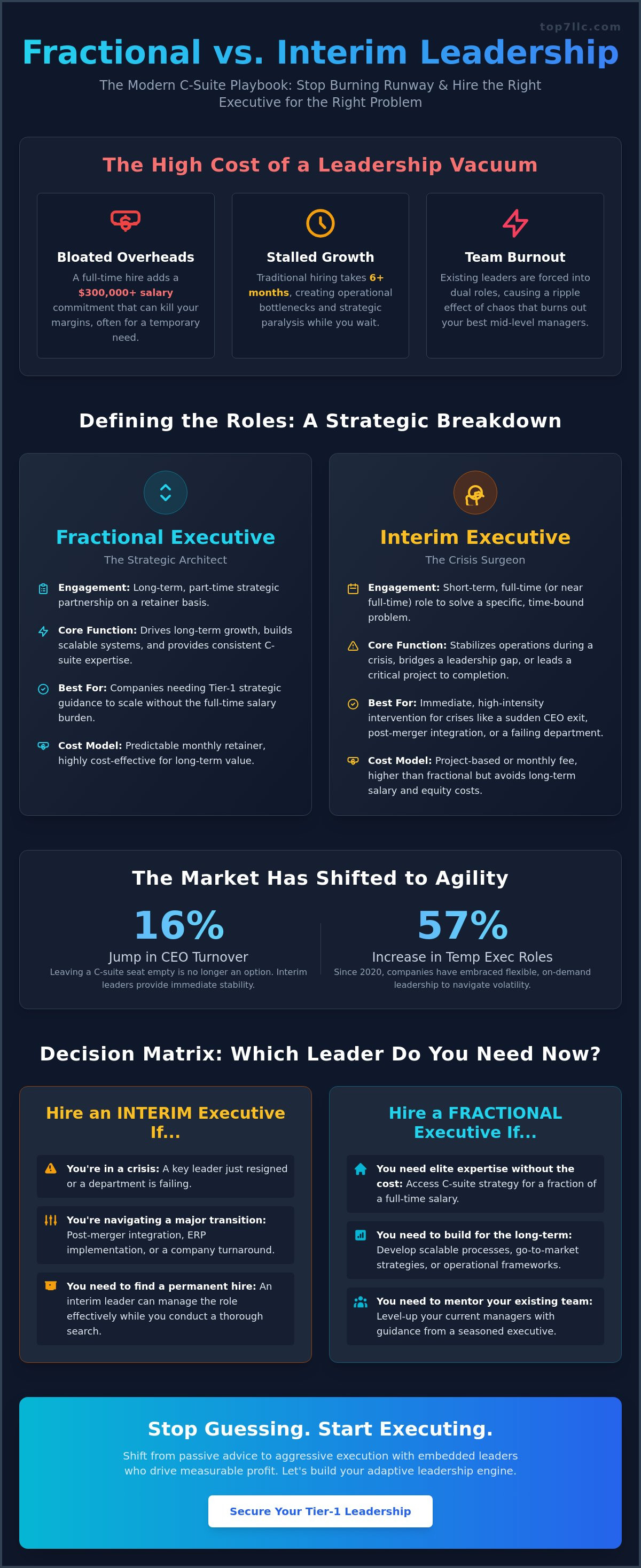
Every day you leave a C-suite seat empty, you’re paying a "stupid tax." In 2025, CEO turnover jumped 16%, with 234 CEOs exiting globally according to Russell Reynolds Associates. For a mid-market firm, this isn’t just a vacancy; it’s strategic paralysis. Traditional executive search firms will charge you 30% of a salary you can’t afford and take six months to find a "culture fit" while your competitors eat your market share. You don’t need a marriage; you need a solution. The "Full-Time or Nothing" myth is a relic of the 20th century that keeps companies stagnant. When weighing fractional vs interim leadership roles, you’re choosing between tactical speed and long-term strategic evolution. Waiting for the perfect full-time hire while your operations redline is a recipe for a terminal crisis.
To better understand the core differences between these high-level placements, watch this breakdown:
Operational friction is the heat generated by a system that’s outgrown its leadership. It shows up as missed deadlines, siloed departments, and a founder who’s stuck fixing technical debt instead of closing deals. Interim management provides the immediate pressure relief needed to stop the bleeding; while fractional roles install the permanent systems for scale. If you can’t identify which one you need, you’re just throwing money at a symptom while the underlying disease kills your growth.
The Executive Burnout Trap
Founders often hit a "ceiling of complexity" where their original hustle no longer scales. Your team is redlining. If your VP of Sales is also acting as the de facto COO, you’ve already lost. This leadership gap creates a ripple effect that burns out mid-level managers who no longer have a clear North Star. Without a dedicated pilot, the plane stays on the tarmac. You aren't just losing time; you're losing your best people to the chaos.
Growth Obstacles in Key US Hubs
In hyper-competitive corridors like Boston or Austin, the talent war is brutal. You’re competing with VC-backed giants for the same elite CTOs and COOs. Regional firms in the Midwest are finally shifting their perspective. They’ve realized they don’t need to relocate a high-priced executive to a secondary market when they can plug in flexible, elite leadership. The 57% increase in temporary executive roles since 2020 proves the market has moved toward agility. The question is: has your hiring strategy moved with it?
Defining the Roles: Fractional vs. Interim Executive Leadership
Stop playing house with your org chart. If you're treating these two roles as interchangeable, you're already losing money. The distinction in fractional vs interim leadership roles isn't just about the hours on a timesheet. It's about the DNA of the engagement. One is a surgeon brought in to fix a specific trauma; the other is a long-term architect building a skyscraper one floor at a time. If you misdiagnose your stage of growth, you'll end up with a part-time strategist trying to put out a five-alarm fire or a full-time crisis manager with nothing to do but micromanage your staff.
Internal stand-ins are the biggest trap for mid-market firms. Promoting your most senior manager to "Acting COO" usually results in a double failure. They lack the C-suite perspective to drive strategy, and their original department collapses while they're distracted by executive duties. You don't need a placeholder. You need a professional who has seen your specific mess ten times before and knows exactly how to clean it up. Choosing between an embedded strategist and an external transition manager determines whether you'll scale or simply tread water.
What is a Fractional Executive?
A fractional executive is a long-term strategic partner who works with you on a retainer basis. They aren't consultants who drop a 50-page PDF and disappear. They're embedded in your team. In high-stakes markets like Chicago and Dallas, growth-stage firms use Fractional CTOs to build strategic roadmaps and mentor junior developers without the $300,000 price tag of a full-time hire. They provide Tier-1 expertise for a fraction of the cost, focusing on long-term ROI and system scalability. They're in the foxhole with you, just not every single hour of the week.
The Role of an Interim Leader
Interim leadership is a full-time, temporary sprint. This is your bridge. Use an interim leader when you've lost an executive unexpectedly or you're undergoing a massive pivot. Their core focus is operational stability. While a permanent COO search can take 180 days, an Interim COO can be on the ground in 72 hours to stabilize the ship. They solve immediate problems, manage the transition, and then hand over a clean, functioning department to your eventual permanent hire. It’s about speed and survival. They're the shock troops you deploy when the mission is clear but the seat is empty.
The Strategic Breakdown: When to Choose Fractional vs. Interim
Choosing between fractional vs interim leadership roles isn't a matter of preference; it's a matter of objective business requirements. Stop looking at your budget and start looking at your bottleneck. If your house is on fire, you don't hire an architect to plan a renovation. You hire a firefighter to save the structure. Conversely, if you're building a second story, you don't need a firefighter standing by 40 hours a week. You need the architect's vision and precision on a consistent, part-time basis. Deployment is a tactical decision. Get it wrong, and you'll either overpay for idle time or under-equip for a crisis.
Scenario A: The Operational Mess (Interim). Your head of operations walked out, or your supply chain just collapsed. You need 50 hours a week of raw executive power to stabilize the chaos. An interim leader is the right choice here because they provide immediate, full-time bandwidth to stop the bleeding.
Scenario B: The Growth Ceiling (Fractional). You're doing $20M in revenue and your "tech guy" can't lead a team of fifteen developers. You need a CTO's brain to build a roadmap, but you don't need them sitting in a chair 40 hours a week. A fractional leader gives you that Tier-1 strategy for 15 hours a week at a fraction of the cost.
Scenario C: The Exit or Funding Round. Investors smell blood when leadership is thin. Bringing in a fractional CFO or CRO six months before a round ensures your data is clean, your pipeline is real, and your valuation is protected.
Execution is the only currency that matters in a growth-stage company. Most firms hire "consultants" who deliver a slide deck and a bill. That is a waste of capital. Whether you choose a fractional or interim path, the executive must be embedded in your workflow. They must own KPIs, manage teams, and make hard calls. If they aren't willing to get their hands dirty in your CRM or project management tools, they aren't leaders; they're just expensive commentators.
Duration and Scope Comparison
The math is simple. Fractional roles typically demand 10 to 20 hours per week of high-level strategic oversight and team mentoring. Interim roles are a full-tilt, 40+ hour commitment designed to fill a vacuum. An interim leader is the bridge that gets you across a chasm, while a fractional leader is the pillar that supports your permanent structure as you build higher. In both models, accountability is non-negotiable. They own the results, not just the hours.
Impact on Company Culture
Interim leaders are often viewed as "placeholders," which can cause anxiety in mid-level management. A professional interim executive neutralizes this by focusing on stability and transparency from day one. Fractional leaders have a different advantage. Because they are seen as long-term strategic partners, they can build culture and mentor talent without the friction of being a full-time "boss." They provide the authority of the C-suite with the agility of an external expert, keeping your team focused on execution rather than office politics.
Assessing Your Velocity: Evaluating ROI and Growth Dimensions
Leadership isn't a line item on your P&L; it's the engine that determines your terminal velocity. If you're still viewing executive hiring as a "staffing choice," you've already lost the competitive edge. In the high-stakes debate of fractional vs interim leadership roles, the only metric that matters is the speed at which you move from operational friction to efficient flow. Cheap leadership is a trap. Hiring a "consultant" who provides advice without execution is the most expensive mistake a growth-stage company can make. Real ROI comes from embedded expertise that pays for itself through system optimization and revenue acceleration.
The math is brutal and undeniable. A full-time C-suite executive often demands a $300,000+ base salary before you even consider bonuses, equity, and benefits. Industry data from 2026 shows that fractional executive engagements typically cost 40% to 60% less than a full-time VP, with typical monthly costs ranging from $7,500 to $25,000. You aren't just saving on overhead. You're buying back the time your current team wastes on trial-and-error. Our Velocity-7 Adaptive Framework solves for the seven dimensions of growth by injecting Tier-1 talent exactly where the friction is highest, ensuring your capital is deployed for maximum impact rather than just filling a chair.
Growth Stage Analysis
Your needs shift as you scale. Early-stage companies often hit a technical or marketing wall that requires a Fractional CTO or CMO to build a scalable foundation. When a mid-market firm needs to execute a massive pivot or navigate a leadership vacuum, an Interim CEO provides the full-time intensity required to shift the organization's trajectory. If you're preparing for M&A or a major funding round, a Fractional CFO is non-negotiable. They plug the financial leaks and professionalize your reporting to protect your valuation before investors start their due diligence.
Measuring Execution Success
Execution must be measurable. You shouldn't wait six months to see if a hire worked. For fractional roles, look beyond the strategic roadmap. Are they mentoring your mid-level managers? Are they hitting the KPIs defined in the first 30 days? In specialized roles like a Fractional CPO, industry benchmarks now expect a 3x to 4x ROI within the first 90 days. Interim success is defined by stability and search support. A successful interim leader leaves the department better than they found it, having stabilized operations and helped vet the permanent successor. If you don't see a shift in operational flow within one quarter, you've hired the wrong person for your growth stage.
Top7 Execution: Embedded Leadership That Drives Real Results
Stop treating your C-suite like a temp agency. Most firms offering fractional or interim talent are nothing more than glorified databases. They provide "access" to a resume and then leave you to manage the integration. That is a recipe for failure. At Top7, we don't just fill seats. We embed Tier-1 leadership directly into your organizational marrow. Whether you are navigating the nuances of fractional vs interim leadership roles, the objective remains the same: total operational dominance. We focus on execution support because a brilliant strategy is worthless if your team lacks the discipline to ship it. We don't deliver slide decks; we deliver results.
Our Fractional CTO, COO, and CEO roles are designed for the high-intensity environment of the mid-market. We understand that a $50M company has different friction points than a Silicon Valley startup. You don't need a "consultant" to tell you what's wrong. You already know what's wrong. You need an executive who can walk into the foxhole, identify the tactical failures, and rebuild the system in real-time. This is why our model is built on accountability. We own the KPIs. We manage the teams. We drive the profit.
The Velocity-7 Adaptive Framework
The path from operational friction to efficient flow isn't found in a textbook. It's built through our proprietary Velocity-7 Adaptive Framework. This is an agile-based transformation engine that moves organizations from stagnation to peak performance. We audit the seven critical dimensions of your business: Strategy, Operations, Technology, Finance, Revenue, Product, and People. Our framework adapts to your specific market speed. A firm in the fast-paced tech hub of Boston requires a different execution rhythm than a scaling enterprise in Florida. We solve for the bottlenecks that are unique to your geography and industry, ensuring your growth is never stalled by outdated dogmas.
Getting Started with Top7
Growth is a kőkemény küzdelem, and you cannot win with a hollow C-suite. The first step is our deep-dive Organizational Audit. We don't look at your surface-level metrics; we look at the structural gaps that are leaking capital. From there, we build a customized leadership roadmap that dictates exactly when to deploy fractional expertise and when an interim bridge is necessary. Whether you're in the Midwest or the East Coast, we provide the strategic superiority you need to crush the competition. Don't let another quarter slip away in a leadership vacuum. Schedule your Strategic Audit with a Top7 Executive and start building your body for scale today.
Secure Your C-Suite for Peak Performance
The choice between fractional vs interim leadership roles determines whether you'll lead your market or simply react to it. You now understand that hiring a full-time executive isn't always the answer; it's often a financial anchor that slows your momentum. Real growth requires the agility to plug in Tier-1 talent exactly when and where it's needed. Top7 doesn't just offer advice; we provide the execution-focused leadership required to transform mid-market firms. Our Velocity-7 Adaptive Framework is the engine that moves your company from friction to flow by embedding seasoned C-suite professionals directly into your operations.
Stop letting leadership gaps stall your progress and start deploying expertise that pays for itself through measurable results. We have a proven track record in mid-market growth transformation, and we're ready to audit your current structure to find the hidden bottlenecks. You don't need another consultant; you need a partner who owns the outcome. Stop the friction. Get the leadership you need; Schedule a Call with Top7. Your business is ready for the next level; it's time to hire the leadership that can actually take you there.
Frequently Asked Questions
What is the main difference between fractional and interim leadership?
The primary difference lies in the commitment and objective of the engagement. Fractional leadership provides ongoing, part-time strategic oversight, whereas interim roles offer full-time, temporary intensity to bridge a gap or manage a crisis. You choose fractional for long-term growth and interim for immediate stabilization. It is the difference between an architect and a firefighter. Both are elite, but they serve different tactical needs in your growth stage.
Is a fractional executive cheaper than a full-time hire?
Yes, fractional executives are significantly more cost-effective than full-time hires. By eliminating $300,000+ base salaries and heavy equity packages, companies typically reduce executive overhead by 40% to 60%. You pay for Tier-1 expertise without the bloated benefits and recruitment fees. It is about capital efficiency. You get the strategic brain of a global-scale leader for the price of a mid-level manager.
How long does a typical fractional leadership engagement last?
Fractional engagements are typically ongoing and last between six months and two years. Unlike interim roles that end once a permanent hire is found, fractional leaders stay embedded until the company reaches a specific revenue milestone or maturity level. They provide the strategic pillar your organization needs as you scale. The duration depends on your growth velocity and how fast your internal team matures under their mentorship.
Can a fractional leader manage a full-time team effectively?
Absolutely, provided they focus on systems rather than micromanagement. A fractional leader manages a full-time team by setting high-level KPIs, establishing clear workflows, and mentoring direct reports. They don't need to be in the office 40 hours a week to drive results. Effective management is about clarity and accountability, not physical presence. They build the machine that runs even when they aren't in the room.
When should a company hire an interim leader instead of a consultant?
Hire an interim leader when you need someone to actually run the department, not just talk about it. Consultants deliver recommendations and leave the implementation to you. Interim executives take the wheel. They own the P&L, manage the staff, and make the hard firing decisions. If you have a leadership vacuum, a consultant is a waste of money. You need a professional who operates within your structure.
What C-suite roles can be filled by fractional leaders?
You can fill almost any C-suite position with fractional talent. Top7 specializes in Fractional CTO, COO, CEO, CFO, CPO, CMO, and CRO roles. Whether you need a revenue engine built by a CRO or a technical roadmap designed by a CTO, these roles provide the specific expertise required for mid-market intensity. Don't settle for a generalist when you can have a specialist who has mastered your specific operational gap.
Does Top7 provide fractional leadership in specific cities like Boston or Chicago?
Yes, Top7 operates across major US hubs including Boston, Chicago, Dallas, and Florida. We understand that market speeds vary by region. A scaling firm in Austin has different competitive pressures than a legacy manufacturer in the Midwest. Our leadership roadmaps are customized to your specific geography. We provide the strategic superiority necessary to dominate your local market while leveraging global-scale executive experience.
How does the Velocity-7 framework improve executive execution?
The Velocity-7 Adaptive Framework improves execution by auditing the seven critical dimensions of your business to identify stalled growth. It moves organizations from operational friction to efficient flow using an agile-based transformation model. We don't guess where the problems are. We use a data-driven approach to inject leadership where it has the highest impact. It turns strategy from a static document into a living, breathing execution engine.



Comments