
Fractional COO for Remote Teams: Build an Executive Team That Executes

More video calls won’t fix a leadership team that can’t agree on priorities or name an owner. If decisions drift across time zones and meetings end without clear commitments, the problem isn’t remote work. It’s how the team operates. A fractional COO for remote teams helps turn scattered leadership effort into coordinated execution.
Remote leaders need visibility and accountability, but adding meetings and process can create more noise instead of more progress. A dependable operating rhythm gives teams clear priorities, explicit ownership, and decisions that move work forward.
This article explains how an embedded fractional COO can help your executive team align priorities, make decisions, and follow through without filling the calendar with calls. You’ll see how stronger communication habits and practical operating systems make commitments and progress easier to track, while clarifying who owns what. We’ll also explore how Top7’s Velocity-7 Adaptive Framework helps move teams from operational friction toward efficient flow. The goal isn’t leadership theory. It’s consistent execution you can assess.
Table of Contents
Why Remote Executive Teams Need More Than Better Meetings
When priorities are unclear, remote executive teams lose time in small but costly ways. A decision waits for clarification. A commitment slips because nobody owns the next step. Functional leaders push their own goals while company-wide work stalls. Across locations, these gaps can compound until leaders spend more time coordinating than executing.
More video calls won’t fix unclear authority, competing goals, or weak follow-through. Remote executive-team development means improving how leaders make decisions and work together, not just building individual skills. A fractional COO for remote teams can help develop those shared habits within the company’s real operating work. The COO role centers on overseeing operations and connecting business priorities to execution; a fractional leader brings that operating focus on a part-time basis. Learn more about the role of a Chief Operating Officer.
For a practical overview of the role, watch this video:
How operational friction shows up in remote leadership
Look at what happens after a leadership decision. If the same issue keeps returning because no one recorded the owner, deadline, or next step, the team hasn’t resolved it. It has only discussed it. That creates delay and makes accountability depend on who remembers the conversation.
Friction also appears when each function optimizes its own targets at the expense of shared outcomes. Busy chat channels and packed meeting calendars can create the feeling of visibility without showing which decisions are final, where risks sit, or whether commitments are on track. Distributed teams perform when decision rights are clear and ownership is visible.
What leadership development should change
Development should lead to observable behavior: leaders delegate with clear authority, escalate risks before they become blockers, make decisions at the right level, and follow through on commitments. These habits matter most when the team is handling live priorities, not discussing leadership in the abstract.
Start with the operating problem. Are decisions stuck between functions? Are risks raised too late? Do commitments lose momentum after meetings? Connect development goals to those patterns, then practice new ways of working on current business priorities. Stronger remote leadership is built through real work, where progress and ownership can be seen.
How a Fractional COO Develops a Remote Executive Team
A fractional COO is a part-time senior operator who works with a company to lead operations and strengthen execution. For a distributed leadership team, the role goes beyond offering advice: an embedded operator connects leadership development to the decisions, workflows, and business priorities leaders handle every day.
Fractional COO support develops remote leaders by building shared operating habits into the work, not by adding another layer of theory. A one-off workshop may introduce useful ideas, but it won’t establish how leaders delegate, resolve blockers, or make decisions together under pressure. Those behaviors develop through repeated practice, feedback, and review.
Build trust and influence across a distributed team
Trust grows when leaders can raise problems early and understand how decisions are made. Consistent one-to-ones give the COO a place to surface blockers, unclear ownership, and support needs without turning every concern into a group meeting. They also help reveal whether a recurring delay is an individual challenge or a gap in the team’s operating system.
Make decision context visible. A shared record can capture the decision, its owner, the next step, and the deadline, so leaders in different locations can act without reconstructing the conversation. Research on the essential skills for remote leadership also highlights the importance of communication and team cohesion. Model both through direct, timely updates and clear follow-through, not a heavier meeting schedule.
Turn coaching into operational habits
Use live planning and review sessions to practice the behaviors the team needs. A leader can delegate a cross-functional commitment with clear authority, identify when an issue needs escalation, and report progress against an agreed outcome. The COO can then give specific feedback: Was the decision made at the right level? Did the owner flag risk early? Did the team follow through?
Connect feedback to actual business commitments, not abstract competency lists. Revisit the same behaviors as work progresses, so the team can see whether a new habit is taking hold and where the process still creates friction.
Top7’s Velocity-7 Adaptive Framework provides an approach to addressing operational friction and improving flow. Its embedded fractional leadership connects strategic guidance with execution support, helping teams work through practical operating challenges. Learn more about Top7’s fractional COO support.
Fractional COO, Leadership Training, or Consultant: Which Fits?
Choose based on the gap you need to close. Is it a specific leadership skill, a decision that needs expert input, or an ongoing execution problem spanning multiple functions? Training, consulting, and fractional leadership serve different purposes. The right fit depends on your team’s needs.
When leadership training is the right starting point
Training can be a strong fit when the gap is specific and teachable, such as giving clearer feedback or delegating effectively. Define what leaders should be able to do after the training, then give them real opportunities to practice. For a remote team, connect that practice to shared goals and regular reviews. Leaders can make commitments visible, discuss what they tried, and get support applying the skill. Without reinforcement, new knowledge may not change daily routines.
When an advisor or embedded leader adds value
An advisor can be enough when the challenge is bounded and the company has the capacity to act on a clear recommendation. For example, leaders may need an outside perspective on a process before deciding how to change it. But recurring delays across functions, unclear handoffs, or priorities that require sustained coordination call for more than a recommendation. They need ongoing attention and ownership within the work.
A fractional COO for remote teams can combine leadership coaching with operational execution, helping leaders set priorities, coordinate across functions, and build discipline around decisions and commitments. The value is continuity and team-wide application, not simply another source of advice. Before choosing, name the problem, identify who will own implementation, and decide how you’ll recognize progress. If embedded operational leadership fits that need, explore Top7’s fractional leadership approach.
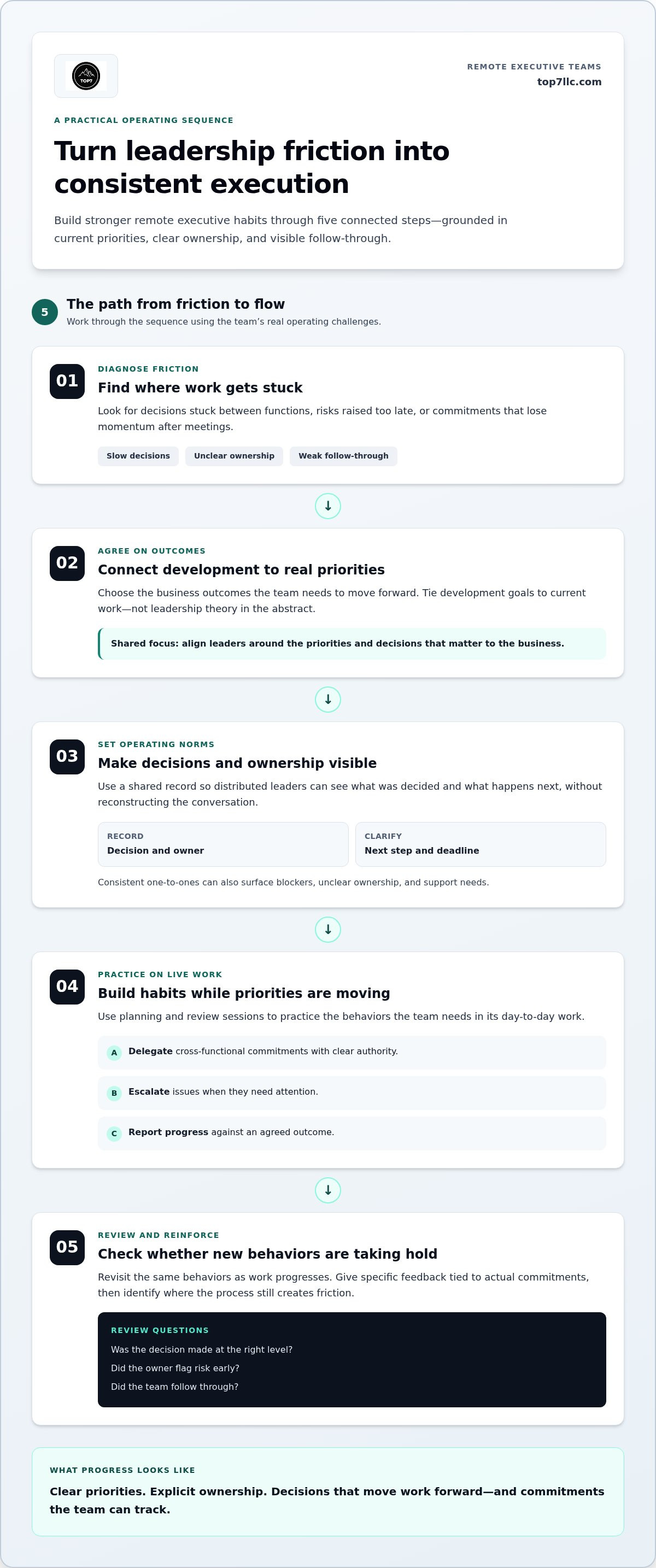
How to Develop Remote Executive Leadership in Practical Steps
Turn leadership development into an operating process. Keep it lightweight enough to fit your team’s size, priorities, and existing communication tools. The aim isn’t to build another system to maintain. It’s to make responsibilities, decisions, and progress easier to see.
Diagnose the friction. Identify where work stalls: decisions that wait for approval, handoffs that break between functions, or commitments that repeatedly slip. Use recent examples rather than guessing what the team needs.
Agree on team outcomes. Choose the shared business priorities leaders must advance together. Define what progress looks like and how each function contributes, so local goals don’t quietly displace company outcomes.
Set norms and decision rights. Decide which calls individual leaders can make, which require a shared forum, and which belong with the CEO. Document expectations for urgent issues, routine updates, and asynchronous work. Record each significant decision with an owner, next action, and review date.
Practice in live work. Use current planning and execution to rehearse delegation, prioritization, and escalation. If a dependency threatens a commitment, clarify who raises the risk, who decides, and what happens next.
Review and adjust. Track a small set of observable measures, such as time to reach decisions, completion of commitments, and unresolved blockers. Keep the measures tied to action. A dashboard without an owner or response plan is just decoration.
Set norms and keep the operating cadence lean
Choose communication practices that fit how the team already works. A concise weekly review can surface priorities, risks, dependencies, and missed commitments without becoming a status recital. Use existing tools where they make decisions and ownership visible. Add a meeting or dashboard only when it solves a specific coordination problem.
Regular reviews turn team agreements into operating habits by giving leaders a chance to act, learn, and correct course.
Review progress, not just activity
Alongside execution reviews, schedule periodic check-ins on leadership behaviors and shared outcomes. Are leaders escalating risks sooner? Are decisions staying with the right owners? Are cross-functional commitments moving? Use the evidence to refine the norms, not create a reporting burden.
A fractional COO for remote teams can help embed this sequence into live operations, connect leadership development to execution, and adapt the cadence as business priorities shift. Top7’s Velocity-7 Adaptive Framework addresses operational friction with an agile-based approach to moving teams toward more efficient flow. Explore Top7’s operational leadership support.
How Top7 Can Help Remote Leaders Move from Friction to Flow
Leadership development matters when it addresses the operating problem slowing the business down. Is work getting stuck between functions? Are decisions repeatedly escalated? Do leaders agree on priorities but struggle to coordinate execution? Start there. The right support connects leadership habits to the work that needs to move, rather than adding a separate layer of theory or process.
Top7 embeds fractional leaders with client teams, pairing strategic guidance with execution support. As a fractional COO for remote teams, Top7 helps leaders clarify priorities, ownership, and how they’ll surface progress and obstacles across locations. The focus is on practical operating improvements shaped around the company’s needs, rather than a one-size-fits-all playbook.
Connect leadership growth to business execution
Strategic planning can help leaders agree on the outcomes that matter. Advanced project management can then translate those priorities into coordinated work, with responsibilities and dependencies made explicit. For example, if a priority involves several functions, the team can identify who owns each step, where decisions sit, and how leaders will raise risks.
Clear ownership makes execution easier to inspect. Leaders can see which commitments are moving, where a handoff is blocked, and what decision is needed next. That visibility also gives leaders concrete opportunities to practice delegation, prioritization, and escalation as part of their day-to-day work.
Top7’s Velocity-7 Adaptive Framework is its approach to addressing operational friction and moving teams toward efficient flow. It supports an adaptive focus on how work gets done, while embedded fractional leadership connects that focus to current priorities and operating challenges.
Choose the next step for your executive team
Before changing your operating model, name the recurring problem you want to solve first. Align your leaders on the outcome they need, the decisions that keep getting stuck, and the habits that would make coordination more reliable. A focused strategic conversation can clarify the issue, the current obstacles, and where leadership or execution support could fit.
Bring a real operating challenge, not a vague goal to “improve communication.” Then explore how Top7’s fractional COO support can connect leadership priorities to execution. Talk with Top7 about fractional COO support.
Make Remote Leadership a Driver of Execution
Remote executive teams don’t need more activity. They need clear priorities, visible ownership, and operating habits that keep decisions moving. Leadership training can strengthen individual skills, but sustained execution depends on applying those skills to real work and reviewing what happens next.
A fractional COO for remote teams can connect leadership development to operational priorities, workflows, and follow-through. Top7 pairs strategic guidance with execution support through fractional COO and interim leadership services. Its Velocity-7 Adaptive Framework helps teams address operational friction and move toward efficient flow.
Start by naming the issue your team needs to solve: decisions that stall, ownership that blurs, or commitments that slip. Then align on the outcomes and habits that will make progress easier to see. You don’t need a perfect system before you begin. You need a clear first priority and the discipline to act on it.
Talk with Top7 about fractional COO support and clarify how embedded operational leadership could support your remote executive team. Build the habits that help your leaders move forward together.
Frequently Asked Questions
What does a fractional COO do for a remote executive team?
A fractional COO provides part-time operational leadership to help executives align priorities, clarify ownership, and improve execution. For a remote team, that can mean defining who makes which decisions, setting a dependable review cadence, and coaching leaders through current operational challenges. A fractional COO for remote teams connects leadership development to live business priorities, so new habits show up in decisions and follow-through, not just in a training session or advisory memo.
Can a fractional COO effectively lead a remote team?
Yes. A fractional COO can work effectively with a remote executive team when authority, communication, and accountability are clear. The work can include structured planning, written decision records, progress reviews, and direct coaching tied to business priorities. Leaders don’t need to share an office to coordinate well, but they do need reliable ways to understand decisions, raise obstacles, and track commitments. The operating approach should fit the team’s work and communication tools.
How do you develop leadership skills in a remote executive team?
Start by identifying the behaviors or operating problems holding the team back, such as unclear delegation or slow escalation. Agree on shared outcomes, decision rights, and communication expectations. Then practice the needed skills in live work, including cross-functional planning and resolving dependencies. Review visible commitments and obstacles regularly. This approach lets leaders apply skills to real priorities and adjust the team’s working agreements as its needs change.
Is a fractional COO better than leadership training for a remote team?
Neither option is universally better; the right fit depends on the problem. Leadership training can address a specific skill or knowledge gap, such as giving feedback or delegating work. A fractional COO may fit when leaders also need sustained support applying those skills to active priorities, coordinating across functions, or establishing execution routines. The approaches can complement each other. Compare the continuity, execution responsibility, and reinforcement your team needs.
How often should a remote executive team meet?
Set meeting frequency according to the decisions and coordination your business requires, not a universal schedule. A concise operating review can surface priorities, risks, dependencies, and commitments, while deeper planning may happen less often. Share routine updates asynchronously when a meeting isn’t needed. Make each meeting produce a decision, owner, or next action. If the same information is repeated without moving work forward, change the format or remove the meeting.
What should a remote executive team measure when improving leadership?
Track a small number of measures connected to the problem you’re solving. Useful examples include whether commitments are completed, how long key decisions remain unresolved, and whether cross-functional blockers are addressed. Pair those measures with observable leadership behaviors, such as clear delegation or timely escalation. Choose indicators leaders can act on, assign responsibility for reviewing them, and use the findings to adjust how the team works. A larger dashboard won’t help without action.
How long does it take to improve a remote executive team’s operating habits?
The timeline depends on the team’s starting point, the complexity of its priorities, and how consistently leaders use new practices. Early reviews may expose unclear ownership or decision bottlenecks, but durable habits require repetition and adjustment. Set near-term checkpoints and define what progress would look like, such as clearer decisions or more reliable follow-through. Use what you learn to refine the approach; don’t treat a particular timeline or outcome as guaranteed.



Comments