
Fractional COO for Manufacturing Companies: Scale Without the $300k Overhead

Updated: Jul 19
Your shop floor isn't failing because your workers are lazy. It's failing because you're still acting like a foreman instead of a CEO. When every decision from the loading dock to the supply chain stops at your desk, you aren't a leader; you're the ultimate bottleneck. Integrating a fractional coo for manufacturing companies is no longer a luxury for the elite; it's a tactical necessity for any owner tired of watching production delays eat their margins alive. You feel the operational friction every day, and it's costing you more than just sleep.
It's time to stop romanticizing the grind and start engineering a real business. You don't need a $300,000 overhead burden to fix your scaling issues. We're going to show you how to eliminate friction and accelerate growth using the Velocity-7 Framework and elite fractional leadership. This article previews how to bridge the gap between shop floor technology and C-suite strategy. You'll learn how to turn your operational mess into a high-velocity profit engine that finally runs better when you aren't there to babysit the process.
Beyond internal operations, a true CEO must also master the art of communicating success to stakeholders; for instance, you can learn more about BCM Public Relations and their guide on presenting strategic results to the board.
Table of Contents
Why Manufacturing Founders Become the Ultimate Scaling Bottleneck
The Fractional COO: High-Octane Operations Without the Full-Time Overhead
Beyond Lean: Using the Velocity-7 Framework to Eliminate Friction
Evaluating the ROI: Why a 0k Full-Time Hire is Often a Strategic Mistake
Stop Firefighting: How to Embed a Top7 Fractional COO in Your Operations
Why Manufacturing Founders Become the Ultimate Scaling Bottleneck
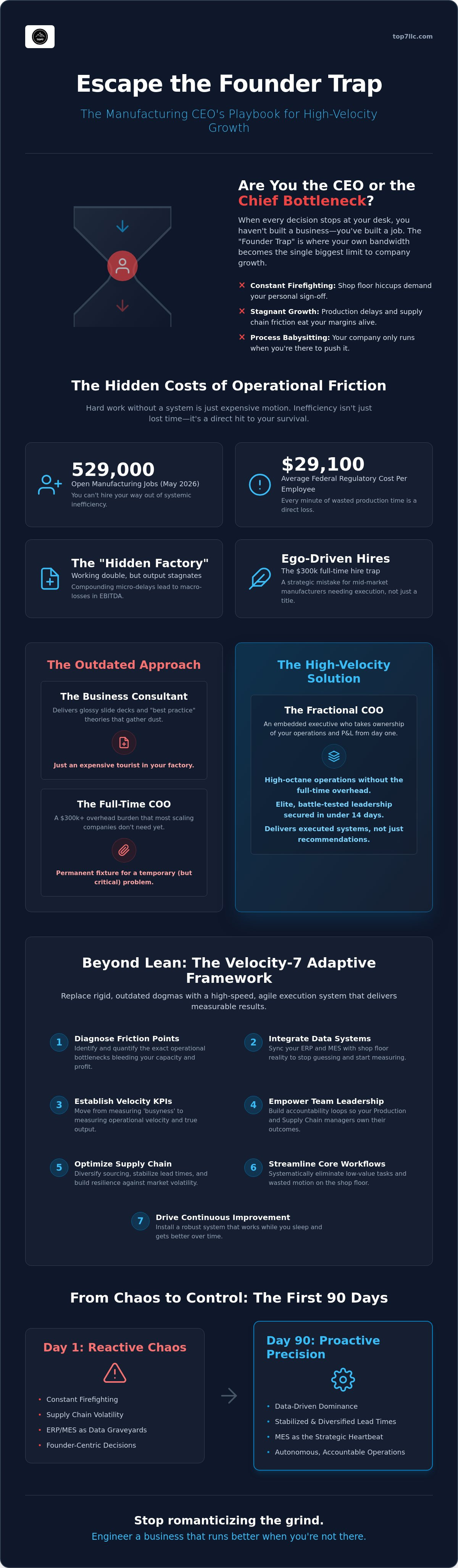
You didn't start a manufacturing company to spend your days approving shift schedules or chasing down missing pallets. Yet, here you are. Most founders fall into the "Founder Trap" where growth isn't limited by market demand, but by the founder's own bandwidth. If every production floor hiccup requires your personal sign-off, you've built a job, not a business. This is where Fractional executives enter the equation. A fractional coo for manufacturing companies is an embedded executive who owns your operations for a fraction of the time and cost of a full-time hire. They aren't here to advise you from the sidelines; they're here to run the engine while you focus on the horizon.
To better understand how this leadership model transforms businesses, watch this helpful video:
The Cost of Operational Friction
Operational friction is the gap between your potential capacity and your actual output. In 2026, this friction is lethal. With manufacturing job openings hitting 529,000 in May 2026, you can't just hire your way out of inefficiency. When supply chain volatility causes micro-delays, those hiccups compound into macro-losses in your EBITDA. You might see a "Hidden Factory" where your team is working double shifts, but your finished goods inventory isn't moving. Hard work without a system is just expensive motion. When you factor in average federal regulatory costs of $29,100 per employee, every minute of wasted production time is a direct hit to your survival. Managing a floor is about keeping the lights on; scaling is about building a system that keeps the lights on without your constant presence.
Why a 'Business Consultant' Isn't the Answer
Don't confuse an operator with a consultant. Consultants deliver glossy slide decks and "best practice" theories that usually gather dust on a shelf. A fractional coo for manufacturing companies delivers executed systems that actually work on the shop floor. You need someone who understands that a shop floor schedule is more important than a fancy mission statement. High-stakes manufacturing requires an "inside-out" approach where the leader knows the difference between a P&L statement and a machine's cycle time. If an expert doesn't know how to bridge the gap between your ERP data and your physical output, they're just an expensive tourist in your factory. You need a veteran who takes ownership of the results, not someone who just points out the problems and leaves you with the bill.
The Fractional COO: High-Octane Operations Without the Full-Time Overhead
Hiring a full-time COO with a $300k price tag is often an ego-driven mistake for mid-market manufacturers. You don't need a permanent fixture; you need a high-octane operator who fixes the machine and then keeps it tuned. A fractional coo for manufacturing companies doesn't sit on your vendor list next to the janitorial service. They embed directly into your org chart. They hold your team accountable and own the P&L impact of every production shift from day one.
Within the first 90 days, an embedded operator moves your facility from reactive chaos to proactive precision. While your competitors are still firefighting supply chain volatility, your fractional leader has already diversified sourcing and stabilized lead times. They bridge the gap between the shop floor and the front office, ensuring that your MES (Manufacturing Execution System) isn't just a data graveyard. It becomes the heartbeat of your strategy. This isn't about "trying harder"; it's about installing a system that works while you sleep.
Direct Reports, Not Just Recommendations
A fractional leader takes command. They don't just give you a list of things to fix and walk away. They manage your production managers, supply chain leads, and quality control heads. This establishes accountability loops that function perfectly even when you're off-site. If you're tired of being the only person who cares about the scrap rate, this shift is non-negotiable. You get executive-level leadership without the long-term liability of a massive salary and equity package. It's about results, not presence.
Strategic Technology Integration
Your ERP should be a weapon, not a chore. Most shop floor technology doesn't talk to the C-suite, which leads to blind decision-making. By leveraging Fractional CTO insights, a COO ensures your tech stack supports automated production flows instead of hindering them. Real-time data must drive executive decisions, or you're just guessing. If your current systems feel like a burden, it's time to evaluate your operational leadership and turn that data into a competitive advantage.
U.S. manufacturing production growth increased 1.4% year-over-year in May 2026, but that growth only benefits those with the infrastructure to handle it. An embedded operator ensures your infrastructure isn't just machines, but a cohesive system of people and technology working in sync. They turn your tech-ops gap into a bridge for scaling, making sure every dollar spent on automation actually returns to the bottom line. You don't need more staff; you need more velocity.
Beyond Lean: Using the Velocity-7 Framework to Eliminate Friction
Lean manufacturing was a revolution in the 20th century. Today, it is just the baseline for survival. If you are still relying solely on Six Sigma or basic Lean principles to scale your operations, you are fighting a modern war with muskets. Waste reduction is important, but speed is what actually wins market share. The Velocity-7 Framework is a proprietary system for moving from friction to flow. It recognizes that manufacturing growth happens across seven distinct dimensions that most founders ignore until they become catastrophic failures. Integrating a fractional coo for manufacturing companies allows you to weaponize this methodology without the years of trial and error typical of traditional consultants.
Whether your plant is in the industrial hubs of Chicago, the rapidly expanding corridors of Dallas, or the specialized clusters of the Northeast, market dynamics require extreme agility. Local labor shortages and regional logistics bottlenecks can't be solved with a generic "one size fits all" strategy. You need a framework that adapts to your specific geography while maintaining a relentless focus on operational velocity. Friction isn't just a nuisance; it's the silent killer of your margins.
The Velocity-7 Methodology in the Factory
Most operators look at the shop floor and see machines. We look at the shop floor and see Bottleneck Patterns across seven dimensions: Strategic Alignment, Operational Rhythm, Technical Integration, Supply Chain Resilience, Quality Precision, Talent Velocity, and Market Agility. By identifying where these patterns stall, we can apply agile sprints to traditional production cycles. This isn't about working harder; it's about identifying the one gear that's holding back the entire machine. A fractional coo for manufacturing companies uses these sprints to fix floor issues in days, not months. We replace the "we've always done it this way" mentality with a culture of rapid, data-driven iteration.
Agile Transformation for Mid-Market Manufacturers
The biggest friction point in mid-market manufacturing isn't usually the machines; it's the silos. Sales promises what engineering hasn't designed, and production is left to clean up the mess. This disconnect creates a "Hidden Factory" of rework and administrative waste. Top7 embeds the Velocity-7 Adaptive Framework to bridge these gaps permanently. We force a synchronization between sales, engineering, and production to ensure that every order is a profitable one. This transformation turns your operation into a high-speed engine that reacts to market shifts in real-time. You don't just get a better factory; you get a business that can outpace any competitor stuck in the old ways of doing things.
Evaluating the ROI: Why a $300k Full-Time Hire is Often a Strategic Mistake
Stop bleeding cash on executive recruiters. For most mid-market firms, a full-time COO is a premature financial burden that delivers a negative ROI for the first twelve months. A seasoned manufacturing executive commands a base salary of approximately $215,000; but when you factor in benefits, bonuses, and equity, the true employer cost often exceeds $305,000 per year. That is a massive fixed cost to add to your P&L before you have even proven the new hire can handle your specific shop floor chaos. Deploying a fractional coo for manufacturing companies is the tactical move that protects your capital while securing the same level of elite leadership.
The math gets worse when you calculate the opportunity cost of the search itself. A typical executive search takes six months to find the right candidate and another six months for them to fully onboard. That is an entire year of unmanaged supply chain volatility and production delays. While you wait for a "perfect" full-time hire, your margins are shrinking. An embedded operator from Top7 starts in under 14 days. You aren't just buying time; you're buying immediate execution. If you want to stop the bleeding today, you need to schedule your operational audit and bypass the recruitment gamble.
Speed to Value: The True Metric of Success
In manufacturing, speed is your only real defense against market shifts. A full-time hire brings one person's experience. A fractional coo for manufacturing companies brings the collective intelligence of the entire Top7 brain trust. We have seen your specific bottlenecks before and already have the blueprints to fix them. This model also offers flexible scaling. You can increase leadership support during a massive facility expansion or decrease it once your systems are stabilized. You pay for the results, not the desk space. Why commit to a lifelong salary when you only need a strategic transformation?
When to Transition to a Full-Time COO
There is a complexity threshold where a full-time hire eventually makes sense. Usually, this happens when your operational volume requires 40+ hours a week of pure maintenance rather than transformation. A fractional leader actually prepares your company for this transition. They clean up the mess, install the Velocity-7 Framework, and document every process. This ensures that when you do hire a permanent executive, they step into a high-velocity engine rather than a burning building. You can even use Top7 Advisory Services to vet your eventual full-time candidates. We know what a great operator looks like because we are the ones who built the system they will be running.
Stop Firefighting: How to Embed a Top7 Fractional COO in Your Operations
Firefighting is a symptom of a broken system. If you're still spending your mornings resolving production floor disputes or chasing late shipments, you're failing as a CEO. You're acting as a high-priced supervisor instead of a strategic leader. Embedding a fractional coo for manufacturing companies isn't just a cost-saving measure. It's a strategic coup. We don't waste time with months of "discovery" or endless meetings that lead nowhere. We move from the initial audit to embedded leadership in under 14 days. Your business doesn't have time for a slow ramp-up when the U.S. Manufacturing PMI is at 53.3 and the competition is reshoring at record speeds.
The Initial Audit: Finding Your Friction Points
We start with a brutal deep dive into your current production, supply chain, and team structure. The result is the "Friction Report," a no-nonsense look at what's actually killing your growth. We don't sugarcoat the reality. We identify the Bottleneck Patterns and align our Velocity-7 Framework to your specific manufacturing niche. Whether you're navigating the high-tech demands of Austin, the specialized engineering hubs of Boston, or the complex regulatory landscape of the West Coast, our audit uncovers the hidden costs eating your EBITDA. With federal regulatory costs averaging $29,100 per employee, you can't afford to ignore these friction points. We find the gap between your capacity and your output and we close it with surgical precision.
Execution and Scalability
Our roadmap to operational dominance is built on a 30, 60, and 90-day execution cycle. In the first 30 days, we stabilize the floor and secure quick wins in supply chain resilience. We address the 529,000 job openings gap by optimizing the talent you already have and streamlining your existing workflows. By day 60, we've implemented the "Operational Rhythm" that keeps your factory humming without your constant sign-off. Decisions are pushed down to the floor where they belong. By day 90, we've installed the systems that make growth automatic rather than accidental. We measure everything through clear KPIs: reduction in scrap, increase in velocity, and the recovery of your time. If you're tired of being the primary bottleneck, it's time to install elite leadership that knows how to win. Schedule your strategy session with a Top7 executive today and start scaling without the overhead.
Own Your Operations Before They Own You
The choice is simple. You can keep acting as the primary bottleneck for every floor decision, or you can install a system that actually scales. We've shown you that the $300,000 full-time executive isn't just expensive; it's often a strategic anchor that slows your momentum. By deploying a fractional coo for manufacturing companies, you gain access to the battle-tested Velocity-7 Proprietary Adaptive Framework without the long-term liability. We don't advise from the sidelines. We embed directly into your leadership team to drive results in Boston, Chicago, Dallas, and across the Northeast.
Your factory should be a profit engine, not a source of constant stress. Stop letting production delays kill your margins and supply chain volatility dictate your future. It's time to bridge the gap between your shop floor technology and your executive strategy. You've seen the roadmap from audit to execution. You know the cost of doing nothing. Now, you just need the courage to stop firefighting and start leading. Your company's growth is waiting for you to step out of its way.
Ready to stop firefighting? Get a Top7 Fractional COO on your team.
Frequently Asked Questions
What is the difference between a manufacturing consultant and a fractional COO?
A consultant delivers a slide deck; a fractional COO delivers a functioning factory. Consultants are outside observers who offer suggestions you have to implement yourself. A fractional COO is an embedded operator who manages your production leads and owns the P&L impact of every shift. They aren't there to tell you what's wrong. They're there to fix it and stay until the system is bulletproof.
How many hours a week does a fractional COO typically work for a manufacturing company?
Most engagements range from 10 to 20 hours per week depending on your operational complexity. This isn't about punching a clock. It's about high-impact leadership during your most critical windows. You get C-suite results and strategic oversight without paying for a full-time seat that would sit idle half the time. We match our leadership hours to your actual production cycles and growth needs.
Can a fractional COO help with ISO certifications or supply chain audits?
Yes, they own the systems that make these audits successful. Instead of panic-prepping for an ISO certification, an embedded leader builds the operational rhythm that keeps you compliant year-round. They lead the supply chain strategy to ensure audits aren't just checkboxes, but profit-protection exercises. They ensure your documentation and processes are audit-ready every single day, not just when the inspector is scheduled to arrive.
Is my manufacturing company too small for a fractional executive?
If your founder is the primary bottleneck for every floor decision, you aren't too small. Size is irrelevant when operational friction is killing your growth. Most firms with over 10 employees find that a fractional coo for manufacturing companies pays for itself by reclaiming the owner's time and stabilizing margins. If you're firefighting daily, you're big enough to need a leader who can build real systems.
How does the Velocity-7 Framework differ from traditional Lean or Six Sigma?
Lean is about waste; Velocity-7 is about speed. Traditional Six Sigma is often too slow and rigid for the 2026 supply chain reality. Our proprietary framework uses agile sprints to identify and crush Bottleneck Patterns across seven dimensions of your business. We don't just trim the fat. We increase the velocity of your entire production cycle so you can outpace competitors who are stuck in outdated methodologies.
What happens if we need more support during a production surge or crisis?
The fractional model is built for extreme elasticity. We can ramp up leadership hours during a facility expansion or a sudden supply chain crisis and scale back once the situation is stabilized. You get the flexibility to match your executive overhead with your actual business needs. You're never locked into a rigid full-time salary when your production volume doesn't justify the expense.
Do you provide fractional COOs for specific regions like Chicago or the Northeast?
We provide elite leadership across all major US manufacturing hubs including Chicago, Dallas, and the Northeast. Local market dynamics matter, especially regarding labor shortages and regional logistics bottlenecks. Our fractional coo for manufacturing companies understands these specific geographic pressures. We know how to navigate the regional regulatory environments and labor pools that impact your facility's specific bottom line.



Comments