
Fractional CMO Services: What They Do and When to Hire One

What if your marketing doesn’t need more activity, but a leader who can turn it into growth? If campaigns, content, and sales priorities keep moving in different directions, the problem may be missing strategic ownership, not a lack of effort. That’s where fractional cmo services can help. What do they include, and when are they the right fit?
You may need experienced marketing leadership without adding a full-time executive role. You also need more than recommendations that sit in a presentation. A fractional CMO should set priorities, align people and resources, and connect marketing decisions to business goals. Without clear ownership of that connection, measuring marketing by output alone won’t show whether it’s moving the company forward.
This article explains what a fractional CMO can lead, how the role differs from a consultant or agency, and what to consider before choosing a leadership model. You’ll also learn when fractional support makes sense and how to connect marketing priorities with company objectives. At Top7, fractional CMO leadership combines strategic direction with execution support and an embedded partnership, helping address organizational friction as well as marketing priorities.
Table of Contents
Fractional CMO Services: The Marketing Leadership Gap They Address
More campaigns won’t fix a growth problem if nobody owns the strategy behind them. A company can publish content, run ads, and attend events while each effort targets a different audience or business priority. The activity looks busy, but the results remain disconnected. The missing piece may be senior marketing leadership: someone responsible for setting direction, making trade-offs, and tying marketing to company goals.
Fractional cmo services provide part-time senior marketing leadership connected to a company’s priorities. The fractional CMO works with decision-makers and the marketing team to guide the function, rather than advising from a distance or managing one channel in isolation. As a fractional executive, the CMO brings leadership into the business without requiring a full-time executive arrangement. The scope depends on the company’s goals and how the engagement is designed.
This video offers a practical look at what the role can involve day to day:
What does a fractional CMO lead?
A fractional CMO owns marketing direction and the decisions that shape it. That can include clarifying the company’s positioning, setting priorities, guiding go-to-market strategy, and deciding how marketing resources support business objectives. The aim is alignment: the message customers hear, the markets the company pursues, and the goals leadership sets should reinforce one another.
Leadership doesn’t mean personally completing every campaign task. A fractional CMO may guide internal marketers and coordinate execution while specialists or other team members handle channel work. The executive contribution is to establish what matters, explain why, and make sure the work follows that direction. Make responsibilities explicit so strategy has an owner and execution has clear priorities.
When does a company need senior marketing leadership?
Look for recurring friction, not just a temporary dip in campaign performance. Activity may be scattered across channels, teams may be unsure which audience or offer takes priority, or marketing reports may not help leaders assess progress toward company goals. If decisions stall because nobody has authority to set direction, adding more isolated tasks is unlikely to close the gap.
Growth changes can expose the problem. A new market, product, or sales motion can make the existing marketing approach inadequate and create competing demands for the team. That doesn’t mean every company needs a CMO. Ask whether marketing needs sustained senior ownership that the current leadership structure can’t provide. If it does, define the priorities and decision-making responsibilities, then shape the engagement around them.
What Fractional CMO Services Typically Cover
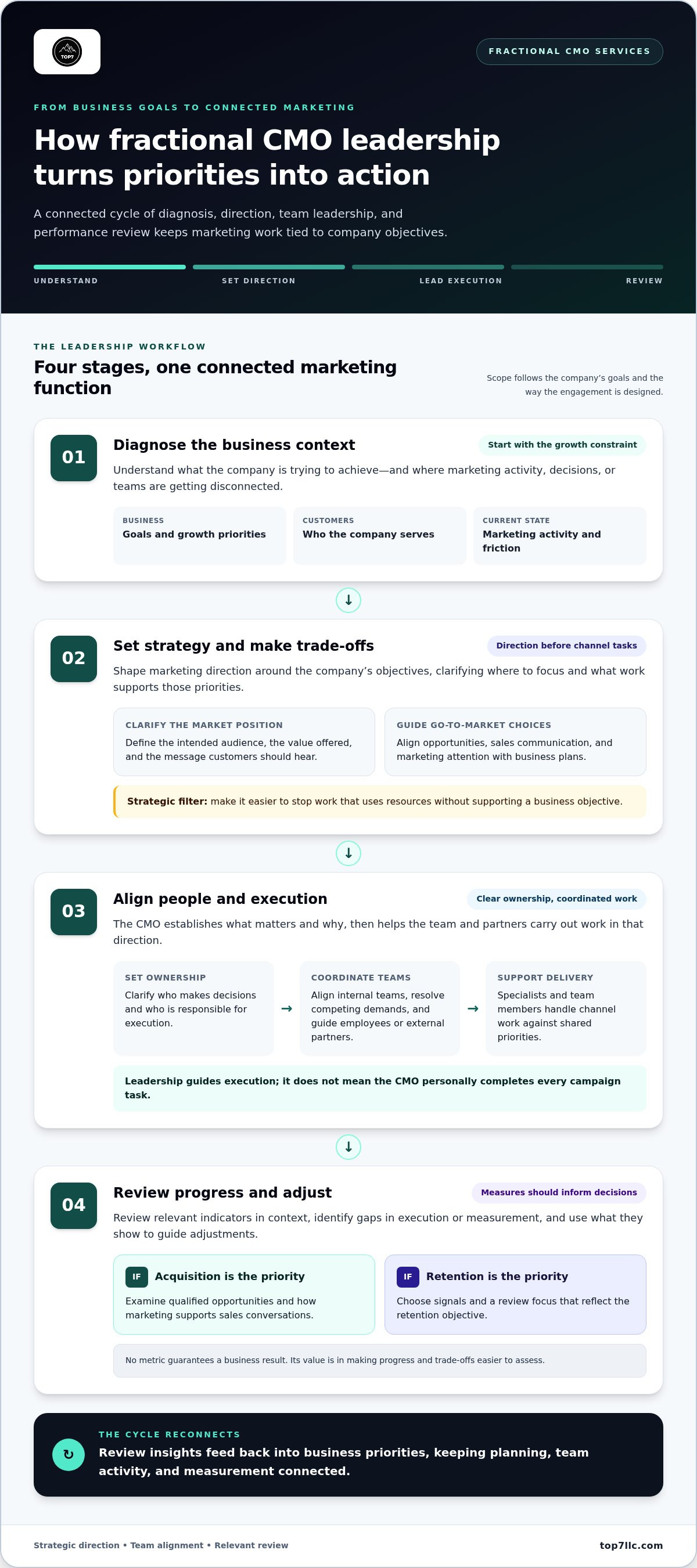
Effective fractional cmo services connect diagnosis, planning, leadership, and review. The work starts with understanding the company’s goals, customers, current marketing activity, and points of friction. From there, a CMO can establish priorities, clarify who owns decisions, and guide execution. The scope should reflect the business problem, not a generic checklist of channels or deliverables.
Use this test: do marketing choices support the company’s current growth priorities? A plan focused on customer acquisition, for example, may need to address audience, positioning, sales handoffs, and how progress will be assessed. If retention is the priority, the strategy and indicators should reflect that instead.
Strategy, positioning, and go-to-market direction
A fractional CMO helps leadership decide who the company is trying to reach, what value it offers those customers, and how that position should shape its marketing. These choices guide go-to-market planning: which opportunities to pursue, what the sales team needs to communicate, and where the company should focus its attention. Clear priorities also make it easier to stop work that uses resources without supporting a business objective.
Marketing direction must connect to sales and company-wide plans. If the company is entering a new market, for instance, marketing and sales need a shared view of the intended customer and the message most likely to resonate. The CMO sets direction and makes trade-offs visible, rather than simply prescribing a list of channels.
Team leadership, execution, and performance review
Strategy matters only if people can act on it. A CMO can align internal teams around priorities, clarify responsibilities, coordinate projects, and help leaders resolve competing demands. They may guide employees or external partners responsible for execution. The division of work depends on the company’s needs and the engagement design.
Performance review should help leaders make decisions, not just report numbers without context. A team focused on acquisition might examine qualified opportunities and how marketing supports sales conversations. A retention priority calls for different signals. The CMO can review what the indicators show, identify gaps in execution or measurement, and recommend adjustments. No metric guarantees a business result; its value is in making progress and trade-offs easier to assess.
CMO leadership turns business priorities into marketing decisions, then uses relevant measures to show whether the work supports those priorities. This keeps planning, team activity, and review connected rather than treating them as separate functions.
For companies facing friction across teams or decisions, Top7 pairs strategic guidance with execution support and embeds directly with clients. Its broader business consulting approach connects marketing leadership to organizational priorities and the conditions that shape how work moves through the company.
Fractional CMO vs. Agency, Consultant, or Full-Time Executive
These options address different needs. An agency can deliver specialized marketing work. A consultant can assess a challenge and recommend a course of action. A fractional CMO takes ongoing responsibility for marketing direction, while a full-time CMO provides that leadership as a dedicated internal executive. The practical difference is ownership: who makes decisions, connects the work, and stays accountable for follow-through?
Fractional CMO or marketing agency?
An agency is built to deliver defined expertise, such as campaign management or channel execution. A fractional CMO determines how those efforts fit the wider plan, sets priorities, and coordinates the people responsible for delivery. One doesn’t replace the other. A company with capable internal leadership and clear direction may need an agency’s specialist execution. A company with several vendors and no clear owner may need leadership to align their work first.
The two models can also work together: the CMO sets direction and helps assess priorities, while an agency delivers specific work. Make ownership clear. Who decides what the campaign is meant to achieve? Who connects it to sales priorities? Who reviews its contribution and adjusts the plan? Without answers, activity can multiply while accountability disappears.
Fractional CMO or full-time CMO?
Choose based on the leadership workload, not on a blanket assumption that one model is better. A fractional CMO can fit when the business needs senior marketing ownership but doesn’t require that leader’s attention full time. A full-time CMO may fit when the scope demands daily executive involvement, sustained internal coordination, and continuous leadership across a larger or more complex marketing function.
Assess the work ahead: how often decisions arise, how many teams need alignment, and whether marketing leadership must be present in day-to-day operations. Fractional cmo services can provide structured leadership when the need is ongoing but part time. If the role’s responsibilities keep expanding, revisit whether the arrangement still matches the business. Match the model to the work, then define its authority and accountability.
How to Evaluate Fractional CMO Services Before You Commit
Don’t evaluate a leadership engagement by the confidence of the pitch or the volume of promised activity. Look for a clear business problem, an accountable owner, and a way to review progress. Before choosing fractional cmo services, use this framework to define what the executive is there to change and how the work will fit your organization.
Name the growth constraint. Identify the specific obstacle holding marketing back. It might be unclear positioning, weak coordination between marketing and sales, or priorities changing before teams can execute. A precise problem gives the engagement a useful starting point.
Translate ambition into desired outcomes. Turn a broad aim like “grow faster” into a small set of company-relevant priorities. Decide what should improve and which indicators can help assess progress. Separate business outcomes from marketing activity: completed campaigns are outputs, not proof of business impact.
Define ownership and decision rights. Agree on which decisions the CMO leads, which require executive approval, and who carries out the work. Clarify how the leader will coordinate with existing employees and external partners. If decision-making authority is vague, accountability will be too.
Set the review cadence. Choose a regular rhythm for reviewing priorities, evidence, and obstacles. The right schedule depends on how the business operates. Each review should establish what changed, what the available measures indicate, and whether the plan or its execution needs adjustment.
Set goals and define executive ownership
Strong goals focus attention. If the constraint is poor alignment between marketing and sales, define what better coordination should look like, such as shared priority audiences or an agreed handoff process. Then identify who sets direction, who provides input, and who executes. Decide how priorities connect to company objectives and what evidence will inform reviews. This makes the role assessable without treating any outcome as guaranteed.
Assess fit through the operating relationship
Fractional leadership depends on access and collaboration, not just expertise. Clarify how the executive will work with company leadership and existing teams, how decisions will move forward, and how often priorities will be revisited. Consider how the plan will account for sales needs, financial constraints, and broader company strategy. Review relevant examples of similar challenges and look for a clear explanation of the proposed scope, responsibilities, and measures.
Clear ownership makes fractional leadership assessable because you can see who is responsible, what decisions they lead, and how progress is reviewed. For an overview of how Top7 connects fractional CMO leadership with execution and broader business priorities, explore Top7’s fractional CMO support.
How Top7 Approaches Fractional CMO Services
Marketing priorities don’t operate in a vacuum. They depend on decisions, resources, and coordination across the business. Top7 provides fractional CMO services as part of its broader business consulting work, combining strategic guidance with execution support. Its professionals embed directly with clients, bringing marketing leadership closer to the teams and priorities shaping the company’s growth.
This matters when marketing friction has roots beyond the marketing function. A plan can be clear on paper and still stall if responsibilities are unclear or decisions move slowly across teams. Top7 connects marketing direction to broader organizational needs, rather than treating every marketing challenge as an isolated campaign problem.
Connect marketing leadership to the wider business
Top7’s embedded-partner approach creates a working relationship with the organization, not just a detached recommendation. Marketing priorities can be considered alongside company goals and operational realities, with strategic guidance and execution support connecting direction to action. The focus is coordination: grounding the work in the business context and helping relevant leaders and teams move in the same direction.
Top7 uses the Velocity-7 Adaptive Framework to help organizations move from operational friction toward efficient flow. Applied to marketing leadership, this organizational lens can help identify where friction affects coordination and progress. It isn’t a promise of specific marketing results. Its value is in examining the conditions around the work and connecting leadership priorities to the wider organization.
That distinction matters. Marketing performance can be affected by more than campaign choices. When priorities compete, decisions lack clear ownership, or teams aren’t aligned, execution may lose momentum. A business-wide perspective helps leaders consider how marketing fits with company objectives and where coordination needs attention.
Turn the evaluation into a next step
Before discussing an engagement, get clear on the need. A concise starting brief can cover:
The growth constraint or organizational friction you want to address.
The company priorities marketing leadership should support.
The decisions and responsibilities you expect the executive to own.
The measures and review rhythm you’ll use to assess progress.
These points make the conversation more useful. They provide a shared basis for discussing scope, leadership involvement, and how strategic guidance connects to execution. They also help distinguish between a need for marketing direction and a need to address broader coordination across the business.
If you’re a decision-maker clarifying the leadership your company needs, discuss your growth priorities with Top7. Bring the constraint, the outcomes you want to support, and the ownership you need. Start with the business reality, then determine how fractional marketing leadership can fit.
Make Your Next Growth Decision Deliberate
The next move isn’t to add more marketing activity by default. Decide what leadership your company needs to make its priorities actionable. Identify the constraint, the decisions that need an owner, and how you’ll assess progress. That gives you a clearer basis for deciding whether fractional cmo services fit your organization now.
Top7 brings fractional CMO leadership into its broader consulting work. Its professionals embed with clients, and the Velocity-7 Adaptive Framework focuses on moving organizations from operational friction toward efficient flow. The aim is to connect leadership and execution to the realities shaping your business, not to promise a specific marketing result.
Bring your growth priorities into focus, then choose a leadership model that fits the work ahead. Map your marketing leadership needs with Top7 and take the next step with a clearer direction.
Frequently Asked Questions
What are fractional CMO services, and what does a fractional CMO do?
Fractional CMO services provide part-time senior marketing leadership to a company that needs executive direction without assigning the role full time. A fractional CMO may assess the marketing function, set priorities, guide positioning and go-to-market decisions, and align marketing work with business objectives. The role is about leading the function and its decisions, not necessarily producing every campaign, asset, or channel deliverable personally.
How is a fractional CMO different from a marketing consultant?
A consultant typically analyzes a defined issue and advises on possible actions. A fractional CMO is more directly involved in leading the marketing function, making or guiding decisions, and following through with the team over time. For example, a consultant might recommend how to improve a product launch; a fractional CMO may also establish its strategic priorities and coordinate the people responsible for carrying them out.
Is a fractional CMO a good fit for a growing business?
A fractional CMO can be a fit when growth creates marketing decisions that existing leaders or teams can’t consistently own. For example, a company expanding its customer base may need clearer priorities across sales and marketing without requiring a dedicated full-time marketing executive. The model is less useful if the company doesn’t need sustained senior marketing direction or can already make and execute those decisions effectively.
Can a fractional CMO lead an existing marketing team?
Yes. A fractional CMO can guide an existing team by clarifying priorities, assigning decision ownership, and connecting individual projects to company goals. If team members are focused on different channels without shared direction, for instance, the CMO can help leadership establish common priorities and coordinate the work. The team continues to handle its responsibilities while the executive provides direction and helps resolve competing demands.
How do companies measure the effectiveness of fractional CMO services?
Measure effectiveness against agreed business priorities, not activity alone. If the priority is improving qualified demand, review relevant lead-quality indicators alongside campaign output. If it’s supporting customer retention, track measures related to continued engagement. Also assess whether decisions are clearer, responsibilities are understood, and execution is aligned. Choose measures before work begins, then review them regularly. No single metric proves causation or guarantees a particular business result.
How much do fractional CMO services cost?
There isn’t one universal fee for fractional CMO services. The engagement’s scope, expected level of involvement, responsibilities, and complexity of the company’s needs all affect how it’s structured. To understand the business commitment, define what leadership the role will own, how it will work with the team, and what the engagement includes. Compare those details with the leadership gap you need to address, rather than relying on price alone.
When should a company hire a fractional CMO instead of a full-time CMO?
Consider fractional leadership when the company needs continuing executive marketing direction but not a full-time leader’s daily involvement. A full-time CMO may be a better fit if the marketing function requires sustained, day-to-day executive attention across a broad workload and multiple teams. Assess how often strategic decisions arise, how much internal coordination is needed, and whether the leadership scope is genuinely part time or has become a full-time responsibility.



Comments