
Fractional Chief Revenue Officer Services: A Practical Buyer’s Guide

What if your revenue problem isn’t a lack of activity, but a lack of shared direction? Sales and marketing can stay busy while priorities drift, forecasts remain unreliable, and execution stalls. Fractional chief revenue officer services bring senior revenue leadership into the business without requiring a full-time executive hire. But the title alone won’t fix a broken system. The work must connect diagnosis to decisions, clear ownership, and accountable execution.
It’s reasonable to want senior leadership without committing to a permanent role. To assess the fit, clarify what the engagement covers, how the CRO will work with your team, and which outcomes you’ll track. This guide will help you evaluate readiness, define the fractional CRO’s remit, and choose a working model that fits your revenue priorities.
You’ll also learn how to distinguish hands-on leadership from advice that never leaves the page, and how to connect revenue priorities to measurable indicators. Top7 provides strategic guidance and embedded execution support, using its Velocity-7 Adaptive Framework to help move organizations from operational friction toward efficient flow. The goal is practical: priorities your team can act on and progress you can review.
Table of Contents
What fractional chief revenue officer services actually cover
Revenue can look busy and still be out of control. Sales pushes deals forward, marketing generates leads, and customer success handles renewals, yet priorities conflict, forecasts miss, and no one owns the full path from demand to revenue. Fractional chief revenue officer services add part-time executive leadership to set direction and move the work forward.
A fractional CRO leads strategy, alignment, execution, and measurement across the revenue engine. The role is broader than managing sales activity: it connects team decisions to shared business priorities and tracks whether those decisions are producing progress. For background on the executive remit, see the Chief Revenue Officer role.
For a practical look at the fractional leadership model, watch:
What does a fractional CRO do day to day?
The work starts with diagnosis. The CRO examines how opportunities move through the pipeline, how teams hand work off, who owns key decisions, and where execution slows. Then the CRO works with company leadership to set priorities, clarify accountability, and choose indicators that show whether the revenue plan is being carried out and making progress.
That means coordinating sales, marketing, customer success, and other relevant teams around one operating direction. For example, a CRO might address a disconnect between the leads marketing delivers and the opportunities sales pursues, or investigate a handoff problem affecting renewals. The CRO sets priorities and drives follow-through. The role is not simply to take over frontline selling or deliver an isolated campaign.
When does a company need fractional revenue leadership?
Look for recurring symptoms: teams execute inconsistently, revenue priorities change without clear ownership, or leaders can’t explain why results are stalling. These signals suggest a leadership or operating problem, not automatically a need for another sales push.
Ambition alone isn’t readiness. A fractional CRO needs access to decision-makers, participation from the teams responsible for revenue, and usable information about pipeline, performance, and customer activity. Without those conditions, even a strong strategy can’t translate into accountable execution. Give the leader the access and decision pathways needed to act, then measure the work against agreed priorities.
What a strong fractional CRO engagement should include
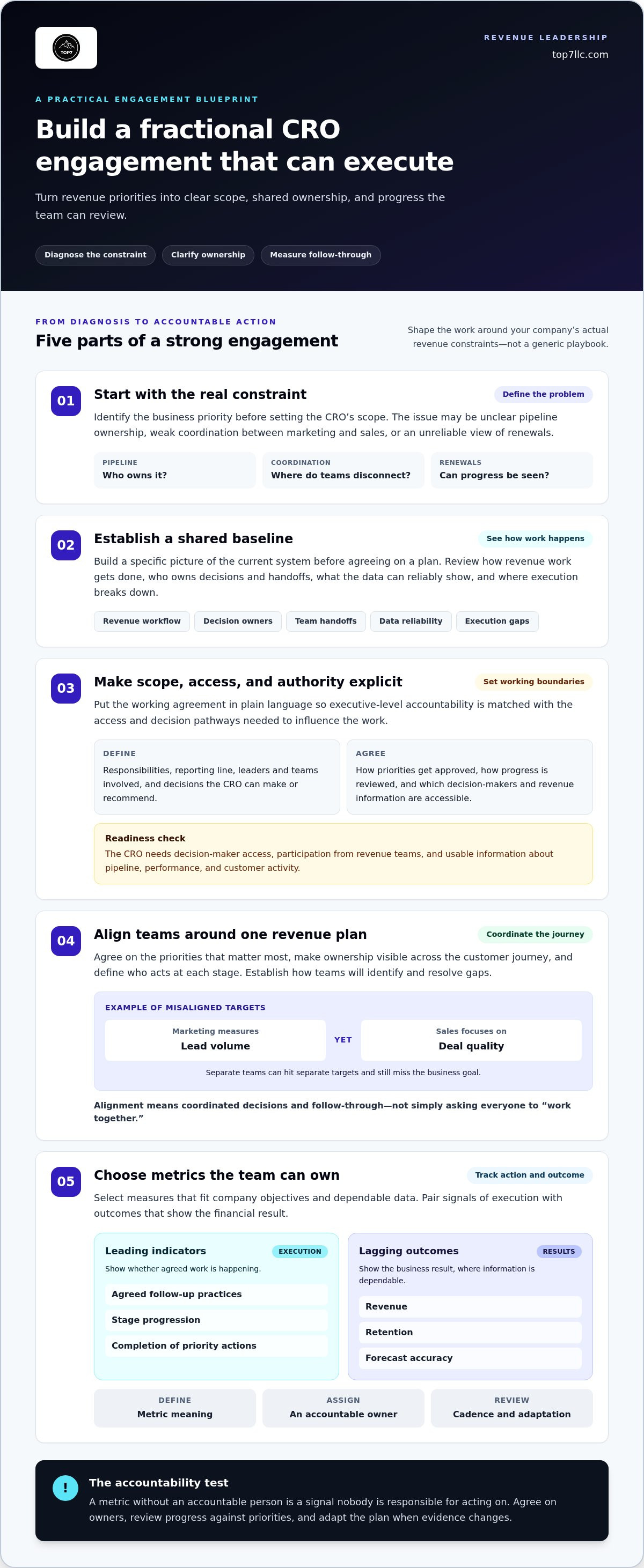
A useful engagement starts with the company’s actual revenue constraints, not a generic playbook. One business may need clearer pipeline ownership; another may need stronger coordination between marketing and sales, or a more reliable view of renewals. Define the business priority first, then shape the CRO’s scope around work that can address it.
Before setting a plan, establish a baseline. Review how revenue work gets done, who owns key decisions and handoffs, what the available data can reliably show, and where execution breaks down. The result should be a shared, specific picture of the problem, not a collection of disconnected observations.
Set scope, access, and decision boundaries
Put the working agreement in plain language. Specify the CRO’s responsibilities, who they report to, which leaders and teams they’ll work with, and what decisions they can make or recommend. Clarify how priorities get approved and how progress gets reviewed. This prevents a predictable failure: expecting executive-level accountability while withholding the access or authority needed to influence the work.
The engagement should also identify the interfaces between teams. Sales management, for example, covers the systems and practices that guide sales teams; Forbes Advisor’s overview of Sales Management offers useful context. A CRO’s broader job is to connect that work with marketing, customer success, and the company’s revenue priorities. Don’t impose one universal org chart. Design collaboration around how customers move through your business.
Align teams around a shared revenue plan
Start by agreeing on the priorities that matter most, then make ownership visible across the customer journey. If marketing is measured on lead volume while sales focuses on deal quality, teams can hit separate targets and still miss the business goal. Examine handoffs, define who acts at each stage, and agree how teams will resolve gaps. Alignment means coordinated decisions and follow-through, not simply asking everyone to “work together.”
Choose metrics the team can own
Select measures based on the company’s objectives and the quality of its data, not a standard dashboard copied from another business. Pair leading indicators, which show whether execution is happening, with lagging outcomes that show the financial result.
Leading indicators: agreed follow-up practices, stage progression, or completion of priority actions.
Lagging outcomes: revenue, retention, or forecast accuracy, where the underlying information is dependable.
Metric ownership matters. A number without an accountable person is a signal nobody is responsible for acting on.
Agree on definitions, owners, review cadence, and how the plan will adapt if evidence changes. Fractional chief revenue officer services should create accountable execution, not promise a result before the baseline is understood. If you need this hands-on leadership model, explore Top7 fractional CRO services.
Fractional CRO vs. full-time, interim, or consulting support
These models solve different problems. The right choice depends on whether you need ongoing revenue leadership, temporary coverage, or focused expertise for a defined challenge. Compare the work and accountability you need, not just the job title.
Fractional leadership is not simply a short-term project with an executive title. It means recurring involvement, with scope tailored to the company’s priorities and operating needs. Part-time doesn’t mean hands-off: accountability should be explicit, including the CRO’s authority, access to decision-makers, agreed priorities, and regular progress reviews.
When is fractional CRO support a better fit than a full-time hire?
It can fit when leadership sees the need for senior revenue direction but the role’s workload doesn’t yet justify a dedicated full-time executive. The arrangement still needs clear ownership and access to the leadership team; without those, the CRO can’t align decisions or move priorities into execution. Revisit the scope as the company changes. A fractional role may expand, narrow, or eventually give way to a different leadership structure.
How does a fractional CRO differ from a sales consultant?
A sales consultant may help solve a defined issue, such as reviewing a sales process or advising on a specific project. A fractional CRO provides recurring executive alignment across revenue-related functions, connecting priorities to execution and tracking progress over time. That broader remit doesn’t make one model universally better. Choose consulting for bounded expertise; choose fractional leadership when the need is ongoing coordination and ownership.
Strong fractional chief revenue officer services make the commitment clear: who decides, who executes, and how progress is reviewed. Choose the model that matches the work your business actually needs.
How to evaluate fit, readiness, and success before starting
A fractional CRO engagement is only as useful as the conditions around it. Before committing, assess whether your company can define the problem, give the leader access to the people and information needed to act, and make decisions at a workable pace. Use this five-step sequence to turn a vague growth concern into an accountable engagement.
Define the business problem. Name the revenue constraint you want to address. Is execution inconsistent, are priorities unclear, or is leadership unable to explain what is slowing progress?
Check readiness and sponsorship. Identify the executive sponsor, the teams that need to participate, and the decisions the CRO can make or influence. If leaders can’t provide access or resolve competing priorities, address that gap first.
Set the scope and boundaries. Agree on responsibilities, team interfaces, decision rights, and what remains with existing leaders. Make the remit specific to the business instead of assuming a standard playbook.
Establish a baseline. Gather relevant sales, marketing, customer, and financial information. The data doesn’t need to be perfect, but the team should know what’s reliable, what’s missing, and how those limits affect decisions.
Agree on governance. Set an operating cadence with priorities, owners, review points, and measures. Decide how the team will raise blockers and adjust the plan as evidence emerges.
What should leadership prepare before the engagement?
Bring the strategic questions that need answers, current priorities, and known obstacles to execution. Map which leaders and teams own each part of the revenue journey, and flag where handoffs or decision-making stall. Prepare the information available from sales activity, marketing performance, customer outcomes, and financial reporting. Identifying data gaps strengthens the starting point; overlooking them can lead to decisions based on incomplete information.
How can the company measure progress responsibly?
Agree on a starting baseline and a focused set of indicators tied to the business problem. Track actions that show whether the plan is being executed, alongside outcomes such as revenue or retention when the underlying data supports them. Review both on a consistent cadence. If a metric shifts after an initiative, treat that as evidence to investigate, not automatic proof that the initiative caused the change.
Useful measurement links a named owner to a specific action and the outcome that action is meant to influence. Review the criteria as evidence accumulates, and adjust them when priorities or data quality change. Strong fractional chief revenue officer services make accountability visible without promising results the baseline can’t support.
If your leadership team is ready to define the problem, ownership, and operating cadence, explore Top7’s fractional CRO support.
How Top7 approaches fractional CRO services and next steps
Once you’ve defined the revenue problem, clarified what leadership must own, and considered how progress will be judged, you can assess the right partner and working model. Top7 provides fractional CRO services that combine strategic guidance with execution support. The aim is not to leave a plan on the shelf. It’s to embed leadership in the work of connecting revenue priorities to how the business operates.
What distinguishes Top7’s approach to fractional revenue leadership?
Top7 pairs executive direction with embedded collaboration. That matters when a challenge crosses team boundaries: a priority may be clear on paper, but execution can stall when ownership, decisions, and day-to-day work don’t line up. The CRO works within the business to connect strategic priorities with operating activity.
Top7 uses its proprietary Velocity-7 Adaptive Framework to help organizations move from operational friction toward efficient flow. The framework provides a structured approach to business improvement while allowing the work to adapt to the organization’s needs. It connects what leadership wants to change with the operating work required to pursue that change, rather than assuming one fixed solution fits every company.
The engagement’s scope, responsibilities, and measures should reflect the company’s situation. A strong working model makes clear how strategic guidance connects to execution while leaving room to adapt as the business learns.
What should the first conversation establish?
Start with the business issue, not a generic growth ambition. Which revenue priority is stuck? What constraints are limiting progress? What outcome does leadership want to pursue, and what evidence would help the team judge movement?
Then identify who needs to participate. Clarify which leaders own relevant decisions, where teams need to coordinate, and how choices will be made when priorities compete. This conversation should surface the context needed to shape a fit-for-purpose engagement, including what the company already understands and what still needs diagnosis. It should also establish whether leadership is prepared to support the work, not simply delegate a problem and wait for a result.
A useful next step is a focused discussion of your revenue priorities, operating constraints, and expectations for fractional leadership. Bring the people who can explain the challenge and influence the decisions. Then define a working relationship and execution plan that fit what the business needs.
Discuss fractional CRO services with Top7 and define a practical next step for your revenue goals.
Turn Revenue Leadership Into Accountable Action
The right CRO model depends on the work your business needs: recurring executive leadership, temporary coverage, or advice for a defined challenge. Before you commit, clarify the revenue constraint, decision rights, team access, and measures that will show whether execution is moving forward. Strong fractional chief revenue officer services connect those pieces instead of treating strategy and delivery as separate jobs.
Top7 provides fractional CRO leadership that pairs strategic guidance with execution support. Its proprietary Velocity-7 Adaptive Framework offers a structured approach to addressing operational friction and connecting priorities to business operations. Shape the engagement around your goals and constraints, with clear expectations rather than unsupported promises.
Ready to align revenue priorities with accountable execution? Discuss fractional CRO services with Top7 and define the right next step for your business.
Frequently Asked Questions
What does a fractional chief revenue officer do?
A fractional CRO is a part-time executive who leads a company’s revenue direction and execution. They diagnose bottlenecks across the revenue engine, align teams around priorities, oversee follow-through, and measure progress against agreed objectives. The remit can include sales, marketing, customer success, and related functions, but it isn’t identical at every company. Scope should reflect the organization’s priorities, decision structure, and where revenue work currently gets stuck.
How do fractional CRO services work?
Fractional chief revenue officer services begin with the company and executive defining how they’ll work together. They agree on scope, priorities, access to leaders and teams, responsibilities, decision boundaries, working cadence, and success measures. The CRO then provides ongoing leadership and collaborates with relevant teams to guide decisions and execution. Regular reviews help surface obstacles and adjust priorities as business needs or available evidence change.
When should a company hire a fractional CRO?
Consider a fractional CRO when revenue ownership is unclear, teams execute in disconnected ways, or the business needs senior leadership before a full-time role makes sense. These signals point to a need for coordinated direction, not automatically to a specific solution. Readiness matters too: an executive sponsor must support the work, relevant teams need to participate, and the CRO needs access to the information required to assess priorities and guide action.
What is the difference between a fractional CRO and a sales consultant?
A fractional CRO typically has an ongoing executive remit across revenue priorities, including cross-functional alignment and execution oversight. A sales consultant more often provides advice or support for a defined project or narrower sales challenge. The distinction depends on the agreed scope: some consulting work can be hands-on, and fractional leadership can vary by company. Neither model is automatically better. Choose based on whether you need continuing executive ownership or focused expertise for a specific issue.
Can a fractional CRO help align sales and marketing?
Yes. Revenue leadership can help sales and marketing agree on shared priorities, clarify how work passes between teams, and make ownership visible across the customer journey. For example, teams can align on what happens after marketing generates a lead and how they review whether the handoff is working. No particular performance gain is guaranteed. Outcomes depend on company context, consistent execution, and the quality of the information leaders can use.
How do you measure whether fractional CRO services are working?
Start with a baseline, then agree on owners, leading indicators, and outcome measures tied to business priorities. Leading indicators show whether agreed actions are happening; outcome measures track results such as revenue or retention when the data is reliable. Review both regularly. Ask what changed, what actions were completed, and whether the evidence supports keeping or adjusting the plan. A change in a metric alone doesn’t prove that a specific action caused it.
Is a fractional CRO the same as an interim CRO?
No. Fractional leadership generally means ongoing, part-time executive support with scope tailored to the company. Interim leadership commonly fills a temporary leadership gap and may involve more intensive coverage during a transition. The labels alone don’t define the working arrangement, though. Set expectations explicitly for each engagement, including time commitment, responsibilities, decision authority, duration, and how progress will be reviewed. The right model depends on the leadership need and operating context.



Comments