

Fractional Chief Information Officer (CIO): Stop Paying for IT Support, Start Investing in Strategy
- Robert Fitzgerald
- Jul 5
- 12 min read

Updated: 2 days ago
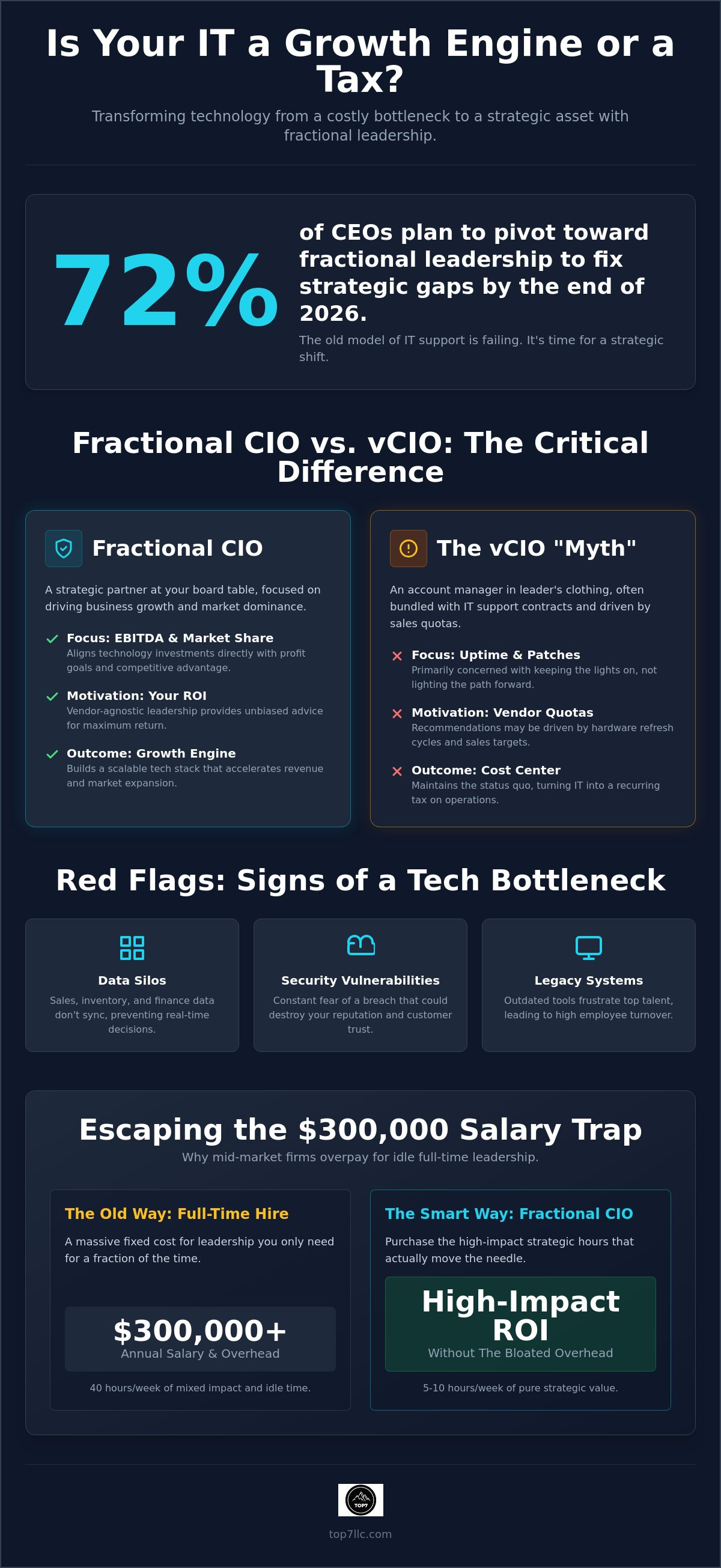
Your current IT support isn't a service. It's a tax on your inability to lead. While you're busy approving invoices for "maintenance" that never seems to end, your competitors are using technology to automate you out of the market. You've likely realized that your IT projects are a black hole for capital, constantly over budget and lagging behind schedule. It's a common pain; in fact, 72% of CEOs are now planning to pivot toward fractional leadership to fix these exact strategic gaps by the end of 2026. You're right to feel that technology should be an accelerator, not a bottleneck.
This article will show you how a fractional chief information officer (cio) removes operational friction and transforms your tech stack from a cost center into a high-velocity growth engine. We'll explore how to build a scalable infrastructure that supports your next five years of expansion while eliminating the constant fear of compliance failures. It's time to stop paying for support and start investing in professional strategy that delivers measurable market dominance.
Table of Contents
Is Your Technology a Growth Engine or an Operational Bottleneck?
Fractional CIO vs. vCIO: Why Most Mid-Market Companies Get It Wrong
The ROI of Strategic Technology Leadership: Beyond Cybersecurity
When to Pull the Trigger: Signs You've Outgrown Your Current Setup
The Top7 Approach: Driving Tech Transformation with Velocity-7
Is Your Technology a Growth Engine or an Operational Bottleneck?
Stop treating IT like a utility bill. Most founders view technology as a necessary evil; something to be managed by a "tech guy" who fixes printers and updates software. This mindset is exactly why your growth has hit a wall. In 2026, technology isn't a support function. It's the foundation of your competitive advantage. If your systems can't handle a 20% spike in sales volume without crashing or requiring manual intervention, you don't have an IT problem. You have a leadership crisis.
This is where a fractional chief information officer (cio) steps in to fix the mess. They aren't here to reset passwords or manage your helpdesk. They're strategic partners who align your digital assets with your profit goals. While your current team focuses on keeping the lights on, a fractional CIO focuses on lighting the path to your next $50M in revenue. They identify the "Growth Stall" before it suffocates your operations, ensuring your tech stack is built for velocity, not just survival.
To better understand this concept, watch this helpful video:
"Good enough" IT is a silent profit killer. Every manual spreadsheet entry, every delayed data sync, and every clunky workflow adds "operational friction." This friction slows down your delivery and frustrates your best customers. By the time you realize your tech stack is outdated, your competitors have already automated their way to your market share. You aren't just losing time; you're losing the war for the customer.
The Symptoms of Technical Friction
Friction doesn't always look like a system crash. Often, it's the data silos that prevent you from making real-time decisions because your sales numbers don't talk to your inventory. It's the security vulnerabilities that keep you awake at night, wondering if a single breach will destroy your reputation. It's also the legacy systems that frustrate your top talent. High employee turnover is frequently a direct result of forcing elite performers to use prehistoric tools. If your tech is a headache, your best people will find a company where it's an asset.
Why Full-Time Payroll Isn't the Answer for Mid-Market Firms
Many mid-market companies fall into the $300,000 salary trap. They think they need a full-time executive to solve these problems, but they end up paying for idle leadership. You don't need a CIO sitting in a corner office 40 hours a week; you need their brain for the five hours that actually matter. There's also a massive "Talent Gap" to consider. Elite technology leaders often prefer fractional work because it offers variety and high-impact challenges. They don't want to be bored by a single company's daily politics. A fractional chief information officer (cio) is a high-impact, part-time strategic leader designed specifically for growing organizations that need executive-level results without the bloated overhead.
Fractional CIO vs. vCIO: Why Most Mid-Market Companies Get It Wrong
You think you have a tech strategist. You actually have a glorified hardware salesperson. Most mid-market firms fall for the "vCIO" trap because it's bundled into their IT support contract. It's a dangerous illusion that costs you more than just money; it costs you time. The fundamental difference lies in where they sit. A vCIO sits in your server room, worrying about uptime and patches. A fractional chief information officer (cio) sits at your board table, worrying about your EBITDA and market share.
The conflict of interest in the vCIO model is staggering. Most vCIOs are account managers for Managed Service Providers (MSPs). Their primary objective isn't your growth; it's maximizing the "share of wallet" they get from your budget. When they suggest a hardware refresh, is it because you need it, or because they have a quarterly quota to hit? A fractional CIO has no horse in that race. They are vendor-agnostic leaders who care only about the ROI of your technology investments. They don't get kickbacks from software vendors, which means their advice is actually worth the paper it's printed on.
The vCIO: A Salesperson in Leader's Clothing
vCIOs have a limited scope that rarely touches your business model or revenue streams. They operate with a "ticket-focused" mindset. If the lights are green and the tickets are closed, they think they've done their job. But what about the manual data entry killing your team's productivity? What about the fragmented customer journey that's driving your churn rate up? A vCIO won't fix those because they don't see them. They prioritize stability over innovation because innovation is risky for their service level agreements. This "free" or low-cost resource is often the most expensive mistake you'll make when it results in years of technical debt.
The Fractional CIO: An Embedded Strategist
A true fractional chief information officer (cio) acts as a permanent, high-impact member of your internal team. They are embedded in your culture and your P&L. They analyze how data flows from your marketing funnel to your fulfillment center to find friction points that cost you money. While a vCIO manages your tickets, a Fractional CIO manages your future. They provide the executive-level accountability that's missing when you outsource leadership to a third-party vendor. If you want to move beyond reactive fixes, you need Strategic Planning that aligns your tech stack with your five-year growth targets.
Accountability is the final straw. When a digital transformation project fails, the vCIO blames the software or your staff. A fractional CIO takes ownership of the outcome. They are there to ensure your technology serves the business, not the other way around. Stop letting a salesperson dictate your digital roadmap from the server room. It's time to bring executive-level intelligence into the room where the real decisions happen.
The ROI of Strategic Technology Leadership: Beyond Cybersecurity
ROI in technology isn't about saving pennies on hardware or finding a cheaper cloud provider. It's about how fast you can pivot when the market shifts. If your systems are brittle and your processes are manual, you're paralyzed. A fractional chief information officer (cio) ensures your infrastructure is a launchpad, not a lead weight. We're talking about building a tech stack that supports 10x growth without requiring a 10x increase in headcount. That is real, measurable profit.
Stop chasing the AI hype that drains capital without delivering results. Most companies burn money on "AI solutions" that solve zero actual business problems. A strategic leader develops a practical AI strategy focused on automation and data orchestration. They ensure your data is clean enough to actually use AI effectively. Without a clean data foundation, your AI investment is just an expensive toy. Scalability means your systems don't break when your sales volume explodes. It means you're ready for the next five years, not just the next five minutes.
Cybersecurity and Compliance as Competitive Advantages
Most CEOs view security as a defensive cost. They're wrong. In high-stakes markets like Dallas or Boston, cybersecurity is a sales enablement tool. If you want to close enterprise deals or pass rigorous financial audits in the fintech sector, you need more than just a firewall. You need "Secure by Design" principles baked into your product roadmap. A fractional chief information officer (cio) prepares you for these audits long before the auditor knocks. This proactive stance does more than protect your brand equity; it lowers your insurance premiums and builds massive trust with your clients. You aren't just defending; you're winning on trust.
Optimizing Data Flow for Executive Decision-Making
Are your managers still wasting hours every Friday on the "Manual Reporting Tax"? If your team is manually merging fragmented spreadsheets to give you a weekly update, your data is already dead by the time you see it. You need a single source of truth, not a collection of guesses. Strategic leadership replaces these silos with real-time dashboards that show your business health in seconds, not weeks. This allows for Strategic Planning based on hard facts rather than gut feelings. When you can see your margins and operational flow in real time, you can make the aggressive moves necessary to dominate your market.
When to Pull the Trigger: Signs You've Outgrown Your Current Setup
If your new platform has been "about to launch" for eighteen months, you don't have a technical delay. You have a leadership failure. Business velocity is the only metric that matters in 2026, and stalled digital transformation is a cancer on your balance sheet. Every month of delay is another month your competitors are eating your lunch. If your internal team keeps hitting walls, it's because they lack the strategic roadmap that only a fractional chief information officer (cio) can provide. You can't fix a structural leadership gap with more "support" tickets.
Tech debt isn't just a nuisance; it's a liability that guts your company's valuation. If you're preparing for an M&A event, your messy, fragmented infrastructure will be the first thing a sophisticated buyer uses to negotiate your price down. They don't see "potential"; they see a massive cleanup bill. Likewise, compliance crises like HIPAA or CMMC are no longer just IT checkboxes. They're legal and operational minefields that can shut you down overnight. If your IT team is overwhelmed by new regulations, you're flying blind. You also need to look at your leadership team's burnout. If your COO is spending 40% of their time playing "Head of IT" because no one else can handle the vendors, you're wasting their executive talent on server patches and software disputes. That is a massive opportunity cost you can't afford.
The "Operational Friction" Audit
You need to measure the cost of your current tech inefficiencies before they become terminal. Start by identifying the "Bottleneck Department" in your organization. Is Sales losing leads because the CRM is too slow? Is Finance stuck in manual reconciliation hell? An operational friction audit quantifies exactly how much market share you're hemorrhaging due to poor systems. Tech debt isn't a technical problem. It's a financial one that requires a strategist to solve. When you eliminate this friction, you don't just improve IT; you increase the entire company's valuation.
Geographic Context: Leadership in US Hubs
Mid-market firms in hubs like Chicago and Austin are already leading the fractional executive trend. They've realized that the talent war for tech leaders in the Northeast and West Coast is a losing game for mid-sized players. Instead of fighting for overpriced, full-time recruits who will leave in two years, these firms are hiring elite fractional talent to drive long-term strategy. Top7 provides this local expertise with a national strategic perspective, ensuring you have the best minds in the country focused on your growth. Stop letting your tech hold you back and contact Top7 to audit your infrastructure for maximum growth.
The Top7 Approach: Driving Tech Transformation with Velocity-7
Most consultants hand you a 200-page PDF and a bill. We hand you a framework for combat. The Velocity-7 Adaptive Framework is designed to move your organization from technical friction to operational flow. When a fractional chief information officer (cio) from Top7 joins your team, they don't sit on the sidelines. They embed directly into your executive suite. We don't just "consult"; we execute. We apply the same agile methodologies that power the world's most successful tech companies to your entire business strategy. This isn't about minor tweaks; it's about a total system upgrade.
You can't wait a year for results. Our 90-day roadmap is a tactical strike on inefficiency. In the first thirty days, we stabilize the ship. By day sixty, we're optimizing the engines and removing the bottlenecks identified in your audit. By day ninety, you have a clear, high-velocity path toward your 2026 growth targets. This isn't theoretical fluff. It's a disciplined, operative approach to winning. We focus on measurable outcomes that show up on your P&L, not just your IT tickets.
How Velocity-7 Solves the Technology Gap
Velocity-7 analyzes the seven dimensions of growth to ensure your tech stack is perfectly aligned with your finance, sales, and operations. We value speed of execution over bloated strategy documents. If a plan takes six months to read, it's already obsolete. This approach often involves close synergy between leadership roles; for instance, a fractional cto might handle the deep technical architecture while the CIO focuses on business outcomes. Together, they bridge the gap between your server room and your boardroom, ensuring your infrastructure supports your sales volume without breaking.
Getting Started: From Friction to Flow
The transformation begins with an initial audit that identifies the low-hanging fruit for immediate ROI. We find the quick wins that fund the larger strategic shifts. We then define your "North Star," which is the exact technological state required to hit your 2026 goals. This isn't about buying more software because a vendor told you to. It's about building a system that wins. A fractional chief information officer (cio) ensures every dollar spent on tech is a dollar spent on market dominance. Stop letting your legacy systems dictate your future. Stop letting tech slow you down. Schedule a call with a Top7 executive today.
Stop Managing IT and Start Leading Your Market
Technology isn't something to be "handled" by a vendor. It's a weapon to be wielded by a leader. You've seen how the wrong setup creates a growth stall that suffocates your revenue. A vCIO is often just an account manager in disguise. In contrast, a fractional chief information officer (cio) is an embedded executive focused on your EBITDA. We've explored how technical friction guts your valuation and why waiting eighteen months for a platform launch is a leadership failure.
Top7 brings seasoned C-suite executives with over 20 years of experience to your board table. We don't offer generic advice. We use our proprietary Velocity-7 Adaptive Framework to turn your infrastructure into a high-velocity engine. We have a proven track record of transforming US mid-market companies from stagnant cost centers into agile market leaders. You don't need more support tickets; you need a roadmap to victory.
Stop overpaying for idle leadership. Start executing with precision. Schedule your Velocity-7 Strategy Audit with a Top7 Executive today. Your future growth depends on the strategic decisions you make right now. You have the vision; we have the framework to make it a reality.
Frequently Asked Questions
What is the difference between a Fractional CIO and a Fractional CTO?
A CIO focuses on internal operational efficiency and business alignment while a CTO focuses on external product technology and technical architecture. The CIO ensures your data flows correctly between departments to drive profit. The CTO ensures the technology you sell or build is scalable and robust. Both roles are essential, but they solve different friction points in your growth engine.
How many hours a week does a Fractional CIO typically work?
Engagements usually range from five to fifteen hours per week depending on your strategic complexity. You aren't paying for a body in a chair for forty hours; you're paying for executive-level decisions that prevent million-dollar mistakes. This model allows you to access elite talent that would otherwise cost $300,000 or more on a full-time payroll.
Can a Fractional CIO help with cybersecurity and compliance?
Yes, they transform security from a defensive cost into a trust-based sales asset. A fractional chief information officer (cio) implements "Secure by Design" principles to help you pass rigorous audits like HIPAA or CMMC. They move your organization beyond basic firewalls and into a state of permanent audit-readiness that protects your brand equity and lowers insurance premiums.
To further support these compliance goals in the medical field, you can explore Infrastructure & Network Services that focus specifically on healthcare data integration and interoperability.
Is a Fractional CIO better than an IT consulting firm?
Consulting firms sell projects and billable hours; fractional leaders sell long-term outcomes and accountability. A consultant delivers a report and leaves the execution to your overwhelmed staff. A fractional leader embeds in your team to drive the execution themselves. They act as your advocate, not a vendor trying to upsell more services.
How does a Fractional CIO integrate with my existing IT team or MSP?
They act as the strategic "command and control" center for all your technical resources. Your MSP handles the tickets and the server room while your CIO ensures those activities actually align with your business goals. They eliminate the conflict of interest inherent in many MSP models by providing unbiased, vendor-agnostic leadership that holds everyone accountable for results. To see how a professional managed service provider can support your infrastructure, find out more.
What is the typical cost structure for a Fractional CIO in 2026?
Most engagements are structured as a monthly retainer based on the scope of your strategic roadmap. This provides predictable budgeting without the massive overhead of executive benefits and equity packages. It's a high-ROI investment that typically pays for itself by eliminating technical debt and automating manual processes that drain your team's time.
Does Top7 provide Fractional CIO services in Dallas and Austin?
Top7 provides elite leadership in major US hubs including Dallas, Austin, Chicago, and Boston. We combine local market expertise with a national strategic perspective to help mid-market firms dominate their respective regions. Our executives understand the specific regulatory and talent landscapes in Texas, ensuring your tech stack is a competitive advantage, not a liability.
How quickly can a Fractional CIO start impacting my business?
Immediate impact occurs within the first thirty days during the initial operational friction audit. By day sixty, we are already neutralizing the most critical bottlenecks in your workflow. By the end of the first ninety days, the Velocity-7 framework has established a clear North Star for your digital transformation, moving your organization from friction to flow.


Comments