
Developing a Competitive Market Position: The C-Suite Execution Guide

Why are you still reacting to your competitors' moves when you should be the one setting the pace? For most mid-market companies, the dream of market dominance is buried under a mountain of operational friction. You've likely felt the frustration of being out-innovated while your internal processes grind to a halt. It's a brutal reality; if you aren't dictating the trends, you're already losing. Developing a competitive market position requires more than a clever slogan. It demands a fundamental shift in how you execute at the C-suite level.
We agree that your current growth trajectory probably doesn't match your true ambition. This guide promises a battle-tested roadmap for market dominance that replaces trend-chasing with strategic authority. You'll discover how to eliminate the operational bottlenecks stalling your progress and implement a scalable leadership model through the Velocity-7 Adaptive Framework. We're going to break down the exact strategic levers needed to stop the bleeding and start winning. It's time to trade operational chaos for precision execution and take your rightful place at the top of the food chain.
Table of Contents
Why Your Current Market Position is Failing (and How to Pivot)
Your marketing slogan is a lie if your operations can't back it up. Positioning isn't about what you say in a boardroom; it's about what you actually deliver to the market every single day. Most businesses fail at market positioning strategies because they treat them as a branding exercise rather than an operational mandate. If your delivery doesn't match your promise, you don't have a position. You have a credibility gap. Developing a competitive market position requires total alignment between your strategy and your execution engine.
Mid-market companies often hit a "Stall Point." They find early success, then stop innovating. They start chasing competitors instead of leading them. This happens because growth introduces operational friction. Friction is the silent killer of market share. It's the reason those expensive consulting reports end up as "shelfware" gathering dust. Without leadership execution, a strategy is just a wish list. Are you winning, or are you just busy?
To better understand the difference between a plan and a true competitive strategy, watch this helpful video:
The Myth of the Static Market Position
Stop thinking of positioning as a one-time project. In 2026, the market moves too fast for fixed strategies. You need an adaptive approach that evolves with real-time data. "Communication Debt" is a massive risk here. When your internal teams aren't aligned with your market promise, your standing erodes from the inside out. Are you still running on a playbook from three years ago? If so, you're already obsolete. Execution velocity is the only thing that keeps you relevant.
Identifying Your Operational Bottlenecks
Is your tech stack an asset or a liability? Many mid-market firms use fragmented systems that stall growth rather than fuel it. When sales promises what operations can't deliver, churn skyrockets. This lack of flow is a direct result of leadership gaps. High-stakes environments require seasoned oversight to ensure every tactical move supports the goal of developing a competitive market position. If your leadership team is reactive, your market position will be too. You can't lead a market if you're constantly putting out internal fires.
The 7 Dimensions of a Dominant Market Position
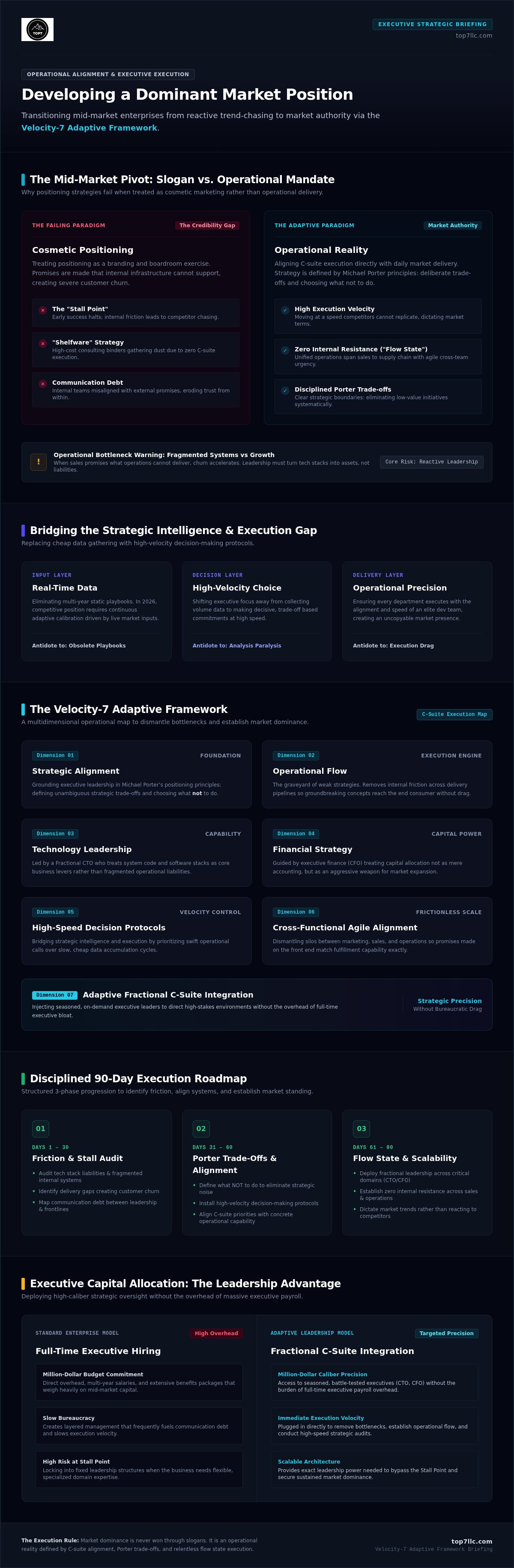
Winning isn't a happy accident. It's the result of a coordinated assault on market friction. To move beyond the stall point, you need a system that aligns your leadership with your operational reality. We use the Velocity-7 Adaptive Framework to dismantle the barriers that keep mid-market companies small. This isn't just another theoretical model. It's a battle-tested methodology for developing a competitive market position by focusing on the seven core dimensions of execution. If your C-suite isn't working from the same map, you aren't leading; you're just managing chaos.
Dimension 1 is Strategic Alignment. Most leadership teams think they're aligned until they're asked to define the trade-offs. True alignment follows Michael Porter’s strategic positioning principles, where choosing what not to do is as vital as choosing what to do. Dimension 2, Operational Flow, is where most strategies go to die. Without a system to remove friction, your best ideas will never reach the customer. Dimensions 3 and 4 focus on Technology Leadership and Financial Strategy. You need a Fractional CTO who sees code as a business lever and a CFO who treats capital allocation as a weapon for growth. If you want to see how these dimensions fit your current structure, our Fractional C-suite experts can help audit your execution velocity.
Moving from Friction to Flow
Flow State isn't just for athletes. For a mid-market organization, it's the point where strategy meets zero internal resistance. Achieving this requires an agile-based transformation that spans the entire business, from sales to supply chain. When every department operates with the same urgency as a high-performing dev team, you stop reacting to the market and start dictating its terms. The Velocity-7 Adaptive Framework acts as the high-speed bridge between abstract strategy and concrete execution.
The Role of Technology in Positioning
Your market position is now inseparable from your tech stack. If your CTO is just "the IT guy," you've already lost. Technology leadership must be a strategic pillar that enables scale and differentiation. Avoid the "Custom Software Trap" at all costs; building bespoke solutions for problems that off-the-shelf tools can solve is a waste of precious capital. Use technology to automate the boring, repetitive tasks. This clears the path for your team to focus on the creative, high-value work that actually moves the needle on developing a competitive market position. Precision in tech leads to dominance in the market.
Strategic Intelligence vs. Tactical Execution
Everyone has data. Your competitors have access to the same AI-powered intelligence reports and market trends that you do. Data is a commodity; execution is a high-stakes competitive advantage. You don't own a market by simply "knowing" it. You own it by out-executing everyone else in the field. This is the foundation of strategic market positioning principles. If your leadership team can't turn insights into tangible results, you aren't a market leader; you're just a well-informed spectator. Developing a competitive market position isn't about who has the prettiest slide deck. It's about who has the most disciplined delivery system.
The Execution Gap: A $2 Trillion Problem
Poor execution and fractured internal communication are more than just annoying; they're a global economic crisis. For many mid-market firms, "Strategy" is often a polite word for wishful thinking. You might have a vision, but without a Fractional COO to act as the architect of tactical execution, that vision will never leave the boardroom. Most strategies fail because they lack an operational bridge. Top7 eliminates this failure point by embedding seasoned professionals directly into your workflow. We don't just suggest a pivot; we execute the turn. This hands-on approach ensures that strategic intelligence actually translates into market dominance.
Building Roadmaps That Actually Sell
Stop building features that nobody asked for. If your roadmap isn't directly tied to revenue, it's a liability. True market dominance requires moving from feature-building to revenue-building. This is where a Fractional CPO becomes your most valuable asset. They align your product development with actual market demand, ensuring every sprint adds measurable value. This level of precision requires more than a standard project manager. You need Advanced Project Management leadership. While a typical manager tracks tasks, an Advanced Project Management specialist tracks velocity and strategic outcomes. They make sure your technical roadmap serves your revenue goals, not the other way around. Is your team building for the sake of building, or are they building to win?
How to Build a Competitive Position in 90 Days
Most consultants want to sell you a two-year transformation plan. You don't have two years. You have 90 days before your competitors make your current strategy irrelevant. Developing a competitive market position isn't a marathon; it's a series of high-intensity sprints designed to strip away operational fat and replace it with execution muscle. If you can't see measurable shifts in your market standing within one fiscal quarter, your strategy is failing. We break this down into three distinct 30-day phases that move you from chaos to total market dictation.
The First 30 Days: Stopping the Bleed
Phase 1 is about the Organizational Audit and Friction Identification. This isn't a "feel-good" survey for your employees. It's a brutal leadership gap analysis to identify exactly where your C-suite is missing vital functions. Are you lacking a CTO who understands revenue, or a COO who understands flow? We look for leakage in your financial and sales strategies that is draining your capital. If the ship is sinking, we don't talk about the paint job; we provide Interim Leadership to stabilize operations immediately. You can't build a dominant position on a fractured foundation.
Phase 2 (Days 31-60) focuses on implementing the Velocity-7 Adaptive Framework. This is the engine that drives your pivot. We stop the reactive firefighting and start embedding systems that prioritize growth. By the end of this phase, your leadership team should be operating from a single, unified map, with every tactical move supporting your new market stance.
Scaling the Framework
Phase 3 (Days 61-90) is where we operationalize the new market position. This is the transition from crisis management to sustainable flow. We embed Fractional Leadership into your existing team without disrupting the culture that made you successful in the first place. These seasoned professionals don't just give advice; they own the outcomes. The 90-day milestone is reached when your internal decision velocity outpaces the market's rate of change, turning your organization into a proactive force that competitors struggle to follow.
Measuring success requires looking beyond the balance sheet. While profit is the ultimate goal, you must track KPIs that indicate long-term dominance. We focus on three critical metrics:
Decision Velocity: How quickly can your C-suite pivot based on new market data?
Friction Reduction: Are operational bottlenecks decreasing month-over-month?
Strategic Alignment: Is every department's roadmap directly contributing to your primary market promise?
If you're ready to stop guessing and start executing, our Fractional C-suite services provide the high-level leadership required to win this 90-day sprint.
Leveraging Fractional Leadership to Solidify Your Market Standing
Stop pretending that hiring a full-time executive is the only way to scale. For most mid-market companies, a traditional C-suite is a structural anchor that drags down agility. You're paying for a massive salary plus benefits and equity, only to realize six months later that the hire is better at protecting their job than growing your business. Developing a competitive market position requires speed and surgical precision, not a bloated payroll. Fractional leadership is the tactical pivot that allows you to access elite talent without the executive overhead. It’s about buying results, not just filling a seat.
The math is simple. You can access over $1 million in collective executive expertise for a fraction of the cost of one full-time hire. This isn't just about saving money; it’s about weaponizing your capital. By leveraging the Velocity-7 Adaptive Framework, you aren't just hiring a person; you're installing a proven operating system for your entire business. This framework moves you from a state of constant operational friction to a permanent state of efficient flow. It’s the difference between struggling to keep up and actually setting the pace for your industry.
Fractional CTO: The Competitive Edge in Tech
Your tech stack should be a revenue engine, not a cost center. Most mid-market firms are trapped in legacy systems or custom software traps because they lack high-level technical oversight. A Fractional CTO provides the strategic vision to outpace your rivals without the massive financial commitment of a full-time role. They ensure your technical roadmap is built to sell, focusing on scalability and market relevance. If your technology isn't actively helping you in developing a competitive market position, it’s a liability that needs to be overhauled immediately.
Your Next Move: Dominance or Decline
The market is a meat grinder that doesn't care about your hiring timeline. While you wait months to find the "perfect" full-time executive, your competitors are eating your market share. Agility is the only currency that matters in 2026. The Velocity-7 Adaptive Framework is the only system designed to help mid-market companies scale at the speed of the modern economy. You have a choice: you can continue to let operational friction stall your growth, or you can take control of your destiny. Schedule a call with a Top7 Executive today and start dictating the terms of your market dominance. The window of opportunity is closing; don't be the one left behind.
Dominate the Market or Be Dictated By It
You have the framework. Developing a competitive market position is no longer a mystery; it is an operational mandate. We have established that market dominance requires moving beyond cheap data and into the realm of high-velocity execution. Whether you are identifying bottlenecks in your first 30 days or scaling through fractional leadership, the goal remains the same. You must turn your strategy into a weapon that competitors cannot replicate. Busy work is not growth, and a plan without a seasoned leader is just a wish.
The time for hesitation has passed. Our proprietary Velocity-7 Adaptive Framework is designed to strip away the friction stalling your mid-market growth. By embedding seasoned C-suite professionals directly into your team, we provide a proven track record in mid-market transformation that traditional consulting cannot match. It is time to stop reacting to industry shifts and start creating them. Stop stalling and start scaling—get your Velocity-7 Audit today. Your future market standing depends on the decisions you make right now. Take command and start winning.
Frequently Asked Questions
What is the most effective way to develop a competitive market position?
The most effective way is to stop chasing trends and start dictating them by aligning your internal operations with your market promise. Developing a competitive market position requires a disciplined execution engine, not just a branding exercise. We use the Velocity-7 Adaptive Framework to ensure every department moves in sync. If your C-suite isn't working from the same tactical map, your strategy will fail before it even hits the market.
How does operational friction impact market positioning?
Operational friction is the silent killer of market share because it creates a gap between what you promise and what you deliver. When internal processes are slow or fractured, you lose your innovative edge to more agile competitors. This friction results in missed opportunities and high customer churn. Eliminating these bottlenecks is essential to maintaining a dominant stance. Without flow, your positioning is just a list of empty promises.
What is the difference between a business consultant and fractional leadership?
Business consultants typically deliver reports and advice that often end up as "shelfware" because they lack an execution plan. Fractional leadership is fundamentally different; our professionals embed directly into your team to own the strategic outcomes. We don't just tell you what is wrong; we fix it. Top7 provides seasoned C-suite experts who manage the transition from operational friction to efficient flow, ensuring your strategy actually produces measurable profit.
Can a fractional CTO help with market positioning?
Absolutely. A Fractional CTO ensures your technology roadmap is a revenue-building asset rather than a cost center. They align your technical infrastructure with your strategic goals, making sure your systems can handle the scale required for developing a competitive market position. By avoiding the "Custom Software Trap" and automating repetitive processes, they free your team to focus on high-value innovation. Tech leadership is a pillar of any modern market strategy.
How long does it take to see results from a new market strategy?
You should start seeing measurable shifts in execution velocity within 90 days. Our phased approach focuses on stopping the bleed in the first month and implementing the Velocity-7 Adaptive Framework by the second. By the third month, your new market position should be fully operationalized. If a consultant tells you it takes two years to see a change, they're just protecting their retainer. We focus on rapid, high-impact pivots.
Is the Velocity-7 Framework suitable for my industry?
The Velocity-7 Adaptive Framework is built for mid-market companies facing growth obstacles, regardless of their specific sector. It is a universal "operating system" for businesses that need to move from friction to flow. Whether you are in manufacturing, SaaS, or professional services, the core dimensions of strategic alignment and operational execution remain the same. If your organization has leadership gaps or stalling growth, this framework is designed to fix those specific failure points.
Why do mid-market companies struggle with competitive positioning?
Mid-market firms often hit a "Stall Point" where the systems that got them to $10M won't get them to $50M. They struggle because they lack the high-level strategic leadership needed to navigate complex growth phases. Without a Fractional COO or CFO, these companies become reactive, chasing competitor moves instead of dictating the market. This lack of leadership velocity makes it impossible to maintain a defensible and dominant position over time.
How much does it cost to implement a fractional leadership model?
Implementation costs are structured through monthly retainer fees or project-based consulting fees, depending on the scope of your transformation. This model allows you to access elite C-suite expertise for a fraction of the cost of a full-time executive salary. You avoid the massive overhead of benefits, equity, and bonuses while gaining immediate strategic precision. Our focus is on profit maximization and ROI rather than just filling a headcount on the organizational chart.


Comments