
Creating a Product Roadmap That Aligns With Business Goals

What if your product roadmap creates motion without moving the business forward? Creating a product roadmap that aligns with business goals means linking major initiatives to meaningful outcomes, not filling a timeline with features and deadlines. When priorities collide and stakeholders lobby for their own requests, the problem often isn’t a lack of ideas. It’s a lack of clear decision rules.
A roadmap should make those rules visible. It should show how product work supports company objectives, where customer value comes from, and what your team can realistically deliver. It should also leave room to respond when evidence changes, without losing its strategic direction. Markets shift, capacity changes, and new information can make yesterday’s plan less relevant.
This guide explains how to translate business objectives into measurable product outcomes, compare initiatives against customer value and delivery capacity, and communicate trade-offs so stakeholders can make decisions together. You’ll also learn how to review and adapt the roadmap as new information arrives. The result is a practical decision system that keeps execution focused on what matters, not simply what’s next on the feature list.
Table of Contents
Why a Product Roadmap Must Start With Business Goals
Teams can ship polished features and still miss the company’s priorities. A sales request gets added, an executive idea moves to the front, and engineering delivers against a packed schedule. But if those releases don’t improve a business result, the team has spent capacity without making strategic progress. The first test of a roadmap isn’t how much work it contains. It’s whether each major choice has a clear reason to exist.
A business-aligned product roadmap connects company goals to product outcomes and the initiatives chosen to improve them. It’s a communication and decision tool, not a guaranteed delivery contract. Its purpose is to show what the team aims to change, why that matters, and how current choices support the company’s direction. Dates can help with coordination, but they shouldn’t turn uncertain work into a fixed promise.
Keep the roadmap distinct from the documents that support execution. A backlog captures possible work and details for the team to assess. A release calendar communicates when planned releases are expected. A project plan tracks tasks, owners, and dependencies for a defined effort. The roadmap sits above them: it explains why certain problems deserve investment and how the work contributes to company priorities. Confusing these tools can make a roadmap look precise while obscuring whether the work matters.
What a business-aligned product roadmap actually shows
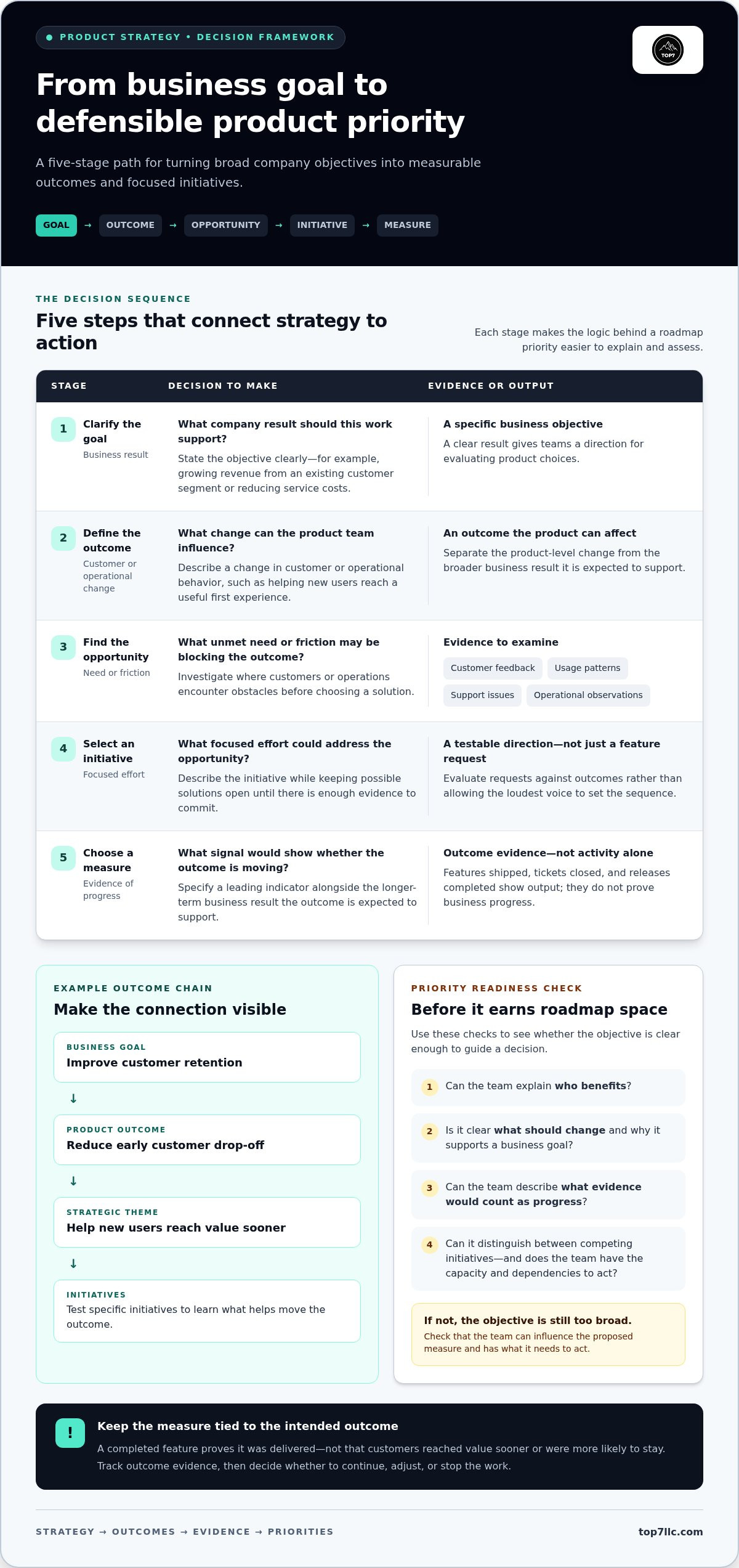
Make the logic visible: a business goal leads to a desired product outcome, which informs a strategic theme and the initiatives that could move the outcome. For example, if the goal is to improve customer retention, an outcome might be reducing early customer drop-off. A theme could focus on helping new users reach value sooner. The team can then test specific initiatives to find out what helps.
Set the level of detail and time horizon to match the uncertainty and the audience. Leaders may need strategic direction and trade-offs, while delivery teams need enough context to plan near-term work. A useful roadmap also makes exclusions legible. If an initiative doesn’t support a priority outcome, the team can defer it rather than quietly absorbing another request.
Why feature-first roadmaps lose strategic focus
A list of requested features gives competing stakeholders equal visual weight, even when their proposals serve different goals or lack evidence. The result can be diluted investment and repeated priority conflicts. Creating a product roadmap that aligns with business goals requires evaluating requests against outcomes, rather than letting the loudest voice set the sequence.
Activity measures such as features shipped, tickets closed, or releases completed show output, not business progress. A completed onboarding feature proves the team delivered it. It doesn’t prove new users understand the product sooner or are more likely to stay. Track evidence tied to the intended outcome, then use what you learn to decide whether to continue, adjust, or stop the work.
Translate Business Objectives Into Product Outcomes and Priorities
A company goal like “grow the business” gives a product team no useful decision rule. Which customers? What needs to change in their experience? How will the team know its work contributed? Creating a product roadmap that aligns with business goals means turning broad ambition into outcomes teams can influence, then choosing initiatives based on evidence and available capacity. Forrester makes a similar case for aligning product portfolio strategy with business strategy: product choices need to support the direction the business intends to pursue.
Use this sequence to move from strategy to a defensible product priority:
Clarify the business goal. State the company result the work supports, such as growing revenue from an existing customer segment or reducing service costs.
Define the product outcome. Identify a change in customer or operational behavior the product team can influence, such as helping new users reach a useful first experience.
Identify the opportunity. Find the unmet need or friction that may be preventing that outcome. Use customer feedback, usage patterns, support issues, or operational observations as evidence.
Select an initiative. Describe a focused effort to address the opportunity, while keeping possible solutions open until the team has enough evidence to commit.
Choose a measure. Specify a leading indicator that can show whether the outcome is moving, alongside the longer-term business result it is expected to support.
Test the objective before it earns space on the roadmap. Can the team explain who benefits, what should change, why that change supports a business goal, and what evidence would count as progress? If the objective can’t help you distinguish between two competing initiatives, it’s still too broad. Also check whether the team can influence the proposed measure and has the capacity and dependencies needed to act.
Turn company goals into measurable product outcomes
Business results such as revenue growth or lower support costs are often lagging indicators. They matter, but product teams may need to influence nearer-term behaviors first. If the goal is stronger retention, a product outcome might focus on helping customers complete a recurring task successfully. An Objectives and Key Results (OKR) structure can make this connection explicit: the objective states the change to pursue, while key results define observable evidence of progress. Keep the relationship clear. A product outcome can contribute to a business result, but doesn’t guarantee it.
Connect opportunities to initiatives without jumping to features
Start with a problem, not a preselected feature. A proposed dashboard, for example, is only a solution hypothesis. First identify which audience struggles to understand its progress, what evidence supports that observation, and how better understanding could change behavior. Then compare possible initiatives against customer value, strategic fit, evidence strength, and delivery capacity. An initiative earns its place when there’s a credible path from solving a real problem to improving a defined business outcome.
Product-market fit learning can sharpen that path: patterns in customer behavior and feedback help teams test whether an opportunity reflects a real need. Strategic planning and fractional technology leadership can also help connect product choices to business priorities and execution. Top7’s strategic planning support helps leadership teams make those connections explicit.
Choose a Roadmap Format That Fits Uncertainty and Stakeholder Needs
A roadmap format should make decisions easier, not force every initiative into a level of certainty you don’t have. Choose the view that fits the work, the audience, and what’s known. An early-stage initiative may have a clear outcome but an untested solution. A cross-team investment may need a shared strategic theme. A launch tied to an operational dependency may require a date. One roadmap can combine these views, as long as its labels don’t disguise assumptions as promises.
Use this comparison to choose the right emphasis:
Outcome-based: Organizes work around changes the product aims to achieve. It keeps attention on results and supports discovery when the solution is uncertain. The trade-off is that stakeholders may want more delivery detail than this view provides. Use it when learning and testing options matter more than committing to specific features.
Theme-based: Groups initiatives under strategic investment areas, such as improving onboarding or reducing operational friction. It helps teams and stakeholders understand where effort is going without prematurely specifying every solution. The risk is that vague themes become labels with no clear outcome. Pair each theme with a defined intent and evidence of progress.
Time-based: Places initiatives or expected releases along a timeline. It helps coordinate dependencies, operational needs, and genuine commitments. The risk is false precision: uncertain work can look guaranteed simply because it has a date. Use dates selectively, and show whether they’re targets, dependencies, or firm commitments.
Flexibility isn’t a lack of accountability. Accountability comes from keeping intended outcomes, decision owners, assumptions, and reasons for changes visible. A roadmap can adapt without losing credibility when stakeholders can see what changed, what evidence prompted the change, and which trade-off followed.
Choose the view that matches uncertainty
Creating a product roadmap that aligns with business goals doesn’t require one format for every audience. Executives may need themes and outcomes to assess strategic investment; delivery teams may need nearer-term initiatives and dependencies. If the solution is still being explored, avoid presenting a feature and date as settled. If a launch depends on another team or an external event, make that constraint explicit rather than burying it in a broad theme.
Make trade-offs without turning scores into false certainty
Compare proposed work using customer value, strategic fit, confidence in the evidence, effort, risk, and available delivery capacity. RICE can structure the discussion by considering reach, impact, confidence, and effort. It’s a decision aid, not an automatic ranking machine. A score can expose assumptions, but it can’t make weak evidence strong or resolve strategic disagreements on its own. Challenge the inputs before treating the result as meaningful.
When work is deferred, record the reason: limited capacity, weaker evidence, lower strategic fit, or a dependency that isn’t ready. Note what would justify reconsidering it. This gives stakeholders a clear explanation and a condition for review, rather than leaving a rejected request to reappear as an unexplained escalation.
Build the Roadmap in Five Steps and Keep It Executable
A roadmap only matters if the team can act on it. Creating a product roadmap that aligns with business goals takes more than arranging initiatives on a timeline. Build a clear chain from company priorities to evidence, choices, and available capacity, then communicate what the plan does and doesn’t promise.
Align on goals. Confirm which business objectives product work should support. Resolve conflicting goals before they become competing commitments.
Gather evidence. Bring together customer signals, product data, operational feedback, and technical constraints. Separate observed facts from assumptions.
Prioritize initiatives. Compare opportunities by strategic fit, customer value, confidence, risk, and effort. Make the trade-offs visible.
Map the initiatives. Place selected work in a sequence that reflects what needs to happen first. Keep uncertain work at a broader level than well-understood work.
Validate capacity. Review team availability, existing commitments, dependencies, and technical constraints before sharing timing or delivery expectations.
Give every initiative enough context to support a decision: its intended outcome, rationale, accountable owner, dependencies, and assumptions. A proposal to improve onboarding, for example, should identify the user group it targets and the evidence suggesting onboarding is a barrier. Record assumptions that still need testing, and don’t present them as established facts.
Validate priorities against evidence and delivery capacity
Before sequencing work, check whether customer signals support the opportunity, whether it advances a strategic goal, and whether technical constraints or cross-team dependencies could change the effort. Ask the teams involved to identify competing commitments and when they can realistically contribute. Roadmap confidence should rise with the strength of the evidence, not with the pressure to promise a date.
Separate committed work from exploratory bets and longer-range possibilities. A committed initiative has a clear owner and known constraints. An exploratory bet needs learning before a delivery promise. A longer-range possibility remains conditional on future evidence, capacity, or dependencies.
Communicate decisions without creating false promises
Tailor the roadmap view to its audience. Executives need the outcomes, strategic choices, and major risks. Product teams need the problem, evidence, assumptions, and decision conditions. Delivery partners need sequencing, ownership, and dependencies that affect coordination. Keep one underlying plan, but show each group the detail it needs to make decisions.
Use plain language to state the intended outcome, confidence level, and what could change the plan. For example: “We’re exploring ways to help new users complete setup; we’ll decide on a solution after reviewing user feedback and technical feasibility.” Reprioritize when goals shift, evidence contradicts the case, a dependency changes, or capacity is materially different. That’s disciplined adaptation, not churn.
Top7 provides strategic and technology leadership to help connect strategic choices with executable work. Learn about Top7’s strategic and technology leadership.
Govern and Adapt the Product Roadmap as Business Goals Change
A roadmap needs governance, not constant executive edits. Without clear ownership, every stakeholder can push a request into the plan, and nobody is accountable for the trade-offs. Set rules for who maintains the roadmap, who can recommend changes, and who makes final priority decisions. The product lead may coordinate evidence and proposals, while designated business leaders resolve conflicts affecting company objectives or resource commitments.
Choose a review cadence that matches how quickly goals and evidence can change. A regular review gives teams a predictable moment to assess progress, but shouldn’t prevent a response to a material shift between reviews. Trigger a review when business goals change, customer evidence challenges an assumption, a dependency moves, or team capacity shifts. Don’t churn the roadmap just to make it look active.
Set clear review rules and measures of progress
Review outcome signals, assumptions, delivery risks, and strategic relevance together. Ask whether the initiative is producing evidence of progress toward its intended outcome, not merely whether the team shipped what it planned. A release can be complete while the customer behavior or business result it was meant to influence remains unchanged. Treat that gap as useful information: investigate, adjust the approach, or stop investing.
Make decision rights explicit. Teams closest to the work can surface new evidence and recommend adjustments; the agreed decision-maker resolves priority conflicts and records the decision. A simple decision log should capture what changed, why, who decided, and which outcomes or assumptions were affected. That record prevents old debates from resurfacing without new evidence and helps teams understand the reasoning behind current priorities.
Bring in fractional technology leadership when alignment stalls
Alignment often breaks down between business ambition and technology execution. A Fractional CTO can connect business objectives with technology choices, delivery priorities, and constraints, helping leaders make trade-offs with a clearer view of execution. Top7’s Velocity-7 Adaptive Framework supports organizations seeking to reduce operational friction and improve flow through agile-based transformation. This leadership can be especially relevant when priorities keep changing but ownership, decision-making, or coordination across teams remains unclear.
Use roadmap reviews to ask three direct questions: Is the outcome still important? Does the evidence still support this initiative? Can the organization deliver it without undermining a higher priority? If the answer changes, update the plan and explain the decision. Creating a product roadmap that aligns with business goals is an ongoing discipline: preserve the strategic direction, but change course when facts justify it.
Top7’s strategic and fractional leadership support helps connect business priorities with technology decisions and execution. Explore Top7’s strategic and fractional leadership support.
Make Your Next Roadmap Decision Count
Your next planning cycle is a chance to test whether strategy is shaping real choices. Pick one upcoming decision and make its business rationale unmistakable: what opportunity matters, what evidence supports it, and what would make you change course? That discipline turns roadmap governance into a repeatable practice, not a document-building exercise. Creating a product roadmap that aligns with business goals is ongoing work. Keep asking whether the plan reflects what the organization knows now, rather than what it assumed months ago.
When priorities stall between business ambition and technology execution, experienced leadership can help restore alignment. Top7 embeds seasoned professionals with client teams, bringing strategic focus into the work where decisions and delivery meet. Explore Top7’s fractional technology leadership and strategic planning to strengthen that connection.
Start with the next decision. Make the rationale clear, keep learning, and give your team a roadmap that helps it move forward with confidence.
Frequently Asked Questions
Is a product roadmap the same as a product backlog?
No. A roadmap communicates strategic direction and the outcomes product work is meant to support; a backlog holds detailed tasks, requests, and potential work teams may consider or deliver. For example, a roadmap might identify improving self-service as a priority, while the backlog contains possible changes to help articles, navigation, or support workflows. Use the roadmap to explain why the work matters and the backlog to manage its execution.
Can a product roadmap change after it has been shared with stakeholders?
Yes. A roadmap should change when new evidence or business conditions make the current plan less relevant. If customer research reveals that a planned improvement addresses the wrong problem, revisit the initiative rather than defending it simply because it was presented. Explain what changed, the evidence behind the decision, and how the adjustment affects expectations. Stakeholders can handle change; unexplained change is what erodes trust.
How often should a product roadmap be reviewed?
Review it on a regular schedule that fits the organization’s planning and decision-making rhythm, and revisit it sooner when a meaningful trigger arises. For example, a sudden change in a major customer need may justify an immediate discussion, while routine delivery updates can wait for the next review. Avoid changing priorities every time someone raises a new request. The goal is timely decisions, not constant motion.
What should a product roadmap include?
A useful roadmap typically includes the business objective, intended product outcomes, strategic themes or initiatives, measures of progress, and enough sequencing to support decisions. Add owners, key dependencies, assumptions, and confidence where they help people understand what could affect delivery. Creating a product roadmap that aligns with business goals also means making trade-offs understandable: readers should be able to see why important work is included and what conditions might cause it to change.
How do you prioritize product roadmap ideas when stakeholders disagree?
Bring each proposal back to a shared decision standard: which business objective does it support, what customer or operational need does it address, and what evidence backs the case? Then compare proposals against capacity, risk, and strategic value. If two ideas still compete, name the decision-maker and document the trade-off. For instance, a request that protects a key customer may outrank a broader enhancement if the evidence supports that choice.
Should a product roadmap include technical debt?
Yes, when unresolved technical debt creates meaningful risk or limits the product’s ability to deliver important outcomes. Make the impact clear, such as slower changes to a critical workflow, increased operational fragility, or a dependency blocking planned work. Avoid listing technical cleanup as a goal in itself. Connect it to the business or customer consequence, estimate the effort with the delivery team, and weigh it against other priorities.
Can a small business benefit from a product roadmap?
Yes. A small business often has limited people and time, which makes clear choices especially valuable. A lightweight roadmap can fit on a single page and focus on the few outcomes that matter most, the next initiatives under consideration, and the work being deliberately deferred. It can help founders and teams avoid treating every customer request as an immediate commitment while keeping product decisions connected to growth and operational needs.



Comments