
Business Consulting Firm: Turn Strategic Advice into Measurable Execution

If you are looking for a reliable business consulting partner to help you solve critical challenges, start with the specific problem your organization needs to address. What’s the value of a sharp strategy if nobody owns the next move? When growth stalls, operations pull leaders into the weeds, or past advice never becomes action, another report won’t fix the problem. The right consulting partner connects clear diagnosis with accountable execution.
You’re right to expect more than recommendations. Useful support starts by identifying the obstacle, then brings in the judgment and hands-on leadership needed to move work forward, without automatically adding a full-time executive to payroll. The difference shows up in clearer ownership, better decisions, and progress the team can track.
This article will help you pinpoint the business problem that needs attention, assess what effective consulting support looks like, and turn strategic advice into action. You’ll see how fractional executive leadership and advanced project management can bridge the gap between a plan and its execution. You’ll also learn how Top7’s Velocity-7 Adaptive Framework supports agile-based transformation, helping teams address operational friction and build more efficient workflows. Start with the real bottleneck, not a generic wish to “grow.”
Key Takeaways
Spot when stalled growth, unclear priorities, or leadership gaps point to a business constraint that needs focused support.
Separate visible symptoms from root causes by tracing where work, information, or decisions repeatedly stall.
Distinguish advice from execution support, and clarify how outside expertise can help while your team retains ownership.
Before work begins, define the intended outcome, scope, owners, decision rights, and review cadence.
Explore how Top7 combines strategic guidance, fractional leadership, and its Velocity-7 Adaptive Framework to address operational friction.
Business Consulting Firm Philadelphia: What This Guide Covers
When Does a Business Need a Consulting Firm? Identify the Cost of Staying Stuck
How to Diagnose the Business Constraint Before Choosing a Consulting Approach
Consulting Advice vs. Embedded Execution: What Actually Moves Work Forward?
What a Strong Consulting Engagement Should Clarify Before Work Begins
How Top7 Connects Business Strategy, Fractional Leadership, and Execution
When Does a Business Need a Consulting Firm? Identify the Cost of Staying Stuck
Growth has stalled. Priorities keep shifting. A key initiative sits in limbo while leaders spend their days untangling operational friction. These aren’t just frustrating moments. If the same delays keep returning or several teams are affected, the business may be facing a constraint that internal effort hasn’t resolved.
A business consulting firm helps organizations diagnose challenges and determine how to address them. Useful consulting doesn’t begin with a preset service or framework. It starts with the outcome the business needs, then identifies what is blocking progress. That distinction matters: solving the wrong problem can consume time without changing the result.
For a broader overview of management consulting, see how the discipline centers on helping organizations analyze and address business challenges. The practical test is whether that analysis leads to better decisions and action.
This video offers another perspective on how technology is changing the consulting industry:
Which business problems warrant outside expertise?
Look for recurring friction that consumes leadership attention or delays decisions with consequences across the business. A temporary symptom might be one missed handoff or a short-lived backlog. A systemic constraint repeats: teams wait for the same approval, rely on incomplete information, or work around the same process breakdown. When the pattern crosses departments, examine the system, not just the latest incident.
Hypothetical example: A company’s sales pipeline grows, but orders take too long to fulfill. Sales forecasts don’t match available capacity, financial planning lacks reliable operating data, and technology systems don’t give teams a shared view of demand. The visible problem may look like slow delivery. The underlying constraint could involve disconnected decisions and processes across sales, finance, technology, and operations. Outside expertise can help leaders trace those connections and decide where to act first. This is an illustrative scenario, not a Top7 client result.
What does a business consulting firm actually do?
Consulting should make a difficult problem clearer and help leaders move from uncertainty to decisions. That can include examining how work flows, identifying where decisions stall, weighing options, and clarifying what capability or ownership is missing. Advisory input can inform a choice; execution support helps leaders put that choice into practice, coordinate next steps, and keep attention on the intended outcome.
Top7 combines strategic guidance with execution support, including fractional executive leadership and advanced project management. This can bring focused expertise to a complex obstacle without assuming the organization needs another full-time executive. When evaluating consulting support, ask whether it will address the actual business problem and help advance the work.
Consulting earns its place when it turns a business problem into clear decisions, accountable action, and forward movement. Start with the outcome you need. Then determine whether the constraint calls for sharper diagnosis, executive judgment, or hands-on support to move the work forward.
How to Diagnose the Business Constraint Before Choosing a Consulting Approach
Don’t pick a consulting approach before you can name the problem it must solve. Start with a clear outcome, then trace what’s blocking it. This keeps the work focused on the business constraint rather than the most visible symptom or a familiar solution.
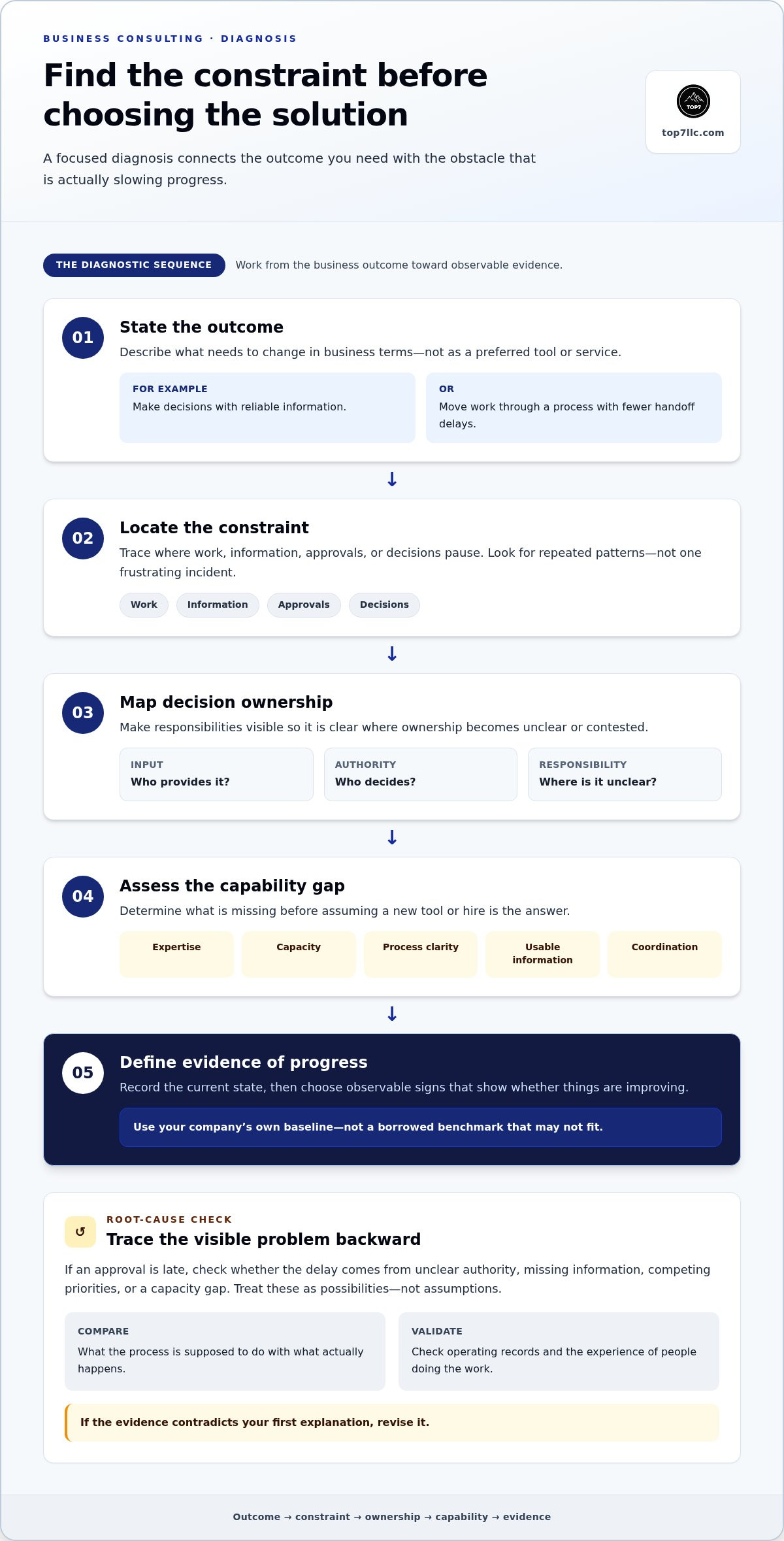
Use this sequence to prepare for a useful diagnosis:
State the outcome. Describe what needs to change in business terms, such as making decisions with reliable information or moving work through a process with fewer handoff delays.
Locate the constraint. Trace where work, information, approvals, or decisions pause. Look for repeated patterns, not a single frustrating incident.
Map decision ownership. Identify who provides input, who has authority to decide, and where responsibility becomes unclear or contested.
Assess capability. Determine whether the gap is expertise, capacity, process clarity, usable information, or coordination. Don’t assume a new tool or hire is the answer.
Define evidence. Record the current state and choose observable signs of progress. Use the company’s own baseline, not a borrowed benchmark that may not fit.
How do you distinguish a symptom from a root cause?
Trace the visible problem backward through the decisions, processes, resources, and technology involved. If an approval is late, for example, find out whether the delay comes from unclear authority, missing information, competing priorities, or a capacity gap. Any of these could contribute; none should be assumed without evidence.
Test your explanation against operating records and the experience of people doing the work. Compare what the process is supposed to do with what actually happens, and ask teams where they wait, repeat work, or rely on workarounds. If the evidence contradicts the first explanation, revise it. A clearly defined constraint turns consulting from broad advice into focused decisions and accountable action.
Which outcomes should the engagement define?
Connect the desired result to an owner, the decisions needed to reach it, and indicators that can be observed. Set a baseline using information the business already tracks or can reliably capture. State the measurement method and review point so the team can tell whether movement is real, without setting a target before understanding the starting point.
Separate leading indicators from lagging results. A leading indicator might be whether a required handoff is completed with the information needed to proceed. A lagging result could be whether the broader business outcome, such as delivery reliability or financial performance, changes. The right measures depend on the constraint; a metric that tracks activity alone may not show whether the problem is being solved.
Use this diagnostic sequence to make an initial discussion with Top7 more focused. A focused strategy discussion can help connect the obstacle you’ve identified with the expertise and execution support the work requires. Define the problem first, then choose the approach that fits.
Consulting Advice vs. Embedded Execution: What Actually Moves Work Forward?
A recommendation can be clear and logical, yet still sit untouched. The difference between advice and execution support is not whether the strategy is smart. It’s whether the organization has the ownership, capacity, and expertise to act on it.
Advice-led consulting can be the right fit when leaders understand the issue, have the authority to make decisions, and can assign internal people to carry out the work. The consultant brings analysis and perspective; the company owns implementation. This approach avoids adding support the business doesn’t need.
Execution support matters when the obstacle is not just knowing what to do. Work may cross teams without a clear coordinator, decisions may lack an accountable owner, or leaders may not have the specific expertise or capacity to move an initiative forward. In those cases, guidance connected to implementation can help turn priorities into assigned actions and keep decisions moving.
When is strategic advice enough, and when is execution support needed?
Match the approach to the constraint. If the team has the skill, authority, and time to act, advice and a practical roadmap may be sufficient. If coordination or follow-through repeatedly breaks down, additional execution support may help. Neither model is automatically superior, and not every project calls for an outside leader embedded with the team.
Before choosing, ask: Who will own each action after the recommendation is delivered? Do they have the time and authority to do it? What decisions remain unresolved? Clear answers suggest the work can stay primarily internal. Gaps point to where outside expertise or project management could add capacity. The company still retains responsibility for its goals, people, and final decisions.
How can fractional leadership close an executive capability gap?
Fractional leadership provides part-time executive expertise for a defined business need, rather than adding a full-time executive role by default. A fractional CTO, for example, can bring technology leadership to decisions about priorities, risks, and how technology supports business goals. This is executive guidance, not custom software development.
The right arrangement depends on the capability gap. A fractional COO may help leaders address operating priorities, while a fractional CFO can provide financial leadership. In each case, internal teams remain central to delivery and contribute the company knowledge an outside executive needs to make sound decisions.
Fractional leadership gives a business access to executive judgment without making a permanent executive hire the default answer. It doesn’t replace every internal role. Its value depends on a defined responsibility, clear decision rights, and collaboration with the people who will carry work forward.
Top7 connects strategic guidance with fractional leadership and advanced project management when an obstacle needs both direction and execution support. The practical test is simple: choose advice when your team can own the next moves; add execution support when expertise, coordination, or accountability is the constraint. Keep ownership clear, and match the support to the work.
What a Strong Consulting Engagement Should Clarify Before Work Begins
A consulting engagement shouldn’t start with a vague mandate to “improve operations” or “support growth.” Before work begins, both sides need a shared definition of the problem, the intended outcome, what falls within scope, who owns the work, who can make decisions, and how progress will be reviewed. These details turn a good intention into an operating agreement.
A useful roadmap connects priorities to owners and outcomes. Each priority should lead to a practical next action, a person responsible for moving it forward, and a way to assess whether it’s helping. A useful consulting roadmap is prioritized work with clear owners, practical next actions, and outcomes the team can evaluate.
How should scope, roles, and decision rights be defined?
Name the executive sponsor who protects the purpose of the work, the day-to-day owners who coordinate it, and the decision-makers who can resolve trade-offs. Identify the teams affected, too. If a decision needs input from one group but approval from another, make that distinction explicit. Otherwise, work can stall while people wait for authority they thought someone else had.
Scope should describe what the engagement will address, what it won’t, and how new issues will be handled. This isn’t red tape. It stops the work from expanding through a series of unexamined requests. If evidence reveals a related obstacle, the sponsor and decision-makers can decide whether to adjust priorities, change the scope, or handle it separately. Top7 tailors strategic and execution support to the project and leadership needs, rather than treating every business challenge as identical.
How should leaders track progress without confusing activity for impact?
Tasks completed show that work happened. They don’t necessarily show that the underlying constraint is improving. Track both: what the team delivered and what changed in the process or business outcome the work was intended to affect. For example, completing a process-mapping exercise is an activity; an illustrative indicator of progress might be fewer repeated handoffs or less time waiting for a decision. These are examples to adapt, not promised client results.
Set a review cadence that gives owners a regular moment to surface blockers and make decisions. At each review, examine measures against the starting point, check risks and dependencies, and identify decisions that need escalation. If the evidence shifts, adjust the roadmap deliberately. Don’t keep advancing a task simply because it was on the original plan.
When comparing a business consulting firm philadelphia search result, use these engagement basics to assess whether proposed work has clear boundaries and practical accountability. If you’re ready to define the scope, owners, and progress reviews around a business obstacle, start a conversation with Top7.
How Top7 Connects Business Strategy, Fractional Leadership, and Execution
Strategy creates value when it changes what the organization does next. Top7 brings strategic guidance and execution support together around the obstacle a business needs to address. Support may involve clarifying priorities, adding executive expertise, coordinating complex work, or combining these elements. The starting point is the business challenge, not a predetermined package.
This connection matters when a company can identify a problem but lacks the leadership capacity, specialist perspective, or coordination to move a response forward. Top7 can provide fractional executive leadership or advanced project management to support the work, while the organization’s leaders and teams remain involved in decisions and delivery. The right mix depends on the obstacle and the outcome the business is pursuing.
How does the Velocity-7 Adaptive Framework support transformation?
Top7’s proprietary Velocity-7 Adaptive Framework is its agile-based approach to transformation. It focuses on helping organizations move from operational friction toward more efficient flow. The framework is relevant when the challenge involves how work moves through the organization, where processes create drag, or how teams adapt as they address a complex business obstacle.
Adaptive transformation means responding to what the work reveals, rather than treating an initial plan as untouchable. The framework gives Top7 an approach for supporting that effort, while its application depends on the organization’s situation. It isn’t a guarantee of results or a fixed sequence that applies identically to every business.
How can leadership and project support fit the obstacle?
Different constraints call for different kinds of support. A business facing technology-related leadership decisions may benefit from fractional CTO expertise. If the issue centers on operating coordination, a fractional COO may be relevant; a need for broader executive direction may call for fractional CEO leadership. These roles add leadership perspective and decision support, not an assumption that every company needs a permanent executive or outside help in every function.
Advanced project management can help coordinate work when initiatives depend on multiple owners, decisions, or teams. Strategic planning can help leaders set direction, while interim leadership can support an organization that needs leadership capacity during a transition. These forms of support can stand alone or work together, depending on what will help the organization address its challenge. A search for a business consulting firm philadelphia should lead to this practical question: what capability does the obstacle demand, and how will support connect to action?
What is the next step toward working with Top7?
Bring three things into the discussion: the obstacle, the teams or decisions it affects, and the business outcome you need. You don’t need a polished project plan. A clear account of where progress stalls is a useful starting point. Top7 can discuss how strategic guidance, fractional leadership, interim leadership, advanced project management, or a combination can address the challenge.
If the problem is consuming leadership attention or keeping a priority from advancing, don’t let the next step stay vague. Discuss your business challenge with Top7 and identify the support that can move the work forward.
Make the Next Move Count
The next step isn’t to commission a grand plan. Choose one business obstacle that keeps progress from moving, name the outcome that would make a difference, and decide who needs to own the next action. That focus turns a search for a business consulting firm philadelphia into a more useful question: what kind of support will help your company move forward?
Top7 connects strategic guidance with execution support, drawing on fractional executive leadership and advanced project management when the challenge calls for added expertise or coordination. Its proprietary Velocity-7 Adaptive Framework offers an agile-based approach to addressing operational friction. The goal is to fit the work to the obstacle, not force your business into a generic playbook.
You don’t need every answer before taking the first step. Bring the challenge, the people it affects, and the outcome you want to pursue. Discuss the business challenge holding your company back, and start shaping a practical path forward.
Frequently Asked Questions
What does a business consulting firm do?
A business consulting firm helps an organization address a challenge and make progress toward a defined outcome. For example, if customer demand is rising but delivery is inconsistent, a consulting partner can help leaders examine how decisions, staffing, and processes interact. The support might focus on strategic choices, leadership input, or coordinating implementation. Judge the work by whether it helps the business make better decisions and advance a priority, not by the length of the report.
How do I know if my business needs a consultant?
Consider outside support when a consequential issue keeps returning, your team can’t pinpoint why, or internal leaders lack the expertise or capacity to act. A search for a business consulting firm philadelphia should lead to an evaluation of the business problem, not just a comparison of service labels. Note what the issue disrupts, who is affected, and what has already been tried. Those details can help reveal whether an outside perspective could change the course of the work.
How much does a business consulting firm cost?
Consulting fees depend on the challenge, scope, level of leadership involvement, and structure of the engagement. A defined strategic planning project differs from ongoing fractional leadership or interim management, so a generic figure may not help you budget accurately. Before discussing fees, clarify the outcome you need, the responsibilities involved, and where the work begins and ends. Top7 offers project-based consulting, monthly retainers for fractional leadership, and interim management engagements, with the fee structure tied to the type and scope of support.
What is the difference between a consultant and a fractional executive?
A consultant typically brings expertise to a defined business issue, while a fractional executive provides part-time leadership within a specific executive function. For instance, a company weighing technology priorities may need a fractional CTO’s leadership perspective, while a focused assessment may call for consulting input. Some challenges call for both. The practical distinction is whether the business needs help evaluating a particular issue, ongoing executive judgment, or support that connects both to action.
How long does a business consulting engagement take?
Engagement length depends on the work, so there isn’t one duration that fits every business. A focused assessment may have a different rhythm from strategic planning or ongoing fractional leadership. Set milestones around decisions and deliverables, then review whether the work is addressing the original need. If new information changes the scope or priorities, revisit the plan rather than treating the initial schedule as fixed.
What should I prepare before speaking with a business consulting firm?
Bring a short account of the challenge, why it matters now, and what a better result would look like. Useful context might include a recent example, the teams involved, decisions that are pending, and what the company has already tried. Relevant process documents or existing reports can help ground the discussion, but you don’t need a complete diagnosis. Start with what you know and flag what remains uncertain.
Can a business consulting firm help with technology strategy?
Yes, a consulting engagement can address technology strategy when technology decisions affect business priorities or execution. A fractional CTO can help leaders assess options, trade-offs, and technology priorities in relation to organizational goals. For example, a company deciding which technology initiatives deserve leadership attention can use that perspective to clarify direction. The focus is executive-level technology leadership and decision support, not custom software development.



Comments