
Technology Roadmap Consulting Services: Stop Planning, Start Executing

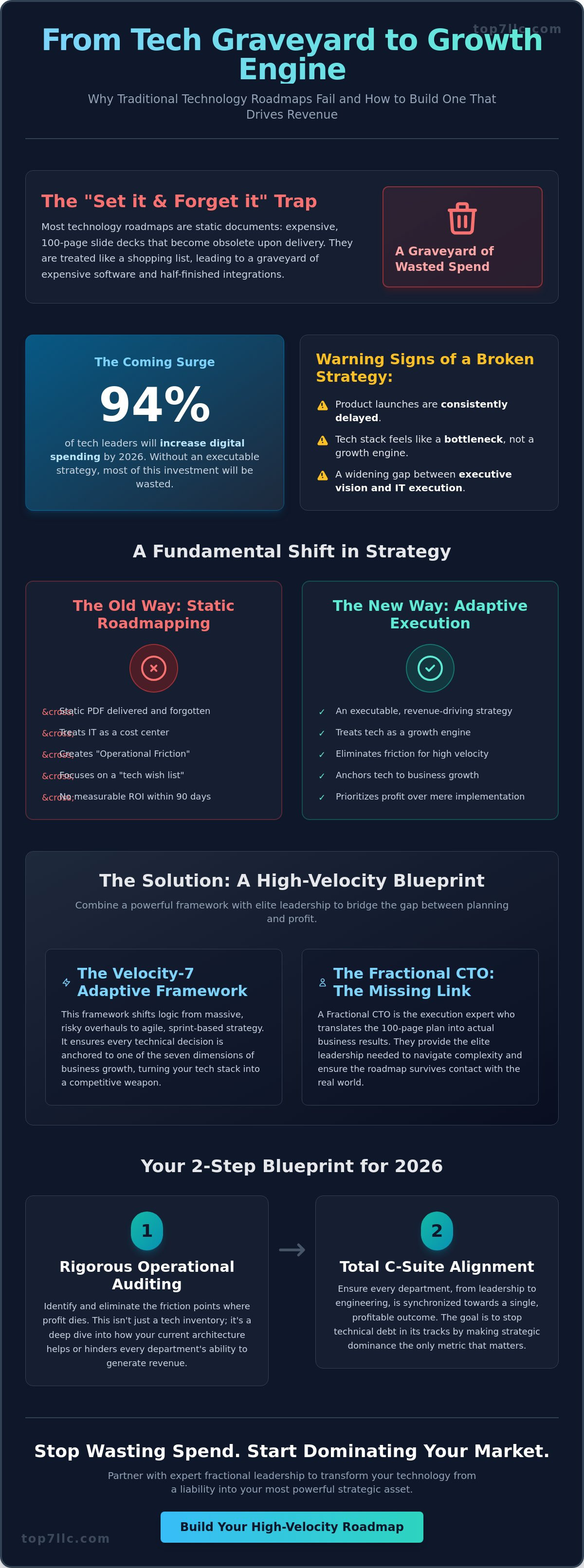
Your current technology roadmap is likely a graveyard of expensive software and half-finished integrations. Most companies treat their tech stack like a shopping list rather than a tactical combat strategy. If your infrastructure feels like a bottleneck instead of a revenue engine, you aren't failing at planning; you're failing at execution. Professional technology roadmap consulting services shouldn't just hand you a static PDF and walk away. You need a blueprint that accounts for the 94% of tech leaders hiking digital spending in 2026 while ensuring every dollar translates into measurable market dominance.
You know the friction all too well. Leadership demands growth, IT is buried in technical debt, and your "scalable" software is actually bleeding cash. You're likely asking how to align these goals without the massive overhead of a full-time executive. We're going to fix that. This article explains how to leverage fractional leadership and the Velocity-7 Adaptive Framework to turn your stack into a high-velocity asset. We'll show you how to stop the wasted spend, navigate the surge of new AI and data privacy regulations like the Digital Choice Act, and finally build a strategy that survives contact with the real world.
Key Takeaways
Identify why traditional technology roadmap consulting services often fail by delivering static documents instead of executable, revenue-driving strategies.
Learn how the Velocity-7 Adaptive Framework eliminates operational friction and transforms your tech stack into a high-velocity growth engine.
Understand the critical execution gap and why a Fractional CTO is the missing link between a 100-page plan and actual business results.
Discover the two-step blueprint for 2026 that involves rigorous operational auditing and total C-suite alignment to stop technical debt in its tracks.
Shift your focus from IT inventory to strategic dominance by embedding elite leadership that prioritizes profit over mere software implementation.
Table of Contents
Stop Building Tech Wish Lists: Why Most Technology Roadmaps Fail
The Velocity-7 Approach: Aligning Tech Strategy with Revenue Flow
Fractional CTO vs. Traditional Consulting: Who Drives the Roadmap?
Building Your 2026 Technology Roadmap: A Strategic Execution Blueprint
Eliminate Tech Friction: Partnering with Top7 for Strategic Dominance
Stop Building Tech Wish Lists: Why Most Technology Roadmaps Fail
Most technology roadmaps are just expensive paperweights. You spend months in meetings, pay for high-priced technology roadmap consulting services, and end up with a 100-page slide deck that collects digital dust. If your roadmap looks like a grocery list of shiny new tools rather than a tactical bridge to market dominance, you've already lost. A real roadmap isn't an IT inventory; it's a strategic execution bridge designed to turn infrastructure into profit. When asking What is a Technology Roadmap? you must understand it as a dynamic plan that evolves with your business, not a static snapshot.
The "Set it and Forget it" trap is the primary reason these plans fail. Traditional consultants drop a "best practices" document on your desk and vanish before the first implementation hurdle. This creates "Operational Friction," a silent killer where your leadership team's vision grinds against the reality of a rigid, unscalable tech stack. You need a revenue roadmap, not a technical wish list. Execution is the only metric that matters.
To better understand how to align these elements, watch this video on building a roadmap for your business strategy:
The Cost of Outdated Roadmapping Methods
Static 12-month plans are obsolete before the ink dries. In 2026, where 94% of tech clients are increasing digital spend, a rigid plan is a liability. You're likely bleeding cash through technical debt and unaligned software subscriptions that don't scale with your actual growth. Beware of consultant-speak that uses buzzwords to mask a total lack of actionable execution steps. If you can't measure the ROI of a roadmap item within 90 days, it's not a strategy; it's a hallucination. You need technology roadmap consulting services that prioritize agility over tradition.
Identifying Your Organization's Tech Bottlenecks
Look for the symptoms of a broken strategy. Are your product launches consistently behind schedule? Does your engineering team roll their eyes when the C-suite mentions innovation? This gap between executive vision and technical execution is where growth dies. Your tech stack should be an asset that accelerates your time-to-market, not an anchor that holds you back. A technology roadmap is a high-velocity execution tool that synchronizes every department toward a single, profitable outcome.
The Velocity-7 Approach: Aligning Tech Strategy with Revenue Flow
Stop treating your technology like an isolated utility. It's the central nervous system of your revenue engine. Most technology roadmap consulting services fail because they treat IT as a cost center to be managed, not a growth lever to be pulled. The Velocity-7 Adaptive Framework changes this by anchoring every technical decision to one of the seven dimensions of business growth. We aren't just visualizing your technology plan; we're weaponizing it to outperform competitors who are still stuck in legacy mindsets.
Moving from friction to flow requires a radical shift in logic. Instead of massive, multi-year overhauls that risk obsolescence before they're finished, we apply sprint-based logic to long-term strategy. This agile transformation ensures your technology remains adaptive. With 94% of technology clients expected to increase spending through 2026, the winners won't be those who spend the most, but those who spend with the highest velocity. By integrating tech into sales, finance, and operations, you ensure every line of code serves a commercial purpose and every integration removes a barrier to profit.
Eliminating Friction in the Tech Stack
Friction is where profit goes to die. Our technology roadmap consulting services audit your current architecture through the lens of the Velocity-7 Framework to find exactly where your stack is slowing down your team. We don't just fix bugs; we prioritize projects based on immediate revenue impact versus long-term stability. This surgical approach identifies the low-hanging fruit, such as automated workflows or critical data integrations, that generate the immediate ROI needed to fund the rest of your roadmap. It's about making your technology pay for its own evolution.
Moving Toward Strategic Flow
Strategic flow happens when your technology supports a frictionless customer experience and provides real-time data to your leadership. We create tight feedback loops between sales, finance, and technology teams to ensure everyone is operating from a single source of truth. Velocity-7 reduces time-to-value for new tech investments by ensuring every implementation is pre-aligned with your operational goals. If you're ready to stop the bleeding and start scaling, it's time to evaluate how strategic planning can actually drive your bottom line and secure your market position.
Fractional CTO vs. Traditional Consulting: Who Drives the Roadmap?
Most technology roadmap consulting services sell you a map but leave you stranded in the wilderness. They hand over a 100-page PDF filled with generic recommendations and wish you luck. That isn't a strategy; it's an expensive distraction. A strategy only exists if it can be executed. When you look at What is a Technology Roadmap? you'll find definitions about alignment and integration, but the missing ingredient is always leadership. A plan without a driver is just a wish list that will eventually be buried under technical debt.
The fundamental problem is incentive. Traditional agencies are designed to sell you billable hours, not business outcomes. They want more meetings, more audits, and more complex implementations because that's how they stay profitable. They aren't incentivized to make your tech stack lean or your processes fast. This is why the Fractional CTO model is disrupting the industry. You get the high-level leadership of a veteran executive without the $300k salary. You aren't buying a document; you're buying the expertise to navigate the execution gap.
Our Top7 executives operate as embedded mentors. We don't sit on the sidelines throwing advice over the fence. We lead from the inside, integrating with your team to ensure the roadmap actually moves. It's a shift from "telling you what to do" to "making it happen."
Why Traditional Consultants Fail Mid-Market Firms
Consultants fail because of the hand-off problem. Once the engagement ends, your team is left with a complex plan they don't have the bandwidth or authority to implement. External agencies often lack the deep business context required to make critical C-suite decisions. They don't have to live with the consequences of their architectural choices. In contrast, a Fractional CTO provides a much higher ROI by staying involved through the implementation phase. They ensure that every technical move supports your Strategic Planning and revenue goals.
The Fractional Advantage for US Businesses
For businesses in competitive hubs like Boston, Austin, or Chicago, accessing tier-1 executive talent is often cost-prohibitive. The fractional model changes the math. You can dial leadership up or down based on your roadmap milestones, giving you extreme scalability. Beyond strategy, a fractional leader actively manages your vendor relationships. They know when you're being overcharged for licenses or sold software you don't need. This tactical oversight often saves companies more in wasted spend than the cost of our Advisory Services combined.
Building Your 2026 Technology Roadmap: A Strategic Execution Blueprint
Planning is cheap. Execution is where the winners are separated from the also-rans in the 2026 market. If you are looking for technology roadmap consulting services that only provide a vague vision, you are buying a fairy tale. You need a blueprint that handles the hard reality of operational friction and technical debt. A roadmap is not a document you file away; it is a tactical manual for market dominance. It must be broken down into five non-negotiable steps to ensure your investments actually move the needle on your bottom line.
Step 1: The Operational Audit. Stop guessing where your money is going. You need an autopsy of your current tech spend to find where the leaks are.
Step 2: Stakeholder Alignment. Tech is not just for the IT department. If your C-suite is not on the same page, your roadmap will fail before the first integration starts.
Step 3: The 90-Day Sprint Plan. Long-term goals are useless without immediate milestones. Break the plan into digestible wins that prove ROI early.
Step 4: Resource Allocation. Be ruthless about what you build, buy, or outsource. Most companies waste millions building custom solutions that they could have bought for a fraction of the cost.
Step 5: Velocity Tracking. Measure the speed of execution, not just the completion of tasks. If your team is moving slow, your roadmap is a liability.
Phase 1: Discovery and Friction Analysis
Stop the "discovery" phases that last three months. A no-fluff audit should take days, not weeks. We look at your current technology assets to find "Bottleneck #1," the single point of failure that is currently stalling your growth. Whether it is an outdated CRM or a fragmented data layer, we identify it immediately. This creates a baseline for ROI measurement that allows you to track every dollar of improvement as we move forward. You cannot fix what you do not measure with precision.
Phase 2: The Tactical Execution Plan
Every tech initiative must map directly to a revenue goal. Whether it is improving your conversion rate optimization (CRO) or implementing sales automation, if it does not drive profit, it does not belong on the roadmap. Your Board does not care about "uptime" or "server health." They care about margin expansion and customer acquisition costs. The 90-Day Sprint is the core unit of roadmap progress, transforming abstract long-term goals into immediate, measurable victories. To ensure your strategy survives contact with reality, you need a Fractional CTO who knows how to drive these sprints to completion without the overhead of a full-time hire.
Eliminate Tech Friction: Partnering with Top7 for Strategic Dominance
Most technology roadmap consulting services are transactional. You pay for a report, receive a handshake, and are left to figure out the implementation on your own. Top7 operates differently. We embed directly into your leadership team because we know that strategy without execution is just an expensive hallucination. We don't just point at the friction; we remove it. This isn't about "helping" you plan; it's about taking command of your technical execution to ensure your business wins in a market that doesn't forgive slow movers.
The Velocity-7 Adaptive Framework is more than a sequence of steps. It's a high-velocity growth engine designed for an era where 81% of technology buyers are increasing their reliance on consultants to stay competitive. We've seen mid-market firms trapped in operational chaos, burning through capital on software that fails to scale or integrate with their sales data. We move these organizations into a state of efficient flow. Every technical investment becomes a tactical move for strategic dominance, ensuring your infrastructure supports revenue instead of draining it.
The success stories we create aren't about "better IT." They're about faster time-to-market and the systematic elimination of technical debt. With the wave of 2026 regulations like the NIST CSF 2.0 and the Digital Choice Act taking effect, your current roadmap is likely already a liability. If you aren't auditing your 2026 technology strategy right now, you're already behind. Professional technology roadmap consulting services must account for these regulatory shifts while driving profit, or they aren't worth the paper they're printed on.
Ready for a Fractional CTO?
Your company has outgrown its current leadership if your technical debt is growing faster than your revenue. If your C-suite and IT department speak different languages, you have a leadership vacuum that is costing you market share. In the first 30 days of onboarding, we don't just "listen." We conduct a friction audit, identify your primary bottleneck, and establish your first 90-day sprint plan. It's time to stop settling for "good enough" and check out our Fractional CTO services to see what elite leadership looks like in action.
Your Next Step Toward High-Velocity Growth
We don't do generic sales pitches. We do diagnoses. Our "No-Pitch" consultation is a high-level session designed to find exactly where your technology is bleeding money. Whether you're operating in a major tech hub or scaling a regional powerhouse, your roadmap needs to work for your specific market reality. Don't let another quarter slip by with a roadmap that doesn't execute. Schedule your Velocity-7 Strategy Session with Top7 today and turn your tech stack into a high-velocity revenue engine.
Stop Planning, Start Dominating: Own Your Technical Future
You've seen the high cost of hesitation. A static plan is just a liability in a market that moves at the speed of AI and shifting regulations. Real technology roadmap consulting services don't end with a slide deck; they begin with a commitment to high-velocity execution. By leveraging our proprietary Velocity-7 Adaptive Framework, you transform your tech stack from a growth bottleneck into a lethal competitive advantage that actually scales.
Our seasoned C-suite executives bring decades of experience directly into your leadership team to drive results. We've proven that US mid-market firms can achieve elite growth without the bloated overhead of a full-time hire. It's time to stop letting technical debt and operational friction dictate your business trajectory. You have the blueprint. Now, you need the leadership to push it across the finish line and win. Your competitors aren't waiting for you to catch up.
Stop the tech friction. Get your Velocity-7 Roadmap today.
Frequently Asked Questions
What is included in technology roadmap consulting services?
These services include a comprehensive operational audit, C-suite stakeholder alignment, and a tactical execution plan tailored to your revenue goals. It isn't just a list of software; it's a strategic bridge that connects your business objectives with your technical capabilities. We focus on identifying bottlenecks that stall growth and creating a baseline for measurable ROI across your entire organization.
How much does a technology roadmap typically cost for a mid-market company?
The investment for a roadmap depends entirely on the complexity of your current tech stack and the friction points identified during the initial audit. You should view this as a strategic investment rather than a fixed expense. A well-executed roadmap often pays for itself by eliminating technical debt and consolidating unaligned software spend that doesn't contribute to your bottom line.
What is the difference between a technology roadmap and an IT audit?
An IT audit is a post-mortem that identifies what is currently broken or non-compliant within your systems. A technology roadmap is a forward-looking tactical strategy that dictates how you will scale and dominate your market. One looks at the rearview mirror to find errors, while the other focuses on the road ahead to ensure your technology remains a high-velocity asset.
How long does it take to see results from a new technology roadmap?
You should see measurable wins within the first 90 days of implementation. High-velocity roadmapping prioritizes immediate, high-impact projects that provide the ROI needed to fund longer-term transformations. If you don't see a tangible change in your operational flow or time-to-market within the first quarter, your plan is likely just a wish list, not a strategy.
Do I need a full-time CTO to implement a technology roadmap?
No, you don't need a full-time executive to drive a roadmap to completion. A Fractional CTO provides the same tier-1 leadership and execution expertise at a fraction of the cost of a full-time hire. This model allows mid-market firms to access elite talent that can manage vendor relationships and engineering teams without the massive overhead of a traditional $300k salary.
How does the Velocity-7 Framework improve technology execution?
The Velocity-7 Adaptive Framework synchronizes your technical decisions with the seven core dimensions of business growth. It prevents the common problem where IT departments operate in a vacuum, building features that don't actually drive profit. Every line of code and every new integration is vetted for its direct impact on revenue flow and operational efficiency.
Can a technology roadmap help reduce our annual software spend?
Yes, professional technology roadmap consulting services are one of the most effective ways to cut technical waste. By auditing your stack through the lens of execution, we identify redundant tools and "shelfware" that your team isn't actually using. Most companies find they can significantly reduce their licensing costs by consolidating their stack into a leaner, more integrated ecosystem.
How often should a technology roadmap be updated in 2026?
Roadmaps must be dynamic and should be reviewed at least quarterly to stay relevant in a fast-moving market. In 2026, with rapid AI advancements and new regulations like the NIST CSF 2.0 taking effect, a static annual plan is a liability. A quarterly update ensures your technology roadmap consulting services keep you compliant and agile enough to pivot as new opportunities emerge.



Comments