
Managing High Burn Rate Before Your Next Funding Round

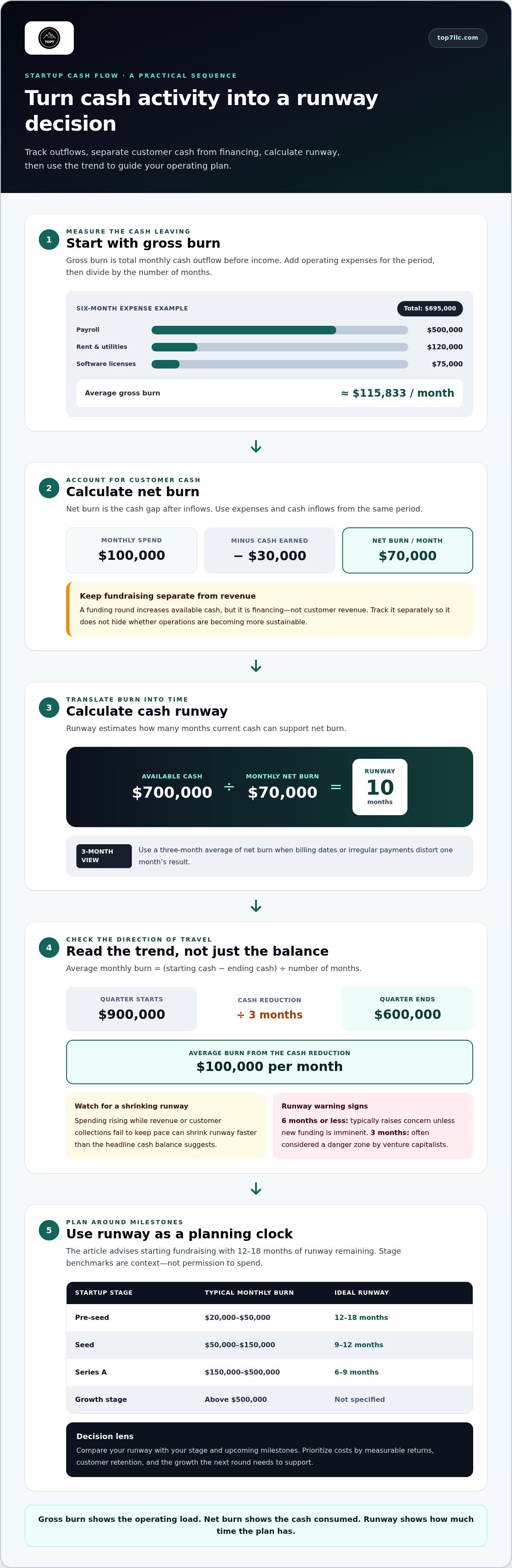
A high burn rate isn’t automatically a problem; losing control of what it buys is. Managing a high burn rate before your next funding round starts with tracking monthly cash outflows against cash coming in: spend $100,000 and earn $30,000, and your net burn is $70,000 per month. Your runway is available cash divided by monthly net burn, so the numbers show how much time your current plan can actually fund.
You’re right to look beyond the headline burn figure. Gross burn is total monthly cash outflow; net burn subtracts cash inflows. A funding round increases your cash balance, but it isn’t customer revenue, so it shouldn’t obscure whether the business is becoming more sustainable.
This article explains what burn rate measures, how gross and net burn differ, and how to calculate runway without treating funding as revenue. You’ll also learn how to prioritize expenses by measurable returns, customer retention, and the growth your next round needs to support. The goal isn’t to slash every cost. It’s to make each dollar work harder before investors review the numbers.
Table of Contents
What is burn rate?
Burn rate measures how quickly a startup’s cash leaves the business, usually expressed in dollars per month. Pair it with cash runway to understand how long current spending can continue before you need funding or positive cash flow.
For a founder-focused explanation, watch Y Combinator’s video with Kirsty Nathoo, “Managing Startup Finances.”
Burn and Runway Warning Signs
Burn and runway warning signs are cash trends suggesting a startup may run short before reaching its next milestone. A runway of six months or less typically raises concerns unless new funding is imminent; venture capitalists often consider three months a danger zone. With little time left, a company has less room to adjust spending, prove growth, or complete fundraising.
There’s no universally acceptable burn rate. Industry, business model, cash reserves, growth stage, and goals all shape the right level. Compare the trend with the plan. If spending rises while revenue or customer collections fail to keep pace, available runway can shrink faster than the headline cash balance suggests.
Monthly Burn and Runway Calculations
Monthly burn shows average cash reduction over a period, while runway estimates how many months current cash can support net burn. Calculate average monthly burn by subtracting ending cash from starting cash, then dividing by the number of months. For example, a company starting a quarter with $900,000 and ending with $600,000 has an average burn rate of $100,000 per month.
To calculate runway, divide available cash by monthly net burn. A startup with $700,000 in cash and net burn of $70,000 per month has 10 months of runway. Use a three-month average of net burn when billing dates or irregular payments distort one month’s result.
Runway and Funding Needs
Cash runway connects today’s spending to the time available for reaching funding milestones. Businesses should plan to start fundraising with 12-18 months of runway remaining, allowing time to prepare and pursue a round before cash pressure dominates decisions. A funding target should also reflect the operating plan and the cash needed to reach the next milestone.
Stage benchmarks provide context, not permission to spend. Listed typical monthly burn rates are $20,000-$50,000 for pre-seed startups, $50,000-$150,000 for seed-stage startups, and $150,000-$500,000 for Series A startups. The associated ideal runway ranges are 12-18 months, 9-12 months, and 6-9 months, respectively. Growth-stage startups are listed above $500,000 monthly burn. Compare your own runway with the relevant stage and upcoming milestones, then adjust the plan before a funding deadline forces reactive cuts.
Gross and net burn rate
Gross burn is total monthly cash outflow before income; net burn is the cash gap after inflows. Track both to distinguish the cost of running the business from the cash reserves operations actually consume.
Gross and Net Burn Definitions
Gross burn is a company’s total monthly cash outflow, while net burn subtracts monthly cash inflows from total monthly expenses. Gross burn reveals the full operating load; net burn shows whether customer cash offsets it. Looking only at net burn can hide rising expenses, while gross burn alone ignores incoming cash.
Use both figures to assess cash flow. If expenses and collections both rise, net burn may remain stable even as gross burn climbs. This distinction helps separate growth investment from a cost base that is expanding without enough cash coming back.
Calculating Gross Burn from Operating Expenses
Calculate gross burn by adding operating expenses for the period, then divide by its number of months. Over six months, payroll totals $500,000, rent and utilities total $120,000, and software licenses cost $75,000. Together, those expenses equal $695,000, or approximately $115,833 per month in gross burn.
Include recurring cash costs such as payroll, rent, utilities, and software. Keep the period consistent: mixing a six-month expense total with one month’s revenue produces a misleading comparison. A company with $1.5 million in monthly operating expenses has gross burn of $1.5 million per month, regardless of its revenue.
That figure is a spending baseline, not a verdict. Compare categories across periods to identify fixed costs, expenses that vary with activity, and costs rising faster than the business can support.
Calculating Net Burn Rate
Calculate net burn by subtracting monthly cash inflows from total monthly expenses. For example, a SaaS company spending $55,000 per month and receiving $25,000 in monthly revenue has net burn of $30,000 per month. This is the amount its cash reserves decline by, assuming those figures reflect the same period.
For a larger operation, monthly expenses of $1.5 million and revenue of $625,000 produce a net burn rate of -$875,000 per month under the stated calculation. The negative result means inflows exceed expenses by $875,000, rather than the company consuming cash. Label the sign clearly; otherwise, a positive cash contribution can be mistaken for a cash shortfall.
Keep revenue and cash collections distinct in your working model if payment timing shifts. The goal is to understand cash available for running the business, not just sales recorded. A useful cash flow and expense plan keeps both burn measures visible for operating decisions.
Does a fundraising round count as revenue in net burn?
No. A fundraising round is financing, not revenue from customers, so it increases available cash without showing whether operations generate sustainable income. In the example, a startup begins the month with $1.38 million in operating cash and ends with $1.26 million. The $120,000 decline reflects its monthly cash burn, not a change in customer revenue.
Bridge financing can include debt, convertible notes, or equity-linked instruments such as SAFEs. Costs depend on the terms, including interest, fees, conversion discounts, valuation caps, dilution, and repayment obligations. Weigh these trade-offs against the runway the financing buys. More cash doesn’t automatically make the underlying business stronger.
To increase revenue or collect cash faster before fundraising, focus on renewals, customer expansion, and prompt invoice collection. Startups can shorten payment cycles, accelerate collections, and offer annual prepayment discounts to improve cash inflows. These steps support the cash position, but keep customer revenue separate from financing in every burn calculation.
Review burn every month, especially before a bridge round. Reconcile bank balances against operating statements, invoices, payroll, vendor payments, and customer collections. A rolling 12-month forecast, updated monthly, exposes expected cash gaps; a rolling 13-week forecast gives weekly detail when cash is volatile or tight. Verify timing, not just totals.
Use historical averages to distinguish a genuine trend from irregular billing dates. A three-month average of net burn can smooth uneven receipts, while a forward forecast captures upcoming obligations and expected revenue. Include known renewals and planned outflows. Compare forecast cash reserves with actual balances each month, then investigate significant differences before they become surprises.
Before investors review your company, prepare monthly gross and net burn, cash reserves, runway, revenue, collections, and expense trends. Show a base case alongside scenarios for slower collections, lower revenue, and planned spending reductions. Connect each scenario to funding needs and operating milestones. Investors need to see what changes if the next round takes longer.
Keep cash-flow tracking disciplined: match each outflow to its category and each inflow to its source. For example, label customer payments separately from fundraising proceeds, then compare actual cash movement with the forecast. A recurring review every 30 days creates a clear record of decisions, trends, and remaining runway. That record gives founders and investors a more reliable picture than a bank balance alone.
Prioritizing expenses by ROI and customer retention
Before cutting spending, distinguish costs that support customer value from those that simply persist. Evaluate each expense against measurable returns, retention, and the milestones your available capital must fund.
Reducing Overhead and Unnecessary Spending
Reducing overhead means removing low-value recurring expenses while preserving the work that keeps customers and revenue moving. Start with fixed costs and subscriptions, then check actual usage, contract terms, and business purpose. A startup paying $5,000 per month for an infrequently used tool spends nearly $60,000 per year on it. Canceling or renegotiating that subscription can free capital without cutting a customer-facing capability.
Review variable spending too. Compare vendor costs, software licenses, and marketing channels with the results they produce. If customer acquisition cost exceeds lifetime value, shift marketing focus and refine the sales funnel rather than continuing to fund an inefficient channel. Assess each expense against relevant measures, not just the department’s budget.
Spend Controls and Expense Reviews
Spend controls are approval rules and regular reviews that make expenses visible before they become entrenched. Assign an owner to each major category, require a business case for new recurring commitments, and compare actual spending with the operating plan. Separate fixed costs from variable expenses to see what changes as the company grows.
At each review, identify unused tools, overlapping subscriptions, and vendor contracts that could be renegotiated. Record the decision, expected cash impact, and any operational trade-off. Cohort analysis can show whether retention or customer expansion is improving; use those trends to assess spending on customer support, product work, and acquisition. A review is useful only when it connects costs to outcomes.
Set a clear test for growth spending: the article’s guidance is that it should demonstrate measurable returns within 3-6 months. If a campaign or initiative cannot show a credible path to that return, pause or redesign it before committing more capital.
Cost-Cutting Trade-Offs and Risks
Cutting costs too aggressively can weaken customer retention, product-market fit, and the growth capacity investors expect. Removing support or product work may reduce expenses immediately but increase churn or stall revenue. Protect essential capabilities while removing spending that doesn’t support customer value or upcoming milestones.
If revenue plateaus, reinvest in product-market fit and cut nonessential spending instead of applying the same reduction everywhere. Strengthen retention to reduce churn, and use cohort analysis to identify where customers leave or expand. These measures make trade-offs clear: preserve work linked to customer outcomes and challenge costs with no clear return.
Apply the same discipline to acquisition spending. Track whether each channel brings in customers whose value justifies the cost, then shift effort when the economics weaken. Before approving a cut, identify its effect on customers, revenue, and delivery. A smaller expense base matters only if the business can still reach the milestones that make its next funding case credible.
Examples of companies reducing burn rate
Company examples show that reducing cash burn can be part of a growth strategy, not simply a retreat. Airbnb, Zappos, Groupon, Buffer, and HotelTonight are identified as businesses that reduced burn. Their situations and outcomes differ, so founders should take the decision principle and test it against their own expenses and customers.
Airbnb is cited for a successful burn-rate reduction in 2017. The practical takeaway is to make cash burn a management metric, not a number reviewed only during fundraising. Founders can compare gross burn rate and operating expenses across periods, then identify which costs support customer value and which can be adjusted without weakening the business.
Zappos is named as an example from its early days, while Groupon is cited for 2011. These examples point to a core discipline: cost decisions must fit the company’s stage and business model. A founder should map each major expense to a business outcome, such as customer retention, revenue generation, or delivery. If the link is weak, investigate the spend before renewing or expanding it.
Buffer is identified as a burn-reduction example in 2016. For a startup applying that lesson, transparency inside the operating plan matters: assign owners to expense categories and review actual spending against the plan. That makes it easier to spot a cost increase early, understand its cause, and adjust before it becomes part of the baseline.
HotelTonight offers a clear outcome: its team went from burning millions to turning profitable in seven months. Profitability isn’t the right target for every startup, but this example shows why founders should connect burn to an explicit operating goal. Decide whether a spending change aims to extend runway, improve unit economics, or reach sustainable cash flow, then track the relevant measure.
Don’t copy another company’s cost cuts without understanding its context. Use each example to test your own plan: which expenses are essential to customer outcomes, which investments show measurable returns, and what changes if revenue slows? Compare forecasts with actual cash burn, document the reason for each adjustment, and assess its effect on customers and growth. A reduction that weakens retention can undermine the business investors are being asked to back.
Turn those comparisons into an operating plan with clear owners, review points, and measurable outcomes. Build a stronger burn-rate plan around the milestones your company needs to reach.
Top7: Fractional CTO
Top7 can help when technical spending is difficult to connect to growth priorities or funding milestones. A Fractional CTO provides leadership for evaluating technology decisions and aligning technical work with business strategy, so founders can make clearer choices about what to continue, delay, or stop.
If burn-rate pressure extends beyond technology, a Fractional CFO can support financial planning, while a Fractional COO can help address operational friction. The right focus depends on where spending is straying from the plan and which decisions need experienced leadership.
Bring the spending questions and milestones you’re working toward. Contact Top7 or visit top7llc.com.
Make Your Next Funding Move Deliberate
Your next funding round should support a sharper operating plan, not postpone difficult decisions. Turn cash assumptions into clear choices: which priorities deserve capital, who owns each decision, and what evidence will show whether the plan is working. Managing high burn rate before next funding round is easier as an ongoing operating discipline than as a last-minute scramble to satisfy investors.
When execution spans technical, operational, and company-wide priorities, experienced leadership can help align decisions. Top7 offers Fractional CTO, Fractional COO, and Fractional CEO support. For founders, managing high burn rate before next funding round means matching leadership focus to the decisions that will shape the business’s next stage.
Contact Top7 to discuss your funding plans and identify the next move for your business. Take control of the plan, and move forward with purpose.
Frequently Asked Questions
How many months of runway should a startup maintain before its next funding round?
Start fundraising with 12-18 months of runway remaining, rather than waiting until cash pressure dictates the timing. This gives founders room to prepare, meet investors, and respond to delays while continuing to execute the operating plan. For managing a high burn rate before the next funding round, align the target with the milestones investors will evaluate and the cash required to reach them. Fundraising proceeds should remain separate from customer revenue.
How do you calculate startup burn rate and cash runway?
Calculate average monthly burn by subtracting ending cash from starting cash, then dividing by the number of months in the period. For net burn, subtract monthly cash inflows from total monthly expenses. Divide available cash by monthly net burn to estimate runway. When timing differs, use actual cash collections and payments, not just booked sales and expenses. A three-month average can smooth unusually large receipts or bills.
What is a healthy net burn rate for a startup by stage?
There is no single healthy net burn rate for every startup; revenue, reserves, business model, and growth goals change the picture. Typical monthly burn ranges are $20,000-$50,000 for pre-seed, $50,000-$150,000 for seed, and $150,000-$500,000 for Series A startups. These are stage benchmarks, not net-burn targets. Compare your net burn with runway and the progress each expense produces, rather than treating a range as a spending quota.
Which expenses should startups cut first to reduce burn without hurting growth?
Start with recurring costs that see little use or have no clear link to revenue, retention, or delivery. Review software subscriptions, vendor terms, and marketing channels before cutting customer-facing work. For example, if acquisition cost exceeds customer lifetime value, redirect or refine the channel instead of funding it unchanged. Protect spending that supports retention and product-market fit, and assign an owner to track whether each retained expense contributes to a defined business outcome.
How can startups extend runway through hiring freezes, renegotiating contracts, or delaying spend?
Pause unapproved roles and nonessential commitments, then assess whether current teams can meet critical milestones without overloading key functions. Renegotiate vendor contracts and software subscriptions before renewal, and defer discretionary purchases that don’t protect customers or support near-term revenue. Model each change against its cash timing and operational impact. A hiring freeze that blocks product delivery or customer support can undermine growth, so distinguish low-priority capacity from roles tied directly to execution.
When should founders start fundraising based on cash runway and typical round timelines?
Begin fundraising when 12-18 months of runway remain, and work backward from the milestones needed to support the round. Build time into the plan for preparing financials, meeting investors, diligence, and decision-making; don’t assume every conversation converts on your preferred schedule. Track runway against a current forecast, then update the fundraising plan as cash collections, spending, or growth change. Starting early preserves options and reduces the risk of negotiating under immediate cash pressure.



Comments