
Sales Process Optimization Philadelphia: Stop Leaking Revenue and Start Scaling
- Robert Fitzgerald
- 3 days ago
- 12 min read

Your sales team isn't failing because they lack "hustle." They're failing because your infrastructure is a sieve. Why are you burning capital on high-priced talent while your deals die in a bottleneck of operational friction? In a city where the BIRT tax is finally dropping to 5.65% in 2026, you shouldn't be handing your hard-earned margins back to internal inefficiency. Real sales process optimization Philadelphia mid-market firms need isn't found in a motivational speech or a generic slide deck. It's found in the tactical removal of every obstacle between your product and a signed contract.
You've likely felt the sting of unpredictable revenue cycles and the disconnect between marketing's promises and sales' reality. It's a common trap, but it's one you can't afford while Philadelphia's economic growth continues to lag behind the rest of the country. We're going to fix that. This guide will show you how to audit your sales friction and implement the Velocity-7 framework to transform your team into a high-velocity revenue engine. We'll explore how fractional leadership moves beyond advisory roles to actually execute a repeatable, scalable playbook that secures predictable monthly recurring revenue.
Table of Contents
Why Philadelphia Mid-Market Sales Teams Stall: The Friction Factor
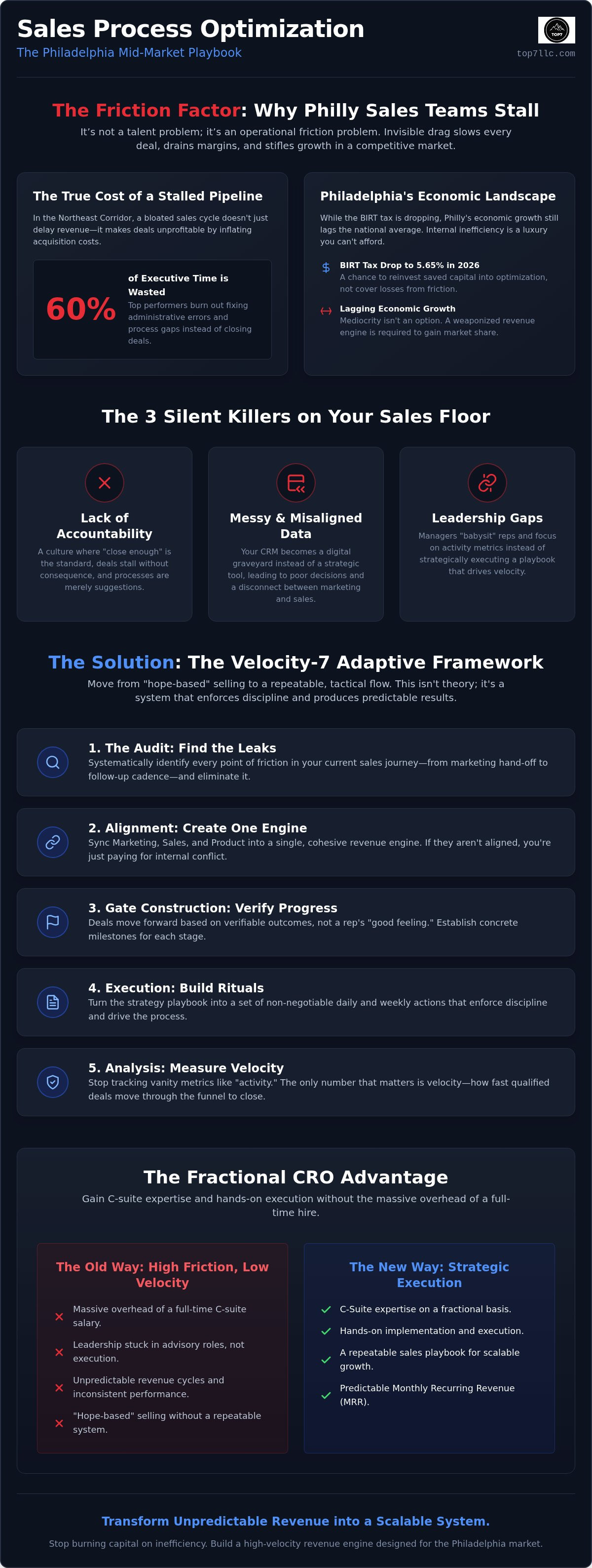
Philly mid-market companies are bleeding out. It’s not a talent problem. It’s a friction problem. Most CEOs think sales process optimization philadelphia is about buying a new CRM or hiring a "rockstar" rep. They’re wrong. True optimization is the systematic removal of "Operational Friction," which is the invisible drag that slows every deal and drains your margins. It’s about building a system where the process drives the people, not the other way around.
The 2026 landscape in the city doesn't forgive mediocrity. While the BIRT tax has dropped slightly to 5.65%, Philadelphia’s economic growth still lags behind the national average. You aren't just competing with the shop down the street; you're fighting for market share in a tightening corridor. If your sales funnel is just a "standard" set of steps, you’re already losing to firms using sales process optimization philadelphia to create a weaponized revenue engine. Stop telling your team to work harder. Hard work without professional Sales process engineering is just a faster way to burn out.
Three silent killers are stalking your sales floor right now. First, a lack of accountability where "close enough" is the standard. Second, messy data that makes your CRM a digital graveyard. Third, leadership gaps where managers "babysit" instead of executing strategy. You don't need more effort; you need better flow.
The Cost of Stalled Sales in the Northeast Corridor
Stalled deals are cash flow killers. In the high-stakes Northeast Corridor, a bloated sales cycle doesn't just delay revenue; it increases your cost of acquisition until the deal is no longer profitable. When your process is broken, your best executives don't just get frustrated; they burn out. They spend 60% of their time fixing administrative errors instead of closing. "Average" performance in this economy is a slow-motion death sentence for your mid-market firm.
Identifying Friction in Your Current Funnel
Where is the deal dying? Most Philly firms have a bottleneck in lead qualification, not closing. Marketing throws "leads" over a wall into a siloed sales department that doesn't know how to handle them. This lack of alignment creates massive drag. Sales Friction is the primary obstacle to the Velocity-7 flow, acting as a tax on every single interaction your team has with a prospect. If you can't see the bottleneck, you are the bottleneck.
Mapping the Optimized Philly Sales Journey: From Lead to Flow
Most Philadelphia sales funnels are works of fiction. They exist in your CRM as a series of aspirational stages that don't reflect the reality of how deals actually close. True sales process optimization philadelphia requires a cold, hard look at the journey from the first touch to the final signature. If your pipeline is full but your bank account is empty, your map is broken. You need a transition from "hope-based" selling to a repeatable, tactical flow.
The Audit: We start by finding the leaks in your Philly office. Is it the hand-off from marketing? Is it the lack of a follow-up cadence? We find the friction and kill it.
Alignment: We sync marketing, sales, and product through the Velocity-7 lens. If these three aren't aligned, you're just paying for internal conflict.
Gate Construction: You don't move a deal forward because a rep "feels good" about it. You move it because a verifiable outcome was achieved.
Execution: Strategy is useless without daily rituals. We turn the playbook into a set of non-negotiable actions.
Analysis: Activity is a vanity metric. We measure velocity. How fast are deals moving through the funnel?
Execution is where most Philly firms fail. They have the "what" but lack the "how." You don't need another brainstorming session; you need a system that enforces discipline. This is about moving from theory to a high-velocity revenue engine that produces predictable results every month.
Aligning Sales Stages with Modern Buyer Behavior
The 2026 B2B buyer in Philadelphia is exhausted by traditional pitches. They've done their research before you even pick up the phone. They expect a consultative partner, not a talking brochure. Mapping your internal stages to the external buyer's journey is critical. If your process adds friction by forcing buyers through "dead weight" stages like redundant discovery calls, you'll lose them to a more agile competitor. Adopting Sales Management Best Practices means respecting the buyer's time while maintaining control of the narrative.
Defining Verifiable Outcomes for Philly Sales Reps
"Had a great call" is not a status update. It's an opinion. In a high-velocity revenue engine, we only care about objective progress. Every stage must have strict exit criteria. Did the prospect provide access to the economic buyer? Did they share their budget constraints? These are verifiable outcomes. Using these gates prevents "garbage" leads from clogging your pipeline and ensures your team only spends time on deals that can actually close. If you're ready to stop the guessing game, it's time to explore how strategic planning can redefine your execution.
The Technology Trap: Why Your CRM Isn't Solving Your Revenue Problem
Buying Salesforce is not a sales strategy. It's a line item. Too many Philadelphia CEOs believe a six-figure software contract will magically fix a broken revenue engine. It won't. If your process is garbage, automation just helps you produce garbage at scale. Real sales process optimization philadelphia leaders understand that technology is a force multiplier, not the force itself. In 2026, the "Garbage In, Garbage Out" reality is more punishing than ever. If your data is messy, your forecasts are fiction, and your scaling efforts will stall before they start.
Technology should facilitate flow, not create a new layer of administrative friction. Your reps should spend their time selling, not fighting with a clunky interface. To Optimize Your Sales Process, you must strip away the noise. A lean, mid-market sales stack only needs three essential tools:
The Spine: A CRM configured for your specific verifiable outcomes.
The Eyes: Sales intelligence tools that provide real-time data on buyer intent.
The Brain: Analytics software that tracks velocity and identifies bottlenecks.
You probably don't need ten different plugins. You need three tools that actually talk to each other and a team that knows how to use them. Anything more is just expensive shelfware that slows down your deal closure.
CRM as a Strategy Enabler, Not a Strategy Substitute
Your CRM must mirror the Velocity-7 Adaptive Framework. If your software stages don't align with your actual sales gates, your data is useless. Feature bloat is the enemy of execution. Every custom field you add is another second your rep isn't talking to a prospect. Data integrity is a leadership issue. A Fractional CRO ensures tech oversight so that the system serves the strategy, rather than the strategy being a slave to the software's limitations.
Automation vs. The Human Touch in B2B Sales
In 2026, AI should handle the grunt work. Automate your administrative tasks, meeting scheduling, and basic follow-up sequences. This clears the deck for what actually closes deals: human intelligence. High-stakes negotiation and complex relationship building cannot be outsourced to a bot. Philadelphia firms that win are those that use AI to identify the "when" and "who," but rely on skilled professionals for the "how." Use technology to get your people in front of the right buyers faster; don't use it to hide from them.
Applying the Velocity-7 Framework to Sales Execution
Linear sales models belong in a museum. If your team is still following a rigid, 5-step process from a decade ago, you aren't scaling; you're just lucky you haven't crashed yet. Real sales process optimization philadelphia requires an adaptive system that moves at the speed of the 2026 market. The Velocity-7 Adaptive Framework isn't a "best practices" list. It's a tactical operating system designed to kill operational friction and replace it with a rhythmic revenue engine. We don't just hand you a roadmap; we embed our leadership into your organization to drive the car.
The framework addresses seven specific dimensions of growth, but when applied to sales, it focuses on the intersection of people, process, and data. It’s about creating a system where the "hero culture" of individual rockstars is replaced by a predictable, repeatable machine. If your revenue depends on one or two people having a good month, you don't have a business; you have a gamble. We turn that gamble into a calculated execution strategy.
From Operational Friction to Efficient Flow
Flow is the ultimate goal of any sales organization. It's the point where revenue generation becomes predictable and rhythmic rather than a series of panicked sprints at the end of the quarter. The Velocity-7 framework identifies the hidden growth obstacles that your internal team is too close to see. For example, one Philadelphia-based mid-market firm used this framework to cut their sales ramp-up time by 40%. By eliminating the administrative noise and focusing on verifiable outcomes, they moved new hires from "training" to "closing" in nearly half the time. If you're ready to stop playing house with your revenue, it's time to implement the Velocity-7 Adaptive Framework.
Agile Sales Management for Philly Leaders
Traditional annual sales plans are obsolete before the ink is dry. In 2026, the market shifts too fast for static strategies. We implement Agile-based transformation, replacing the yearly grind with high-intensity sales "Sprints." These short-term focuses allow for real-time adjustments based on actual market data, not optimistic projections from six months ago. The daily "Scrum" replaces the bloated weekly meeting that everyone hates. It’s about immediate accountability and tactical precision. If a deal is stalled, we find out today, not during a post-mortem at the end of the month. This level of sales process optimization philadelphia demands a culture of transparency and a relentless focus on movement.
The Fractional CRO Advantage: Strategic Execution for Philly’s Ambitious Firms
Hiring a full-time Chief Revenue Officer is often a $300,000 mistake for mid-market Philadelphia companies. When you factor in the base salary, bonuses, benefits, and equity, you're looking at a massive drain on capital before a single deal even closes. Most firms at this stage don't need a permanent fixture. They need a transformation. This is where sales process optimization philadelphia shifts from a theory into a tactical reality. A Fractional CRO gives you C-suite expertise without the crippling overhead. You get the tactical precision of a seasoned veteran who has seen every bottleneck in the book and knows exactly how to kill it.
Top7 doesn't play the role of the outside consultant who drops a slide deck and disappears. We embed our executives directly into your organization. We solve complex sales problems from the inside, identifying where the friction is loudest and silencing it. Our goal isn't to stay forever. It's to build a system so robust that it eventually runs without us. We help you transition from fractional leadership to a permanent hire only when the foundation is ready to support one. We build the engine; you eventually hire the driver.
Why Philly CEOs Choose Fractional Leadership
The philosophy is simple: pay for results, not payroll. In a city where the unemployment rate sat at 4.4% in early 2026, finding top-tier sales leadership is both expensive and risky. Fractional leadership provides immediate operational stability during transitions. It allows CEOs to stop playing "interim sales manager" and get back to their actual jobs. You avoid the executive burnout trap by delegating the heavy lifting of sales strategy to a professional who executes. It’s about strategic superioriority without the long-term liability of a massive executive contract.
Next Steps: Auditing Your Sales Velocity
Transformation doesn't happen overnight, but it does happen in 90 days. Our roadmap begins with an intensive audit of your current sales velocity. We identify the leaks, implement the Velocity-7 framework, and start the sprint. If you're ready to stop the bleeding, you can schedule a Strategic Planning session right here in Philadelphia. We don't do fluff. We do results. It's time to move from friction to flow and reclaim your market share.
Own Your Revenue Engine: The Path to High-Velocity Growth
You've seen the cost of stalled deals and the trap of hope-based selling. Real growth happens when you stop treating sales as a series of random acts and start treating it as a precision-engineered system. By implementing sales process optimization philadelphia mid-market firms can finally bridge the gap between marketing promises and actual bank deposits. It requires moving past the technology will save us myth and adopting a framework that prioritizes verifiable outcomes over vanity metrics.
Michael J. DiPiano Jr. and the Top7 team don't just provide a roadmap; we embed our leadership to drive your results. We use the Velocity-7 Adaptive Framework to turn your sales floor from a source of anxiety into a repeatable revenue machine. Don't let another quarter slip away with unpredictable cycles and high-cost talent that doesn't deliver. It's time to stop the leaks and start scaling with precision.
Your market share is waiting. Go take it.
Frequently Asked Questions
What is sales process optimization?
It's the systematic identification and removal of operational friction within your revenue engine. It isn't about better scripts; it's about engineering a repeatable flow from lead generation to deal closure. By aligning your people, technology, and verifiable outcomes, you create a system where sales success is predictable rather than accidental. This is the foundation of high-velocity growth for any ambitious mid-market organization in the Philly region.
How long does it take to see results from sales optimization in a Philadelphia business?
You should expect to see measurable shifts in pipeline clarity and team accountability within the first 30 to 45 days. Complete sales process optimization philadelphia transformations typically follow a 90-day roadmap. This timeframe allows for a full audit, the implementation of the Velocity-7 framework, and the establishment of new daily rituals that drive long-term revenue velocity. Speed is a priority, but execution must be precise to ensure the results are scalable.
What is the difference between a sales consultant and a Fractional CRO?
A consultant gives you a roadmap and leaves; a Fractional CRO sits in the seat and drives the car. While consultants offer advice from the sidelines, a Fractional CRO is an embedded leader responsible for executing the strategy and hitting revenue targets. They provide the C-suite expertise your mid-market firm needs without the long-term liability or high overhead of a full-time executive hire. It's about having a partner who is as invested in the outcome as you are.
Does our company need a new CRM to optimize our sales process?
Usually, no. Most companies don't need new software; they need to stop using their current CRM as a digital graveyard. Optimization is about configuring your existing tools to mirror your actual sales gates and verifiable outcomes. We focus on stripping away feature bloat and ensuring data integrity. If your current system is genuinely the bottleneck, we'll tell you, but the process always dictates the technology. Don't buy more tech to fix a human process problem.
How much does it cost to hire a Fractional CRO in Philadelphia?
Costs for fractional leadership vary based on the complexity of your organization and the scope of the execution required. Unlike a full-time CRO, which can be a $300,000 mistake for mid-market firms, a fractional model allows you to pay for results rather than payroll. You gain access to elite strategic execution at a fraction of the total compensation package required for a permanent C-suite executive. It's an investment in growth, not a fixed administrative expense.
What are the key KPIs we should track for sales process velocity?
Stop obsessing over activity metrics like calls made and start tracking velocity. The critical KPIs include:
Sales Cycle Length: How many days from lead to close?
Win Rate per Stage: Where are deals actually dying?
Pipeline Value vs. Realistic Forecast: Is your data clean?
Average Deal Size: Are you moving up-market?
These metrics reveal the health of your
sales process optimization philadelphia
efforts. If you can't measure the speed at which a lead becomes a customer, you can't manage your growth.
Can the Velocity-7 framework work for small sales teams of 3-5 people?
Absolutely. The framework is designed to be adaptive, meaning it scales down to small, agile teams just as effectively as it scales up for larger organizations. Smaller teams often see faster results because there is less institutional inertia to overcome. The focus remains the same: identify friction, install accountability, and create a rhythmic flow that makes every rep more productive. Whether you have three reps or thirty, the physics of revenue generation don't change.
How does Top7 handle the transition once the sales process is optimized?
We don't believe in permanent dependency. Our exit strategy is built into the engagement from day one. Once your revenue engine is stabilized and the Velocity-7 framework is fully embedded, we help you transition to a permanent hire if the business requires it. We build the infrastructure, document the playbook, and ensure your team is trained to maintain high-velocity execution long after we leave. We aren't here to stay; we're here to help you win.


Comments