
Interim vs Fractional Leadership: 2026 CEO Guide
- Robert Fitzgerald
- 2 days ago
- 12 min read

The $300,000 mistake isn't just hiring the wrong person; it's hiring the wrong structure. Most mid-market CEOs are drowning in operational friction because they can't distinguish between a temporary fix and a strategic catalyst. Understanding the nuances of interim vs fractional leadership is no longer a luxury for the "someday" pile. It's the difference between stabilizing a sinking ship and supercharging a high-performance engine in 2026. If you're currently staring at a stagnant growth chart while your executive team burns out, you don't need another full-time salary weighing down your P&L. You need a surgical strike of expertise.
You've likely felt the sting of a bad C-suite hire or the paralysis of an empty seat in your leadership team. It's exhausting, and it's stalling your momentum. This guide will help you decide whether your business requires a temporary crisis manager to bridge a gap or a fractional partner to drive systemic growth. We'll break down the operational realities, the cost structures, and the strategic frameworks needed to eliminate bottlenecks and reclaim your time. By the end, you'll know exactly which model will turn your current friction into measurable flow and long-term strategic dominance.
Table of Contents
Interim vs. Fractional Leadership: The Strategic Distinction You Can't Ignore
Interim Leadership: The Emergency Response for Executive Vacancies
Fractional Leadership: The High-Octane Fuel for Scaling Mid-Market Firms
The ROI Battle: Comparing Costs, Outcomes, and Execution Velocity
Beyond the Title: How to Deploy External Leadership for Maximum Impact
Interim vs. Fractional Leadership: The Strategic Distinction You Can't Ignore
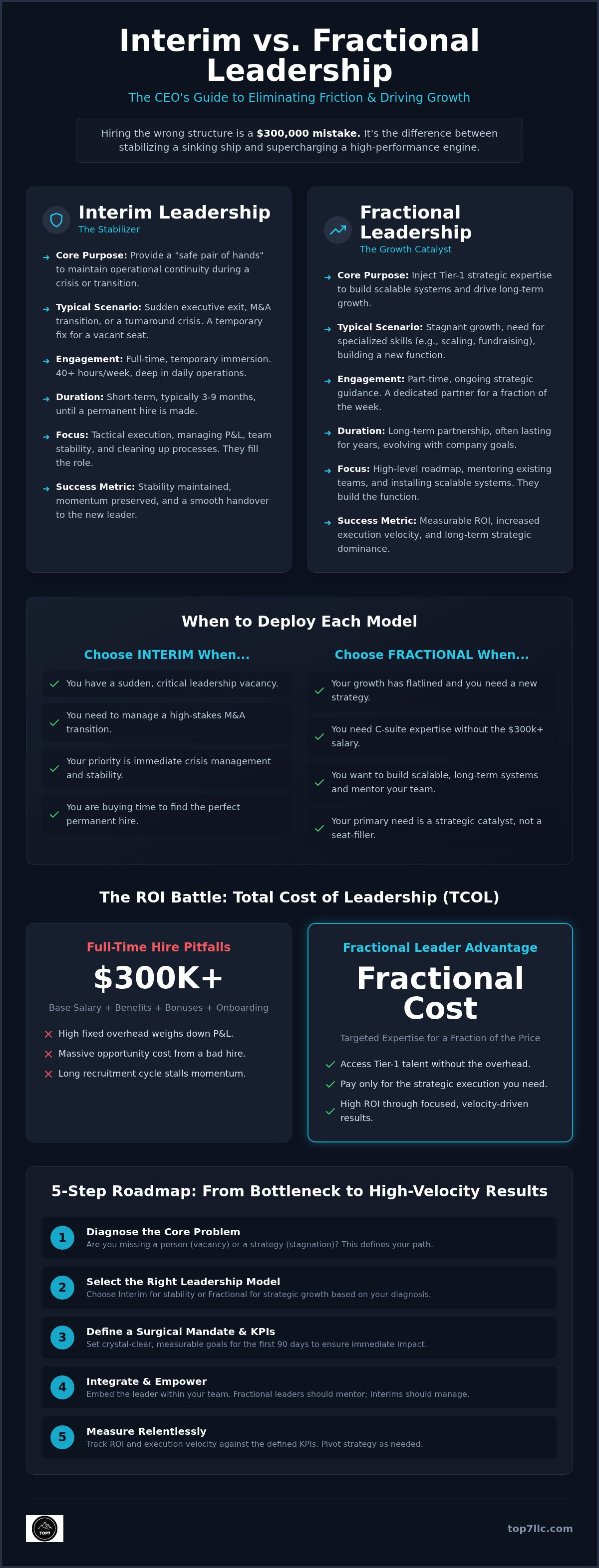
Stop confusing a placeholder with a partner. If your CEO just quit, you're in a panic. If your growth is flatlining despite a full team, you're in a strategic rut. The choice between interim vs fractional leadership determines whether you're fixing a hole or building a bridge. Interim leadership provides full-time, temporary coverage for a specific vacancy or crisis. It’s the "safe pair of hands" during a sudden exit. Fractional leadership offers part-time, ongoing strategic guidance for specialized growth. It isn't a bridge; it's the foundation of your next scale-up phase.
By August 2026, the global fractional executive market is accelerating toward a projected $24.7 billion valuation. This growth isn't accidental. It represents a fundamental shift in how mid-market firms access top-tier talent without the bloat of a $300k+ base salary. Here is the reality most consultants won't tell you: Interim is about 'who' fills the seat; Fractional is about 'how' the seat drives strategy. One maintains the status quo. The other destroys it to build something better.
The Scope of Authority and Engagement
Interim executives dive deep into the weeds. They manage daily operations, handle personnel issues, and report directly to the Board to maintain stability while you search for a permanent hire. This model of Interim management typically lasts between three to nine months. Conversely, a fractional leader focuses on the high-level roadmap. They don't just "do" the work; they mentor your existing team and install scalable systems. While interims are measured by stability, fractionals are measured by long-term ROI and execution velocity. The engagement length reflects this difference. Interims leave once the seat is filled. Fractionals often stay for years, evolving alongside your revenue targets.
When 'Temporary' Isn't Enough
Buying time is expensive. If you hire an interim leader to fix a fundamental strategic flaw, you're just paying a premium to delay the inevitable. Mid-market firms in competitive hubs like Boston or Chicago are pivoting away from the "seat-filler" mentality. They've realized that an empty office is often less dangerous than a leader with no roadmap. Are you missing a person, or are you missing a strategy? If it's the latter, a temporary hire will fail you every time. You need a catalyst, not a placeholder. Choosing the wrong side of the interim vs fractional leadership divide isn't just an HR error. It's a strategic bottleneck that can cost you years of market share. Stop looking for a body to fill a chair and start looking for the expertise to move the needle.
Interim Leadership: The Emergency Response for Executive Vacancies
When your CFO walks out the door in Dallas or your COO resigns in the middle of a Chicago merger, you don't have months to wait for a headhunter. You have days. This is the "Safe Pair of Hands" scenario. Interim leadership isn't about redefining your 2030 vision; it's about making sure the lights stay on and the team doesn't scatter. Whether it's a sudden departure, a high-stakes M&A transition, or a turnaround crisis, the interim mandate is a bridge to a permanent future. It ensures operational continuity so you don't lose momentum while the Board searches for a long-term fit.
The core of the interim vs fractional leadership debate often centers on urgency. An interim executive is a full-time, temporary immersion. They aren't just advising from the sidelines; they're in the trenches, managing the P&L and reporting to the Board daily. While Oxford HR defines fractional leadership as a strategic, part-time commitment, interim management is a 40 plus hour per week sprint to stabilize a department in flux. It's a tactical response to an immediate threat.
The 90-Day Interim Impact
A seasoned interim leader doesn't waste time on pleasantries. Within the first 30 days, they perform a surgical audit of department health. They identify the "skeletons in the closet" left by their predecessor. By day 60, their focus shifts to team morale. Executive turnover creates fear. An interim leader acts as a shock absorber, keeping top talent from jumping ship. By the end of their term, they've cleaned up the processes and prepared the "seat" for the next full-time executive. They leave the house cleaner than they found it. If you need this level of immediate stabilization, our interim leadership services provide the seasoned pros required to stop the bleeding.
Risks of the Interim Model
Stability comes at a price. As of August 2026, interim executive rates average $157 per hour, often reaching much higher for C-suite roles in tech-heavy hubs like Boston. This "daily burn" is expensive. Because most interims lack long-term equity or strategic alignment, there's a risk of the "treading water" trap. They maintain the status quo but rarely innovate. If you aren't careful, an interim leader can become a bottleneck for transformation, protecting old systems because they won't be around to see the new ones flourish. You're paying for a bridge, not an engine. Don't mistake a placeholder for a catalyst if your real problem is a broken business model.
Fractional Leadership: The High-Octane Fuel for Scaling Mid-Market Firms
If you're running a $50M firm in Chicago or Dallas, you don't need a part-time freelancer. You need a strategic partner who has already navigated the path you're currently carving. Most mid-market CEOs think fractional leaders are just for cash-strapped startups. They're wrong. For companies in the $10M to $100M revenue range, fractional leadership is the secret weapon that turns a local player into a national threat. It's about accessing Tier 1 talent that usually demands a $400,000 base salary plus equity, but securing them for a surgical, high-impact engagement. This is where the choice in interim vs fractional leadership becomes a massive competitive advantage for those who value execution over optics.
Fractional leaders aren't just filling a gap; they're permanent members of your strategic inner circle. They provide the "Velocity" required to scale without the bloated overhead of a full-time executive hire. While an interim manager stops the bleeding, a fractional leader builds the engine. They don't just "advise" from the sidelines. They embed themselves into your culture, align with your long-term goals, and drive systemic changes that survive their tenure. You aren't paying for their time; you're paying for their track record of winning.
The Fractional CTO: Beyond Managing Developers
Technology shouldn't just "work"; it should print money. A Fractional CTO from Top7 doesn't just manage Jira tickets or oversee offshore teams. They align your entire technology roadmap with your business revenue goals. Most mid-market firms are drowning in technical debt that creates massive operational friction. Our approach uses the Velocity-7 Adaptive Framework to identify these anchors and cut them loose. We transform your tech stack from a cost center into a primary growth driver, ensuring every line of code serves the bottom line.
The Fractional COO: Architecting Execution Flow
If your business stops when you go on vacation, you don't have a company; you have a high-stress job. A Fractional COO architects the execution flow necessary to remove owner-dependency. They take a chaotic, founder-led mess and turn it into a scalable system of predictable results. By implementing agile methodologies across non-tech departments, they create a rhythm of execution that scales as your revenue climbs. This isn't about adding more meetings. It's about removing the friction that prevents your team from winning. As your company grows, this operations leadership scales with you, ensuring the foundation never cracks under the weight of new success.
The ROI Battle: Comparing Costs, Outcomes, and Execution Velocity
Stop measuring executive value by hours logged. If you're still looking at a simple spreadsheet to decide between interim vs fractional leadership, you're missing the bigger picture: the Total Cost of Leadership (TCOL). This framework accounts for more than just a paycheck. It calculates the "Cost of Inaction"—the revenue you lose every month your strategy remains stagnant and your team spins their wheels. An interim leader represents a "Daily Burn," a necessary expense to prevent a total collapse. A fractional leader is a "Monthly Retainer," a precision investment in execution velocity that builds long-term equity within your systems.
Most mid-market firms prioritize stability during a crisis, but they fail to map the transition to growth. Stability is the floor; growth is the ceiling. The reality is that an interim manager stops the bleeding by maintaining current processes. A fractional leader, however, uses their tenure to install the Velocity-7 Adaptive Framework, ensuring that your ROI isn't just a temporary bump, but a permanent upward trajectory. You aren't just buying time; you're buying a superior operating system.
Speed to Impact: Who Moves Faster?
Interim managers offer 24-hour immersion. They're in the building, answering emails, and putting out fires immediately. But don't confuse being busy with being effective. "Full-time" doesn't always equal "faster execution." While an interim is busy maintaining the status quo, a fractional leader uses a strategic ramp-up to target systemic bottlenecks. The debate over interim vs fractional leadership isn't about who works more hours; it's about who delivers the highest speed to value. Our Velocity-7 Framework allows us to identify your primary growth anchors in week one. We don't spend months "getting to know" the team; we spend days mapping the path to measurable results.
Financial Efficiency for Mid-Market Firms
Avoid the "Full-Time Trap." As of March 2026, US employer benefit costs account for 30.1% of total compensation. When you add equity, bonuses, and the $400k+ base salary for a Tier 1 executive, the weight is enough to sink a mid-market firm. Fractional models allow you to scale leadership hours up or down based on your specific project needs. This flexibility is the core of effective Strategic Planning for budget optimization. You get the brainpower of a seasoned veteran without the baggage of a permanent executive contract. You pay for the results, not the overhead.
Ready to stop bleeding cash on placeholders and start investing in strategic catalysts? Schedule a strategic audit to see how we turn your operational friction into measurable growth flow.
Beyond the Title: How to Deploy External Leadership for Maximum Impact
Hiring the right talent is only 20% of the battle. The other 80% is the integration. Most mid-market CEOs fail because they treat external executives like high-priced freelancers rather than strategic partners. To win the interim vs fractional leadership game, you need a surgical integration plan that moves from day one. If you don't embed them correctly, you're just paying for a very expensive spectator.
Our 5-step integration plan ensures maximum impact. First, define the 'One Thing'—the single most critical bottleneck they must destroy. Second, grant full authority. If they can't fire a vendor or change a process, they aren't leading. Third, provide a Day 1 Data Dump with total access to the CRM, the P&L, and the code. Fourth, establish direct reporting to the CEO. Fifth, implement Milestone Mapping. KPIs must shift from 'hours worked' to 'milestones achieved.' If your technical debt isn't shrinking or your sales velocity isn't climbing, the title doesn't matter. Top7 executives embed directly into your team to solve complex problems in financial and tech strategy. We don't sit in the lobby; we're in the trenches with your team, ensuring the cultural fit enhances rather than disrupts your existing flow.
Avoiding the 'Consultant' Trap
You need an 'Operator,' not an 'Advisor.' Advisors build 50-page slide decks that gather dust. Operators build 5-page execution roadmaps that produce revenue. Here is a provocative truth: if your external leader doesn't have their hands in the code or the CRM, they aren't leading. They're just spectating. The value of interim vs fractional leadership lies in the execution, not the opinion. If they can't show you the systems they've built by week four, you've hired a consultant. Fire them and find someone who actually builds.
Choosing Your Catalyst: Next Steps
Audit your current growth obstacles right now. Is it a gap caused by a missing person or a bottleneck caused by a missing strategy? The Top7 approach combines fractional expertise with our proprietary Velocity-7 Adaptive Framework to ensure you aren't just filling a seat, but accelerating a machine. We don't offer generic advice. We offer precision execution for firms that are hungry for market dominance. It's time to stop guessing and start growing. Stop the friction and start the flow with a Top7 Executive.
Dominate Your Market by Choosing the Right Catalyst
The choice between interim vs fractional leadership isn't a mere HR decision; it's a declaration of your company's intent. If you're treading water after an executive exit, hire an interim manager to stabilize the ship. But if you're ready to dismantle operational friction and architect a high-velocity growth engine, you need a fractional partner. You've seen the data: the cost of a bad full-time hire or the daily burn of a placeholder can bleed your P&L dry. You don't have time for another expensive mistake.
Top7 provides seasoned C-suite operators who don't just advise; they execute. By leveraging our proprietary Velocity-7 Adaptive Framework, we help mid-market growth specialists turn bottlenecks into flow. We don't believe in fluff or 50-page slide decks. We believe in measurable results and strategic dominance. Don't let another quarter slip away while your team burns out under the weight of an empty seat or a broken strategy. It's time to install the strategic systems that make your success inevitable.
Ready to scale? Book a strategy session with a Top7 Fractional Executive.
Your next level of growth is waiting. Go get it.
Frequently Asked Questions
What is the difference between an interim and a fractional leader?
An interim leader provides full-time coverage for a specific vacancy, while a fractional leader offers part-time, ongoing strategic guidance. The core of interim vs fractional leadership is the mandate. Interims are "seat-fillers" who manage daily operations during a crisis. Fractionals are "catalysts" who install scalable systems and drive long-term ROI. One stops the bleeding; the other builds the engine. Choose based on whether you need temporary stability or permanent growth velocity.
Is fractional leadership cheaper than hiring a full-time executive?
Fractional leadership is substantially more cost-effective because it eliminates the $300k plus base salary and the 30.1% employer benefit load. You avoid the "Full-Time Trap" of paying for idle hours, equity, and bonuses. Instead, you secure Tier 1 talent for a surgical monthly retainer. This model allows mid-market firms to access $400k level expertise without the bloated overhead that usually sinks a scaling P&L. You pay for execution, not attendance.
How long does a typical fractional leadership engagement last?
Interim engagements typically last three to nine months to bridge a specific gap. Fractional engagements are more durable, often lasting 12 to 24 months or more as the leader evolves with your revenue targets. Because fractionals focus on building systems rather than just filling seats, they become part of your strategic inner circle. They stay as long as they are driving measurable growth and removing operational friction from your leadership team.
Can a fractional COO really manage my full-time staff?
Absolutely. A Fractional COO embeds directly into your organization as a high-authority leader, not a remote advisor. They manage your full-time staff, own the P&L, and implement agile methodologies to remove owner-dependency. If an external leader doesn't have the authority to manage your team or change your processes, they aren't leading. They're just spectating. Our operators take full responsibility for team performance and execution flow from day one.
When should a mid-market company choose an interim CEO over a permanent one?
Choose an interim CEO when your organization faces a sudden leadership vacuum, a turnaround crisis, or a complex M&A transition. Don't rush a permanent hire while your operations are unstable. An interim leader provides a "Safe Pair of Hands" to maintain continuity and clean up the house before a long-term executive arrives. This strategy reduces the risk of an expensive bad hire and ensures the seat is ready for a permanent successor.
What industries benefit most from fractional CTO services?
While any scaling firm benefits, SaaS, Fintech, and Healthcare firms see the highest impact from Fractional CTO services. These industries often drown in technical debt that creates massive operational friction. A Fractional CTO aligns your technology roadmap with your business revenue goals, ensuring your tech stack prints money instead of just consuming it. If your development team is a "black box" that produces more excuses than features, you need a strategic technical catalyst.
How does Top7's Velocity-7 framework differ from traditional consulting?
Traditional consulting produces a 50-page slide deck that gathers dust on a shelf. Top7's Velocity-7 Adaptive Framework produces a 5-page execution roadmap that produces revenue. We don't just "advise" from the sidelines; we embed seasoned operators who install agile systems across your entire company. The framework is designed to move your firm from friction to flow by identifying growth anchors in week one and implementing measurable, systemic changes immediately.
What are the common risks of hiring an interim executive?
The primary risks include high "daily burn" rates and the "treading water" trap. Because interim executives lack long-term equity or strategic alignment, they often maintain the status quo rather than innovating. If you aren't careful, an interim can become a bottleneck for transformation by protecting outdated systems. You risk paying a premium for a placeholder who keeps the lights on but fails to move the needle on your long-term growth objectives.


Comments