
Interim CEO for Mid-Market Companies: Stop Filling Seats and Start Scaling

Most mid-market companies don't need a visionary to sit in the big chair and talk about five-year plans. They need a tactical operator to stop the bleeding and fix the pipes right now. Hiring an interim ceo for mid-market companies shouldn't be a desperate attempt to keep the lights on while you wait nine months for a headhunter to find a permanent replacement. It's a strategic strike designed to eliminate the operational friction that's currently costing you millions in lost momentum.
You know the feeling of stagnation. Burnout is high, revenue is leaking through unoptimized processes, and your leadership gap is widening every day. It's frustrating to watch your growth stall because you lack the right hand on the tiller. This article shows you how to bridge that gap using the Velocity-7 Adaptive Framework. This isn't just about filling a seat; it's about installing a battle-tested execution system that creates immediate operational stability. We'll explore how to build a clear roadmap to efficient flow, ensuring your business is primed for a permanent hire or a high-value exit. Stop settling for a placeholder and start demanding a catalyst for scale.
Table of Contents
What is an Interim CEO for Mid-Market Companies?
Most businesses treat an executive vacancy like a hole that needs a temporary plug. They call a headhunter and wait. That's a losing strategy. An interim ceo for mid-market companies is not a placeholder; they are a high-level tactical operator deployed for a specific timeframe to hunt down and kill specific operational problems. In 2026, an interim CEO for mid-market companies is a high-velocity strategic asset deployed to force rapid transformation and bridge the execution gap. They don't just occupy an office. They weaponize your existing resources to drive immediate results.
The mid-market, specifically companies in the $20M to $500M revenue range, faces a unique "plateau" challenge. At this size, the founder's original gut-feel management style starts to fail. Complexity scales faster than the leadership's ability to adapt. You need an execution specialist who understands that "good enough" is the enemy of profit. This role requires someone who can walk into a chaotic environment, identify the friction points, and install a system that works without them.
The Difference Between Interim and Traditional Consulting
Consultants are paid to provide advice. They deliver 50-page slide decks and leave the implementation to your already exhausted team. Interim management is different. An interim CEO doesn't just give advice; they give orders. They take full accountability for the P&L and the culture. They have real skin in the game. While a consultant reports from the outside, an interim leader is embedded in the trenches. They lead from the front, making the hard calls that internal candidates might avoid to protect their long-term standing.
Accountability: Interims own the outcome, not just the recommendation.
Speed: They bypass internal politics to focus on what actually moves the needle.
Execution: The goal is a functioning system, not a theoretical plan.
Why the Mid-Market is the 'Danger Zone' for Leadership Gaps
When a mid-market company loses its CEO, the clock starts ticking. Traditional executive searches often take 6 to 9 months to find a permanent fit. In a fast-moving market, that's an eternity. During that vacancy, leadership friction trickles down to your EBITDA. Decisions are delayed. Top talent starts looking for the exit. Operational silos harden as departments fight for resources instead of fighting the competition. You aren't just missing a person; you're losing momentum. An interim ceo for mid-market companies stops the bleed on day one, ensuring that when the permanent hire finally arrives, they inherit a well-oiled machine rather than a burning wreck.
Interim vs. Fractional CEO: Choosing Your Leadership Model
Stop choosing leadership models based on a revenue bracket. It’s a rookie mistake. A $200M company might need a fractional strategist to fine-tune a specific department, while a $40M firm facing a sudden exit needs a 100% committed interim ceo for mid-market companies. The decision hinges on the intensity of the friction, not just the size of the P&L. You aren't just buying time; you’re buying a specific level of force to apply to your business bottlenecks.
When to Hire an Interim CEO (The 100% Commitment)
This is wartime leadership. You hire an interim when the house is on fire or you’re moving into a high-stakes M&A transition. Because a permanent CEO search often drags on for 6 to 9 months, you cannot afford a power vacuum. An interim leader resets the culture and stabilizes operations until a permanent replacement is vetted. They’re embedded, full-time, and relentless. They don't just "advise" from a distance. They own the daily grind and the hard decisions that keep the business from sliding backward during a crisis or turnaround situation.
When a Fractional CEO Makes More Sense
Most growth-stage firms don't need a massive annual salary sitting in a corner office. They need elite expertise without the bloated overhead. A fractional CEO provides high-level strategic planning and execution on a part-time basis. It’s the sustainable path for scaling sales or technology while the founder remains the face of the company. You get the "been-there-done-that" experience at a fraction of the cost of a full-time hire. This model works best for long-term monthly retainers where you need a steady hand on the tiller but don't require 40+ hours a week of executive presence.
At Top7, we don't guess which model you need. We use the Velocity-7 Adaptive Framework to map your leadership requirements against the seven specific dimensions of your business. We act as the Navy SEALs of mid-market leadership, deploying exactly the amount of force required to move you from chaos to efficient flow. Whether your situation demands a full-time interim sprint or a targeted fractional engagement, we lead and execute. If you're ready to stop guessing and start scaling, explore our leadership models to see how we eliminate operational friction.
5 Signs Your Mid-Market Company Has a Leadership Friction Problem
Most mid-market executives are blind to the rot eating their company from the inside. They blame the economy, "market shifts," or bad luck when the real problem is a failure of leadership execution. If you're experiencing these symptoms, an interim ceo for mid-market companies isn't a luxury; it's a survival requirement. Ignoring these signs is a choice to let your business slowly bleed out.
Stalled Growth: Your market is expanding, yet your revenue has hit a hard ceiling. If you're flat while competitors are scaling, your leadership is the bottleneck.
Operational Silos: Your departments aren't collaborating; they’re competing for survival. When Sales and Ops are at war, your customers are the ones who pay the price.
Decision Paralysis: If your board or leadership team hasn't aligned on a clear 3-year roadmap, you're just drifting. Every day without a decision is a day you lose to the competition.
Talent Bleed: High-performing middle managers don't leave because of the work. They leave because they're tired of directionless leadership and "gut-feel" management.
Financial Leaks: Top-line stability is a vanity metric if your EBITDA is shrinking every quarter. Operational friction is expensive, and it's visible in your bottom line.
Deploying an interim ceo for mid-market companies is the fastest way to diagnose and repair these fractures before they become terminal. You need an operator, not a cheerleader.
The 'Invisible' Bottleneck: Founder-Led Stagnation
The brutal reality is that the skills that got you to $10M are often the same ones keeping you from $50M. Founders frequently create a single point of failure by refusing to step back from daily operations. This isn't just about ego; it's about a lack of systems. An interim CEO provides the objective buffer the company needs to professionalize. They implement the structure that allows the business to breathe and scale without the founder's constant, suffocating oversight.
Post-Acquisition Friction in Private Equity
In Private Equity, the first 100 days determine the success of the investment thesis. If the existing CEO can't align with new performance expectations, the deal is already failing. We see it constantly: the "old guard" resists new data-driven mandates, and momentum stalls. Using interim leadership to clean up the operational mess is a strategic move. It allows you to reset the culture and hit your performance milestones before you even think about starting a permanent executive search.
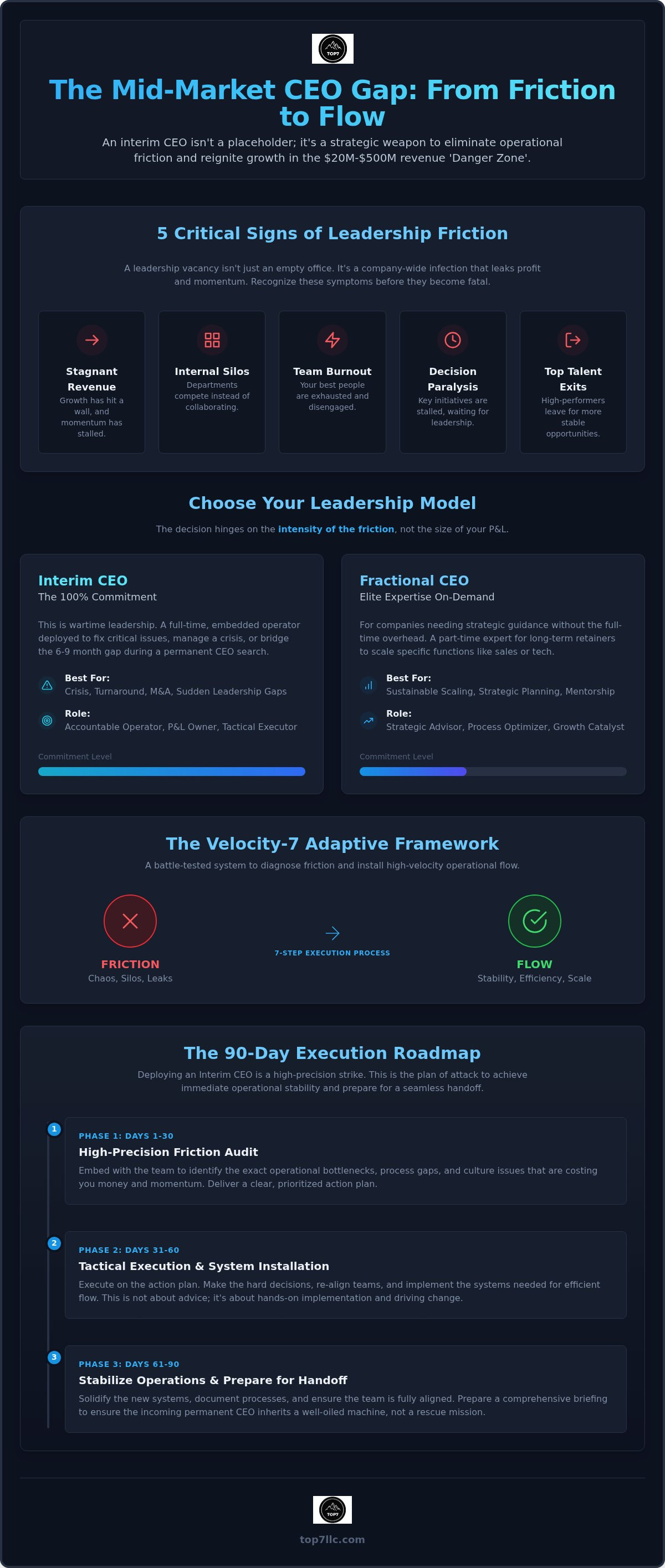
The Velocity-7 Framework: Moving from Friction to Flow
Experience is a commodity; execution is a rare asset. When you hire an interim ceo for mid-market companies, you shouldn't be paying for a resume. You should be paying for a system. At Top7, we deploy the Velocity-7 Adaptive Framework to move your business from operational friction to efficient flow. We don't just "consult" or offer vague advice. We embed ourselves into the seven critical dimensions of your organization: Strategy, Sales, Technology, Finance, Operations, Product, and Revenue. This isn't a theory. It's a battle-tested execution model designed for the brutal reality of 2026. Friction is the chaos that leaks your profit. Flow is the automated, systems-driven growth that creates market dominance.
Strategy vs. Execution: Bridging the Gap
Most strategic plans are expensive paperweights. They gather dust while your team stays stuck in the weeds. The Velocity-7 method changes the rhythm of your business. We take high-level objectives and break them down into daily stand-ups and measurable sprints. We focus on the KPIs that actually drive flow, such as lead-to-close velocity and operational throughput, rather than vanity metrics that look good in a board deck but don't impact EBITDA. If you can't measure the friction in your sales cycle or the lag in your product delivery, you aren't leading; you're just guessing. Our framework ensures that every tactical move aligns with the long-term mission.
Agile Leadership in Non-Tech Environments
Agile isn't just for software developers anymore. In 2026, mid-market companies in manufacturing or professional services must move at tech-world speed to survive. We apply iterative growth principles to traditional business models. This means we fix the engine while the car is moving. We identify the biggest bottleneck, solve it, and move to the next one in two-week cycles. It’s about precision execution. We don't wait for a "perfect" plan that takes six months to draft. We lead, we execute, and we win. Our "embed and execute" philosophy ensures that the transformation is permanent. We don't just leave a manual; we leave a high-performance culture that knows how to pivot.
If your current leadership is stuck in slow motion, it’s time to implement the Velocity-7 Adaptive Framework and start scaling with purpose.
Deploying Your Interim CEO: The 90-Day Execution Roadmap
Deployment isn't a transition; it's a tactical strike. When you bring in an interim ceo for mid-market companies, the clock is already ticking against your EBITDA. You don't have months to "get settled." You have days to identify the leaks and weeks to plug them. A professional interim leader doesn't wait for permission to lead. They arrive with a pre-built execution engine designed to deliver measurable results before the first quarter ends.
Days 1-15: The Friction Audit. We perform a high-precision diagnostic across the seven dimensions of your business. We aren't looking for "feelings." We're looking for the structural gaps in strategy, sales, and operations that are currently stalling your growth.
Days 16-45: Stabilization and Quick Wins. We stop the bleed. This phase focuses on immediate operational fixes that provide instant relief to your cash flow and team morale. We kill the most obvious friction points first.
Days 46-75: Systemic Transformation. This is where we install the Velocity-7 Adaptive Framework. We move beyond surface-level fixes to rebuild your processes for long-term scalability and efficient flow.
Days 76-90: Handover and Long-term Flow. We don't leave you with a vacuum. We prepare the organization for a permanent hire or an exit, ensuring the new systems are self-sustaining.
Top7 leadership isn't an expense. It’s an investment with a guaranteed focus on results. We lead, we execute, and we ensure the transformation pays for itself through recovered revenue and optimized margins.
Vetting Your Interim Leader: What to Look For
Stop obsessing over industry experience. It’s a distraction. You don't need someone who knows your specific niche; you need someone who knows how to run a profitable company. Operational expertise is universal. You should also ignore the "cultural fit" trap. If your culture was perfect, you wouldn't be stagnant. You don't need a friend; you need an agitator who isn't afraid to break the status quo to save the business. During your discovery call, ask about execution speed. If they can't tell you exactly how they’ll identify friction in the first 72 hours, they aren't the right fit.
The ROI of Interim Leadership
The cost of hiring an interim ceo for mid-market companies is high, but the cost of doing nothing is terminal. When you calculate the revenue lost to operational friction, the retainer for an expert becomes a bargain. In many cases, a mere 2% increase in operational efficiency is enough to cover the entire cost of the engagement. Everything beyond that is pure profit for your bottom line. Stop letting your growth stall because of a leadership gap. Stop the friction. Schedule your Velocity-7 Audit with Top7 today.
Stop Managing Stagnation and Start Dominating Your Market
Mid-market growth plateaus aren't a market problem; they're a leadership friction problem. You've seen the data: a six-month vacancy or a placeholder manager can cost your company millions in lost momentum and shrinking EBITDA. Deploying an interim ceo for mid-market companies is the only way to bridge the execution gap with precision. By using our proprietary Velocity-7 Adaptive Framework, we don't just offer advice; we embed ourselves in your operations to move you from chaos to efficient flow.
Top7 provides seasoned operators with national mid-market experience who lead from the front. Our embedded execution model ensures that your 90-day roadmap isn't just a plan on a shelf but a series of tactical wins that pay for themselves. Whether you're stabilizing after a sudden exit or prepping for a high-value transaction, you need a leader who prioritizes profit over politics.
Ready to eliminate operational friction? Schedule a call with a Top7 Executive.
Take control of your company's trajectory today. Let's turn your operational friction into a competitive advantage and start scaling with purpose.
Frequently Asked Questions
What is the typical duration of an interim CEO assignment?
Assignments typically last between six and twelve months. This timeframe allows us to complete the 90-day execution roadmap and ensure the new systems are self-sustaining. The duration depends on whether you're facing a turnaround crisis or a planned transition. We focus on results, not billable hours. Once the Velocity-7 Adaptive Framework is embedded and the "flow" is established, we prepare for a clean handover to your permanent leadership.
How much does an interim CEO for a mid-market company cost?
Fees are structured as daily or weekly rates rather than a traditional annual salary. While the rate is a premium, it’s designed to be results-oriented. Consider the alternative: a permanent CEO search often takes 6 to 9 months, costing your business millions in lost momentum. Our interim leadership pays for itself by stopping revenue leaks and increasing operational efficiency by at least 2% to cover the retainer cost.
Can an interim CEO eventually become the permanent CEO?
It can happen, but it’s rarely the objective. An interim ceo for mid-market companies is an execution specialist, not a long-term caretaker. They are "wartime" leaders who thrive on fixing broken systems and breaking through growth plateaus. Their value comes from being an objective outsider who isn't afraid to make unpopular decisions. Once the business is stabilized and scaling, they usually move on to the next high-stakes challenge.
How fast can a Top7 interim executive start?
We can embed an executive within days. We don't believe in the slow, traditional "discovery" phase that consultants love. Because our team uses the battle-tested Velocity-7 Adaptive Framework, we hit the ground running on day one. We identify your biggest friction points in the first 72 hours and start plugging the holes immediately. If your business is bleeding profit, you don't have weeks to wait for a "match" or a resume review.
What is the difference between an interim CEO and a management consultant?
Consultants sell decks; we sell outcomes. A consultant provides a strategy and leaves your team to struggle with the execution. A Top7 interim leader is an embedded operator with full P&L accountability. They don't just suggest a better way to manage your sales or technology. They take the wheel, make the hard calls, and install the systems themselves. We lead from the front, not from a slide presentation in a boardroom.
Do interim CEOs bring their own team or work with our existing staff?
We work directly with your existing staff to upgrade their performance. The goal is to eliminate the "gut-feel" management style and replace it with a systems-driven culture. We don't need to bring a new army; we just need to train yours to use the Velocity-7 dimensions. We professionalize your middle management so that when our assignment ends, your team is capable of maintaining the "flow" without external support.
How do you measure the success of an interim CEO engagement?
We measure success through hard, data-driven results. This includes EBITDA growth, the elimination of operational silos, and measurable improvements in lead-to-close velocity. Success means your company has moved from chaos to a predictable, scalable system. An interim ceo for mid-market companies is effective when the business can function at a high level without them. We provide a documented roadmap of every win achieved during the 90-day execution period.
Does an interim CEO handle the search for their permanent replacement?
Top7 does not offer executive recruitment services. However, we make the recruitment process much easier for you. We stabilize the operations and document the new systems so you know exactly what skills your permanent hire must possess. By cleaning up the operational mess before the search ends, we ensure your new CEO inherits a healthy organization. This significantly reduces the 5 to 27 times salary cost of a failed hire.


Comments