

How to Vet a Fractional Executive: Stop Hiring Resumes and Start Hiring Results
- Robert Fitzgerald
- May 16
- 12 min read

Is your latest high-priced hire actually driving growth, or are they just a glorified consultant clogging up your Slack channels? Most CEOs are currently bleeding cash on fractional experts who provide nothing but sophisticated opinions and zero ROI. You don't need another advisor to tell you what's wrong; you need an operator who knows how to fix it. If you don't master how to vet a fractional executive, you'll stay exhausted from acting as your own COO while paying someone else to "strategize" from the sidelines. It stops now.
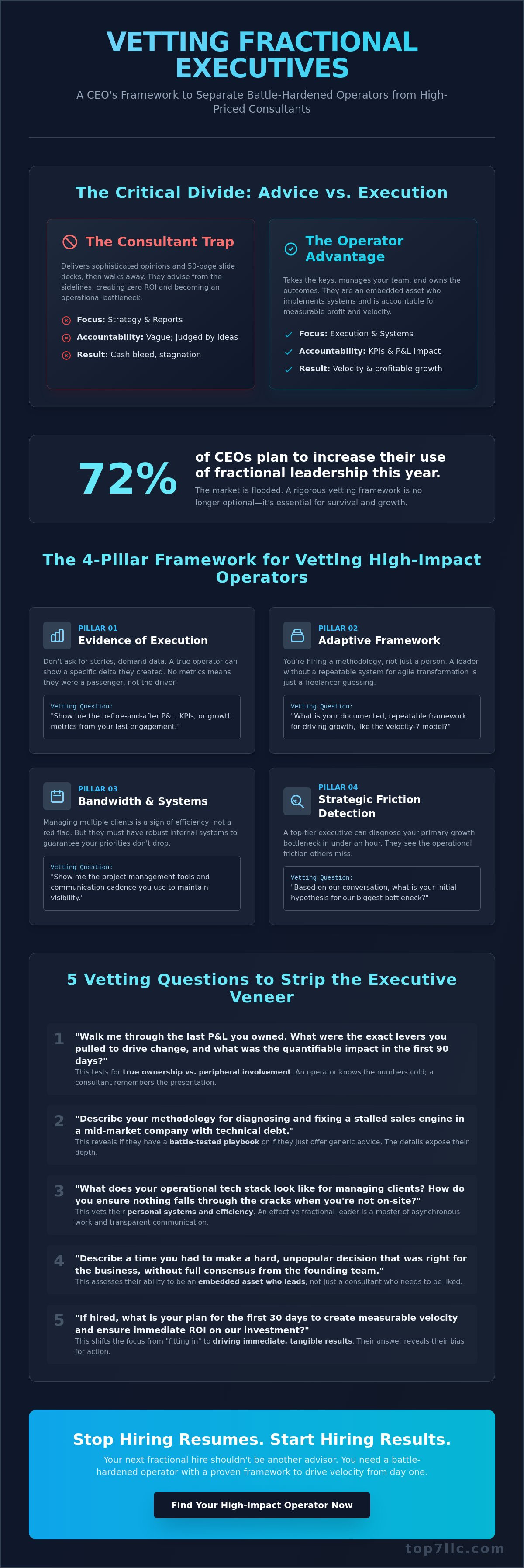
With 72% of CEOs planning to increase their use of fractional leadership this year, the market is flooded with pretenders who look great on LinkedIn but fail in the trenches. We're handing you a battle-tested framework to separate the battle-hardened operators from the high-priced talkers. You'll gain the confidence to hire a leader who prioritizes velocity over vanity metrics. We'll break down the exact indicators of executive-level execution and the tactical questions that expose a lack of operational depth. It's time to stop hiring resumes and start hiring results.
Key Takeaways
Identify the dangerous gap between high-priced advisors who merely suggest and battle-hardened operators who take full ownership of business outcomes.
Master a high-stakes framework for how to vet a fractional executive that prioritizes evidence of execution over polished resumes or "Big 4" pedigrees.
Expose hidden operational friction by testing a candidate's ability to solve specific mid-market scaling bottlenecks, such as technical debt or innovation lag.
Use strategic, "veneer-stripping" questions to reveal if a leader possesses a concrete methodology for fixing a stalled growth engine.
Ensure immediate ROI by shifting from passive vetting to an onboarding strategy that drives velocity from day one using the Velocity-7 Adaptive Framework.
Table of Contents
The Consultant Trap: Why Most Fractional Vetting Fails
Most CEOs are currently bleeding capital on strategic advisors who have never actually fixed a broken P&L. They hire for the logo on the resume, hoping a former Big 4 director can save their mid-market firm. It's a fantasy. These hires are used to massive budgets and specialized teams; they don't know how to operate in the trenches where resources are lean and speed is the only currency. If you want to stop the bleeding, you must understand What is a Fractional Executive in the context of real-world execution. Learning how to vet a fractional executive starts with one brutal truth: advice is cheap, but ownership is expensive.
To better understand this concept, watch this helpful video:
The "Advice vs. Execution" litmus test is simple. If they don't do, they aren't fractional. A consultant hands you a 50-page slide deck and walks away. A fractional executive takes the keys, manages your team, and stays accountable for the numbers. Stop looking for vague "experience" and start looking for repeatable systems of success. If a candidate cannot demonstrate a clear methodology for driving growth, they will become another operational bottleneck rather than a solution.
Defining the True Fractional Executive
A true fractional leader is an embedded asset. They make the hard decisions that you've been avoiding. They don't just suggest a new CRM; they implement it, train the staff, and ensure it actually drives revenue. Their focus is entirely on operational flow. Accountability is the primary metric here. If they aren't willing to be judged by the same KPIs as a full-time hire, they are just a high-priced advisor in a suit. You need a battle-hardened operator who thrives on the pressure of delivering measurable profit.
Why Your Current Vetting Process is Broken
Most hiring processes are obsessed with "culture fit". This is a trap. You don't need a new friend; you need competence in a crisis. When you are determining how to vet a fractional executive, you must prioritize velocity over everything else. Can they move the needle in the first 30 days? The cost of a bad hire in a fractional capacity is not just the retainer. It is the months of lost growth and the burnout you suffer while doing two jobs at once. Traditional vetting fails because it ignores the speed of meaningful business movement. You need a leader who can diagnose technical debt or sales friction instantly and execute a fix without needing their hand held. Stop hiring resumes. Start hiring the systems that drive results.
The 4-Pillar Framework for Vetting High-Impact Leaders
Hiring based on a "gut feeling" is how CEOs end up with a six-figure hole in their budget. You need a rigorous, objective stress test. If you want to master how to vet a fractional executive, you must move beyond the interview and into the audit. Most candidates can talk a great game about their "vision," but vision doesn't fix a broken supply chain or a stalled sales engine. Results do.
The first pillar is Evidence of Execution. Don't ask for stories; ask for the data. A battle-hardened operator should be able to show you a specific delta they created in a previous role. If they can't produce before-and-after metrics, they weren't the driver; they were just a passenger. The second pillar is the Adaptive Framework. You aren't hiring a person; you're hiring their methodology. A leader without a system like the Velocity-7 Adaptive Framework is just a high-priced freelancer making it up as they go. You need a repeatable process that ensures consistent, agile-based transformation.
The third pillar focuses on Bandwidth and Systems. A fractional leader manages multiple high-stakes clients simultaneously. This isn't a red flag; it's a testament to their efficiency. However, you must vet their internal systems. How do they ensure your priorities don't drop? What project management tools do they use to maintain visibility? Finally, the fourth pillar is Strategic Friction Detection. A top-tier executive should be able to find your primary growth bottleneck in under 60 minutes. If they need a month of "discovery" to find the problem, they aren't an expert; they're a student on your payroll.
Testing for Evidence of Execution
Stop accepting vague references to "improved team morale" or "better alignment." Demand specific numbers. If you're vetting a Fractional CRO, ask for the exact percentage increase in pipeline velocity they achieved in their last three engagements. Vetting for skin in the game means ensuring they are committed to your specific KPIs. One of the most effective tactics is to request a preliminary 90-day roadmap during the interview phase. A real operator will already have a mental model of how to attack your problems. If they can't outline a path to ROI before they start, they won't find it after you hire them.
The Methodology Requirement
Why is a framework non-negotiable? Because frameworks prevent "hero culture" and replace it with operational flow. Without a methodology, you are at the mercy of the executive's mood or memory. A structured approach ensures that the transition from friction to growth is systematic rather than accidental. This is why the Velocity-7 framework is critical. It provides a roadmap for rapid transformation, allowing an interim leader to embed directly into your culture and start solving complex obstacles immediately. Don't settle for intuition when you can hire a proven system.
Detecting Operational Friction: Vetting for the Mid-Market
Mid-market companies in high-velocity hubs like Austin or Boston don't fail because they lack ideas. They fail because of friction. When you are figuring out how to vet a fractional executive, you must look for a leader who understands the specific growing pains of a firm trying to scale from $20M to $100M. This isn't the same as managing a seed-stage startup or a global enterprise. It's a different beast. You need someone who can spot the invisible bottlenecks that stall your momentum before they become fatal. If your candidate hasn't lived through the chaos of mid-market scaling, they'll be learning on your dime. That's a cost you can't afford.
Regional market knowledge isn't just a "nice to have" either. A Fractional CRO who has spent a decade navigating the relationship-heavy East Coast market will have a completely different playbook than one from the West Coast tech scene. You need to vet for cultural and regional alignment to ensure they don't walk into a room and alienate your most valuable partners. Success in this role requires more than just a title; it requires the tactical awareness to navigate your specific competitive landscape without hesitation.
The Technical Leadership Stress Test
Most technical hires focus on "new features." A real executive focuses on the product roadmap's velocity. You must vet a candidate on their ability to balance crushing technical debt with the need for aggressive innovation. Ask them how they prioritize refactoring versus new development. If they can't explain how tech debt impacts your bottom line in plain English, they aren't the right fit. There is a massive difference between hiring a Fractional CTO vs. an agency. An agency wants to bill hours; a Fractional CTO wants to align your tech stack with your business strategy to drive profit.
Operations and Revenue Alignment
A Fractional COO shouldn't just "manage people." They should bridge the gap between sales and operations. Friction happens when sales sells what operations can't deliver. Vet your candidates on their history of revenue stream optimization and their ability to stop the bleeding in your delivery process. Do they have a background in Advanced Project Management? This is a non-negotiable skill for any fractional leader. Without it, they are just another person sitting in meetings. You need an operational friction specialist who sees the structural flaws you've missed and has the guts to fix them immediately. Every day they spend "observing" is a day you aren't growing.
5 Vetting Questions to Strip the Executive Veneer
Stop asking about "management style" or "communication preferences." These are soft questions that invite soft, rehearsed answers. If you want to know how to vet a fractional executive effectively, you must throw them into the deep end of operational reality. You aren't looking for a pleasant colleague; you're looking for a mercenary who can stabilize a sinking ship or accelerate a stalled engine. Use these five high-stakes questions to separate the true operators from the polished pretenders.
"What is the first thing you would fire yourself from in this company?" This tests their understanding of executive leverage. A real leader knows they shouldn't be doing $20-an-hour tasks. If they don't have a plan to delegate their own tactical work, they'll become a bottleneck.
"Show me a framework you used to fix a stalled growth engine." Theory is useless. You need to see the architecture of their success. If they can't sketch out a methodology on a whiteboard, they are just guessing.
"How do you handle conflict between a Founder’s vision and operational reality?" You don't need a "yes-man." You need someone with the backbone to tell the CEO when their vision is physically impossible given the current resources.
"What specific metrics did you move in your last 6-month engagement?" Demand hard numbers. If they talk about "alignment" or "synergy" without mentioning CAC, LTV, or EBITDA, end the interview.
"Tell me about a time your execution failed and how you pivoted." Real operators have scars. If they claim a perfect record, they're lying or they've never taken a meaningful risk.
Analyzing the Answers for Red Flags
Listen for the "Consultant" trap. This is the candidate who speaks in beautiful, multi-syllabic jargon but consistently avoids specific metrics. If they can't tell you exactly how they measured success, they didn't achieve any. Another immediate deal-breaker is "The Ego." This is the individual who refuses to embed with your existing team and instead wants to act as a remote oracle. If they aren't willing to get their hands dirty in your CRM or project management tools, they aren't a fractional executive. They're just a billable expense. A lack of a clear "Velocity" plan is your signal to move on. If they don't know how to move fast, they'll only slow you down.
The Reference Check: Going Beyond the Surface
When you call their references, don't ask if they're "nice." Ask: "Did they actually do the work, or did they just tell your team what to do?" You need to verify their ability to manage teams they didn't hire themselves. This is the ultimate test of a fractional leader's influence. If you're still unsure if your current situation warrants this level of scrutiny, review these 5 Signs Your Company Needs a Fractional Executive to confirm your stage of growth. Don't let a polished resume blind you to a lack of results. If you are ready to stop guessing and start growing, book a strategic planning session with a proven operator today.
Onboarding for Velocity: The Top7 Approach
Vetting is just the filter; it isn't the solution. You can spend months learning how to vet a fractional executive only to have them sit idle once the contract is signed. Real ROI is won or lost in the first 30 days. At Top7, we don't believe in passive discovery periods that drain your budget while your growth remains stagnant. Our executives embed directly into your operations to dismantle complex growth obstacles from day one. We don't wait for permission to lead. We move with the intent to solve.
Our approach centers on the Velocity-7 Adaptive Framework. This isn't a generic set of suggestions; it's a battle-tested methodology designed to move mid-market organizations from friction to efficient flow. With 72% of CEOs planning to increase their use of fractional leadership through 2026, the market is crowded. You cannot afford to hire someone who is still "finding their feet" after a month. We focus on agile-based transformation for companies that are ready to stop talking about growth and start executing it. If you aren't prepared for a high-intensity shift in your operational reality, you aren't ready for a Top7 leader.
The First 90 Days: From Audit to Execution
Our seasoned professionals eliminate operational friction through direct intervention. In the Top7 model, there's a massive divide between "Strategic Planning" and "Strategic Execution." Anyone can write a plan; very few can execute it while managing a team they didn't hire. We lead from the inside out, becoming part of your leadership fabric to ensure that technical debt, sales stagnation, or operational bottlenecks are resolved in real-time. We don't just consult. We own the outcomes. By the end of the first 90 days, your organization won't just have a new strategy; it will have a new pace of play.
Ready to Scale? Stop Vetting and Start Leading.
Every day you spend waiting for the "perfect" full-time hire is a day your competitors eat your market share. Recruitment lag for a traditional C-suite executive can take six months or more. Your business cannot afford to stall for half a year while you search for a unicorn. You can get C-suite results right now without the full-time overhead or the massive recruitment fees. The framework for how to vet a fractional executive has been laid out. Now you just need to pull the trigger and stop the bleeding in your operations. Stop the endless cycle of interviews and start driving velocity today.
Take Command of Your Growth Engine
Resume-based hiring is a relic of a slower business era. If you want to dominate your market, you must transition from passive interviewing to active operational stress testing. You now have the tactical framework to identify the difference between a sophisticated talker and a battle-hardened doer. Mastering how to vet a fractional executive is the only way to protect your profit margins and reclaim your focus. It is time to stop acting as your own operational bottleneck and start leading from a position of undisputed strategic strength.
At Top7, we don't just offer opinions. We provide decades of battle-tested C-suite experience and our proprietary Velocity-7 Adaptive Framework to ensure your organization moves from friction to flow. Our leaders embed directly into your team, delivering immediate operational results that a standard consultant simply cannot match. You've spent enough time doing two jobs at once. It's time to hire a leader who owns the outcome.
Stop the friction. Get an executive who actually executes. Contact Top7.
Your next level of scale is within reach. Take it.
Frequently Asked Questions
What is the difference between a fractional executive and an interim leader?
A fractional executive is a long term strategic partner who works part time to drive ongoing growth and operational maturity. Interim leaders are temporary gap fillers hired to keep the seat warm during a transition or crisis. While an interim manager focuses on stability, a fractional leader focuses on building repeatable systems and scaling the business over the long haul.
How many hours per week should a fractional executive dedicate to my company?
Most fractional engagements require 5 to 15 hours per week, but you should focus on outcomes rather than the clock. Top tier operators deliver results through leverage and systems, not by sitting in every low level meeting. If you find yourself counting their minutes, you've hired a freelancer instead of an executive. Results are the only metric that matters.
What are the biggest red flags when vetting a fractional CFO or CTO?
The biggest red flag is a reliance on jargon to mask a lack of operational ownership. If a CFO can't explain your cash runway without a complex spreadsheet or a CTO can't align the product roadmap with revenue goals, they're just advisors. Use a rigorous process for how to vet a fractional executive to ensure they can actually execute in the trenches.
Do fractional executives typically manage existing staff members?
Yes, true fractional leaders embed directly into your org chart to manage and mentor your existing team. They set KPIs, conduct performance reviews, and hold your people accountable to the business strategy. If a candidate refuses to manage your staff, they're a consultant giving advice from the sidelines, not an executive owning the outcome.
How do I measure the ROI of a fractional leadership engagement?
Measure ROI by the specific delta in your primary KPIs, such as pipeline velocity, EBITDA growth, or technical debt reduction. You must set hard benchmarks before the engagement begins. If the leader isn't moving the needle on these metrics within the first 90 days, they're a cost center rather than a growth engine.
Can a fractional executive help with a full-time executive search later?
They are often the best people to lead that search because they've already stabilized the role and identified the specific requirements for success. A fractional leader can vet candidates with an insider's perspective, ensuring you don't hire another "resume" that fails to deliver. They bridge the gap while helping you find the perfect permanent fit.
What is the Velocity-7 framework and how does it apply to vetting?
Velocity-7 is a proprietary adaptive framework designed to move mid-market companies from operational friction to efficient flow. When you are learning how to vet a fractional executive, you should look for this type of structured methodology. A leader without a framework is just winging it, but a leader with a system ensures consistent and measurable transformation.
Is a fractional executive right for a company under $10M in revenue?
Smaller firms often need fractional talent the most because they lack the budget for a $300k full time C-suite but face complex scaling walls. Accessing elite strategic maturity on a part time basis allows a $5M company to operate like a $50M enterprise. It's the most efficient way to buy the expertise needed to break through your current revenue ceiling.


Comments