
How to Find a Fractional Executive: The CEO’s Guide to High-Velocity Leadership

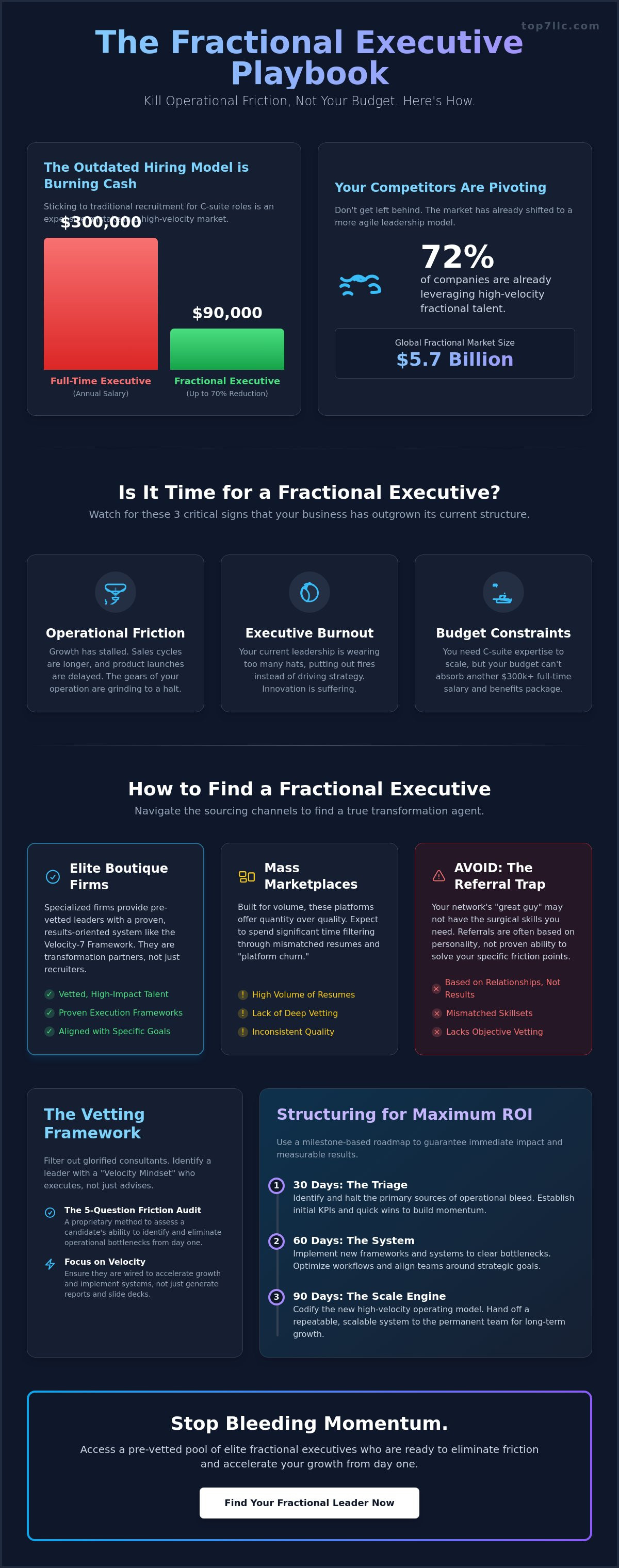
Why are you still burning $300,000 a year on a full-time executive when 72% of your competitors are already pivoting to high-velocity fractional talent? If your operations are grinding to a halt, the problem isn't your team; it's your outdated hiring model. You need to master how to find a fractional executive who can kill the friction without nuking your budget. In a global market that just surpassed $5.7 billion, sticking to traditional recruitment is just an expensive ego trip.
You're likely tired of operational friction slowing your tech while you personally suffer from executive burnout. We agree that a bloated full-time payroll is a growth killer for any midsize enterprise. I'll show you exactly how to source, vet, and onboard C-suite talent to reduce your leadership costs by up to 70% while clearing every bottleneck in your way. We're covering the specific sourcing channels, the vetting protocols that filter out the glorified consultants, and the 30-day roadmap to getting a proven leader on your team.
Key Takeaways
Identify the three critical signs that your business has outgrown its current structure and requires a strategic transformation agent instead of another full-time hire.
Discover how to find a fractional executive without falling into the "Referral Trap" or wasting time on generic job boards that miss high-velocity talent.
Implement the 5-question Friction Audit to vet candidates for a "Velocity" mindset, ensuring they kill operational friction rather than just generating reports.
Learn to structure engagements using Velocity Milestones at 30, 60, and 90 days to guarantee maximum ROI and immediate strategic impact.
Transition from traditional leadership to a "marketing-commando" approach that reduces executive payroll by up to 70% while accelerating growth.
Table of Contents
When to Stop Recruiting and Start Finding a Fractional Executive
Stop treating your C-suite like a social club. Recruiting a full-time executive is a six-month gamble you can't afford to lose. When growth plateaus, your first instinct shouldn't be to post a generic job on LinkedIn; it should be to identify where the engine is smoking. Mastering how to find a fractional executive is the difference between a surgical strategic strike and a slow, expensive descent into mediocrity. You don't need another name on the payroll; you need a system that works.
Operational friction is the silent killer of American startups. It's the sand in the gears of your sales machine or the technical debt dragging down your product launch. You've hit the wall when you see three critical signs: operational friction is stalling your tech, your current leaders are burnt out from wearing too many hats, and your budget can't handle a massive payroll hit. Before you start the hunt, you must understand What is a Fractional Executive? because it isn't just a part-time hire. It's a strategic asset designed to clear bottlenecks that your current team can't even see.
To better understand this high-velocity leadership model, watch this breakdown:
Fractional vs. Interim vs. Consultant: Cutting Through the Noise
Consultants sell you a glossy slide deck filled with theory. Interim leaders are placeholders for bridge-building while you search for a permanent hire. A fractional executive is an embedded, outcome-owning leader who integrates into your team to hit specific KPIs from day one. They don't just advise; they execute. They own the results in tech, ops, or finance, allowing you to focus on the big picture without the full-time payroll burden.
The Cost of the 'Leadership Gap' in 2026
In 2026, the cost of an empty chair is higher than ever. In hyper-competitive tech hubs like Austin or Boston, a vacant C-suite seat drains your momentum daily. If you're still wondering how to find a fractional executive to stop this bleed, you're already behind the curve. Research shows that waiting for the 'perfect' full-time hire can cost your company 20% in annual growth velocity. You're trapped in the 'burnout trap', doing the work of three people while your company's value erodes. Efficiency is the only metric that matters. Your payroll shouldn't be a trophy for how many full-time people you can afford to waste; it should be a measurement of your strategic advantage.
3 Primary Channels to Source Top-Tier Fractional Talent
Stop asking your inner circle for recommendations. Your golf buddy’s "great guy" might be a disaster for your specific operational friction. Referrals are often based on personality, not the surgical precision required to break a growth plateau. If you want to know how to find a fractional executive who actually delivers, you need to look beyond your network. In May 2026, the global fractional market hit $5.7 billion. This means there is plenty of talent available, but most of it is noise. You have three real options: elite boutique firms, mass marketplaces, or direct headhunting.
The "Referral Trap" is a common way founders kill their own momentum. Just because an executive was successful at a Fortune 500 company doesn't mean they can handle the scrapiness of a mid-market scale-up. You need a specialist, not a generalist who happens to be between jobs. North America accounts for 43.7% of this market for a reason; the competition is fierce, and the talent is increasingly specialized. Don't settle for a "good fit" when you need a "perfect strike."
Boutique Leadership Firms vs. Mass Marketplaces
Mass marketplaces are built for volume. They will give you fifty resumes in forty-eight hours, but you will spend weeks filtering through "platform churn." These platforms often lack a cohesive execution method. In contrast, boutique firms like Top7 don't just provide a person; they provide a results-oriented system. When you work with specialists, you get access to the Velocity-7 Adaptive Framework. This ensures the leader you hire isn't just a part-time employee, but a transformation agent. Pre-vetted talent is useless if they don't align with your specific $10M to $50M hurdle.
Direct Outreach: The CEO-to-CEO Approach
LinkedIn is a goldmine if you know how to filter. You must distinguish between a dedicated "Fractional Operator" and an "Unemployed Executive" who is just looking for a full-time gig while you pay their bills. Look for portfolios highlighting "Transformation," "Scale," or "Exit." These keywords signal a leader who understands outcomes, not just activities. If you are struggling to cut through the noise, consider a strategic intervention to identify the exact leadership profile your company needs before you start the hunt.
When you write your outreach, stop sending job descriptions. Write a "Fractional Brief." Define the specific friction point, the 90-day objective, and the measurable ROI. A-players don't want a job; they want a mission. Direct sourcing requires you to be brutally honest about your failures. If your tech stack is a mess, say so. High-velocity leaders are attracted to hard problems with clear rewards. Don't settle for a resume-spammer when you could have a battle-tested veteran who has already solved your exact problem three times over.
The Vetting Framework: How to Spot a Real Leader
Stop reading resumes. They are historical fiction designed to hide failures and inflate titles. If you want to know how to find a fractional executive who doesn't just sit in meetings, you must vet for a "Velocity" mindset. A 20-year corporate veteran often arrives with an expectation of heavy support staff and deep administrative layers. You don't have time for that. You need a "Portfolio Career" leader who has survived multiple battlefields and brings a proven system to the table. By 2027, over 30% of midsize enterprises will have at least one fractional leader on retainer. Don't let yours be a placeholder.
The first interview is a diagnostic session, not a get-to-know-you coffee. Use the 5-question "Friction Audit" to see if they are a commando or a clerk:
Based on our brief, where is our most expensive operational leak right now?
What does your day 15 roadmap look like, and what's the first bottleneck you'll kill?
How do you integrate with a team that is already suffering from executive burnout?
Which specific metrics will you own and report on every Friday?
Under what conditions should we decide to end this engagement because the mission is complete?
If they can't answer these without hiding behind "consultant speak," show them the door. A real leader knows that if they don't have a clear roadmap by week two, they aren't the right fit for a high-velocity environment.
Assessing the Velocity-7 Dimensions
A true leader understands that tech, ops, and finance are not silos. They are interconnected gears. In our framework, we look for "Agile Transformation" capabilities that span the entire organization. A Fractional CTO who doesn't understand your customer acquisition cost is just an expensive developer. A Fractional CFO who doesn't understand product lifecycle is just a bookkeeper. You need an embedded leader who owns the outcome, not just the department. They must move your company from operational friction to efficient flow within their first 30 days.
Red Flags in a Fractional Candidate
Watch out for the "Full-Time Hunter." As of May 2026, 25% of U.S. businesses use fractional hiring, but many candidates are just using these roles as a bridge to their next 9-to-5. If they aren't managing a portfolio of 2-3 clients, they likely aren't a career fractional operator. They'll leave you the moment a recruiter calls with a "real" job. Another red flag is availability vs. scalability. If they are just filling their own calendar to pay bills, they won't have the mental bandwidth to handle your growth. You need someone who scales their impact, not just their hours.
Structuring the Engagement for Maximum ROI
Finding the right person is only half the battle. If you don't structure the engagement for speed, you're just paying for a high-priced spectator. Most CEOs fail here because they treat fractional leadership like a part-time job rather than a performance-based intervention. As of May 2026, monthly retainers for fractional CMOs and CTOs in the U.S. typically range from $8,000 to $22,000. You aren't paying for hours. You're paying for the removal of bottlenecks that are costing you millions in lost growth velocity. Stop counting minutes and start measuring milestones.
Monthly retainers are superior to project-based fees for long-term scaling. Projects have an end date; growth shouldn't. A retainer ensures your executive is thinking about your exit strategy, not just their next invoice. When it comes to incentives, consider a cash-plus-equity model if you're aiming for a high-multiple acquisition. This aligns their "marketing-commando" mindset with your long-term wealth. If they don't ask about your exit goals during the negotiation, they aren't a true strategic asset.
The 90-Day Fractional Roadmap
Your new leader must hit the ground running. Month one is the Audit and Diagnostic phase. They should identify every leak in your conversion machine or tech stack by day 15. Month two is the Execution phase. This is where they implement the Velocity-7 Adaptive Framework to kill operational friction. By month three, you move into the Optimization phase. This is where you measure the flow, verify the ROI, and prepare the infrastructure for massive scale. If you don't see a measurable shift in efficiency by day 60, you've hired a consultant, not an operator.
Communication Cadence for Off-Site Leaders
Part-time does not mean out of touch. You must set rigid expectations for Slack and Zoom availability from the start. A high-velocity leader provides an Executive Summary every Friday afternoon. This isn't a list of "tasks completed." It's a report on friction removed and progress toward your 90-day targets. For high-stakes initiatives that require surgical precision, you might need to integrate Advanced Project Management protocols to ensure nothing slips through the cracks. If you want a leader who actually owns the outcome and drives measurable profit, start your Velocity-7 transformation today. Don't let your growth plateau become a permanent grave for your ambitions.
Why Top7 is the Final Stop in Your Fractional Search
You've done the research. You've analyzed the channels and learned how to find a fractional executive who can navigate the 2026 market. Now, you face the most critical decision for your company’s survival: do you hire a part-time spectator or embed a strategic transformation agent? Most agencies are just glorified recruiters. They match keywords on a resume and take a fee. Top7 is different. We don't just find talent; we deploy a high-velocity leadership system designed to dominate your market. We focus on your profit, not our hours.
Our approach is built on the Velocity-7 Adaptive Framework. This isn't a generic set of guidelines. It's a proprietary method for killing operational friction at the root. Whether you're in Boston, Chicago, or Dallas, you get direct access to seasoned pros who have already scaled companies from $10M to $50M. We don't believe in the "wait and see" approach. We believe in surgical strikes against the bottlenecks that are slowing down your sales or tech teams. If a leader isn't adding measurable value by day 30, they aren't a Top7 leader.
The Top7 Difference: Execution Over Advice
Most "rent-a-boss" services provide people who give advice. We provide people who drive execution. Our Fractional CTOs and COOs are battle-hardened veterans who move your company from friction to flow in under 90 days. For example, in early 2026, we helped a mid-market manufacturing firm scale their output by 40% while reducing executive payroll by 65%. We didn't add a single full-time C-suite salary. We simply replaced traditional, bloated leadership with our high-velocity model. We don't care about the history of your industry; we care about the future of your bank account.
Ready to Level Up Your Leadership?
Don't let another quarter of stalled growth become your legacy. As of May 2026, 72% of CEOs are already increasing their use of fractional talent to stay competitive. If you aren't scaling, you're dying in this market. The cost of doing nothing is significantly higher than the investment in a Fractional CEO. You've seen the data. You know the risks of executive burnout. It's time to stop playing defense and start building your conversion machine. Take the first step toward market dominance and Schedule your Velocity-7 Diagnostic with Top7 today. We are the final stop in your search for leadership that actually works.
Kill the Friction and Claim Your Market Dominance
Operational friction is a choice you make every day you refuse to evolve. You've learned that traditional recruitment is a slow-motion gamble, while mastering how to find a fractional executive is a surgical strike against stagnation. Success in 2026 requires more than just "advice"; it demands a leader who understands how to move from chaos to flow using a proven execution system. You don't need more meetings. You need a conversion machine that scales without the dead weight of a $300,000 payroll.
Top7 brings the proprietary Velocity-7 Adaptive Framework to mid-market firms across Boston, Austin, and the West Coast. We don't play at leadership; we dominate it. It's time to stop the bleeding and start the transformation. Stop the friction. Get the leadership you need with Top7. Your competitors are already moving. Make sure you're the one leading the charge.
Frequently Asked Questions
What is the average cost of a fractional executive in 2026?
Monthly retainers for fractional leaders in the U.S. typically range from $8,000 to $22,000 as of May 2026. While the average annual salary sits at $93,552, top-tier operators who drive massive growth can reach $148,500. You aren't paying for a person to sit in a chair; you're investing in a strategic advantage that eliminates the 60% burden of full-time benefits and taxes.
How many hours a week does a fractional executive typically work?
Engagements usually span 4 to 25 hours per week depending on the complexity of your operational friction. Don't make the amateur mistake of managing their clock. High-velocity leaders are hired for their output and their ability to hit "Velocity Milestones" rather than their ability to fill a 40-hour time sheet with busy work.
Can a fractional executive manage a full-time team effectively?
Yes, they are embedded, outcome-owning leaders who integrate directly into your hierarchy. If you're learning how to find a fractional executive, look for those who have managed teams of 50 or more. They don't just advise from the sidelines; they hold your full-time staff accountable and drive the daily execution of your strategic plan.
What is the difference between a fractional leader and a management consultant?
Consultants sell you a map; fractional executives drive the truck. A consultant delivers a slide deck and leaves before the implementation fails. A fractional leader owns the department, manages the budget, and stays until the results are visible in your bank account. They are operators, not theorists.
Is a fractional executive a good fit for a seed-stage startup?
They are a perfect fit if you have reached the point where founder-led chaos is slowing down your tech or sales. 25% of U.S. businesses currently use fractional talent to access C-suite expertise they couldn't otherwise afford. If you have the capital but lack the systems to scale, a fractional leader is a surgical strike against failure.
How do I protect my company's IP when hiring a fractional leader?
Use ironclad NDAs and IP assignment clauses that are standard in the May 2026 legal landscape. Professional fractional operators manage multiple clients and rely on their reputation for discretion. They treat your intellectual property as a tactical asset that belongs exclusively to your "conversion machine" and never leaves your perimeter.
What happens if we need to transition from fractional to a full-time hire?
A true fractional leader builds a system so robust that they eventually become replaceable. Part of their mission is to stabilize the department and, when the time is right, help you vet their full-time successor. This ensures you don't lose growth velocity during the handoff to a permanent hire.
Which fractional role should I hire first: COO, CFO, or CTO?
Hire for the bottleneck that is costing you the most money right now. If your product is crashing, you need a CTO. If your operations are leaking cash, you need a COO. Knowing how to find a fractional executive means identifying which gear in your machine is broken and hiring the specific specialist to fix it today.



Comments