

Operational Efficiency Consultant Philadelphia: Stop Managing Friction, Start Driving Flow
- Robert Fitzgerald
- 5 hours ago
- 12 min read

Your business is currently a collection of expensive friction points masquerading as a company. If you're still managing daily fires while revenue remains stagnant, you aren't leading; you're just surviving. In a year where Philadelphia's BIRT and U&O tax exemptions have vanished and the city is bracing for the global spotlight of 2026, "good enough" operations are a death sentence. Partnering with an operational efficiency consultant philadelphia isn't a luxury. It's a tactical necessity to prevent your infrastructure from buckling under the pressure of growth.
We understand the frustration of watching high effort result in low velocity. You feel the burnout of being the human bridge for every broken process, and it's draining your profit. It's time to stop being the bottleneck. You're about to discover how to eliminate growth obstacles and transform operational friction into a high-velocity business using fractional leadership and our proprietary Velocity-7 Adaptive Framework. We'll break down the shift from reactive firefighting to proactive leadership, showing you how to build a scalable model that generates clear ROI and runs flawlessly without your constant intervention.
Table of Contents
Why Your Philadelphia Business is Stalling (Hint: It’s Not the Market)
The $10M to $50M revenue range is a graveyard for Philadelphia businesses that refuse to evolve. You have the product and the team, yet your growth has flatlined. You probably blame the Fed, local tax changes, or the talent pool. You're wrong. The real culprit is internal. It's the silent accumulation of friction that turns a high-growth machine into a sluggish bureaucracy. You don't have a market problem; you have an execution problem. When the machinery of your business grinds against itself, no amount of marketing spend or sales hustle will fix the underlying rot.
Most leaders look at the definition of operational efficiency and see an academic metric. We see a battlefield. Operational friction is the gap between strategic intent and tactical execution. It's what happens when your vision for a 20% margin gets chewed up by manual data entry, redundant meetings, and the "that's how we've always done it" mentality. When you hire an operational efficiency consultant philadelphia, you aren't looking for a cheerleader. You're looking for a specialist to dismantle the obstacles you've spent years building. Traditional consulting reports end up as digital paperweights because they offer theory without the guts to implement change. We don't do theory.
Identifying the Hidden Costs of Operational Friction
Inefficient processes don't just slow you down; they leak cash. Your sales team is fighting your CRM instead of closing deals. Your financial reporting is a lagging indicator rather than a predictive tool. The most dangerous element is the "Founder's Trap." If every critical decision still requires your sign-off, you aren't a CEO; you're a high-priced traffic controller. This personal involvement is your biggest bottleneck. It leads to executive burnout, which is a massive, unquantified cost in the hyper-competitive Northeast business corridor. If you're the only one who can fix a fire, you've built a job, not a scalable company.
Why 'Business as Usual' is a Death Sentence in Philadelphia
Philadelphia is a tough town, but agile firms from New York and Boston are aggressively moving in on your territory. They aren't smarter than you. They're just lighter. While you wait six months to find the "perfect" full-time executive hire, your competitors are using fractional leadership to pivot and scale. Relying on legacy systems and manual workarounds in 2026 is a conscious choice to lose. Every day you spend managing friction is a day you aren't driving flow. In this market, stagnant companies don't just stay still. They get acquired or they disappear.
Defining Operational Efficiency for Mid-Market Leaders in 2026
Most mid-market CEOs think efficiency is about spending less. They're wrong. In 2026, efficiency is about velocity. It's the ability to deliver maximum value with zero friction. If you're stuck in survival mode, you're just a glorified firefighter. You need to transition to a flow state where your organization moves with precision and speed. This is where an operational efficiency consultant philadelphia becomes your most valuable asset. They don't just look at your P&L; they look at your process velocity and executive bandwidth. Your financial statements are a rearview mirror. You need a windshield.
The 2026 reality is harsh for those clinging to manual processes. A 2026 PwC survey of operations leaders found that 89% say their technology investments haven't fully delivered the expected results. Why? Because 87% of those same leaders believe poor data quality has crippled their ability to realize value. Modern optimization of business processes requires more than just a faster spreadsheet. AI and automation are now baseline requirements. If you aren't using them to accelerate decision-making, you're already losing market share to firms that do.
Moving Beyond Basic Cost-Cutting
Efficiency doesn't mean firing people. It means empowering them by removing the garbage from their day. When you eliminate redundant tasks, you allow your team to focus on high-value strategy. There's a massive difference between being busy and being productive. If your C-suite is stuck in the weeds of daily operations, your organization is hemorrhaging potential. Focusing on flow ensures that information and value move through your company without stopping for unnecessary approvals or manual interventions.
The Role of Technology Leadership in Operational Flow
This is where a Fractional CTO changes the game. They identify tech bottlenecks before they crash your growth. They integrate disparate systems to create a single source of truth for the executive team. Technology is an asset only when it accelerates human decision-making. Without that acceleration, it's just another expense. An operational efficiency consultant philadelphia ensures your tech stack serves your strategy, not the other way around. Stop managing the tools and start driving the results.
The Fractional Advantage: Why Traditional Consulting Fails
Traditional consulting is a racket designed to keep you paying for insights you never implement. You get a sleek presentation, a heavy bill, and zero change on the factory floor or in the sales bullpen. That's the consultant trap. For a mid-market firm in the Northeast, burning capital on strategic advisory that doesn't include execution is financial negligence. You don't need a 50-page PDF. You need an operational efficiency consultant philadelphia who actually knows how to pull the levers of your business, not just point at them from the sidelines.
The math for full-time C-suite hires in Philadelphia is brutal. With senior business consultants averaging $143,279 and top-tier talent commanding well over $165,000 plus benefits, the payroll burden for a single executive can cripple your cash flow. Fractional leadership gives you the same strategic dominance at a fraction of the cost. We provide the surgical precision needed to fix specific operational rot without the bloat of a permanent salary. We don't shout from the sidelines. We embed directly into your team, taking ownership of the outcomes and driving the execution ourselves.
Interim Leadership is another tool in our arsenal. When your organization is in a state of flux or facing a leadership gap, you can't afford to wait six months for a recruiter to find a "perfect" match. You need stability now. We step in to bridge the gap, stabilizing the ship while building the systems that will make your future full-time hire successful. We build the engine; they just have to keep it running.
Advice vs. Execution: The Fractional COO Difference
Traditional consultants give you a map and wish you luck. A Fractional COO takes the wheel. We focus on accountability because we have skin in the game. When our leaders enter your organization, we aren't there for a discovery phase that lasts three months. Our 90-day impact plan is about immediate stabilization and the aggressive removal of friction. We measure success by the increase in your process velocity, not the number of hours we bill your accounting department.
Avoiding the 'Consultant Trap' in Business Strategy
Most strategic plans fail within 30 days because the people who wrote them don't have to live with the consequences of their theories. If your current consultant is just selling you more consulting, fire them immediately. The benefit of part-time, high-level expertise is focus. We provide the tactical execution required to move from friction to flow. If your advisor isn't talking about measurable ROI and system integration, they're just selling you digital paperweights. Stop paying for advice. Start paying for results.
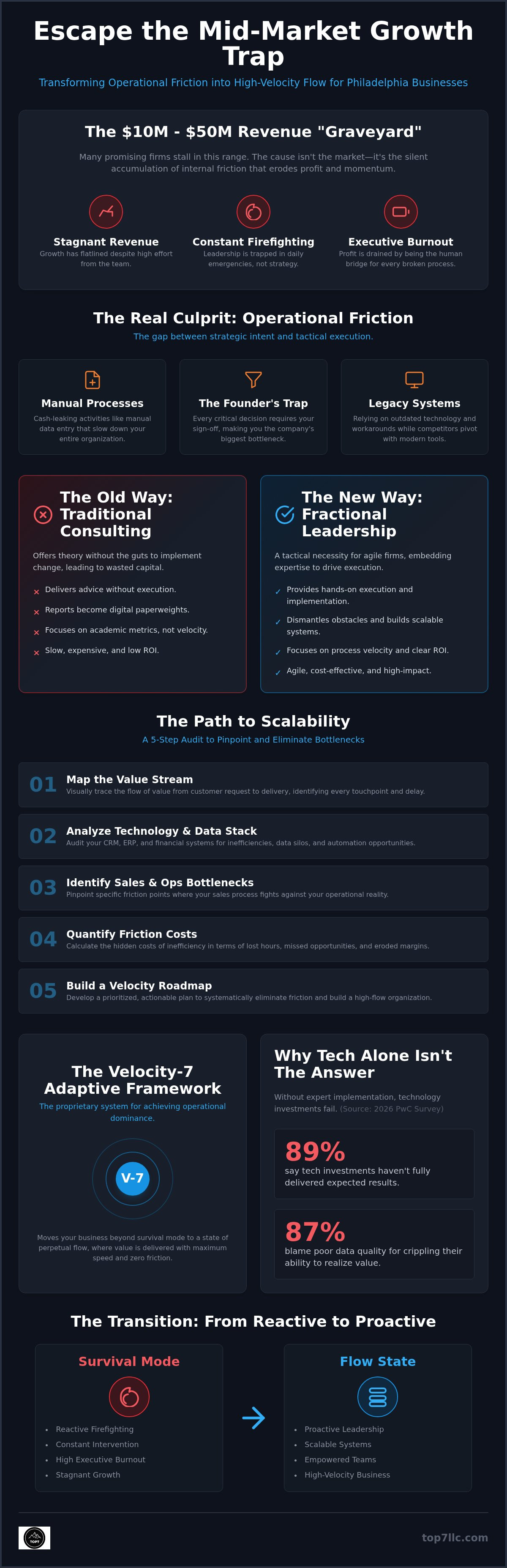
How to Audit Your Operations for Scalability (A 5-Step Process)
Most audits are a waste of time because they focus on compliance rather than cash. If your audit doesn't reveal exactly why your revenue is stuck, it's just administrative theater. To scale, you must strip your business down to its raw mechanics and see which gears are grinding. An operational efficiency consultant philadelphia doesn't just look for leaks. They look for the structural failures that will cause your entire infrastructure to snap the moment you try to grow. Follow this aggressive five-step process to see if your business is actually built to last.
Step 1: Map the Value Stream. Forget every secondary process. Map the direct path from a lead entering your system to cash hitting your bank account. If a step doesn't directly contribute to that flow, it's a candidate for elimination.
Step 2: Identify the Friction Points. Look at your sales and tech stack. Where does data stop moving? Where does a human have to manually intervene to fix a system error? These are your profit killers.
Step 3: Audit Executive Bandwidth. List every task your C-suite performs. If your CEO is troubleshooting software or your CFO is chasing down individual invoices, they're doing work far below their pay grade. This is the most expensive friction you have.
Step 4: Stress-Test the Infrastructure. Ask yourself: if your revenue doubled tomorrow, what would break first? If the answer is "everything," you don't have a business; you have a fragile job.
Step 5: Apply the Velocity-7 Framework. Use our proprietary dimensions to close the gaps identified in the first four steps. This is how you move from a collection of parts to a high-velocity machine.
Ready to stop guessing? Schedule a Strategic Planning session to get a professional audit of your growth obstacles.
Pinpointing Your Revenue and Process Bottlenecks
Stop relying on "gut feelings." Data is the only thing that matters. Use your CRM and ERP data to identify exactly where your sales funnel is leaking. A major red flag is when your best employees are the ones working the longest hours. Often, these "rockstars" are actually hiding massive inefficiencies by manually bridging broken processes. They aren't heroes; they're symptoms of a failing system. If your operations rely on individual heroics rather than repeatable systems, you're one resignation away from a total collapse.
Aligning Executive Leadership with Operational Goals
Operational alignment is the synchronization of C-suite vision with frontline action. If your CEO, CFO, and CTO aren't reading from the same playbook, your team will receive conflicting orders that paralyze productivity. You must communicate operational changes as tactical upgrades, not criticisms of the current staff. When the leadership team is unified, you can implement the Velocity-7 Framework without destroying your company culture. Alignment ensures that every dollar spent on technology or payroll is an investment in flow, not just another layer of friction. Hire an operational efficiency consultant philadelphia to facilitate this alignment before your competitors do it for you.
Velocity-7: The Proprietary Framework for Operational Dominance
Static business models are for companies that have already given up. In a market as volatile as 2026, a rigid three-year plan is nothing more than a suicide note. We built the Velocity-7 Adaptive Framework because standard consulting frameworks are too slow and too theoretical for the mid-market. This isn't just another set of slides. It's a high-velocity operating system designed to move your organization from friction to flow. When you bring in an operational efficiency consultant philadelphia from Top7, you aren't just getting an extra pair of hands. You're getting a battle-tested methodology that forces your business to pivot in real-time.
The Seven Dimensions of Growth provide a holistic approach to business transformation. We don't just fix your tech and ignore your cash flow. We don't optimize your sales and ignore your leadership bottlenecks. Velocity-7 integrates financial health, sales velocity, technological agility, and executive bandwidth into a single, cohesive engine. Philadelphia firms that have adopted this model didn't just see incremental gains. They achieved the kind of scale that allows them to dominate their niche while their competitors are still struggling with legacy systems and manual workarounds. Being adaptive means you stop reacting to the market and start dictating it.
How Velocity-7 Solves Growth Obstacles
Mid-market companies often hit a wall because their infrastructure can't keep up with their ambition. Velocity-7 addresses the financial, sales, and technology hurdles that paralyze growth. We take the principles of Agile, which most people wrongly think are only for software, and apply them to your entire organization. This creates iterative growth. You stop waiting for a massive "launch" and start making continuous, data-driven improvements. The result is a flow state where your company finally runs like a precision machine, delivering value without the constant need for CEO intervention.
Securing Your Philadelphia Business's Future with Top7
The window for "good enough" operations is closing. With Philadelphia hosting major events like the FIFA World Cup and the nation's 250th anniversary in 2026, the demand for goods and services will skyrocket. If your business is still bogged down by operational friction, you'll miss the greatest revenue opportunity of the decade. You can't afford to wait for a full-time hire while your infrastructure is buckling. Bridge the leadership gap now. The first step is simple: we perform an aggressive operational audit to see where you're leaking cash and losing time.
Ready to eliminate friction and start driving flow? Schedule a call with a Top7 executive today. An operational efficiency consultant philadelphia will show you exactly how to turn your current bottlenecks into your greatest competitive advantages. Stop managing the mess. Start leading the market.
Own Your Market: Transition from Friction to Flow
Managing daily fires isn't leadership; it's a slow drain on your company's future. We've shown that mid-market stagnation in Philadelphia is rarely about the market and almost always about the internal friction stalling your execution. By leveraging expert fractional C-suite leadership, you gain the strategic dominance needed to dismantle bottlenecks without the high-risk payroll of a full-time executive. Our proprietary Velocity-7 Adaptive Framework, founded by Michael J. DiPiano Jr., is the only roadmap designed to turn your operational chaos into a high-velocity growth engine.
The choice is simple. You can continue to act as the human bridge for broken processes, or you can build a system that runs without you. Partnering with an operational efficiency consultant philadelphia is the tactical move that separates the market leaders from the companies that will be acquired or dissolved by 2026. It's time to stop surviving and start winning.
Stop managing friction. Get the Velocity-7 Framework roadmap now.
Frequently Asked Questions
What does an operational efficiency consultant actually do?
An operational efficiency consultant philadelphia identifies and eliminates the structural friction that bleeds profit from your organization. They audit your value stream, pinpoint tech bottlenecks, and rebuild processes to ensure maximum velocity. Unlike a generalist, they focus strictly on the mechanics of how work gets done and how value is delivered. They turn your messy daily operations into a repeatable, scalable machine that functions without constant executive intervention.
How is a fractional COO different from a business consultant?
Consultants sell you a plan and leave the implementation to your already overwhelmed team. A Fractional COO embeds within your company to execute that plan personally. They take ownership of the results and manage the daily operations required to achieve them. It's the difference between buying a map and hiring a driver who has already navigated the terrain. You get C-suite leadership without the full-time payroll burden.
Is my Philadelphia company too small for fractional leadership?
If your revenue is between $10M and $50M and you're stuck in a growth plateau, you're the ideal candidate for fractional leadership. Size isn't the metric; friction is. If the CEO is still handling tactical fires or software troubleshooting, the organization is failing to scale. Fractional leaders provide the high-level expertise needed to bridge the gap between small-business hustle and mid-market dominance without the cost of a permanent executive.
How much does an operational efficiency consultant in Philadelphia cost?
While full-time business consultants in Philadelphia average approximately $143,279 per year as of July 2026, fractional models provide a significantly higher ROI by focusing on specific outcomes. You pay for the level of expertise and the complexity of the friction you need to eliminate. Instead of a fixed salary and benefits package, you invest in a targeted strike on your operational bottlenecks. This allows you to access elite talent that would otherwise be cost-prohibitive.
What is the Velocity-7 Adaptive Framework?
The Velocity-7 Adaptive Framework is our proprietary system for moving organizations from friction to flow across seven distinct dimensions of growth. It's designed to replace static, outdated business plans with an agile operating system that pivots in real-time. By integrating financial health, sales velocity, and technological agility, the framework ensures that every part of your business is synchronized. It's the engine that powers high-velocity companies in the Northeast corridor.
Can an interim leader help during a CEO transition?
Interim leadership is critical during a C-suite transition to prevent operational drift and loss of market share. We step in to stabilize the organization, maintain momentum, and prepare the infrastructure for your eventual permanent hire. This prevents the "panic hire" mistake where companies rush to fill a seat with the wrong person. We ensure the ship stays on course while you take the time to find the right long-term fit.
How long does it take to see results from operational optimization?
You should expect to see measurable stabilization within the first 90 days of engagement. While total business transformation is a continuous process, the aggressive removal of obvious friction points often results in immediate improvements to executive bandwidth and process velocity. We focus on quick wins that generate ROI early, providing the capital and momentum needed for deeper structural changes. If you aren't seeing results in three months, your consultant is just talking.
Does Top7 provide technical leadership like a Fractional CTO?
Yes, we provide Fractional CTO services to ensure your technology stack is an accelerator rather than a bottleneck. Most mid-market firms suffer from disparate systems that don't communicate, leading to poor data quality and slow decision-making. Our technical leaders integrate these systems to create a single source of truth. We ensure your tech investments deliver the expected results, moving you away from the 89% of leaders who report failed digital initiatives.


Comments