

Go-to-Market Strategy for New Products: The 2026 Guide to Frictionless Launches
- Robert Fitzgerald
- Jul 9
- 11 min read

Updated: 3 days ago
Why are you still treating your product launch like a hopeful experiment? In 2026, a "soft launch" is just a polite term for an expensive failure. If your sales and marketing teams aren't perfectly aligned, you aren't launching; you're just leaking cash. Most companies let operational friction turn a potential breakthrough into a 218-day enterprise sales slog that misses every ROI target. You've felt the pain of a go-to-market strategy for new products that looks brilliant in a slide deck but survives exactly zero seconds in the real world. It's frustrating, it's expensive, and it's a sign of weak strategic execution.
Stop guessing and start executing. This guide provides a high-velocity GTM framework designed to eliminate friction and secure market dominance. You'll learn how to deploy fractional C-suite expertise to bridge specialized gaps and use the Velocity-7 Adaptive Framework to drive a 4:1 LTV:CAC ratio. We're stripping away the fluff to show you how to build a roadmap that turns R&D into a precision strike for profit. It's time to stop hiring full-time overhead and start scaling with surgical precision.
Table of Contents
Beyond the Hype: Why Most GTM Strategies Fail in the Mid-Market
Stop pretending marketing can fix a broken foundation. Flashy campaigns can't save a product that lacks a coherent operational blueprint. Most mid-market firms fall for the "Launch and Pray" fallacy. They build a product, hand it to a tired marketing team, and hope for a miracle. It never happens. A robust go-to-market strategy is more than just a promotional checklist. It's an execution engine that aligns every department toward a single, profitable outcome. Without it, you're just lighting money on fire to keep the lights on.
Startups are agile because they have nothing to lose. Mid-market companies are different. You have legacy systems, departmental silos, and a C-suite that's already stretched thin. Your leadership team is often the biggest bottleneck to a successful launch. They don't have the bandwidth to manage a complex go-to-market strategy for new products while keeping the core business running. This friction doesn't just slow you down; it kills your ROI before you've even cleared the starting gate.
To better understand how to build a framework that actually converts, watch this video:
The Cost of Internal Friction
Misaligned KPIs are the silent killers of your product's potential. When sales is chasing immediate volume while marketing is focused on long-term brand equity, the launch stalls. This isn't just an HR issue; it's a financial drain. With the average mid-market sales cycle hitting 121 days in 2026, you can't afford a single week of internal hesitation. Every delay increases your customer acquisition cost (CAC) and gives competitors time to eat your lunch. Executive burnout isn't a badge of honor. It's a sign that your team is failing to manage the weight of a new market entry. You can't just "add" a launch to an already full plate and expect excellence.
From Friction to Flow: A New Perspective
Execution is 90% of the battle in 2026. You don't need a bloated 100-page slide deck that nobody reads. You need "Flow." In a GTM context, Flow is the state where operational obstacles are removed, and the path to the customer is clear. Achieving this requires a go-to-market strategy for new products that focuses on precision execution rather than vague promises. Strategic leadership must prioritize removing launch obstacles over adding more meetings. If your current structure can't handle the pressure, you need to find a way to clear the path. Victory belongs to those who move the fastest, not those who plan the longest.
The 4 Pillars of a High-Velocity GTM Strategy
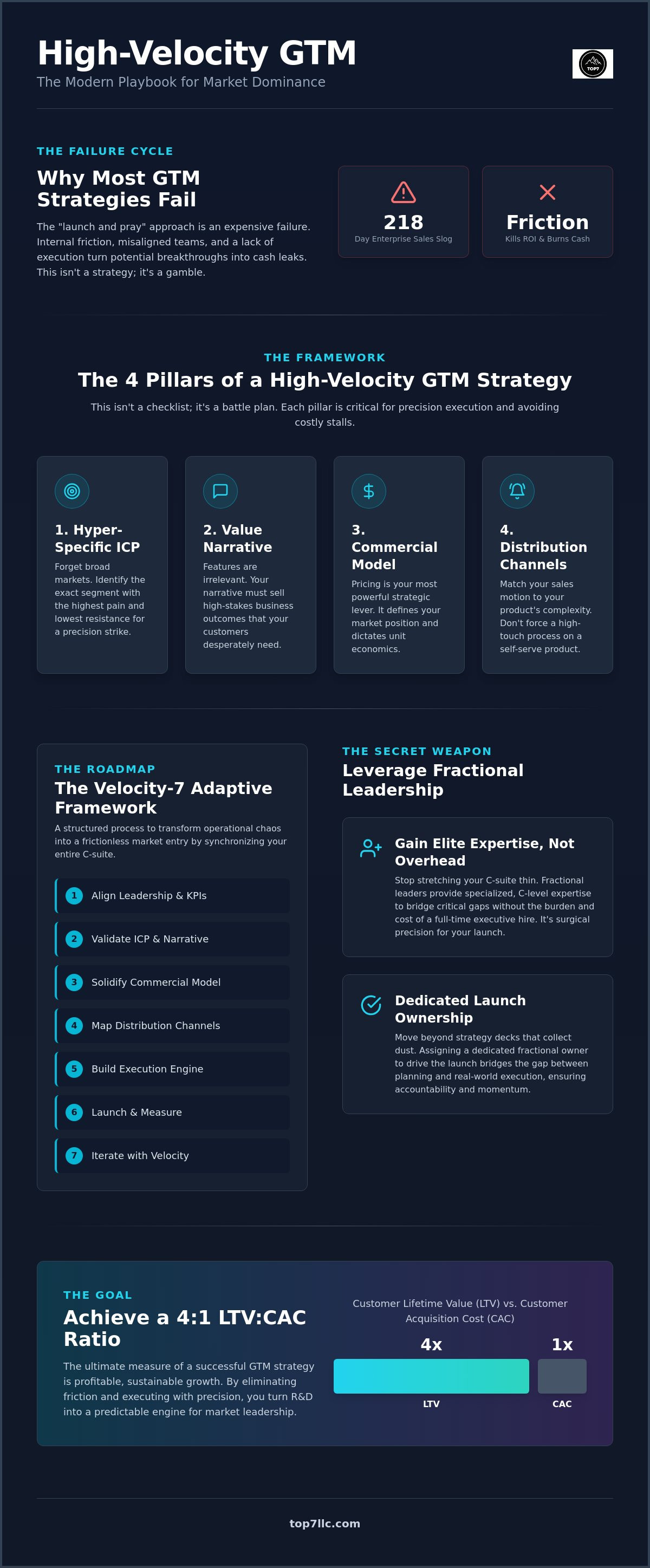
A high-velocity go-to-market strategy for new products isn't a theoretical exercise. It's a battle plan. If you miss even one of these four pillars, your launch will stall, your CAC will spike, and your board will start asking uncomfortable questions. You can't afford to be vague when the median B2B buying committee now includes 11.2 stakeholders. You need precision, not a wish list.
Pillar 1: Hyper-Specific ICP and Market Segmentation. Forget broad market categories. You need to identify the exact segment where the pain is highest and the resistance is lowest. If you market to everyone, you're invisible to everyone.
Pillar 2: Value Proposition and Narrative. Features are for technical manuals. Your GTM narrative must focus on the high-stakes business outcomes your customers crave.
Pillar 3: The Commercial Model. Pricing is your most powerful strategic lever. It dictates your unit economics and defines your market position. Get it wrong, and you're dead on arrival.
Pillar 4: Distribution Channels. Match your sales motion to your product's complexity. Don't try to force a high-touch sales-led motion on a low-margin self-serve product.
Defining Your Winning Narrative
The Commercial Model and Pricing Strategy
Pricing isn't a financial afterthought; it's a weapon. With B2B marketing budgets sitting at a median of 9.1% of revenue in 2026, your pricing must reflect the specific value you capture. Testing your packaging is critical. Mid-market buyers want predictability, while enterprise buyers prioritize customization and security audits. Align your sales motion with your product's complexity. If your CAC for a sales-led model is hitting the $11,400 median, your pricing better support that burn. For those struggling to align these complex levers, strategic planning from an embedded expert can turn a pricing disaster into a competitive advantage. Don't let a bad commercial model anchor your growth before you even leave the harbor.
Strategic Planning vs. Real-World Execution: Closing the Leadership Gap
Your 50-page strategy deck is a paperweight. It doesn't matter how many colorful charts or market projections you have if no one is driving the machine. In the mid-market, the Leadership Gap is where ROI goes to die. Your current team likely has the will; they just don't have the bandwidth. Expecting your VP of Sales to suddenly become an expert in a go-to-market strategy for new products while hitting their quarterly quota is a recipe for disaster. It's not just a lack of time. It's a lack of specialized, high-velocity execution experience.
Why Traditional Consulting Fails the Execution Test
Consultants provide the "What." They hand you a map, collect their fee, and wish you luck. Leaders provide the "How." They get in the trenches and move the obstacles. The benefit of embedding an expert leader directly into your team is immediate. Unlike a traditional agency that stays at arm's length, a fractional executive integrates into your daily workflow. They don't just suggest a go-to-market strategy for new products; they enforce the cross-functional accountability required to make it work. The ROI of a leader who can course-correct in real-time far outweighs the value of a static PDF from a consultant who hasn't seen the inside of an ops meeting in years. You need someone who is responsible for the outcome, not just the advice.
The Role of the Fractional GTM Leader
A Fractional GTM leader acts as the bridge between product vision and revenue reality. They own the launch timeline and have the authority to break down the departmental silos that turn simple launches into 218-day enterprise marathons. In hyper-competitive hubs like Boston, Chicago, and Austin, you don't have room for a learning curve. You need someone who has navigated these complex dynamics before. This leader synchronizes your product development with your sales motion, ensuring that what you build is actually what the market is willing to pay for. They don't just manage a project; they manage the flow of the entire organization toward market dominance. Stop planning and start leading.
The Velocity-7 Roadmap: From Operational Friction to Market Flow
Most mid-market product launches die in the "Stalled" phase. You have the product, you have the team, but you don't have the momentum. The Velocity-7 Roadmap is designed to move you from operational paralysis to market flow in under 90 days. This isn't a suggestion; it's a disciplined, four-step transformation for any go-to-market strategy for new products that actually intends to win. If you aren't following a repeatable framework, you're just gambling with your R&D budget.
Step 1: Diagnostic. We identify the 7 dimensions of launch friction, from leadership bandwidth to commercial model misalignment. You can't fix what you haven't measured.
Step 2: Alignment. We synchronize C-suite objectives with the GTM roadmap. If your CFO and CMO aren't reading from the same playbook, your launch is doomed before it starts.
Step 3: Execution. We deploy agile-based transformation for market entry. This is where the strategy hits the pavement and starts generating data.
Step 4: Optimization. We use real-time data to pivot and scale. In 2026, teams using AI-assisted workflows report a 38% reduction in cost-per-lead. We find those efficiencies and exploit them.
Applying the Velocity-7 Adaptive Framework
The Velocity-7 Adaptive Framework is the engine that drives this roadmap. It forces leaders to monitor 7 key dimensions, including market readiness, commercial viability, and leadership flow. Traditional consulting leaves you with a static plan that's obsolete by the time it's printed. Our framework accelerates GTM success by transforming static plans into living, breathing execution engines that adapt to market shifts in real-time. You don't have 218 days to wait for an enterprise sales cycle to mature. You need to move now. If you're tired of watching your competitors outpace you, it's time to deploy the Velocity-7 framework and clear the path to revenue.
Agile Transformation for Product Launches
A go-to-market strategy for new products must be adaptive. Static strategies are for companies that enjoy losing market share. Agile transformation allows you to manage high-stakes projects without losing operational efficiency. It breaks the launch into manageable, high-velocity sprints that prioritize results over activity. This methodology ensures that your team stays focused on the KPIs that actually move the needle. See how Advanced Project Management supports high-velocity launches by embedding precision into every phase of the roadmap. Stop managing tasks and start managing outcomes. The market doesn't reward effort; it rewards dominance.
Fractional Leadership: The Secret Weapon for Your Next Product Launch
Hiring a full-time executive for a single product launch is a legacy move that kills your agility. In 2026, the smart money is on fractional leadership. Why commit to a multi-year salary and equity package for a mission that requires high-intensity execution over the next six months? You need a seasoned pro who has launched dozens of products, not someone who needs half a year just to learn your culture. A go-to-market strategy for new products is a high-stakes operation. It requires a Fractional CTO, CPO, or CMO who can step in, execute, and step out once the revenue engine is humming. This isn't about filling a seat; it's about deploying a tactical strike team.
Scaling your leadership team without the long-term payroll burden is the only way to maintain a healthy LTV:CAC ratio. When the median enterprise CAC is hitting $11,400, you can't afford to waste capital on executive overhead that isn't directly tied to market dominance. A fractional partner provides the specialized expertise you lack in-house, from navigating new data privacy laws in Indiana and Kentucky to managing a complex buying committee of 11.2 stakeholders. Success with a fractional partner is measured in hard data: shorter sales cycles, reduced cost-per-lead, and a launch that actually generates ROI instead of just noise.
Is Your Organization Ready to Scale?
CEO, look at your calendar. If 40% of your time is spent mediating between product and sales, your organization is broken. That's the first sign of a leadership bottleneck. Your internal team is likely drowning in the day-to-day, leaving no room for the precision required for a go-to-market strategy for new products. Don't confuse an interim leader with a fractional one. An interim leader is a placeholder. A fractional leader is a builder. They identify the silent killers of ROI and install the systems needed to bypass them. If your team is fearful of a "soft launch," you are already behind. You need a leader who prioritizes profit over politeness.
Partnering with Top7 for GTM Success
Top7 executives don't just advise from the sidelines. They embed directly into your organization to drive results. We've moved mid-market firms from operational friction to flow by taking direct ownership of the launch timeline. Our case studies highlight a consistent pattern: organizations that stop guessing and start executing with a fractional CPO or CMO see a 30% improvement in conversion rates. We don't offer custom software development or recruitment; we offer strategic dominance. Your next step is to stop the internal debate and get an objective audit of your readiness. Schedule a Strategic Planning session with a Top7 Executive to see exactly where your friction is hiding and how we can eliminate it. The market is moving. Are you?
Dominate Your Market or Get Out of the Way
You've seen the reality of the 2026 market. A mediocre launch isn't just a missed opportunity; it's a slow-motion car crash for your R&D budget. Winning requires more than a strategy deck gathering dust in a cloud folder. It demands a go-to-market strategy for new products built on the Velocity-7 Adaptive Framework. This is a system designed to crush mid-market growth obstacles and turn operational friction into predictable revenue flow. You don't need more internal meetings. You need seasoned C-suite professionals who have been in the trenches and know how to close the leadership gap without bloating your permanent payroll.
Stop letting internal silos and executive burnout dictate your ROI. The difference between a failed soft launch and market dominance is the quality of your execution. We've shown you the roadmap. We've identified the secret weapon of fractional leadership. Now, the choice is yours: stay stalled in friction or move into flow. Your next product deserves a precision strike, not a hopeful experiment. It's time to lead with authority and secure the market share you've worked for.
Stop the friction. Start the flow. Book your Top7 consultation now.
Frequently Asked Questions
What is the difference between a go-to-market strategy and a marketing plan?
A marketing plan is just one tactical component of your overall strategy. A go-to-market strategy for new products is the comprehensive blueprint that synchronizes sales, product, finance, and operations to dominate a specific market segment. Marketing handles the communication; GTM handles the entire commercial engine. If your commercial model and distribution channels aren't aligned, your marketing plan is just an expensive way to generate noise.
When is the best time to start building a GTM strategy for a new product?
You need to start building your go-to-market strategy for new products during the early R&D phase. Waiting until the product is "finished" is a rookie mistake that leads to soft launches and wasted capital. Aligning your strategy with development ensures you build features the market actually values. It allows you to validate your ICP and narrative before you've spent your entire budget on a product nobody wants to buy.
How much does a fractional executive cost compared to a full-time hire?
A fractional executive costs significantly less than a full-time hire because you skip the long-term payroll burden. You aren't paying for executive recruitment fees, massive benefit packages, or permanent equity stakes. You pay for high-intensity expertise during the critical 90-day launch window. It's a tactical investment that gives you elite leadership without the permanent weight on your balance sheet.
How do I know if my organization has too much operational friction for a successful launch?
Check your calendar and your sales cycle. If the CEO is spending 40% of their time mediating between product and sales, you have a friction problem. If your sales cycle is dragging beyond the 121-day mid-market median, your execution is failing. Friction is the gap between your brilliant strategy deck and the real-world revenue that never seems to materialize.
Can a Fractional CTO lead a product launch if we don't have a CPO?
Yes, a Fractional CTO can lead the charge, especially for tech-heavy launches where the technical roadmap must support the commercial narrative. They act as the bridge between your product vision and revenue reality. However, their focus must remain on removing technical obstacles that slow down market entry. If your friction is purely departmental, a Fractional CPO or CMO might be the more precise tool.
What are the most important KPIs to track during a product launch in 2026?
Focus on your LTV:CAC ratio and the length of your sales cycle. In 2026, a healthy benchmark for LTV:CAC is 3:1, but elite performers push for 4:1. You must also monitor how AI-assisted workflows are reducing your cost-per-lead. If these numbers aren't trending in the right direction within the first 90 days, your GTM strategy is stalled and needs an immediate pivot.
How does the Velocity-7 framework differ from standard agile methodologies?
Agile is a methodology for building products; the Velocity-7 Adaptive Framework is a methodology for building businesses. While agile helps your dev team ship code, Velocity-7 synchronizes your entire C-suite to remove launch obstacles. It's an execution engine that focuses on "Flow" across seven critical dimensions, ensuring your strategy survives the transition from a slide deck to the competitive market.
Does Top7 provide GTM support for businesses outside of major hubs like Boston or Austin?
We provide results wherever growth obstacles exist. While we have a deep presence in hubs like Boston, Austin, and Chicago, our fractional model is designed for any mid-market company ready to scale. We don't care about your zip code; we care about your profit maximization and market dominance. If you're serious about execution, we're ready to embed and drive results.


Comments