
Fractional CTO for SaaS Startups in Boston: Scale Velocity, Not Headcount

Your engineering team is currently losing 40% of every sprint to technical debt while your burn rate accelerates toward a cliff. It's a common trap in the Seaport tech scene; you hire more developers to move faster, but your velocity actually drops by 15% due to management overhead. If you're struggling to translate complex technical needs to VC investors during a Series A round, you don't need a bigger payroll. You need a fractional cto for saas startups boston who prioritizes profit over headcount.
You've likely realized that throwing more junior engineers at a broken architecture is like pouring gas on a house fire. It's frustrating to watch your product roadmap stall while competitors ship features weekly. We're going to fix that. This article shows you how to eliminate technical friction, secure a clear 18-month strategic roadmap, and build an investor-ready infrastructure that meets SOC2 and HIPAA standards. Stop hiring for status and start scaling for dominance. We'll show you exactly how to deploy executive-level technical leadership to turn your engineering department into a high-velocity conversion machine.
Key Takeaways
Identify why Boston’s hyper-competitive hiring market is a trap and how to scale your technical velocity without the full-time liability.
Discover how a fractional cto for saas startups boston aligns your architecture with revenue goals to ensure your stack survives 10x growth.
Compare the hard ROI of fractional leadership against bloated executive salaries and the strategic limitations of traditional dev agencies.
Follow a 90-day technical transformation roadmap designed to plug performance leaks and install an agile process that delivers measurable results.
Leverage the Velocity-7 Adaptive Framework to turn technical friction into a precision-engineered engine for market dominance.
Table of Contents The Boston SaaS Growth Wall: Why Your Tech is Stalling Your Scale What a Fractional CTO for SaaS Startups Actually Delivers Fractional vs. Full-Time vs. Agency: The Boston ROI Calculation The 90-Day Roadmap for SaaS Technical Transformation Top7 & Velocity-7: Beyond Traditional CTO Advisory
The Boston SaaS Growth Wall: Why Your Tech is Stalling Your Scale
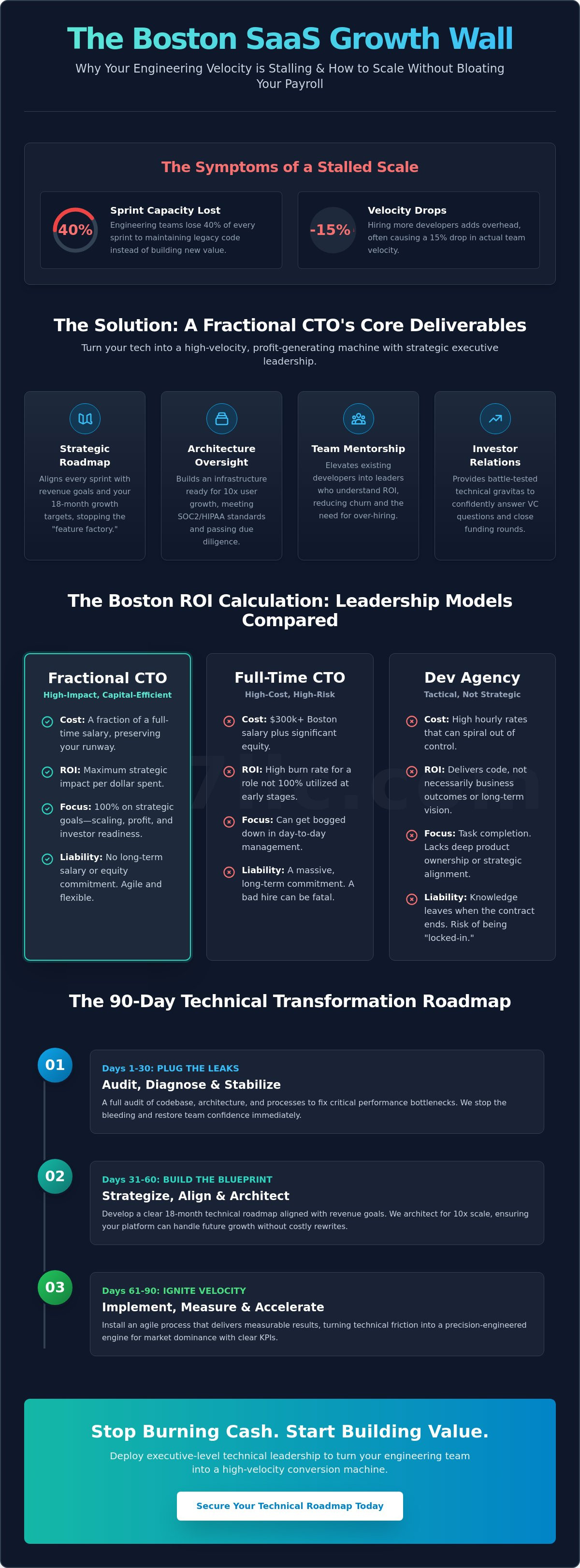
You hit the wall when your revenue growth no longer hides your technical failures. It happens to almost every founder in the Seaport or Kendall Square. You’ve found product-market fit, but your release cycles have slowed to a crawl. Your engineering team is a black box, and every new feature request feels like pulling teeth. This is the Boston SaaS Growth Wall. It is the exact point where technical debt starts compounding faster than your MRR. If you are spending 40% of your engineering budget on maintaining legacy code rather than shipping new value, your scale has already stalled.
In this hyper-competitive environment, hiring a fractional cto for saas startups boston is no longer a luxury; it is a tactical necessity. You cannot afford to let operational friction kill your momentum. Missed deadlines and high developer churn are not just "startup growing pains." They are symptoms of a structural failure in your leadership. When your engineers stop suggesting improvements and start looking for the exit, you aren't just losing headcount. You are losing the institutional knowledge required to reach your next funding round or acquisition.
To better understand this concept, watch this helpful video:
The True Cost of Technical Debt in 2026
By 2026, technical debt will be treated as a primary liability on your balance sheet during due diligence. It functions like a high-interest payday loan. You get the feature today, but you pay for it with a 30% reduction in future velocity. This friction destroys team morale. Your best developers don't want to spend their careers patching holes in a sinking ship. Adding more developers to a broken process only increases communication overhead; it doesn't fix the speed problem. You need a better blueprint, not more hammers.
Boston's Unique Startup Challenges
Boston is a war zone for talent. You are competing against tech giants in Cambridge who offer $300,000 salaries and golden handcuffs. For an early-stage startup, trying to outbid Google for a full-time CTO is a suicide mission. New England VCs and private equity firms expect lean operations and high capital efficiency. You can leverage the local "brains" by understanding What is a Fractional Executive and applying that model to your leadership team. This allows you to secure elite strategic guidance without the massive equity grant or the quarter-million-dollar salary commitment.
A fractional cto for saas startups boston acts as a strategic architect who builds for exits, not just features.
What a Fractional CTO for SaaS Startups Actually Delivers
Stop thinking of a CTO as your most expensive coder. That is a developer's job. A fractional cto for saas startups boston is a strategic weapon designed for one purpose: market dominance. They don't just look at syntax; they build a machine that generates profit by aligning every line of code with your revenue goals. If your product roadmap isn't directly tied to your next $1M in ARR, you're burning cash on features that nobody wants to buy.
The delivery is divided into four critical pillars of execution:
Strategic Roadmap: They stop the "feature factory" mentality. Every sprint is measured against market demand and your specific 2024 growth targets.
Architecture Oversight: When you scale from 1,000 to 50,000 users, architectural debt can eat 40% of your development budget. A veteran CTO ensures your stack handles 10x growth without a total rewrite.
Team Mentorship: They stop you from over-hiring. Instead, they elevate your current lead devs into technical leaders who understand ROI, not just git commits.
Investor Relations: During a Series B round, VCs will grill your tech. A fractional CTO provides the technical gravitas and "battle-tested" presence needed to close the deal.
Architecting for Scalability and Exit
Designing for an exit means passing 100% of a buyer's technical due diligence. You need a multi-tenant SaaS platform that handles data isolation and performance spikes without flinching. A CTO's job is to make the technology invisible to the user so the value proposition takes center stage. If a user notices your infrastructure, you've already lost. A fractional CTO ensures your foundation is built for a 9-figure acquisition, not just a successful weekend launch.
Security, Compliance, and SOC2 in Boston
In the Boston tech corridor, you're likely selling to healthcare or fintech giants. For these organizations, SOC2 is no longer a "nice-to-have" badge; it's the entry ticket. As of January 2024, 92% of enterprise buyers require SOC2 Type II reports before even starting a pilot program. If you can't prove "Security by Design," your sales cycle will die in the procurement office.
A fractional cto for saas startups boston navigates the specific HIPAA or fintech requirements of the Northeast corridor. They implement security protocols that protect your data and your valuation simultaneously. Don't wait for a data breach to realize your "MVP security" was a liability. You need a professional to harden your systems before the market demands it.
Fractional vs. Full-Time vs. Agency: The Boston ROI Calculation
Boston isn't just a tech hub; it's a financial battlefield. If you're hunting for a fractional cto for saas startups boston, you've already realized that hiring a full-time heavyweight is a high-stakes gamble most early-stage founders lose. The math doesn't lie, and the traditional hiring model is broken for companies that need to move fast without bloated overhead.
Breaking Down the Salary Gap
By 2026, the average base salary for a CTO in the Boston-Cambridge-Newton corridor is projected to hit $285,000, according to industry labor reports. That's just the starting point. When you tack on 25% for health insurance, 401k matching, and payroll taxes, you're looking at a $350,000 annual burn before you even discuss equity. Most Boston-based C-level hires demand 1% to 3% of your company. You're trading away your future for a role you might only need 10 hours a week right now. The "Fractional Math" is simple: you get 80% of the strategic value for roughly 30% of the cost. You keep your equity. You keep your cash. You win.
Why Agencies Can't Replace a CTO
Don't confuse a dev shop with leadership. Agencies are built to bill hours, not to protect your margins. They thrive on complexity because complexity equals more billable developer time. They'll build exactly what you tell them, even if it's a strategic dead end that won't scale. A fractional cto for saas startups boston acts as your internal filter, ensuring you own your Intellectual Property (IP) instead of being held hostage by a vendor's proprietary stack.
Strategic Alignment: Agencies focus on delivery; CTOs focus on equity value.
Cost Control: Agencies want more headcount; a fractional leader wants more efficiency.
IP Security: You maintain total control over your code and technical documentation.
The hidden costs of a bad full-time hire are the real startup killers. A failed executive hire costs you 30% of their first-year salary in recruitment fees alone. Add six months of wasted salary and a three-month severance package. You've just set $200,000 on fire and lost a year of market traction. The fractional model gives you "variable expertise." You scale the involvement up during a Series A push or down during steady-state growth. It's precision engineering for your C-suite. Stop paying for potential and start paying for performance.
The 90-Day Roadmap for SaaS Technical Transformation
Stop treating your technology like a cost center. It is your primary profit engine. If your roadmap is a graveyard of half-finished features, you don't need more developers; you need a better system. A fractional cto for saas startups boston doesn't come in to "consult" for months. We execute a 90-day tactical strike to turn your technical debt into a competitive weapon.
The first 30 days focus on the leak. We find where your capital is evaporating. Between days 31 and 60, we install processes that actually work, moving from chaos to a predictable rhythm. By day 90, your team isn't just shipping code; they're shipping high-impact features with a velocity that scares your competitors. We link every technical output to a business KPI. If a line of code doesn't move the needle on MRR or churn, it shouldn't exist.
Phase 1: The Tactical Audit
We don't start with "feelings." We start with a deep dive into your codebase, infrastructure, and security protocols. Most startups lose 25% of their engineering budget to invisible technical debt. We interview your stakeholders to find the disconnect between what sales promises and what engineering builds. This phase identifies "quick wins" that reduce operational friction immediately. Whether it's optimizing a database query to cut server costs by 18% or patching a critical security vulnerability, we fix the bleeding in the first four weeks.
Phase 2: Implementing the Flow
Process isn't bureaucracy; it's the infrastructure of speed. We customize the Velocity-7 framework for your specific product needs. We look at your CI/CD pipeline with a microscope. If your deployment process takes longer than 15 minutes, your pipeline is a bottleneck that costs you money every single day. We set up a "Command Center" for technical decision-making. This eliminates the "death by committee" culture and empowers your lead devs to make high-stakes choices without second-guessing. We replace vague updates with hard data, ensuring the CEO and the CTO speak the same language: the language of growth.
Scaling execution requires a shift in how you measure success. We implement KPIs like Deployment Frequency and Lead Time for Changes. Data from DORA metrics shows that high-performing teams deploy 208 times more frequently than low performers. We aim to put you in that top tier. By day 90, your technical team functions as a precision-guided unit, not a disorganized group of freelancers.
Top7 & Velocity-7: Beyond Traditional CTO Advisory
Top7 doesn't sit on the sidelines. We don't offer generic advice or vague roadmaps that collect digital dust. We embed directly into your organization to drive hard, measurable results. Our role as a fractional cto for saas startups boston is to act as a force multiplier for your existing team. We utilize a "Marketing-Commando" approach to technical execution. This means we treat your product development as a precision weapon for market capture, not a cost center. We strip away the fluff, ignore the hype cycles, and focus strictly on what moves the needle for your MRR and your valuation.
The Velocity-7 Adaptive Framework isn't a theory; it's a system designed to transform technical friction into efficient flow. Most technical leaders ignore the CFO and COO functions. That's a strategic failure. A Top7 CTO understands your burn rate, your customer acquisition cost, and your operational bottlenecks. We align every line of code with your business goals. When your tech stack is synchronized with your P&L, you stop wasting capital on features that don't convert.
The Velocity-7 Difference
Stop reacting to fires. Start executing a strategy. We move your team from a "hope and pray" release cycle to a predictable, high-output machine. We bridge the gap between "tech speak" and "boardroom speak" so your investors see progress in metrics they actually care about. Consider these results:
Strategic Alignment: We turn technical debt into a managed asset rather than a hidden liability.
Boardroom Clarity: We translate complex architecture into clear growth trajectories for stakeholders.
Proven Results: In October 2023, a Boston-based Fintech SaaS firm implemented our framework. They were struggling with a 6-week release cycle and mounting bugs. Within 4 months, we reduced their deployment time to 2 weeks and doubled their feature velocity without adding a single new hire.
Ready to Stop Stalling?
Waiting is the most expensive mistake you can make. Every month you spend with low velocity is capital down the drain. If you're trailing your competitors in feature delivery, you're actively losing market share. Current data suggests that a 15% lag in development speed can lead to a 30% hit on your next funding round valuation. Don't let technical inertia kill your startup's momentum.
We offer a comprehensive Velocity Audit to identify exactly where your team is leaking productivity. We'll find the friction and give you the roadmap to eliminate it. It's time to stop managing excuses and start managing growth.
Take the first step toward elite execution:Schedule your Strategic Tech Consultation with Top7
Dominate the Boston SaaS Market with Precision Engineering
Your technical debt isn't just a line item; it's a silent killer that halts your scale in the Seaport District. Industry data shows most Boston startups lose 40% of their engineering capacity to maintenance because they lacked a strategic roadmap from day one. You don't need another expensive hire sitting in a 6-month onboarding cycle. You need an execution-focused leader who embeds with your team to dismantle bottlenecks immediately. Our proprietary Velocity-7 Adaptive Framework is designed specifically for the high-pressure Boston VC ecosystem, ensuring your tech stack evolves as fast as your market demand.
Partnering with a fractional cto for saas startups boston gives you the 90-day transformation required to move from technical friction to market dominance. We bring direct experience navigating the complexities of Series A and B funding rounds where technical due diligence can make or break your valuation. Stop guessing about your architecture and start deploying with the precision of a marketing-commando unit. Your product deserves a foundation that supports 10x growth without breaking. Let's build the engine that makes your competitors irrelevant.
The next phase of your growth starts with a single decision to lead rather than follow.
Frequently Asked Questions
What is the difference between an Interim CTO and a Fractional CTO?
An interim CTO is a full-time placeholder who occupies a seat for 3 to 6 months while you search for a permanent hire. A fractional CTO is a long-term strategic partner who provides high-level leadership for a fraction of the cost and time. You don't need a full-time salary to get 100% of the strategic brainpower. It's about buying the result, not a warm body in an office chair.
Can a Fractional CTO manage my existing offshore development team?
Yes, managing offshore development is a core function of a fractional CTO for SaaS startups in Boston. Most offshore teams suffer from a 30% productivity leak due to poor communication and weak technical oversight. We plug those leaks immediately. We establish strict code review standards and 24 hour feedback loops to ensure your remote devs actually deliver the profit-driving features you're paying for.
How many hours a week does a Fractional CTO typically dedicate to a SaaS startup?
Most engagements require 5 to 15 hours per week depending on your current scale and technical debt. We don't bill for "being available" or sitting in useless meetings. We bill for execution. If your roadmap is stalled, we ramp up intensity. If the engine is humming, we focus on high-level architecture and 12 month scaling projections. Efficiency beats clock-punching every single time.
Is a Fractional CTO suitable for a startup that hasn't raised seed funding yet?
A fractional CTO is essential for pre-seed startups to prevent the 40% failure rate caused by unscalable architecture. Building on the wrong stack is a death sentence for your capital. We ensure your MVP isn't a pile of spaghetti code that you'll have to scrap in 8 months. You get the technical foundation of a Series A company without burning through your initial runway. Hiring a fractional CTO for SaaS startups in Boston early on secures your path to funding.
Will a Fractional CTO help us with SOC2 or HIPAA compliance?
We lead the technical implementation for SOC2 and HIPAA compliance by building security into the CI/CD pipeline from day one. Compliance isn't a checkbox; it's a competitive advantage that helps you close 50% more enterprise deals. We don't just give you a list of tasks. We oversee the encryption, access controls, and audit trails required to pass a 3rd party audit without slowing down your development velocity.
How does Top7's Velocity-7 framework differ from standard Agile or Scrum?
Standard Agile often devolves into "theatre" where teams move fast but produce zero market impact. Velocity-7 replaces generic rituals with 7 specific metrics focused on deployment frequency and revenue-linked features. While Scrum focuses on arbitrary "points," we focus on market dominance. We cut the 15% waste found in traditional sprint cycles to ensure every line of code contributes to your bottom line.
What happens if we need a full-time CTO later? Can a Fractional CTO help with the transition?
We design the roadmap for our own replacement once your revenue hits the 5 million to 10 million dollar ARR mark. A fractional CTO documents every process and system so the handoff to a permanent hire takes less than 14 days. We even lead the interview process. We filter out the "CV padders" to ensure you hire a true 1% engineering leader who can maintain the momentum we built.
Does a Fractional CTO write code or just manage the strategy?
A fractional CTO focuses 90% of their time on strategy, architecture, and team leadership rather than individual tickets. If your CTO is spending 40 hours a week writing CSS, they aren't leading your company. They're just an expensive developer. We provide the high-level roadmap and technical north star. We jump into the codebase for critical architecture reviews or emergency debugging, but our primary job is to build a dev machine that doesn't rely on us.



Comments