
Fractional CTO for Cloud Migration Strategy: Turn a Risky Move into a Business Plan

What if your cloud migration’s biggest risk isn’t the technology, but the lack of a clear business owner? A fractional cto for cloud migration strategy can connect technical choices to business priorities, but leadership alone won’t solve an undefined scope or unclear decision rights.
It’s sensible to question the plan before committing. A migration can disrupt operations, expose security gaps, or create cloud spending your team can’t explain. When internal staff and vendors each assume someone else is steering, small decisions can turn into costly delays.
This guide explains how to evaluate migration options, set a practical sequence, and establish milestones and risk controls before execution begins. You’ll also learn how to assess whether your team has the authority and capacity to lead, or whether fractional CTO leadership could provide the strategic guidance and execution support you need.
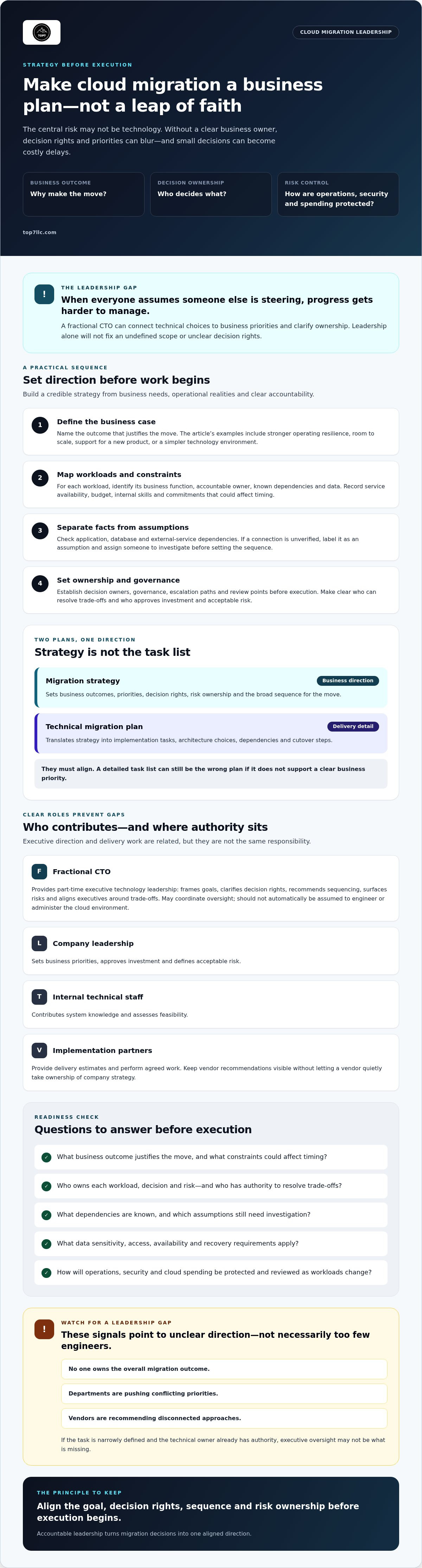
Start with practical questions for your leadership team: What outcome justifies the move? Who owns each decision? How will you protect operations, security, and spending as workloads change? Answer these first, and cloud migration becomes a business plan rather than a leap of faith.
Table of Contents
What a Fractional CTO for Cloud Migration Strategy Actually Owns
A fractional CTO provides part-time executive technology leadership. They connect business goals to technology decisions, set direction, and clarify ownership. That doesn’t automatically make them the engineers, cloud administrators, or delivery team. The value of a fractional cto for cloud migration strategy is executive accountability: turning competing priorities into decisions the organization can act on.
Cloud migration is a business change, not just a hosting switch. It can affect how teams operate, manage risk, and make technical trade-offs. Start by understanding cloud computing and its service models, then ask what the business needs to change and why.
For a concise overview of fractional cloud strategy leadership, watch:
Migration strategy sets the business outcomes, priorities, decision rights, risk ownership, and broad sequence for the move. A technical migration plan translates that direction into implementation tasks, architecture choices, dependencies, and cutover steps. The two must align, but they aren’t interchangeable. A detailed task list can still be the wrong plan if it doesn’t support a clear business priority.
What decisions should a fractional CTO lead?
A fractional CTO can frame goals, clarify who decides what, recommend sequencing, surface risks, and align executives around trade-offs. Company leadership still sets business priorities, approves investment, and defines acceptable risk. Internal technical staff contribute system knowledge and assess feasibility. Implementation partners provide delivery estimates and perform agreed work. The CTO may coordinate oversight, but shouldn’t be assumed to personally engineer or administer the cloud environment.
Platform selection also needs clear boundaries. The CTO can guide an evaluation against business needs and technical constraints. Leadership makes or approves the business decision, while technical staff and partners validate practical implications. Keep vendor recommendations visible, but don’t let one vendor quietly take ownership of your company’s strategy.
When does a migration need executive technology leadership?
Watch for signs such as no one owning the overall outcome, departments pushing conflicting priorities, or vendors recommending disconnected approaches. These point to a leadership gap, not necessarily a shortage of engineers. If the task is narrowly defined and the right technical owner already has authority, executive oversight may not be what’s missing.
Accountable leadership turns migration decisions into one aligned direction. If your team can’t agree on the goal, sequence, or person empowered to resolve trade-offs, settle that before execution begins.
Build a Cloud Migration Strategy Around Business Priorities
Start with the business case, not a provider shortlist. What needs to improve: operating resilience, room to scale, support for a new product, or a simpler technology environment? Document constraints too, including service availability, budget limits, internal skills, and commitments that could affect timing. A fractional cto for cloud migration strategy can connect these priorities to technical decisions, but the strategy must reflect your organization’s needs.
Discovery makes the plan credible. For each workload, identify the business function it supports, its accountable owner, known dependencies, and the data it handles. Ask how much downtime the business can tolerate, what availability is required, and which technical limitations are confirmed. Mark unverified assumptions separately. If no one knows whether two applications exchange data, don’t treat that dependency as settled. Assign someone to investigate it before setting the sequence.
Which discovery questions shape the strategy?
Which systems support critical operations, and who owns each workload?
What applications, databases, or external services depend on one another?
What are the data sensitivity, access, availability, and recovery requirements?
Which staffing, budget, or technical constraints could limit the options?
Use a readiness process to turn the answers into a clear view of resources, processes, and tools. The U.S. General Services Administration offers a practical readiness checklist to help structure that review. Treat it as an input, not a substitute for understanding your own workloads and responsibilities.
How should leaders evaluate migration approaches?
There’s no universal route. Rehosting moves a workload with limited changes, which may suit a system that needs to move before deeper modernization. Refactoring changes how an application is built or operates, which may better support a business goal the current design can’t meet. Replacement means adopting another application instead of migrating the existing one. That choice depends on functionality, data, process fit, and the organization’s capacity for change.
Compare each option against business value, dependencies, risk, internal capability, and the effort required to operate it afterward. The fastest move isn’t automatically the best investment. Some systems may need to move together; others may be better retained or retired. Record the reason for each decision and what evidence would change it. Verify platform-specific claims and performance promises against your own requirements before relying on them.
Include security, governance, resilience, and ongoing cloud management from the start. Define who approves access and configuration decisions, how continuity needs will be tested, and who will monitor usage and address operational issues after a workload moves. For executive guidance connecting these choices to business priorities, explore Top7’s fractional CTO leadership.
Fractional CTO vs. Internal Lead vs. Cloud Migration Vendor
Choosing who leads a migration is a decision about authority, strategic scope, available time, and delivery responsibility. An internal technology lead may know your systems best. A vendor may bring implementation capacity. A fractional CTO can provide executive-level direction when the company needs strategic ownership without taking on a full-time CTO role. These models can work together, but they aren’t interchangeable.
When is a fractional CTO the right leadership model?
Consider a fractional CTO when migration decisions cross teams, executives need a clear technology perspective, or no internal leader has both the authority and time to align priorities. The role only works if it can reach decision-makers, challenge assumptions, and influence trade-offs. Match the engagement’s scope and availability to the migration’s demands. A narrow advisory role may not fit a complex effort that needs ongoing coordination and oversight.
A fractional cto for cloud migration strategy can bridge executive goals and technical execution, but shouldn’t be a title without decision rights. Agree in advance which decisions the role leads, which require executive approval, and how progress or risks will be escalated.
When should you hire a vendor or rely on your team?
Rely on an internal lead when capability, authority, and time are demonstrably sufficient, not merely because that person knows the systems. Bring in an implementation vendor for defined work your team can’t or shouldn’t absorb. Keep company-side accountability in place: someone must approve priorities, manage trade-offs, and confirm that delivery supports business needs.
The company sets direction; the implementation team executes the agreed technical work. If nobody inside the company owns that direction, adding another vendor won’t close the leadership gap.
A Practical Readiness Checklist for Cloud Migration Leadership
A migration is ready to move forward when people know what’s changing, who can make decisions, and how the business will judge progress. Use five checkpoints: discovery, prioritization, governance, planning, and review. This gives the fractional cto for cloud migration strategy a clear operating structure and makes gaps visible before they become execution problems.
What should happen before migration work begins?
Create a shared record of the current environment, workloads, dependencies, operating constraints, and known uncertainties. Identify the owner for each workload and decision, name executive sponsors, and document implementation partners’ responsibilities. Separate confirmed facts from open questions, then assign an owner and decision date to each unresolved issue.
A readiness baseline is a documented view of current systems, ownership, dependencies, risks, and unanswered questions that leaders use to decide whether planning can proceed. It isn’t a universal score. It’s a practical reference point for your organization.
Before approving a migration stage, set a decision gate tied to evidence. For example, confirm that dependent workloads have been identified, an accountable owner has reviewed continuity needs, and unresolved risks have a documented response. Define success in business terms, such as maintaining a required service or enabling a planned operating change. Don’t rely on activity counts alone.
Security and data: Confirm who reviews access, data handling, and security risks.
Continuity: Document acceptable disruption and how recovery expectations will be evaluated.
Ownership: Assign responsibility for decisions, delivery, and escalation.
Operations: Name who will manage the environment and review usage after migration.
How should leaders govern execution and change?
Set a decision cadence that fits the work, with named participants and a clear route for escalating risks or blocked decisions. Decide who communicates changes to affected teams and when. At each review, compare progress with agreed milestones and business outcomes. A completed task matters only if it advances the intended result without leaving a material risk unowned.
Governance doesn’t end at launch. Assign ongoing responsibility for cloud access, operational support, and cost oversight before workloads move. If ownership is split across teams, make the handoffs explicit. Otherwise, issues can fall between the migration project and day-to-day operations.
Need executive guidance to establish ownership, decision gates, and review discipline? Explore Top7’s fractional CTO leadership to connect migration decisions with business priorities and execution.
How to Choose a Fractional CTO for Your Cloud Migration
Don’t choose a fractional CTO based on impressive titles or a confident pitch. Look for someone who can connect business priorities to clear decisions, accountable owners, and credible oversight. For a fractional cto for cloud migration strategy, assess how the candidate thinks, communicates, and works with your team. Ask for specific examples of leadership experience relevant to your organization’s scale and complexity. Verify what they personally led and what a delivery team handled.
A strong candidate makes trade-offs understandable. They should explain how they’d assess the current environment, identify unknowns, and distinguish strategic direction from technical implementation. Be cautious if every challenge seems to have the same solution or if the candidate promises technical results before learning your requirements.
What should you ask before engaging a fractional CTO?
How will you assess our current environment, and what information do you need before recommending a direction?
Which decisions would you lead, which stay with company leadership, and which belong to technical staff or implementation partners?
What access to executives and workload owners do you need to influence priorities effectively?
What time commitment, reporting rhythm, and collaboration approach would fit the complexity of our migration?
How will you communicate progress, emerging risks, and decisions that need executive attention?
Define the initial engagement scope in plain language. Clarify its purpose, boundaries, decision authority, expected availability, stakeholders, reporting expectations, and how the company will review whether the arrangement is working. Don’t leave “support” undefined. Specify whether the role focuses on strategic guidance, execution oversight, or both, and how it will coordinate with internal staff and vendors.
How does Top7 fit a cloud migration leadership need?
Top7 provides fractional CTO leadership, strategic guidance, and execution support. Its team embeds with clients, connecting technology decisions with business priorities and the work required to move them forward. Top7’s Velocity-7 Adaptive Framework focuses on helping organizations move from operational friction to efficient flow through agile-based transformation. It’s a company framework, not a claim of specific cloud migration results or technical deliverables.
Use the questions above to identify the leadership gap you need to fill, then make sure any engagement has clear access, authority, and expectations from the outset. If you’re ready to discuss your company’s needs, Discuss your technology leadership needs.
Make Your Migration Plan Accountable Before It Moves
A cloud migration earns its place when it advances a business priority, not just because a new platform is available. Define the outcomes, clarify who owns key decisions, and assess workloads and risks before execution begins. Choose leadership based on the gap: internal teams can lead when they have the authority and capacity, vendors can deliver defined work, and a fractional cto for cloud migration strategy can connect executive priorities with technical direction and oversight.
Top7’s fractional CTO offering provides embedded strategic guidance and execution support. Its Velocity-7 Adaptive Framework focuses on moving organizations from operational friction to efficient flow through agile-based transformation. Neither replaces clear scope and ownership. Those controls help keep the migration tied to the business.
Ready to define the leadership your migration needs? Discuss your cloud migration leadership needs with Top7. Move forward with clear priorities, accountable owners, and a plan your team can execute with confidence.
Frequently Asked Questions
What does a fractional CTO do in a cloud migration?
A fractional CTO provides executive technology leadership that connects migration choices with business priorities. They can help define goals, clarify decision ownership, guide sequencing, surface risks, and align company leaders, technical staff, and implementation partners. The scope depends on the engagement. A fractional CTO may oversee execution without personally performing engineering or cloud administration, so confirm responsibilities and decision authority before work begins.
Can a fractional CTO lead a cloud migration strategy without a full-time CTO?
Yes. A company can use fractional CTO leadership to set direction without taking on a full-time CTO. The role can help executives evaluate trade-offs, assign accountable owners, and keep migration decisions tied to operating priorities. It works only if the leader can access decision-makers and influence priorities. Internal staff and implementation partners still need clearly defined responsibilities for technical assessment and delivery.
Is a fractional CTO the same as a cloud migration consultant?
No, though responsibilities can overlap. A consultant may provide advice or complete a defined assessment, while a fractional CTO typically serves in a part-time executive leadership role with a broader view of technology priorities and decision-making. The title alone doesn’t settle the difference. Ask what authority the person will have, how they’ll work with leadership, and whether their scope includes ongoing alignment and execution oversight.
How do you choose a fractional CTO for cloud migration?
Choose based on relevant leadership experience, clear communication, and an approach that fits your organization’s needs. Ask how the candidate assesses your current environment, turns business goals into decisions and ownership, and distinguishes strategy from implementation. Confirm access to executives, expected availability, reporting, collaboration, and how risks will be escalated. A capable candidate should make the role’s boundaries and decision rights explicit, not promise results before discovery.
What should a cloud migration strategy include?
A useful strategy starts with business outcomes and operating constraints, then accounts for workloads, dependencies, data needs, and accountable owners. It should explain why different workloads may require different migration approaches and define decision rights, milestones, risk review, security, continuity, and governance. It should also identify who will manage cloud operations and spending after migration. The goal is a business-led direction that guides technical planning, not just a task list.
Does a fractional CTO perform the technical cloud migration?
Not automatically. A fractional CTO provides part-time executive technology guidance and may support execution oversight, but hands-on engineering and cloud administration depend on the agreed scope and the individual’s role. Technical work may sit with internal staff or implementation partners. Before engaging anyone, document who assesses workloads, performs changes, manages vendors, approves decisions, and remains accountable for business outcomes. Don’t assume leadership and implementation are the same job.
When should a company bring in a fractional CTO for cloud migration?
Consider a fractional CTO when migration ownership is unclear, executives and technical teams have competing priorities, or vendor recommendations aren’t connected to a company-wide direction. The need is strategic if leaders lack a clear decision process, not simply because a technical task is difficult. A fractional cto for cloud migration strategy can align priorities and execution when the role has suitable access, authority, and scope. If your internal lead already has the capacity and mandate, additional leadership may not be necessary.



Comments