
When to Bring in an Interim Executive for Leadership Expertise

Hire an interim executive when a leadership gap or urgent business priority needs experienced ownership now, but a permanent appointment is not the right immediate move. This can happen during rapid growth, restructuring, transformation, a turnaround, or a leadership transition. The role works best when it has a clear mandate, decision-making authority, and outcomes the organization needs to advance.
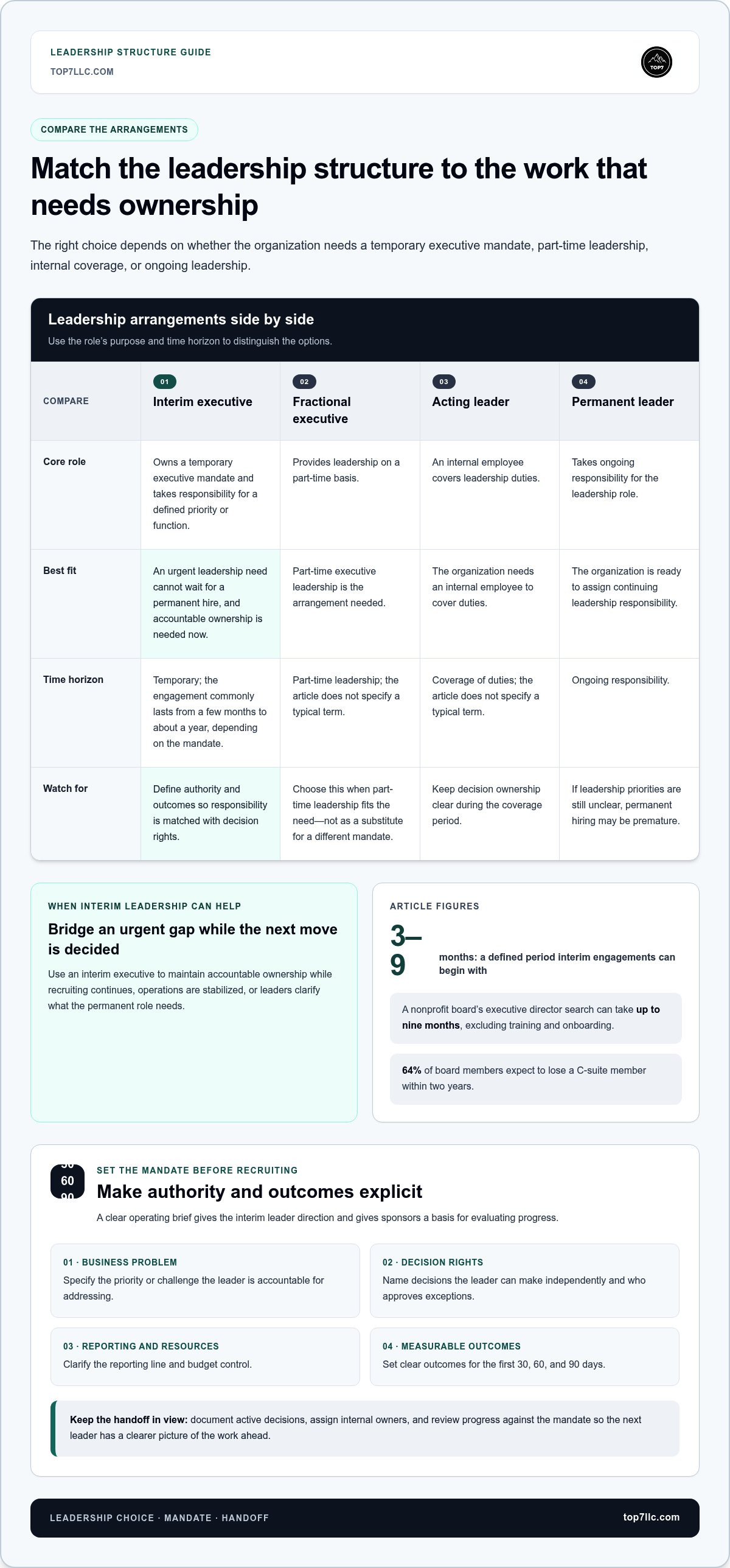
It’s tempting to treat interim leadership as a temporary seat-filler. That misses the point. An interim executive can take responsibility for a function, bring focus to urgent decisions, and keep important work moving while the organization handles its next move. The engagement commonly lasts from a few months to about a year, depending on the mandate.
This article explains what interim executives do, how interim leadership differs from fractional leadership, and when each arrangement can help. It also covers how to set priorities, assess progress, support the leader, and plan a handoff. The goal is to match the leadership arrangement to the work your organization needs done, not simply to fill a title on the org chart.
Table of Contents
Interim leaders during growth, restructuring, and transformation
Growth, restructuring, and transformation can stretch an executive team beyond its capacity. An interim leader takes ownership of a defined priority while the organization manages the transition and keeps essential work moving.
During growth, pressure often shows up in practical ways: a larger team, unclear reporting lines, or decisions bottlenecked at the top. An interim executive can take responsibility for a designated function, clarify decision ownership, and help managers coordinate their work. During rapid hiring, for example, the leader can set operating priorities and establish routines that give an expanding team clearer direction.
Maintaining Momentum Through Leadership Transitions
To maintain momentum, give the interim leader clear authority to keep essential work and transition priorities moving. This is especially important when a vacancy leaves employees unsure who owns decisions, responsibilities, or deadlines.
Start by naming the decisions the interim leader can make, then identify work that cannot pause. During a CEO transition, for example, the leader might maintain customer commitments while the board sets direction for the permanent role. Interim engagements commonly begin with a defined period of three to nine months, which can provide a focused window for stabilizing operations and advancing agreed priorities.
Adding Capacity for Transformation
Adding capacity means giving a transformation initiative a leader with the time and authority to drive it alongside day-to-day operations. This helps when existing executives are already accountable for core functions and cannot give a complex change effort the attention it needs.
During a restructuring, for example, an interim leader can coordinate the transition plan, surface dependencies, and keep decisions tied to business outcomes. Assign specific deliverables, decision rights, and owners across the team. That gives the initiative active leadership instead of leaving transformation work as an extra task between existing priorities.
Employee communication needs its own rhythm. The interim leader and executive sponsor should explain what is changing, what remains in place, and how employees can raise operational concerns. After a department restructure, for example, managers can share consistent updates about reporting responsibilities and decision pathways. Clear, repeated messages reduce conflicting assumptions and help staff focus on their work.
Build knowledge transfer into the engagement rather than postponing it until the leader leaves. An interim executive can document decision processes, explain the reasoning behind new priorities, and coach managers as they take ownership. During a systems transformation, for example, internal team members can lead project reviews and track dependencies. The team then retains practical knowledge, not just a completed plan.
Start the handoff early: record active decisions, assign internal owners, and review progress against the mandate. If the interim leader is guiding a restructuring, a shared transition tracker can show which decisions are complete and which need permanent leadership. This supports continuity and gives the next leader a clearer picture of the work ahead.
WHY CONSIDER INTERIM LEADERSHIP?
An interim appointment fits when an urgent leadership need cannot wait for permanent hiring. It creates accountable ownership while the organization decides what leadership it needs next.
Defining the Mandate and Authority
A mandate defines the outcomes, decisions, and boundaries assigned to the interim leader. Clear authority matters because responsibility without decision rights creates delay, not progress.
Before recruiting candidates, specify the business problem, reporting line, budget control, and decisions the leader can make independently. For example, a restructuring mandate might authorize operating changes while reserving permanent organizational design for the board. Set measurable outcomes for the first 30, 60, and 90 days, then identify who approves exceptions. This gives the interim leader a useful operating brief and gives sponsors a basis for evaluating action.
A leadership gap may follow a sudden departure, extended leave, or a permanent search that takes longer than the work can wait. A nonprofit board’s search for an executive director can take up to nine months, excluding training and onboarding. Meanwhile, 64% of board members expect to lose a C-suite member within two years. In either situation, an interim leader can maintain accountable executive ownership while recruiting continues.
Uncertainty about the role can also make permanent hiring premature. If a board has not agreed whether the next CEO needs turnaround or growth experience, an interim leader can stabilize operations while leaders clarify priorities. Match the arrangement to the need: an interim executive owns a temporary leadership mandate; a fractional executive provides part-time leadership; an acting leader is usually an internal employee covering duties; and a permanent leader takes ongoing responsibility. The wrong structure can split authority or leave needed capability unused.
Costs and Contract Terms
In the United States, interim executive cost depends on the role’s scope, required expertise, time commitment, and engagement length. The price depends on the case and is given after a quote request.
An interim executive agreement should define the mandate, authority, reporting relationship, deliverables, term, compensation, confidentiality, and exit or handoff expectations. Specify how the organization approves expenses and handles scope changes. Clear terms prevent disputes about who owns a decision or what completion means.
The risks are real: a temporary leader may need time to learn the organization, encounter employee resistance, or leave before knowledge is transferred. Reduce those risks by naming an internal counterpart, documenting decisions, holding regular sponsor reviews, and planning the handoff from the start. Interim leadership may be a poor fit when the organization needs an enduring leader and can manage the transition internally. A clear mandate can turn an urgent gap into focused action.
A clear executive mandate keeps priorities, authority, and accountability aligned.
What Does an Interim Executive Do?
An interim executive takes responsibility for a defined leadership role while the organization addresses a temporary need. The work can include decisions, budgets, team management, and preparing a permanent hire to take over.
Bridging the Permanent Search
An interim executive can bridge the gap during a permanent search by owning critical work while candidates are considered. That gives the organization room to make a thoughtful appointment without leaving the position unmanaged.
Run both efforts concurrently: assign the interim leader operational priorities, while the board or hiring team sets the role requirements and evaluates candidates. For example, an interim CFO can maintain financial reporting while the organization searches for a permanent finance leader. Interim engagements commonly last a few months to about a year, so define the handoff before the search concludes.
The role is more than keeping a seat warm. An interim executive can assess the organization, identify urgent issues, and prepare the incoming leader with a clear account of decisions and risks. By 60 days, an interim executive should be advancing priority decisions and implementing agreed actions. That progress gives the permanent hire a stronger starting point than an unstructured backlog.
Comparing Executives and Consultants
An interim executive owns a temporary leadership position, while a consultant typically advises on a defined problem and a permanent hire accepts ongoing responsibility. Choose based on whether the organization needs immediate decision-making authority or specialized advice.
A consultant might recommend changes to a product launch, while an interim executive can lead the team, manage its budget, and take responsibility for delivery. A permanent executive can build longer-term strategy and leadership relationships. The distinction matters because advice alone will not close a leadership gap that requires direct accountability.
A temporary need can make a permanent hire a poor fit. If a restructuring creates a short-term need for executive ownership, hiring permanently may leave the organization with more capacity than it needs after the transition. An interim appointment focuses leadership on the temporary mandate, then hands over documented decisions and active priorities.
Use the engagement to transfer practical knowledge, not just complete a project. Ask the interim leader to document key assumptions, explain unresolved trade-offs, and coach the internal successor. A new executive can, for example, review the transformation plan with the interim leader and understand why specific priorities were chosen. That preparation helps the permanent hire act with context from the start.
Organizational systems, change, and turnaround needs
Interim executives may be ready to address an organization’s needs within 48 hours, while a six-week wait may miss the moment. Engagements usually last a few months to about a year, depending on the mandate and the work required.
During disruption, an interim leader can stabilize a critical function while senior leaders address the cause. After a sudden departure in operations, for example, the interim can clarify decision ownership, review essential workflows, and protect customer commitments. This creates continuity while the organization assesses risks and the leadership capacity needed for recovery.
Base an assessment on evidence, not assumptions. An interim executive can examine financial reports, customer issues, team responsibilities, and project dependencies, then identify where work stalls. In a turnaround, that might mean tracing delayed decisions to unclear authority rather than blaming employees. A concise assessment helps leaders distinguish urgent operational risks from deeper structural problems.
Objectivity matters when internal teams have lived with the same problems for years. An interim leader can compare stated priorities with actual decisions, reporting lines, and resource use. If a company says product quality is its top priority, for example, the interim can examine whether teams have clear ownership of defects and escalation paths. The goal is an actionable diagnosis, not a report that goes unused.
Transformation needs systems that keep change moving after initial announcements. Yet less than one-third of respondents say their companies’ transformations both improved performance and sustained those improvements over time. An interim executive can connect the change plan to owners, operating routines, and measurable outcomes. In a turnaround, that means prioritizing the work that restores control before adding new initiatives.
Nonprofit organizations face a distinct challenge when staff, board members, and community stakeholders need continuity during an executive transition. An interim executive director can clarify immediate responsibilities, maintain essential services, and give the board a grounded view of organizational needs. That assessment can help trustees decide whether the next leader needs fundraising, operational, or change-management expertise.
Make the diagnosis useful by translating it into a focused operating agenda. Identify the critical function, the decisions blocking progress, the people responsible, and the next review point. A restructuring assessment might reveal that customer handoffs fail between sales and delivery. The interim leader can assign ownership, establish a review process, and track unresolved issues until the organization has a workable system.
Selecting and supporting interim executives
Select for the ability to deliver the mandate, not just an impressive résumé. Measure performance against agreed outcomes, review progress by 90 days, and plan the permanent leader’s handoff from the first week.
Begin by defining the temporary role’s strategic purpose, decision rights, and success measures. A turnaround leader may need authority to reset department priorities, while a transformation leader may need to coordinate teams without changing reporting lines. Match the candidate’s experience to the actual work, the function’s current risks, and the decisions that cannot wait.
Interim executives typically bring a decade or more of management-role experience, but years alone don’t prove fit. Ask candidates to describe the first two weeks of comparable assignments and what they did during their first 30 days. Their examples should show how they gathered facts, built trust, made decisions, and moved from assessment to action.
Keep selection focused. Employers don’t need six interview rounds for an interim leader expected to drive results quickly. Use structured conversations with the sponsor, relevant team members, and decision-makers. Ask each person to assess the same evidence: comparable challenges, judgment under pressure, communication style, and ability to transfer knowledge. That makes trade-offs visible instead of letting confidence overshadow capability.
Set the operating cadence before the engagement begins. The interim executive and direct sponsor should hold check-ins weekly or every other week to surface obstacles and confirm priorities. At each meeting, compare completed actions with the mandate, note decisions awaiting approval, and resolve barriers. A department head who lacks budget authority, for example, needs a clear escalation path before commitments stall.
Use milestones to measure delivery, not activity. Define what must change by 30, 60, and 90 days, such as restoring a reporting process, completing a diagnostic, or implementing agreed actions. At 90 days, assess progress against the original mandate and decide whether priorities need adjustment. Record evidence and unresolved risks; a busy calendar isn’t proof of results.
Plan the successor transition from the start. Maintain a decision log, document key assumptions, assign internal owners, and schedule knowledge-transfer sessions. The permanent hire should receive current priorities, open risks, stakeholder context, and a clear record of why major decisions were made. This protects continuity and gives the new executive a practical starting point.
Use interim leadership support to define the mandate, align sponsor check-ins, and keep delivery accountable.
Top7: Fractional CTO
Top7 offers Fractional CTO leadership for organizations that need experienced technology direction without immediately filling a permanent executive position. Turn to this option when technology decisions, delivery priorities, or transformation work need clearer executive ownership. For broader operational or company-wide leadership needs, Top7 also offers Fractional COO and Fractional CEO support.
The right engagement starts with the business problem: define the decisions that need leadership, the outcomes to pursue, and how execution should support strategic priorities. Top7’s guidance and execution support are designed to help organizations address growth obstacles and move from operational friction toward more efficient flow.
To discuss whether Fractional CTO leadership fits your organization’s needs, contact Top7 or visit top7llc.com.
Turn the Leadership Gap Into Your Next Move
Deciding when to hire an interim executive is also deciding what your organization needs next. Before acting, name the pressure that cannot wait, the outcome that matters, and the authority required to deliver it. That clarity turns a temporary leadership choice into a deliberate move rather than a rushed reaction.
Top7 offers Interim Leadership and fractional executive support, including Fractional CTO, Fractional COO, and Fractional CEO. Choose the path that fits the challenge: focused technology leadership, stronger operational execution, or executive direction through a transition. The next step is a direct conversation about the leadership need and the work ahead.
Contact Top7 about interim leadership and move forward with a clear mandate and a focused plan.
Frequently Asked Questions
What Is Interim Management?
Interim management means temporary executive-level ownership of a defined business function or leadership mandate. Unlike an assessment that ends with recommendations, an interim manager may direct employees, make operating decisions, and take responsibility for agreed outcomes. During a finance leader’s leave, for example, an interim finance executive can maintain reporting routines and resolve workflow issues. A written scope should identify decision limits, reporting lines, and how responsibilities will transfer.
Can an Interim Role Become Permanent?
Yes, an interim role can become permanent if the organization and executive agree that the fit and long-term need are right. According to Challenger, Gray & Christmas, 20% of interim CEOs they tracked were ultimately named permanent. Treat that possibility as an option, not the assignment’s default purpose. Agree early on how a permanent appointment would be considered, so the interim mandate remains clear while the organization evaluates its leadership needs.
What is an interim executive?
An interim executive is a senior leader who temporarily assumes executive responsibility within an organization. The defining feature is not a temporary title, but accountability for decisions and outcomes in the assigned role. An interim technology executive might prioritize a security review, coordinate internal stakeholders, and brief the board on unresolved risks. The organization gets leadership applied to a live business need, not advice alone.
When should a company hire an interim executive?
Hire an interim executive when decisions with meaningful operational consequences lack a capable owner. Look for concrete signals: approvals repeatedly stall, risks have no accountable executive, or a team cannot meet commitments because its leader is unavailable. If a product launch depends on decisions across engineering and sales, for instance, an interim leader can coordinate the work while the organization addresses its longer-term leadership plan.
What situations call for an interim CEO, CFO, or other executive?
An interim CEO can help when leadership responsibilities are divided and the board needs one executive to coordinate company-wide decisions. An interim CFO may fit when reporting, forecasting, or a financing process needs active executive oversight. A technology leader can be useful during a security review or systems assessment, while an operations executive may lead an integration after an acquisition. Match the executive’s functional expertise to the decision bottleneck.
How do interim executives compare with permanent executives, consultants, and fractional executives?
Choose by the work’s duration, accountability, and leadership capacity required. An interim executive takes temporary ownership of an executive role; a permanent executive provides ongoing leadership; a consultant primarily advises on a scoped problem; and a fractional executive contributes part-time leadership. For example, a company needing recurring technology decisions but not a full-time CTO may consider fractional leadership, while a vacant executive seat requiring immediate ownership points toward an interim arrangement.



Comments