
Fractional CIO for Data Privacy Compliance: How to Choose the Right Leadership

What if your privacy-compliance problem isn’t a missing policy, but a missing owner for the systems and workflows behind it? A fractional CIO for data privacy compliance can help connect validated requirements to technical controls, but that leader shouldn’t replace privacy counsel or a dedicated privacy officer.
This distinction matters when technology, security, legal, and business teams each own part of the work, but no one is accountable for how it operates in practice. A full-time executive may be more than the business needs, but fractional leadership doesn’t make specialist expertise optional. Define the role’s authority and boundaries, and establish how it will work with the people responsible for privacy and legal decisions.
This article explains which responsibilities a fractional technology leader can drive, where privacy specialists remain essential, and how to compare fractional leadership with a full-time hire. Top7 offers Fractional CTO leadership, a related technology-leadership option that may coordinate implementation with your privacy, legal, and security specialists. The goal is a clear path from privacy requirements to controls your teams can operate and review.
Table of Contents
What a Fractional CIO Can, and Cannot, Do for Data Privacy Compliance
How Fractional CIO Leadership Turns Privacy Requirements into Technical Controls
Fractional CIO vs. Privacy Consultant, Privacy Officer, or Full-Time Hire
A Practical 30-Day Evaluation Plan for Fractional Privacy Technology Leadership
How to Assess Top7 for Fractional Technology Leadership in a Privacy Initiative
What a Fractional CIO Can, and Cannot, Do for Data Privacy Compliance
Compliance leadership sets direction, while implementation changes systems and workflows. A fractional CIO is a part-time executive technology leader who helps guide technology decisions without taking on a full-time CIO role. The role can connect privacy requirements to the people, platforms, and processes needed to put them into practice.
That distinction matters because a policy alone won’t change who can access customer data or how systems handle it. The Chief Information Officer (CIO) role generally centers on an organization’s technology direction. Fractional leadership applies that kind of executive perspective on a part-time basis, with a specific remit agreed between the leader and the organization.
To see how fractional technology leadership can fit into an organization, watch this overview:
Which privacy-compliance responsibilities may involve a CIO?
Depending on the engagement, a technology leader may coordinate work such as:
Creating or updating an inventory of systems that store or process personal data.
Reviewing access controls and system configurations against documented requirements.
Coordinating technology changes with vendors and internal teams.
Overseeing implementation and tracking each action’s owner and supporting evidence.
These tasks are useful when tied to a specific business requirement and an accountable owner. For example, if a documented requirement calls for restricting access to certain records, the business must identify who approves access. The technology team can then determine how to configure and review that access. A fractional CIO for data privacy compliance may coordinate this execution, but the scope should be defined rather than assumed.
Where do legal and privacy specialists remain essential
Privacy obligations depend on the organization, the data it handles, its activities, and the jurisdictions involved. Qualified counsel should interpret applicable laws and provide jurisdiction-specific advice. A privacy specialist or designated internal owner may also be needed to govern the broader privacy program, make decisions, and keep responsibilities clear.
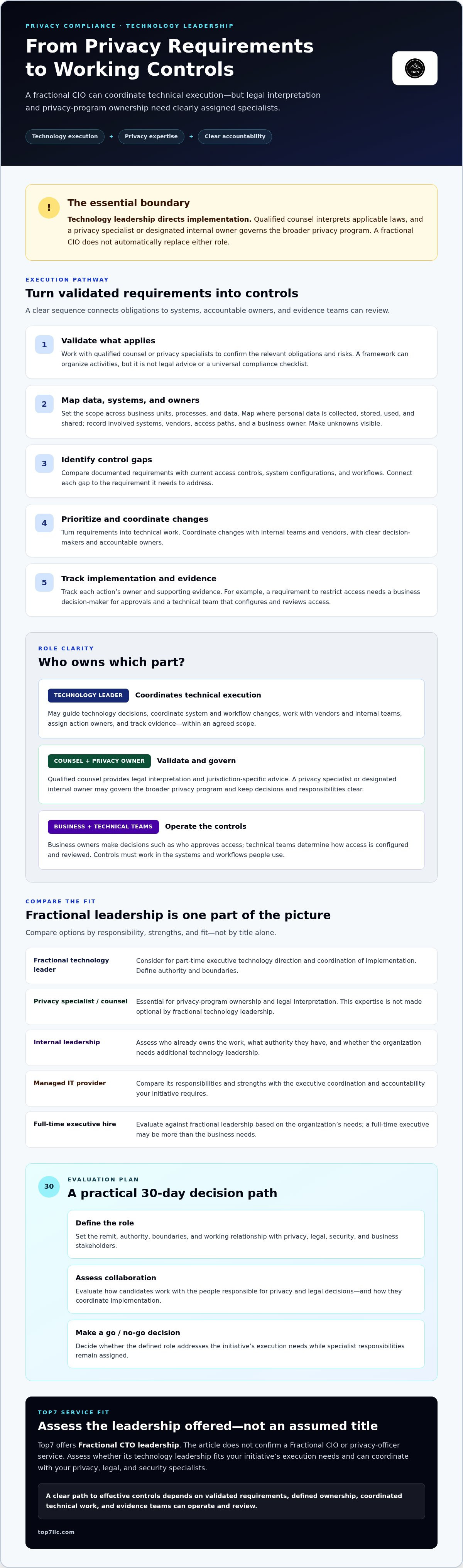
A technology leader can direct the implementation of privacy controls; qualified counsel and privacy owners determine what compliance requires. A fractional CIO doesn’t automatically replace either role. Define the boundaries before work begins, or technical teams may build controls against requirements no one has validated.
How Fractional CIO Leadership Turns Privacy Requirements into Technical Controls
Privacy requirements don’t change a system by themselves. Putting them into practice takes a clear sequence, decision-makers with authority, and owners who can follow through. In a fractional cio for data privacy compliance engagement, a technology leader may coordinate that work, while qualified counsel or privacy specialists first validate which obligations apply.
The voluntary NIST Privacy Framework can help teams organize privacy-risk activities. It isn’t a substitute for legal advice or a universal compliance checklist. Use a framework to structure the work, then confirm the obligations and risks that apply to your organization.
From data and system visibility to prioritized controls
Start by setting the scope: which business units, processes, and data are in play? Then map where personal data is collected, stored, used, and shared. Record the systems involved, processors and vendors, access paths, and a business owner for each process. The map doesn’t have to be perfect to be useful, but make unknowns visible instead of leaving them unrecorded.
With counsel or privacy specialists validating obligations, technology and business teams can translate them into requirements and assess current controls. A gap register turns findings into assigned work:
Risk: What exposure or control gap was identified?
Action: What change is proposed, such as limiting access or reviewing retention settings?
Owner: Who is accountable for making the change?
Evidence: What record or test will show it was completed?
Possible control areas include data minimization, access management, retention, and vendor oversight. The right controls depend on verified obligations, the organization’s systems, and its risks. Treat these as examples, not as legal requirements.
How to prove implementation is working
Policies describe intent. Evidence shows whether teams and systems follow through. For each control, document its owner, approval, test or review, exceptions, and remediation status. For example, an access-control policy doesn’t prove that access is limited. Records of approvals and a documented review of permissions provide a clearer view of how the control operates.
Useful compliance evidence connects a validated requirement to a control, an accountable owner, and a documented review. Executive sponsorship makes this sequence actionable. Leaders can resolve competing priorities, assign decision rights, and unblock work across technology, security, legal, and business teams. Without that backing, privacy tasks can become an orphaned project without the authority to change systems.
Set a regular review cadence and keep unresolved gaps visible. If you’re assessing whether embedded technology leadership fits the execution work, review Top7’s Fractional CTO leadership as a related option. Confirm the scope and relevant experience rather than assuming a specific privacy-compliance service.
Fractional CIO vs. Privacy Consultant, Privacy Officer, or Full-Time Hire
The right model depends on the gap you need to close. A privacy specialist can guide program design and interpret privacy needs within their expertise. A technology leader can focus on systems, ownership, and execution. Neither role substitutes for the other, and technical leadership alone doesn’t establish legal compliance.
Use the NIST Privacy Framework as one voluntary reference for organizing privacy-risk work, not as a legal checklist. Role titles and actual scopes vary, so compare what each candidate or provider will own, deliver, and escalate.
Which model fits the gap your organization actually has?
If the organization lacks privacy-program design or specialist expertise, start with a qualified privacy consultant or officer. If obligations have been validated but technical work is stalled by unclear ownership, competing priorities, or system complexity, technology leadership may be the missing piece. If both gaps are real, combine specialist privacy guidance with technology execution and name who coordinates the handoff.
A fractional cio for data privacy compliance can support technical execution, but shouldn’t be expected to decide independently what the law requires. Keeping that boundary clear helps avoid confusing implemented controls with a legal determination.
What to compare before committing
Ask candidates to describe relevant experience, access to decision-makers, expected time commitment, concrete deliverables, and how they will transfer knowledge to internal teams. Make decision rights explicit: who interprets obligations, approves controls, implements changes, keeps evidence, and escalates unresolved risks? Put the scope and escalation paths in writing.
Don’t assume fractional leadership always costs less or produces better outcomes. Compare the actual need, engagement scope, and accountability model. The strongest arrangement gives each responsibility a capable owner and addresses the gap you actually have.
A Practical 30-Day Evaluation Plan for Fractional Privacy Technology Leadership
A structured evaluation helps you test whether fractional technology leadership can address your execution gap. Treat the 30 days as a decision window, not a promise that privacy work will be completed or compliance achieved. For a fractional cio for data privacy compliance, assess how the candidate would coordinate technical work with the people who own legal interpretation, privacy governance, and business decisions.
Use four stages to reach a decision
Days 1 to 7, discovery: Identify the business process in scope, relevant systems, stakeholders, known dependencies, and current blockers. Don’t share live personal data during early candidate discussions.
Days 8 to 14, scope definition: Ask candidates to outline a sample map of one process using fictional or anonymized information. The example should show how they’d identify data touchpoints, system owners, decisions needed, and open questions for counsel or privacy specialists.
Days 15 to 23, candidate assessment: Review relevant experience, proposed approach, capacity, access needs, reporting cadence, confidentiality practices, and knowledge transfer. Ask what evidence supports claims about privacy-related technology work they’ve led.
Days 24 to 30, decision: Compare the proposed scope and outputs with your needs. Decide whether to proceed, revise the role, or address a different gap first.
Test accountability before you engage
Ask candidates to explain how they work with counsel, privacy owners, security teams, and business leaders. Get specific: who interprets obligations, who owns privacy governance, who approves controls, who implements changes, and who monitors them afterward? Confirm how decisions and unresolved issues will be escalated. If answers blur these boundaries, pause. A confident pitch isn’t a substitute for clear responsibility.
Also agree on how the leader will access decision-makers and relevant systems, what information they may handle, and how progress will be reported. Knowledge transfer matters: internal owners should understand decisions and next steps rather than depend on an outside leader to explain the work indefinitely.
Set a measurable first phase
Before work starts, define a bounded assessment with a named process or system scope, stakeholders, outputs, and approval points. Prioritize gaps using verified requirements and business impact, not generic fear-based scoring. Agree on operational evidence such as a reviewed system map, documented owners, approved priorities, and recorded decisions. These measures show progress; they don’t prove legal compliance or promise breach prevention.
If you’re assessing whether technology leadership fits your execution needs, discuss Fractional CTO leadership with Top7. Top7 offers Fractional CTO leadership, not a confirmed Fractional CIO or privacy-officer service, so clarify fit and scope before proceeding.
How to Assess Top7 for Fractional Technology Leadership in a Privacy Initiative
Top7 offers Fractional CTO leadership, not a confirmed Fractional CIO or privacy-officer service. That distinction matters. If your initiative needs someone to guide technology strategy and coordinate execution, Fractional CTO support may be relevant, subject to confirming scope and fit. It shouldn’t be treated as a complete fractional cio for data privacy compliance offering or a substitute for privacy specialists.
When Top7’s confirmed technology leadership may be relevant
Consider whether your main bottleneck is technology execution: unclear system ownership, competing implementation priorities, or difficulty coordinating technical work with business needs. Top7 describes its professionals as embedding directly with clients. In a privacy initiative, embedded technology leadership may help coordinate work with your counsel, privacy lead, security stakeholders, and business owners, if that coordination is part of the agreed scope.
Privacy-law interpretation and program ownership still need separate, accountable owners. The information available about Top7 doesn’t confirm dedicated privacy expertise or privacy-compliance implementation experience, so ask about relevant experience directly. Don’t assume a particular control, regulatory outcome, or compliance result.
Top7 also offers the Velocity-7 Adaptive Framework, described as supporting agile-based organizational transformation. Treat it as a framework for transformation, not evidence of privacy-specific results. Ask how, if at all, it would apply to the technology-execution needs you’ve defined.
What to clarify in an initial conversation
Bring a concise description of the initiative, the systems or processes in scope, the specialists already involved, and the decisions that are stuck. Then ask focused questions:
What relevant privacy-compliance implementation experience can you substantiate, and what was your role?
How would you coordinate with our counsel, privacy lead, security team, and business owners?
Which decisions and deliverables could you own, and which require our specialists’ approval?
How would progress, open risks, and handoffs to internal teams be made visible?
Agree on boundaries before work begins. Counsel should handle legal interpretation, and your organization should designate who owns privacy governance and approves decisions. Confirm the technology leader’s responsibilities, access, reporting approach, and knowledge-transfer expectations in the agreed scope. This prevents an implementation role from quietly becoming an assumed privacy-officer role.
If your need is specifically technology leadership, discuss the scope, fit, and specialist partners required with Top7. Start with the execution gap, then determine whether its confirmed Fractional CTO offering aligns with it.
Turn Privacy Requirements into Accountable Technology Work
Effective privacy compliance depends on clear ownership, not just written policies. Legal and privacy specialists should validate obligations and guide program governance. Technology leadership can help translate approved requirements into system changes, assign execution owners, and track evidence.
A fractional cio for data privacy compliance may be the right model when technology execution is the bottleneck, but the title alone doesn’t guarantee the expertise or scope your organization needs. Define decision rights, confirm relevant experience, and agree on measurable operational outputs before engaging anyone.
Top7 offers Fractional CTO leadership and strategic guidance, with professionals who describe themselves as embedding directly with clients. Its Velocity-7 Adaptive Framework supports agile-based organizational transformation. These are technology-leadership capabilities, not a confirmed Fractional CIO or privacy-officer service. Assess fit against your specific execution needs and identify the specialist partners your initiative requires.
Discuss whether Top7’s Fractional CTO leadership fits your technology execution needs. Set clear boundaries, bring the right experts to the table, and move forward with a plan your teams can own.
Frequently Asked Questions
Can a fractional CIO manage data privacy compliance?
A fractional CIO can help coordinate the technology work that supports privacy compliance, but shouldn’t be treated as the sole owner of legal or privacy-program decisions. A fractional cio for data privacy compliance may help identify relevant systems, clarify technical ownership, prioritize implementation, and track evidence. Qualified counsel or privacy specialists should validate applicable obligations, while your organization assigns clear owners for governance, approvals, and ongoing oversight.
What is the difference between a fractional CIO and a fractional privacy officer?
A fractional CIO provides part-time executive technology leadership, often focusing on technology direction, systems, and implementation priorities. A fractional privacy officer typically focuses on privacy-program responsibilities, but the exact scope depends on the engagement and organization. These roles can work together: a privacy owner governs the program, while technology leaders coordinate relevant system changes. Confirm responsibilities, decision rights, and escalation paths rather than relying on titles alone.
Does a fractional CIO replace a privacy lawyer?
No. A fractional CIO doesn’t replace a privacy lawyer or qualified counsel. Counsel provides legal interpretation and advice about which obligations apply to the organization. A technology leader may then help translate validated requirements into technical work, such as assigning system owners or coordinating configuration changes. Keep those responsibilities distinct. If nobody is accountable for legal review, appoint that specialist before treating technical implementation as evidence of compliance.
When should a business hire a fractional CIO for privacy compliance?
Consider fractional technology leadership when privacy requirements have been validated, but system changes are stalled by unclear ownership, competing priorities, or coordination problems. For example, teams may know a process needs review but lack someone to align technical owners and business decision-makers. If the main gap is legal interpretation or privacy-program design, seek qualified privacy expertise instead. Choose the role that matches the bottleneck, not just the compliance label.
Can a fractional CIO help with GDPR or U.S. state privacy laws?
A fractional CIO may help coordinate technical implementation after qualified counsel or privacy specialists determine which requirements apply. The relevant obligations depend on factors such as the organization, its data, its activities, and the jurisdictions involved. A technology leader can help teams assess systems and execute approved changes, but shouldn’t independently interpret GDPR or state laws. Ask counsel to validate the requirements and define who owns decisions and evidence.
How do you evaluate a fractional CIO’s privacy compliance experience?
Ask for examples of privacy-related technology work they’ve led and what evidence can substantiate their role. Discuss how they would coordinate with counsel, privacy owners, security teams, and business leaders. Clarify who interprets obligations, approves controls, implements changes, and tracks evidence. You can also request a sample process map using fictional or anonymized data. Confirm scope, capacity, reporting, confidentiality, and knowledge transfer before engaging them.
Can Top7 provide a fractional CIO for data privacy compliance?
Top7’s confirmed offering is Fractional CTO leadership, not Fractional CIO or privacy-officer services. Its technology leadership may be worth assessing if your initiative needs support with technology strategy or execution, subject to confirming scope and relevant experience. Top7’s professionals describe themselves as embedding with clients, and the company offers the Velocity-7 Adaptive Framework for agile-based transformation. Discuss fit directly, and identify separate counsel and privacy-program owners.



Comments