
Financial Modeling for Growth Companies: Stop Guessing and Start Scaling

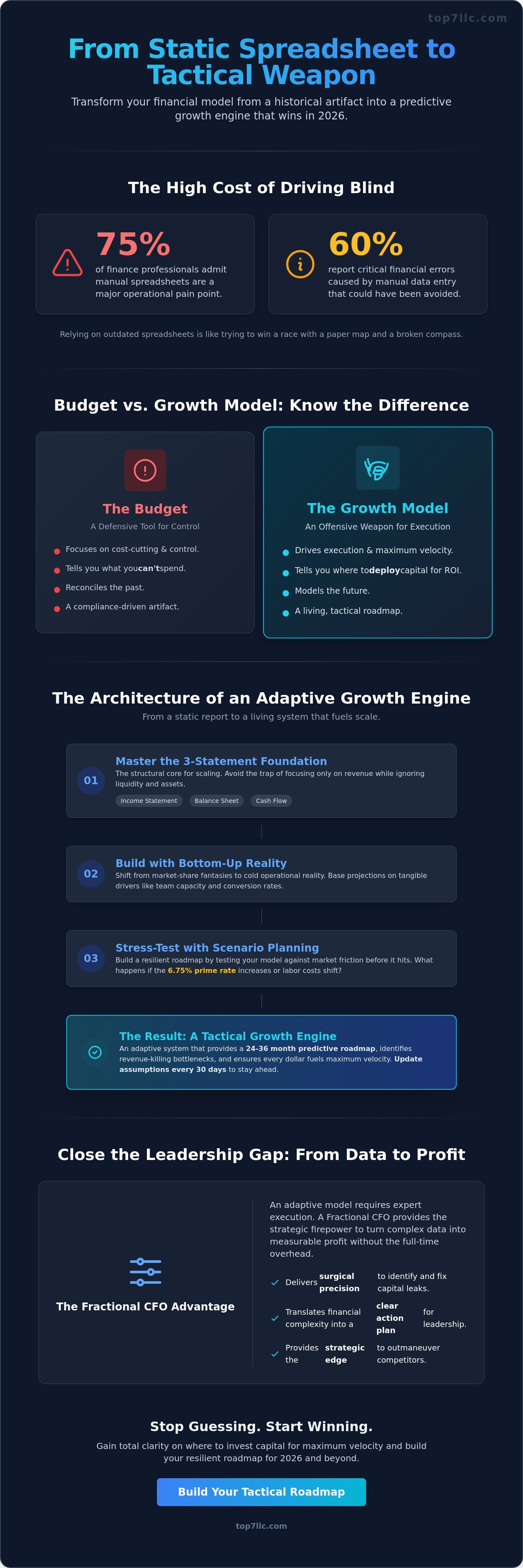
Why are you still running a high-velocity business on a spreadsheet that was obsolete the moment you hit "save"? If your growth is stalling despite record sales, you don't have a revenue problem; you have a visibility problem. Most founders treat financial modeling for growth companies as a secondary compliance task rather than a tactical weapon. It's a dangerous mistake. With 75% of finance professionals admitting that manual spreadsheets are a major pain point, relying on them is like trying to win a race with a paper map and a broken compass.
You've likely felt the operational friction when cash flow surprises hit. It's the sound of your scaling engine grinding to a halt because you couldn't see the curve in the road. This article changes that dynamic. We'll show you how to transform static data into an adaptive engine that identifies bottlenecks before they stall your revenue. You'll gain a predictive roadmap for the next 24 to 36 months and total clarity on where to invest capital for maximum velocity. We're providing the framework to stress-test your 2026 market assumptions so you can stop guessing and start winning.
Key Takeaways
Stop treating your model as a historical artifact; transform it into a tactical growth engine that identifies revenue-killing bottlenecks before they hit your bottom line.
Master the architecture of adaptive modeling by syncing your 3-statement core with aggressive unit economics to ensure every dollar fuels maximum velocity.
Discover why bottom-up financial modeling for growth companies is the only way to survive 2026, shifting from market-share fantasies to cold operational reality.
Build a resilient roadmap using scenario planning that stress-tests your business against shifting interest rates and labor costs before they cause operational friction.
Close the leadership gap by understanding how a Fractional CFO delivers the surgical precision required to turn complex spreadsheets into actual, measurable profit.
Table of Contents
Why Your Current Financial Model is a Ghost of Growth Past
Most "financial models" sitting in executive folders right now are useless artifacts. They are static reports, built once a year to satisfy a board or a bank, but they do nothing to drive daily decisions. If you're still relying on a spreadsheet that hasn't been updated since last quarter, you're driving blind. High-impact financial modeling for growth companies functions as a tactical roadmap. It's a living system that translates fiscal data into operational velocity. With 75% of finance professionals reporting that manual processes are a major pain point, your reliance on outdated spreadsheets isn't just inefficient; it's a liability. In fact, 60% of respondents in a 2026 survey reported that manual data entry led to critical financial errors that could have been avoided with a dynamic framework.
The market doesn't care about your 2025 projections once the calendar turns. We call this the "Snapshot Trap." A model built for 2025 conditions is irrelevant in a 2026 landscape defined by a 6.75% prime rate and shifting labor costs. When your model is a ghost of the past, you miss the signals of operational friction. These are the discrepancies between what you expected to happen and what is actually draining your bank account. If your model doesn't update as fast as your market, it's not a tool; it's a tombstone for your scaling ambitions.
To better understand how to build a model that actually drives your business forward, watch this helpful video:
The High Cost of Reactive Financial Planning
Waiting for the end of the month to see if you hit your targets is a recipe for executive burnout. Reactive planning means you're always solving yesterday's problems while today's opportunities pass you by. It leads to capital leakage, where money disappears into inefficient channels because you didn't have the data to stop it. In 2026, guessing isn't just risky; it's the fastest way to surrender your market share to competitors who use data as a weapon. If you aren't seeing the iceberg until you hit it, your model has already failed you.
Budgets vs. Growth Models: Know the Difference
Don't confuse a budget with a growth model. They aren't the same thing. A budget is a defensive tool; it's designed for control and cost-cutting. It tells you what you can't spend. A growth model is an offensive weapon designed for execution. It tells you where to deploy capital for maximum return. Your local tax accountant is likely great at compliance, but they aren't the right person to build an execution strategy. Strategic financial modeling for growth companies requires predictive analytics that model the future, not just reconcile the past. Stop looking for a bookkeeper and start looking for a framework that fuels scale.
The Architecture of an Adaptive Growth Model
Building a model isn't about filling cells with optimistic numbers. It's about building a machine. If you aren't updating your assumptions every 30 days, you're operating on fiction. Adaptive financial modeling for growth companies requires a structural shift from reporting to predicting. This is where we integrate the Velocity-7 Layer. This layer maps your financial inputs directly to your operational flow, ensuring that every dollar spent actually accelerates your business instead of vanishing into overhead.
An adaptive model doesn't just sit there. It breathes. It reacts to the market. When interest rates shift or a competitor pivots, your model should tell you the impact on your runway within minutes, not weeks. This level of precision is exactly what we provide through our Fractional CFO services, giving you the strategic edge without the full-time overhead.
Mastering the 3-Statement Foundation
The 3-statement model is the skeleton of any growth strategy. Without it, your business lacks the structural integrity to scale. Most founders focus exclusively on the Income Statement, chasing revenue while their Balance Sheet rots. In 2026, real-world liquidity is the only metric that guarantees survival. With the prime rate at 6.75%, debt is expensive and mistakes are lethal. Your Cash Flow Statement must be the primary lens through which you view every decision. If it doesn't show where the cash is coming from and exactly where it’s going, it’s useless.
Unit Economics: The Pulse of Your Scalability
Growth is a math problem. If you can't solve for your unit economics, you can't scale. In the current market, you must track three critical pillars:
Customer Acquisition Cost (CAC): The true, fully-loaded cost to acquire a user in a crowded 2026 digital landscape.
Lifetime Value (LTV): The total net profit a customer generates before they churn.
Payback Period: The exact number of months it takes to recoup your CAC.
Your LTV/CAC ratio is the ultimate predictor of growth friction. If this ratio is shrinking, your engine is overheating. You need to identify the tipping point where your unit economics allow growth to become self-sustaining. Anything less is just expensive guesswork. Stop looking at your bank balance and start looking at the efficiency of your capital. That's how you win.
Top-Down vs. Bottom-Up: Which Strategy Wins in 2026?
Founders love the Top-Down approach because it looks impressive in a pitch deck. You pick a massive market size, claim a small percentage of it, and call it a strategy. This is the "Dreamer" model. In reality, it's often just a professional hallucination. High-performance financial modeling for growth companies demands a confrontation with the "Realist" view: the Bottom-Up approach. This isn't about what you want to happen. It's about what your operational engine is actually capable of producing. If your model starts with a market share goal rather than your current sales capacity, you're setting yourself up for a crash.
The gap between these two approaches is where most businesses fail. We use the Velocity-7 Adaptive Framework to bridge this divide. It takes your high-level vision and anchors it in cold, operational reality. This ensures your growth isn't just a number on a page, but a repeatable, scalable process. Geography also plays a role. A mid-market company in Dallas faces different labor market pressures and tax environments than one in Chicago. Generic models ignore these local nuances. We don't.
The Perils of Pure Top-Down Modeling
Top-down models are dangerous because they systematically ignore internal bottlenecks. If you set a goal to triple revenue without auditing your fulfillment capacity, you aren't scaling; you're imploding. This mismatch creates intense operational friction. It leads to massive employee churn and executive burnout when the team realizes the targets are impossible. Use top-down targets to set a long-term destination. But when it comes to monthly execution, ignore the dreamer. You cannot wish your way past a staffing shortage or a broken supply chain.
Bottom-Up: Building on Operational Reality
The realist starts with capacity. How many leads can your marketing team actually generate? What is the true hiring lead time for a senior engineer in 2026? Your financial modeling for growth companies must account for the fact that a new hire takes 60 to 90 days to reach full productivity. If your model doesn't bake in these delays, your cash flow projections are a work of fiction. Aligning your C-suite on these realistic milestones is the only way to maintain strategic control. It prevents the leadership gap where expectations outpace the actual ability to execute.
Stress Testing and Scenario Planning: Preparing for Market Friction
Hope is not a financial strategy. If your model only shows a steady climb to the right, it's a fantasy, not a roadmap. High-performance financial modeling for growth companies requires you to break your own business in a controlled environment before the market does it for you. This means moving beyond a single set of numbers and building Base, Best, and Worst-case scenarios that dictate your tactical response. It's the difference between panicked reacting and calculated execution. You need to know exactly what happens to your runway if your primary revenue stream takes a hit.
In 2026, the variables are moving faster than ever. With the prime rate holding at 6.75%, the cost of capital is a constant pressure on your margins. You must model for shifts in labor costs and supply chain volatility that can erase your profit in a single quarter. We also account for the "Black Swan" factor. You can't predict the specific event, but you can model your resilience to a sudden 30% increase in operational costs. If you need a battle-tested framework to survive market friction, partner with our Fractional CFOs to build your resilience today.
Modeling for Market Volatility
Stop looking at revenue and start looking at your Debt Service Coverage Ratio (DSCR). If your revenue drops by 20% tomorrow, how long is your "Survival Runway"? Most mid-market companies don't know the answer until it's too late. Stress testing is not about pessimism, but about tactical readiness. It allows you to identify exactly where your cash flow breaks and what levers you need to pull to stay solvent. When debt is priced at current 2026 levels, liquidity is your only true protection against market shifts.
The "Pivot" Trigger: When to Change Course
A model is useless if it doesn't drive action. You must establish clear financial tripwires. These are the specific metrics that, if hit, trigger an immediate strategic shift. Perhaps it's a CAC that stays 15% above target for two consecutive months or a gross margin dip that threatens your debt covenants. An adaptive framework allows for 48-hour decision cycles. You don't wait for a board meeting; you execute the pivot the moment the data demands it. This is where Fractional Leadership becomes your unfair advantage, providing the surgical precision needed to execute a mid-stream pivot without losing momentum.
Executing the Model: Why a Fractional CFO Beats a Full-Time Hire
Execution is the graveyard of most business strategies. You can build the most sophisticated spreadsheet in the world, but if you don't have the leadership to drive it, it's just expensive digital wallpaper. The "Leadership Gap" is the primary reason mid-market companies fail to scale. They have the data, but they lack the surgical precision to turn that data into operational momentum. High-impact financial modeling for growth companies requires an architect who understands how to bridge the divide between a balance sheet and daily floor operations. Without that bridge, you aren't scaling; you're just getting busier while your margins evaporate.
Choosing between a full-time hire and a fractional expert is a matter of capital efficiency. The average annual salary for a full-time CFO in the U.S. is approximately $229,069 in 2026. For a growth company, that is a massive amount of overhead to lock into a single role. Contrast this with fractional CFO hourly rates that typically range from $175 to $450. You get the same tier of elite C-suite expertise for a fraction of the cost, allowing you to reallocate that saved capital into direct revenue-generating activities. Our Velocity-7 Adaptive Framework ensures that this isn't just a part-time consultation. It's a system that embeds financial strategy directly into your operations, turning your model from a static report into a tactical engine.
The Strategic Advantage of Fractional Leadership
Accessing top-tier expertise without the $300k+ overhead is a competitive advantage your rivals are likely missing. An outside perspective is critical for identifying internal friction. When you're inside the jar, you can't read the label. A Fractional CFO from Top7 brings a cross-industry vantage point that identifies capital leakage your internal team has grown blind to. We don't just hand over a report and walk away. Our executives embed directly with your team, ensuring the financial modeling for growth companies we implement is actually executed at every level of the organization.
Next Steps: Turning Your Model Into Momentum
The transition from data chaos to predictive flow happens in a structured, 90-day roadmap. It starts with a ruthlessly honest audit of your current reporting. We look for the "leakage" where your capital is stalling. Once the leaks are plugged, we move to build your adaptive framework, giving you the 24 to 36-month visibility you've been missing. Don't let another quarter pass with guesswork and cash flow surprises. It's time to take control of your fiscal destiny. Stop guessing and start scaling with a Top7 Fractional CFO.
Dominate Your Market With Data, Not Guesswork
You've seen the cost of driving blind. A static spreadsheet isn't a strategy; it's a liability that invites operational friction and capital leakage. High-performance financial modeling for growth companies requires an adaptive engine that stress-tests every assumption against the brutal reality of the 2026 market. We've shown you why bottom-up realism beats top-down dreaming and how unit economics dictate your actual scaling velocity. Now, the focus shifts from planning to execution.
Mid-market players in the $10M to $100M range don't need more raw data; they need elite leadership to interpret it. Our proprietary Velocity-7 Adaptive Framework embeds seasoned C-suite professionals directly into your team to turn data chaos into predictive flow. Stop letting cash flow surprises stall your revenue and start making decisions based on cold, hard numbers. It's time to build a roadmap that actually drives your business forward. Audit your growth bottlenecks with a Top7 Strategic Audit and start scaling with precision. You have the vision. We have the framework to make it profitable.
Frequently Asked Questions
What is the most important metric in financial modeling for growth companies?
Net Cash Flow is the ultimate reality check for any scaling business. While revenue often acts as a vanity metric, cash flow dictates your survival runway and your ability to reinvest without operational friction. Effective financial modeling for growth companies must also prioritize the LTV to CAC ratio to ensure your acquisition engine is actually profitable at scale. If you aren't tracking the efficiency of every dollar deployed, you aren't modeling; you're just hoping.
How often should a growth company update its financial model?
You should update your financial model every 30 days to maintain tactical agility. A model that hasn't been touched in a quarter is a historical artifact, not a decision-making tool. In a 2026 market where the prime rate sits at 6.75%, your cost of capital and labor expenses can shift overnight. Monthly updates allow you to identify revenue bottlenecks and pivot your strategy before the data becomes obsolete.
Can I build a financial model if my data is messy or incomplete?
Messy data is a common starting point for mid-market companies, but it's not an excuse for strategic blindness. The first step in building a professional model is normalizing your disparate data streams into a single source of truth. Starting with imperfect data is actually beneficial because it highlights exactly where your reporting systems are leaking capital. We clean the chaos as we build the framework, ensuring you gain visibility while we fix the underlying processes.
What is the difference between a financial forecast and a financial model?
A forecast is a static prediction of a future outcome, while a model is a dynamic engine that shows you how different variables interact. Models are built on the 3-statement foundation, allowing you to change a single assumption, like a 10% increase in lead costs, and see the immediate impact on your cash flow. Forecasts are for pitch decks and board meetings. Models are for the daily execution and stress-testing required to dominate your market.
How does a Fractional CFO help with financial modeling?
A Fractional CFO provides the strategic architecture and execution discipline that a standard bookkeeper or accountant simply doesn't possess. They bridge the gap between your financial data and your operational flow, ensuring your model drives real-world decisions. By embedding directly with your team, they turn financial modeling for growth companies into a tactical weapon. They provide the C-suite expertise you need to scale without the $229,069 average annual salary of a full-time hire.
How much does it cost to build a professional growth model for a mid-market company?
The investment required to build a professional model varies based on your data complexity and the depth of scenario planning your industry demands. Rather than focusing on the upfront fee, consider the high cost of capital leakage and missed opportunities caused by guessing. A professional framework pays for itself by identifying inefficiencies and providing the clarity needed to invest capital for maximum velocity. It's an investment in strategic control, not just another line-item expense.
What software is best for financial modeling in 2026?
The best software in 2026 integrates directly with your accounting systems and utilizes AI for anomaly detection and predictive insights. The trend has moved away from static, error-prone spreadsheets toward dynamic platforms that support real-time scenario planning. These tools are essential for avoiding the manual entry errors that 60% of finance professionals reported as a significant pain point in recent industry surveys. You need a platform that updates as fast as your business moves.
How long does it take to implement the Velocity-7 Adaptive Framework?
We typically move from data chaos to a fully predictive flow within a 90-day roadmap. The initial 30 days are focused on auditing your current systems and plugging immediate capital leaks. By the end of the 90-day cycle, your leadership team will have a stress-tested, adaptive model that provides a clear roadmap for the next 24 to 36 months. This timeline ensures the framework is deeply embedded in your operations rather than just sitting on a shelf.



Comments