
Executive Transition Management: Engineering C-Suite Continuity in 2026
- Robert Fitzgerald
- Aug 4
- 12 min read

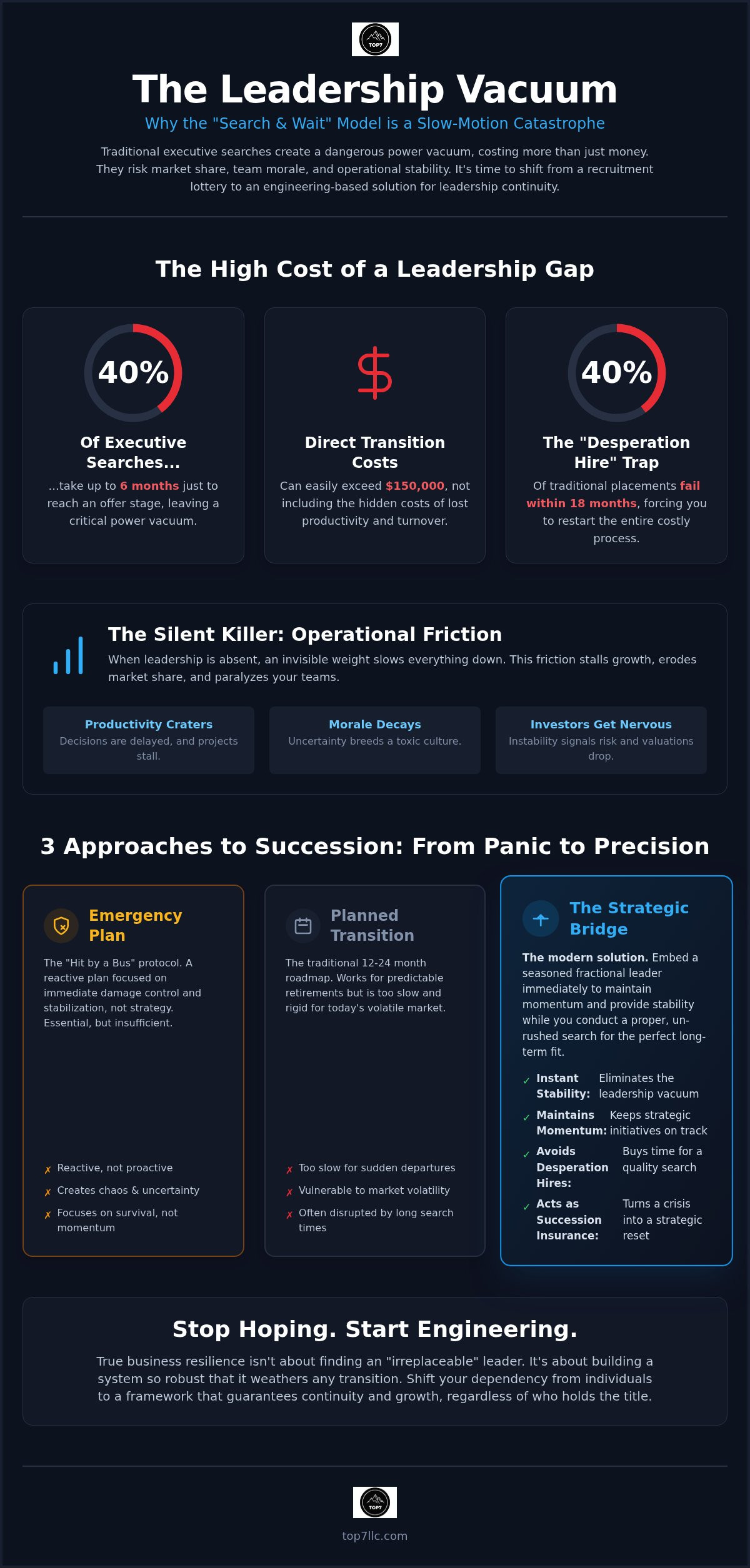
Your C-suite just lost a key player, and your board thinks a six-month search is a "plan." It isn't; it's a slow-motion suicide for your market share. In 2026, 40% of executive searches take up to half a year just to reach an offer. Can your operations survive 180 days of a power vacuum? Most can't. The resulting friction, desperation hires, and internal politics will cost you far more than the $150,000 in direct transition fees you'll eventually pay. You need a better way to handle executive transition management that doesn't involve crossing your fingers while the ship drifts.
We know the fear of operational collapse is real. You've seen the high price of a rushed hire and the toxic culture that grows when leadership is absent. This article shows you how to engineer continuity using the Velocity-7 Adaptive Framework. You'll learn how to eliminate leadership gaps and operational friction by embedding seasoned fractional leaders who provide instant stability. We're moving past the "search and wait" model. We'll explore a framework that guarantees business continuity and turns a potential crisis into a strategic reset.
Table of Contents
The Myth of the Irreplaceable Leader: Why Your Current Plan is Failing
Hoping your CEO doesn't quit isn't a strategy; it's a prayer. In the high-stakes environment of 2026, relying on the perceived loyalty of a single individual is a liability that can sink your valuation overnight. Executive transition management is the systematic process of ensuring leadership continuity to eliminate operational friction. It isn't a HR checkbox. It's a systems-engineering requirement for any company that plans to exist three years from now.
When a leader exits without a framework in place, the "Leadership Gap" begins to bleed your resources. Productivity doesn't just dip; it craters. Morale decays as departments wait for permissions that never come. Investors don't just get nervous; they pull back. According to the Batten Group, the direct costs for a senior leadership transition can hit $150,000 before you even account for the cost of employee turnover. If you're treating succession as a "someday" project, you're failing to stress-test your company's operational flow.
The Single-Point-of-Failure Risk
Tribal knowledge is the poison pill of the mid-market. When an executive walks out the door, they take more than their login credentials; they take the unwritten rules of your revenue engine. Mid-market companies in hubs like Boston or Chicago are far more vulnerable than the Fortune 500. You don't have the massive HR infrastructure to buffer a sudden vacancy. You have a "Succession Depth Chart" that looks great on paper but falls apart in reality because your "bench" isn't actually ready to play.
Ask yourself: who owns the relationship with your top three clients? Who understands the nuances of your tech stack's legacy debt? If the answer is "the person who just resigned," you've allowed a single-point-of-failure to jeopardize your entire growth trajectory. Real leadership depth requires a system where processes are mapped to frameworks, not personalities.
Operational Friction: The Silent Growth Killer
Operational friction is the resistance created by unclear leadership transitions. It's the invisible weight that slows down every decision, every project, and every sale. When a leadership vacuum exists, your growth frameworks stall. Teams stop taking risks because they don't know who will sign off on the results. This isn't just a minor inconvenience; it's a silent killer that erodes your market share while you spend four to six months searching for a replacement.
You can recognize the signs of transition-related friction before they become a crisis. Look for "analysis paralysis" in mid-level management or an uptick in "just checking in" emails that replace actual execution. If your team is waiting for a leader to tell them how to breathe, you haven't built a business; you've built a cult of personality. Eliminating this friction requires a proactive approach that prioritizes immediate stability over the long, slow hunt for a "perfect" permanent hire.
3 Types of Succession Plans: From Emergency to Strategic Bridge
Succession planning is usually a binary choice between a slow-motion retirement and a high-speed car crash. Most boards treat executive transition management as a choice between a 24-month roadmap or a weekend of panic. This binary thinking is exactly why mid-market companies stall when a leader exits. You need a third option. The Strategic Bridge model is the secret weapon for US firms in 2026 because it replaces the pressure of "finding a person" with the discipline of "maintaining the flow."
Emergency succession is your "Hit by a Bus" protocol. It isn't about finding a replacement; it's about immediate stabilization. Planned succession, the 12-24 month transition, works well for predictable retirements but often fails in a volatile market where search timelines stretch to six months. Then there is the Fractional Bridge. This is the modern alternative to the panicked permanent hire. It allows you to embed a seasoned expert today while you take the time required to find the right long-term fit without losing operational momentum.
Emergency vs. Planned: Managing the Chaos
Your "Day 1" emergency kit must contain more than just passwords and bank access. It needs a pre-drafted communication plan for stakeholders and clear delegation of authority. The board's job in the first 48 hours isn't to call a headhunter. It's to stabilize the ship and reassure investors. A sudden departure shouldn't cause a fire drill if you've already identified who holds the operational keys. If you haven't, you aren't leading; you're just waiting for a crisis to dictate your company's future.
The Fractional Bridge: Buying Time and Intelligence
Rushing to hire a permanent replacement is a strategic mistake that leads to a 40% failure rate within 18 months. A Fractional CEO or COO keeps the wheels turning without the long-term baggage of a "desperation hire." This "outside-in" perspective is invaluable. These experts don't just fill a seat; they audit the role. Before you hire the next person, use Interim Leadership to stress-test your current processes and identify what the position actually requires in the 2026 market.
By the time you reach the offer stage of a traditional search, an interim leader has already eliminated the tribal knowledge risks that plague most transitions. They ensure that when the permanent hire finally arrives, they're stepping into a streamlined system rather than a chaotic vacuum. You aren't just buying time; you're buying intelligence and operational security.
Search vs. Stability: Why Rushing to Recruit is a Strategic Mistake
Desperation is the worst advisor in the boardroom. When a C-suite seat goes cold, the reflexive instinct is to call a headhunter and fill the hole as fast as possible. This is a strategic error that treats executive transition management as a recruitment task rather than a systems-engineering challenge. You're trying to solve a structural problem with a personality hire. It doesn't work. Data shows that 40% of new executives fail within their first 18 months. They don't fail because they lack talent; they fail because they were dropped into a friction-filled vacuum that hadn't been stabilized before they arrived.
Recruiters sell resumes; they don't sell results. Their incentive is to close the placement and collect the fee, not to ensure your operational flow remains intact during the 4-6 months the search actually takes. Letting a third party define your future leadership needs based on a stale job description is a recipe for a "Desperation Hire." A successful transition follows a strict hierarchy: stability first, strategy second, and search last. If you haven't stabilized the ship, your new hire will spend their first year fighting fires instead of driving growth.
The Hidden Costs of Executive Recruitment
Placement fees typically hover around 30% of the position's annual salary. For a role with a $150,000 base, you're looking at a $45,000 check just to get a signature. According to the Batten Group, the total direct costs for a senior leadership transition often range between $75,000 and $150,000. But the real cost is the cultural mismatch. Rushing a hire in a high-growth environment is like grafting a limb without checking the blood type. Using interim leadership to maintain results while the search plays out isn't just an option; it's a financial necessity to protect your EBITDA.
Auditing the Seat: Do You Actually Need a Full-Time Replacement?
The transition period is the only time you can objectively evaluate if a role needs restructuring. Most companies hire for the problems they had in 2021, ignoring the reality of 2026. With 94% of executives reporting that AI is fundamentally changing their roles, you must ask if a traditional full-time replacement is even the right move. Could a Fractional CTO or Fractional CFO deliver 80% of the strategic value at 40% of the cost? By using a fractional executive retainer, you de-risk the transition and give yourself the breathing room to align the role description with your actual 2026 growth goals. Stop hiring for the past and start engineering for the future.
The Velocity-7 Approach to Succession: Engineering Resilient Leadership
Most succession plans are nothing more than dusty PDFs sitting in a drawer, waiting for a crisis that will render them obsolete. In 2026, a static plan is a liability. Real executive transition management requires a living system that prioritizes operational flow over organizational charts. If your plan doesn't involve a repeatable framework for transferring authority and intelligence, you don't have a plan; you have a hope. We use the Velocity-7 Adaptive Framework to turn leadership from a single point of failure into a scalable asset.
Engineering resilience isn't about finding a clone of your outgoing leader. It's about building a structure that doesn't care who is in the seat. This requires a five-step tactical approach:
Audit the 'Seven Dimensions of Growth': Identify exactly where your revenue and operations are dependent on a specific person's "gut feeling" rather than a documented system.
Map Processes to the Velocity-7 Adaptive Framework: Ensure every critical process is tethered to a framework that any seasoned executive can pick up and run on day one.
Implement Shadow Leadership: Create a culture where internal successors are actively managing high-stakes projects under the guidance of current leaders.
Establish a 'Fractional Reserve': Maintain relationships with pre-vetted interim partners like Top7 who can step in within 48 hours.
Conduct Regular 'Friction Audits': Test your company's ability to pivot every quarter. If a leadership change would stall a project, you've found a friction point that needs fixing.
Applying Agile to Succession Planning
Static documents fail because the market moves too fast. Agile succession treats leadership transition as an iterative process. Instead of a massive hand-off on a Friday afternoon, we implement sprint-based transitions. This involves transferring executive responsibilities in small, manageable chunks over several weeks. It reduces the learning curve friction and ensures that documentation is updated in real-time. When you treat succession as a series of sprints, you eliminate the "information dump" that usually leads to new executive failure.
The Top7 Velocity-7 Framework in Action
We recently stepped into a mid-market manufacturing firm after their COO exited abruptly. The operations department was broken, held together by the outgoing leader's personal relationships and unwritten rules. By applying the Velocity-7 Adaptive Framework, we didn't just fill the gap. We audited the operational flow, mapped the dependencies, and restructured the department for efficiency. We focused on strategic planning as the foundation, ensuring the next permanent hire inherited a streamlined engine rather than a pile of problems. We move organizations from friction to flow by proving that leadership is a system, not a personality trait.
Fractional Leadership: The Ultimate Succession Insurance
Leadership isn't a title; it's a function of your business engine. When that engine stalls because a C-suite executive exits, you don't need a consultant to tell you why it's smoking. You need an operator to fix it. Fractional leadership is the ultimate insurance policy for your executive transition management strategy. It de-risks the most volatile period in your company's lifecycle by replacing uncertainty with proven execution. Effective executive transition management ensures you never have to make a strategic choice out of fear or desperation. It's about proactive maintenance that prevents the crash from happening in the first place.
Consultants sell ideas. Fractional leaders sell results. At Top7, our executives don't sit in the corner office giving "strategic advice" while your team founders. They embed directly into your operations. They own the P&L, they manage the tech stack, and they lead the people. This is how you eliminate the six-month search friction we discussed earlier. You get the caliber of a Fortune 500 executive without the full-time overhead or the long-term commitment. You're buying speed, stability, and a clear path forward.
Why Top7 is the Preferred Partner for Mid-Market Firms
Mid-market companies in cities like Boston, Chicago, Dallas, and across the West Coast face a unique challenge. You're too big to wing it, but often too small to have a deep internal bench. Top7 bridges this gap. We provide immediate access to high-level strategic guidance across the CEO, CFO, and CTO roles. We don't deliver reports; we deliver execution. Our focus is on profit maximization and system efficiency. We've seen the strategic mistakes boards make during a panic. We exist to ensure you aren't one of them. Our partners are seasoned operators who have navigated high-growth transitions and complex turnarounds.
From Friction to Flow: Your 90-Day Transition Roadmap
A successful transition isn't an event. It's a 90-day sprint. In the first 30 days of a Top7 interim engagement, we focus on stabilization. We identify the tribal knowledge risks and document the critical processes using the Velocity-7 Adaptive Framework. By day 60, we've moved from crisis management to operational optimization. We aren't just "holding the fort." We're improving it. This ensures that the business doesn't just survive the transition; it gains momentum.
The final 30 days are dedicated to the handoff. Whether you're promoting from within or bringing in a permanent hire from the outside, we ensure they inherit a streamlined system. We've already done the hard work of auditing the seat and fixing the friction. Your new hire can focus on the future because we've secured the present. Stop the bleeding and start your succession audit today. Don't wait for a resignation to build your bridge.
Stop Waiting for a Crisis: Engineer Your Continuity Now
The business world in 2026 doesn't reward those who wait for a vacancy to act. You've seen the reality: traditional searches are too slow and desperation hires are far too risky. Effective executive transition management isn't about filling a seat; it's about ensuring your revenue engine never skips a beat. By shifting your focus from finding a specific person to implementing a resilient framework, you turn a potential operational collapse into a strategic advantage.
Top7 provides the proprietary Velocity-7 Adaptive Framework and battle-tested expertise across CEO, COO, CTO, and CFO roles to stabilize your operations. We specialize in mid-market growth and crisis management, delivering the tactical leadership needed to lead through any transition without losing momentum. Don't let a single resignation dictate your company's future. You have the tools to build a bridge that lasts.
Secure your leadership continuity with a Fractional Executive from Top7
Your company is ready for its next phase of growth. Now, make sure you have the leadership systems in place to actually get there.
Frequently Asked Questions
Who is responsible for executive succession planning?
The Board of Directors holds ultimate accountability, but the sitting CEO is responsible for the tactical execution of the plan. It's a strategic business mandate, not an administrative task for HR. If the board isn't treating succession as a top-tier risk management priority, they're neglecting their fiduciary duty. Effective leadership ensures that the company's growth doesn't depend on the presence of a single individual.
How long does a typical executive succession plan take to implement?
A comprehensive succession plan typically requires 12 to 24 months to fully mature and integrate into the culture. However, emergency stabilization protocols must be ready to deploy within 48 hours. Real executive transition management isn't a static document you finish; it's a continuous cycle of auditing leadership depth and validating successor readiness against current market demands.
What is the difference between interim management and fractional leadership?
Interim management provides a full-time, temporary placeholder to maintain the status quo during a search. Fractional leadership offers ongoing, part-time strategic oversight focused on long-term growth and process optimization. While an interim manager simply keeps the lights on, a fractional leader builds the systems that allow the next permanent hire to succeed. One is a patch; the other is an upgrade.
How much does executive succession planning cost for a mid-market company?
Direct costs for senior leadership transitions, including search fees and onboarding, typically range between $75,000 and $150,000 according to 2026 industry reports. These figures don't include the hidden costs of operational friction or the 50-75% of annual salary required to replace mid-level talent who leave during a leadership vacuum. Failing to plan is a multi-million dollar liability for mid-market firms.
Can a fractional executive eventually become a permanent hire?
Absolutely. Many boards use a fractional engagement as a readiness validation period before making a permanent offer. This approach eliminates the risk of a cultural mismatch and allows the company to see real-world results before committing to a full-time salary and benefits package. It's a high-performance stress-test for both the executive and the organization that ensures the right long-term fit.
What are the biggest mistakes boards make during a CEO transition?
The most fatal error is letting a recruiter define the company's future strategy through a stale job description. Boards often rush into a search before auditing the role's actual requirements for 2026. This leads to hiring for the problems of the past instead of the opportunities of the future, contributing heavily to the high failure rate of new C-suite executives who find themselves misaligned with the current reality.
How does the Velocity-7 framework help with succession?
The Velocity-7 Adaptive Framework de-risks executive transition management by mapping critical business processes to systems, not personalities. It identifies where tribal knowledge creates a single point of failure and replaces it with documented, repeatable workflows. This ensures that when a leader exits, the operational intelligence stays within the company, allowing for a seamless handoff to an interim or permanent replacement without a loss in momentum.


Comments