
Aligning Sales and Marketing Teams: A Practical 2026 Guide

What if your sales and marketing teams don’t need another meeting, but one shared revenue system? If marketing calls a lead qualified and sales disagrees, the problem usually isn’t just poor communication. It’s unclear definitions, weak handoffs, or competing measures of success. That’s why aligning sales and marketing teams starts with how both groups operate, not another calendar invite.
You already know the cost of the disconnect: campaigns promise one thing, sales conversations deliver another, and leadership can’t trust a single view of pipeline performance. Blame won’t fix it. Shared evidence and clear accountability will.
This guide shows you how to build that foundation in 2026. You’ll learn how to agree on lead definitions and revenue goals, tighten handoffs and feedback loops, and use consistent reporting to make better decisions. You’ll also see where technology helps, where it can’t solve the real problem, and when leadership support may help turn alignment into execution. The goal is simple: get both teams acting on the same evidence and owning the same outcomes.
Table of Contents
Why aligning sales and marketing teams is a revenue problem, not a personality problem
How aligned sales and marketing teams connect goals, handoffs, and feedback
Siloed, meeting-led, or aligned: which operating model actually works?
When fractional leadership can make sales and marketing alignment stick
Why aligning sales and marketing teams is a revenue problem, not a personality problem
Marketing celebrates a campaign response. Sales says the leads aren’t qualified. Prospects hear one promise in an ad and another in a sales call. Then the pipeline forecast shifts, and both teams have a reason why it’s someone else’s problem. These aren’t isolated personality clashes. They’re signs that the revenue process has gaps.
Sales and marketing alignment is a shared operating system in which both teams use common goals, definitions, processes, data, and accountability to support the buyer journey and revenue. More meetings won’t create it. Clear decisions and consistent execution will. For context, marketing principles center on understanding and serving customer needs, a responsibility that must connect to what sales learns in real conversations.
Watch this discussion for a practical perspective on why coordination matters:
What sales and marketing alignment means in practice
Alignment connects the buyer journey from audience selection and campaign planning through sales follow-up and deal learning. Both teams need a shared meaning for each stage: what counts as a response, when a lead is ready for sales, and what qualifies as accepted or disqualified. Without those definitions, a campaign can look successful in one report and like wasted effort in another.
The roles stay distinct. Marketing creates relevant demand and equips the journey; sales leads direct conversations and advances opportunities. They coordinate around shared outcomes, not identical tasks. For example, marketing can own campaign execution while sales owns follow-up and opportunity progression, with both teams agreeing on the criteria used to hand a lead from one to the other.
The hidden cost of keeping the teams in separate lanes
Separate plans can make buyers do the work of connecting the dots. A campaign may target one need while a sales conversation focuses on another, weakening trust before the opportunity has a chance to progress.
Unclear lead ownership adds another failure point. If nobody knows who follows up, when, or what feedback must be recorded, response can stall and accountability disappears. The result is a blurred view of what’s working: campaign performance, lead quality, and sales follow-through become competing stories instead of evidence teams can act on.
That’s the business case for aligning sales and marketing teams: not smoother meetings, but a more coherent buyer experience and a revenue process leaders can inspect. Start by fixing the definitions and handoffs that shape the work.
How aligned sales and marketing teams connect goals, handoffs, and feedback
Alignment becomes operational when the buyer journey has no unexplained gaps. Marketing helps choose the audience, shape campaign messages, and capture responses. Sales follows up, tests whether the need and timing are real, and records what happens next. Both teams use what they learn to improve the next campaign and conversation. The connection matters more than the number of coordination meetings on the calendar.
Sales and marketing friction has long-standing organizational causes, not just personal ones. Harvard Business Review explores this revenue problem, not a personality problem. The practical response is to make the process explicit, then give both teams a reliable way to see and improve it.
Agree on the buyer journey and qualification language
Map the stages from campaign response to closed outcome, then name who owns each step. Define MQL and SQL for your business rather than assuming those labels mean the same thing everywhere. For example, specify which signals make a lead ready for sales review, such as a fit with your target audience or a stated need, and what evidence sales needs before accepting it as an opportunity.
Make the handoff rules usable: how quickly sales follows up, what happens when a lead is rejected, what reason must be recorded, and who reassigns it. State where the rejection reason belongs in your system and who reviews recurring reasons. Clear rules prevent a lead from sitting in limbo while teams debate ownership.
Build a feedback loop around shared data
Sales feedback should capture more than “good lead” or “bad lead.” Record fit, stated objections, buying timing, follow-up status, and outcomes in consistent fields. Marketing can then use those patterns to refine audience choices, campaign messages, and content. Closed-loop feedback connects lead quality and follow-up outcomes to campaign decisions, so targeting improves from observed buyer evidence rather than assumptions.
A CRM and marketing automation can make that evidence visible by recording campaign source, stage changes, ownership, and follow-up activity. They can flag missing information or route records according to agreed rules, but they can’t decide whether a prospect is a genuine fit. People still need to apply judgment and keep records accurate. Before adding automation, confirm that the underlying fields and handoff rules are clear enough to use consistently.
Start with a small set of shared reports: lead acceptance and rejection reasons, stage conversion, follow-up completion, and opportunity outcomes by source. Agree on what each field means and review the same view together. If the teams can’t explain a number the same way, it isn’t a decision-ready metric. When a measure looks off, trace the records behind it before changing a campaign or process.
If ownership or reporting rules are difficult to establish, strategic planning and leadership support may help clarify decision rights and execution responsibilities.
Siloed, meeting-led, or aligned: which operating model actually works?
There are three common ways sales and marketing work together. The difference isn’t how often they talk. It’s whether decisions, handoffs, and performance data connect to shared revenue outcomes. Alignment doesn’t require merging the teams or erasing specialization. It requires clear interfaces between distinct roles.
Communication is activity; operational alignment is shared decisions, workflows, and evidence that change how revenue work gets done. Use that distinction to assess your current model:
Siloed execution: Each team sets its own priorities and reports separately. Decision ownership stays within functions, handoffs rely on informal requests, data may conflict, and adapting to buyer feedback is slow.
Meeting-led coordination: Teams exchange updates in recurring meetings, but ownership and processes may remain unchanged. Handoffs improve only when someone takes action, reporting can still tell different stories, and adaptation depends on whether decisions get documented and implemented.
Integrated revenue operations: Sales and marketing retain their specialist responsibilities but coordinate through shared goals, agreed processes, and consistent reporting. Decision rights are explicit, handoffs are defined, and teams can adjust based on the same evidence.
The third model is the destination, not necessarily a new department or a large reorganization. The right setup depends on team size, sales cycle, and operational complexity. A small team may need clearly assigned process ownership and a shared CRM view. A more complex operation may need dedicated coordination across functions. Choose the simplest structure that makes accountability and performance visible.
Why more meetings don’t automatically create alignment
A status update tells people what happened. An alignment decision changes what happens next: who owns a lead, which audience takes priority, or what evidence qualifies a prospect for handoff. If the same disputes return every week, meetings may be compensating for unclear ownership. If teams can’t access the same numbers, more discussion won’t fix the reporting gap.
Keep meetings focused on decisions, blockers, and measurable follow-up. Assign an owner to each action and record the agreed change. If there’s no decision to make and no obstacle to remove, the meeting may not be doing useful work. Before the next review, circulate the agreed measures and bring the records behind any disputed result.
When revenue operations can help connect the functions
Revenue operations, or RevOps, is an approach to coordinating processes, systems, and reporting across revenue-generating teams. It doesn’t automatically require a new team. The essential work is assigning ownership for shared definitions and workflows, and ensuring reports use consistent rules. That reduces disputes caused by different versions of pipeline performance.
Start by fixing the handoffs and data rules that create friction. Add more structure only when complexity demands it. That’s how aligning sales and marketing teams becomes an operating discipline, not a meeting habit.
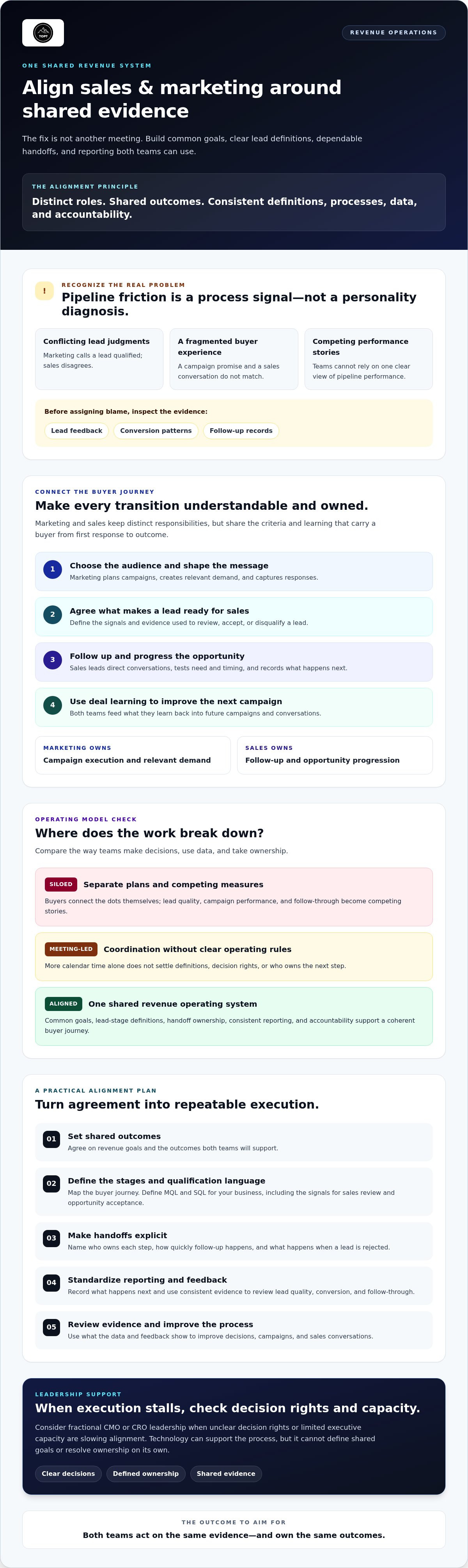
A practical plan for aligning sales and marketing teams
Don’t start by choosing new software or adding more activity. Start with the evidence already in front of you. Review pipeline stages, sales feedback on leads, conversion patterns, and follow-up records. Where do prospects stall? Which leads are rejected, and why? Where does the recorded process differ from what teams actually do? For a practical diagnosis, trace a sample of records from campaign source through sales follow-up and outcome. Those gaps show you where to focus.
Use this sequence to turn the diagnosis into an operating plan:
1. Diagnose friction. Find recurring breakdowns in stage progression, lead feedback, campaign-to-conversation fit, and follow-up.
2. Agree on outcomes. Set the business result first, such as qualified pipeline or revenue, before choosing activity measures.
3. Define handoffs. Document qualification criteria, ownership, acceptance or rejection rules, and how exceptions get resolved.
4. Instrument reporting. Ensure CRM fields and reporting rules capture the agreed stages, sources, ownership, and outcomes.
5. Review and adjust. Check the evidence together, assign next actions, and update the process when results show a gap.
Set shared outcomes and clear ownership
Choose a small set of measures that reflect your business model and sales cycle. Shared measures might include qualified pipeline, lead acceptance, stage conversion, or completed follow-up. Teams can share outcome measures without having identical responsibilities: Harvard Business Review’s discussion of sales and marketing describes distinct functions that need to work together toward common goals. Marketing can own campaign execution; sales can own opportunity progression. Assign named owners for qualification criteria, handoff rules, data quality, and exceptions so shared accountability doesn’t become nobody’s job.
Write the rules down in plain language. A new team member should be able to tell what qualifies for handoff, who acts next, what to do when a lead is not accepted, and where to record the result without relying on unwritten history.
Review performance and improve the process
Set a recurring review to resolve specific questions, not to repeat status updates. Compare the shared measures, examine disputed records, and leave with an owner and next action for each issue. Separate leading indicators, such as follow-up completion, from lagging outcomes, such as closed revenue. Leading indicators can show whether a process is being followed, but they don’t prove the process is producing the right buyers or results.
If sales and marketing still disagree on the root cause, pause the debate and run a focused diagnostic. Trace a sample of leads from source through follow-up and outcome, using the same definitions. If decision rights or capacity are blocking progress, discuss strategic planning and leadership support with Top7. A disciplined process is the foundation; aligning sales and marketing teams means acting on what that process reveals.
When fractional leadership can make sales and marketing alignment stick
A process can be clear on paper and still fail in practice. If lead quality disputes keep resurfacing, priorities conflict, pipeline definitions change between teams, or nobody can make cross-functional decisions, the blocker may be leadership ownership, not another workflow document. Aligning sales and marketing teams requires someone with the authority and capacity to resolve trade-offs and keep decisions moving.
Diagnose the constraint before choosing support. A capability gap means the team needs skills or execution capacity. An ownership gap means people can do the work but lack clear decision rights. Conflicting incentives mean teams are rewarded for outcomes that pull in different directions. Each calls for a different response.
Signs the organization needs more than another process document
Look for repeat patterns: sales and marketing dispute lead quality without resolving the definition, campaign priorities shift without a shared decision, or pipeline reports use inconsistent stage rules. Ask whether the problem is missing expertise, unclear authority, or competing goals. Don’t assume external help is the answer. First identify what’s preventing teams from applying the process they’ve already agreed on.
Evaluate leadership support before committing
Compare options against the specific gap. Internal ownership may fit when an existing leader has the authority and capacity to make decisions across functions. Fractional leadership may be worth considering when the organization needs executive-level direction but lacks that capacity internally. Advisory support may suit a defined strategic question where internal leaders retain implementation ownership.
Before choosing, ask:
Who will make cross-functional decisions when priorities or definitions conflict?
What will that person own, and what remains with sales and marketing leaders?
How will progress be assessed using the shared evidence and outcomes already established?
Top7 offers Fractional CMO and Fractional CRO leadership, as well as strategic planning and advisory services. Its Velocity-7 Adaptive Framework is also available to explore as part of its broader work on organizational transformation. Evaluate any support by its fit with your identified constraint, decision rights, and expectations, not by a promised result.
If ownership is still unclear after your team has examined the evidence, consider a focused discussion about the alignment barriers and who should own resolving them. Top7 can discuss whether its fractional leadership or advisory services fit your needs. Start with the problem to solve, then decide whether outside support makes sense.
Turn alignment into a revenue advantage
Aligning sales and marketing teams isn’t a one-time initiative or a calendar full of meetings. It’s a shared way to set revenue goals, define lead stages, clarify handoffs, and act on the same performance evidence. Start with the friction your pipeline already reveals, assign clear owners, and review a focused set of measures to decide what changes next.
Keep the teams’ responsibilities distinct, but connect their work through consistent definitions and feedback. If recurring disputes point to unclear decision rights or limited leadership capacity, identify that gap before choosing a solution.
Top7 offers Fractional CMO and Fractional CRO services, alongside strategic planning, advisory services, and fractional leadership. If leadership ownership may be slowing your progress, talk with Top7 about the leadership gap slowing alignment.
Build the operating system your teams need, then improve it with evidence. Clear ownership and consistent execution can put both teams on a stronger path forward.
Frequently Asked Questions
What does aligning sales and marketing teams mean?
Aligning sales and marketing teams means connecting their work through shared revenue goals, lead definitions, handoff rules, data, and accountability. Each team keeps its own responsibilities, but both use consistent criteria to understand how prospects move from campaign response to sales conversation and opportunity. For example, marketing and sales agree on what makes a lead ready for follow-up, who owns the next step, and how the outcome is recorded.
How do you align sales and marketing teams?
Start by examining pipeline stages, lead feedback, conversion patterns, and follow-up records to find where work breaks down. Then agree on business outcomes, define lead stages and qualification criteria, assign owners to each handoff, and record the rules in a shared system. Choose a few measures both functions can interpret consistently. Review those measures together, resolve specific process issues, and document actions with accountable owners.
Why is it difficult to align sales and marketing?
Alignment is difficult when teams have different goals, incentives, definitions, or views of performance. Marketing may judge a campaign by responses generated, while sales may focus on qualified opportunities and revenue. If ownership is unclear, leads can stall as each team disputes responsibility or quality. Limited access to shared data makes disagreements harder to resolve. Address the underlying decision rights and processes, not just the communication gap.
What metrics should sales and marketing teams share?
Choose shared measures that reflect your business model and sales cycle. Useful options include lead acceptance and rejection reasons, conversion between agreed pipeline stages, follow-up completion, qualified pipeline, and opportunity outcomes by source. Treat early indicators, such as completed follow-up, differently from later outcomes, such as closed revenue. A metric only helps if both teams use the same definition, data source, and reporting period to interpret it.
What is the difference between sales and marketing alignment and revenue operations?
Sales and marketing alignment is the condition of working toward shared outcomes with agreed definitions, handoffs, and accountability. Revenue operations, or RevOps, is an approach to coordinating processes, systems, and reporting across revenue-generating functions. A company can improve alignment without creating a dedicated RevOps department. The right structure depends on its team size, sales cycle, and operational complexity. In either model, ownership and consistent data rules matter.
How can a CRM help align sales and marketing teams?
A CRM can give both teams visibility into lead sources, ownership, stage changes, follow-up activity, and opportunity outcomes. Consistent fields and reporting rules help reveal where prospects stall and which handoffs need attention. Automation can route records or flag missing information, but a CRM can’t settle disagreements about qualification or accountability by itself. Agree on the process first, then configure the system to record and support it.
Can a fractional CMO or CRO help align sales and marketing?
A Fractional CMO or Fractional CRO may help when the organization needs executive-level direction but lacks clear ownership, decision capacity, or shared priorities. The right leader can support strategy and help clarify who makes cross-functional decisions, while existing teams retain their functional responsibilities. Define the gap, expected scope, decision rights, and measures of progress before selecting support. Fractional leadership can provide a path forward, but it can’t guarantee alignment or business results.


Comments