
When to Hire a Fractional COO: Stop Being Your Company’s Biggest Bottleneck

Are you actually leading your company, or are you just the most expensive project manager on the payroll? Most founders pride themselves on being "hands-on" until that same grip starts strangling their EBITDA. If your projects are stalling at the 90% mark and communication between sales and delivery has turned into a game of telephone, you need to know exactly when to hire a fractional COO before your momentum hits a brick wall. It's the difference between scaling a system and surviving a daily crisis.
You know the burnout that comes from managing every department, yet you hesitate because a full-time hire feels like a heavy anchor on your cash flow. This guide identifies the precise operational "leaks" killing your growth and explains how a fractional executive restores your momentum. You'll learn how to regain 15+ hours of strategic time per week and transition from chaos to high-performance flow. We're stripping away the fluff to reveal the tactical triggers for bringing in elite operational leadership without the overhead of a traditional hire.
Table of Contents
The Founder’s Trap: When Your Brilliance Becomes a Bottleneck
You’re the smartest person in the room, and that’s exactly why your company is dying. This is the Founder’s Trap. You started with a vision, but now you’ve become the human roadblock. If every decision requires your signature and every project stops at your desk, you aren't a CEO; you're a glorified bottleneck. Your brilliance built the company, but your need for control is now strangling its potential.
In 2026, mid-market companies have stopped chasing the "big hire" myth. Why gamble on a $400,000 full-time salary for an executive who spends six months just finding the bathroom? Savvy leaders are turning to a Fractional Executive to inject immediate results. Understanding when to hire a fractional coo is about recognizing the moment operational friction has replaced operational flow. Friction is the grit in the gears that stalls projects; flow is the silent, automated execution of your strategy while you sleep.
To better understand how this transition works, watch this helpful video:
A Fractional COO is a strategic architect who builds the systems that allow the CEO to lead again.
The High Cost of Being "The Answer Man"
Every time you answer a question your team should already know, you bleed cash. This constant interruption slows down the Velocity-7 of your business, creating a massive, hidden EBITDA leak. When decision-making cycles are tied to your personal bandwidth, growth is capped by your fatigue. If your team has stopped taking initiative, look in the mirror. It’s your fault. You’ve trained them to wait for your permission instead of following a system. A fractional leader stops the bleeding by replacing your "approval" with a repeatable process.
Consulting vs. Fractional Leadership: Know the Difference
Don't confuse a consultant with an operator. Consultants give you a watch; Fractional COOs tell you the time and then fix the gears. The shift from "Advisory" to "Embedded Execution" is where the real profit is found. You don't need another 50-page slide deck gathering digital dust on your hard drive. You need someone with the agency to kick doors down and implement change. Advice without agency is just expensive noise. When you decide when to hire a fractional coo, you're choosing a partner who owns the outcome, not just the observations.
Strategic Architecture: What a Fractional COO Actually Executes
Stop treating a Fractional COO like a high-end project manager. They aren't here to check off your to-do list; they're here to burn the list and build a factory. In the high-stakes world of mid-market scaling, the CEO is the Visionary. The COO is the Integrator. Without an Integrator, your vision is just an expensive hallucination. They build the "Operational Backbone," creating systems that don't just work while you're in the office, but thrive when you're gone.
This role is about cross-functional alignment. Sales, Tech, and Finance often speak different languages; the COO acts as the universal translator. They identify single points of failure before they become catastrophic collapses. Harvard Business Review outlines seven basic reasons why companies decide to hire a COO, and for most founders, the primary driver is the need for a partner who can turn raw ambition into repeatable profit. If you're wondering when to hire a fractional coo, look at your project completion rate. If it's dropping while your stress is rising, you're already late.
Bridging the Gap Between Strategy and Reality
Strategy is easy. Execution is hard. A fractional leader takes your three-year vision and grinds it down into 90-day tactical sprints. This is where the Velocity-7 Adaptive Framework becomes your secret weapon. It accelerates the transition from planning to profit by removing the friction between "what we should do" and "what we are doing." You need KPIs that actually drive behavior. If your current metrics just fill spreadsheets without changing how your team works, they're vanity metrics. Real operational leadership installs the gauges that tell you exactly where the engine is overheating.
Team Scaling and Organizational Design
You can't scale a $10M company using the org chart of a $1M startup. A Fractional COO designs the organization for the company you want to become. They take the "People Debt" off your plate. This means handling the hiring, firing, and performance management that keeps you awake at night. They create a culture of accountability through clear ownership. When everyone knows exactly what they're responsible for, you don't have to be the primary escalation point for minor hiccups. If you want to regain your strategic edge, check out how embedded operational leadership can transform your execution speed today.
The Redline Test: 5 Signs You Needed an Operations Leader Yesterday
Your business is an engine. When you push it too hard without the right oil, it redlines and eventually explodes. Knowing when to hire a fractional coo isn't about a "gut feeling" or waiting until you're too tired to function. It's about hard metrics. If your headcount is climbing but your "Project Completion Rate" is plummeting, you've hit the limit of your current structure. You're hiring hands, but you lack the nervous system to coordinate them. More people in a broken system just creates more noise, not more profit.
Look for these five redline indicators in your current workflow:
The CEO is the primary escalation point: If you're still deciding which CRM field to use or mediating minor staff disputes, you're a bottleneck.
Shrinking gross margins: This is the silent killer. It usually happens because of "re-work" and communication errors that force your team to do the same task twice.
Process-Market Friction: You've found Product-Market Fit, but your delivery is a nightmare. You can sell the dream, but you can't fulfill it without a crisis.
Top talent is walking: A-players don't stay in chaotic environments where direction changes every Tuesday. They crave the structure you aren't providing.
The 90% Curse: Strategic initiatives stay at the 90% mark for months because no one owns the final execution.
Diagnosing the "Execution Gap"
Measure the time between a strategic decision and its tactical completion. If it takes six weeks to implement a simple pricing change or a new lead-gen tool, you have a massive execution gap. Most founders are stuck in a "Founder Burnout" cycle, performing $10/hr tasks while their $1,000/hr strategic thinking gathers dust. Don't expect your current managers to fix this. They've likely hit the Peter Principle; they were promoted for their technical skills but lack the architectural talent to build scalable systems. They are operators, not architects.
The Post-Revenue Milestone Trigger
The $5M to $50M revenue range is the "Death Valley" of operations. What got you to $5M was "scrappy" energy and sheer willpower. What gets you to $50M is "scalable" precision and systems that survive your absence. You can't bridge this gap by working more hours or drinking more coffee. You need a different level of leadership to navigate the complexity of a growing organization. A COO is the bridge across this valley. Deciding when to hire a fractional coo at this stage determines whether you scale into a market leader or stall into a cautionary tale.
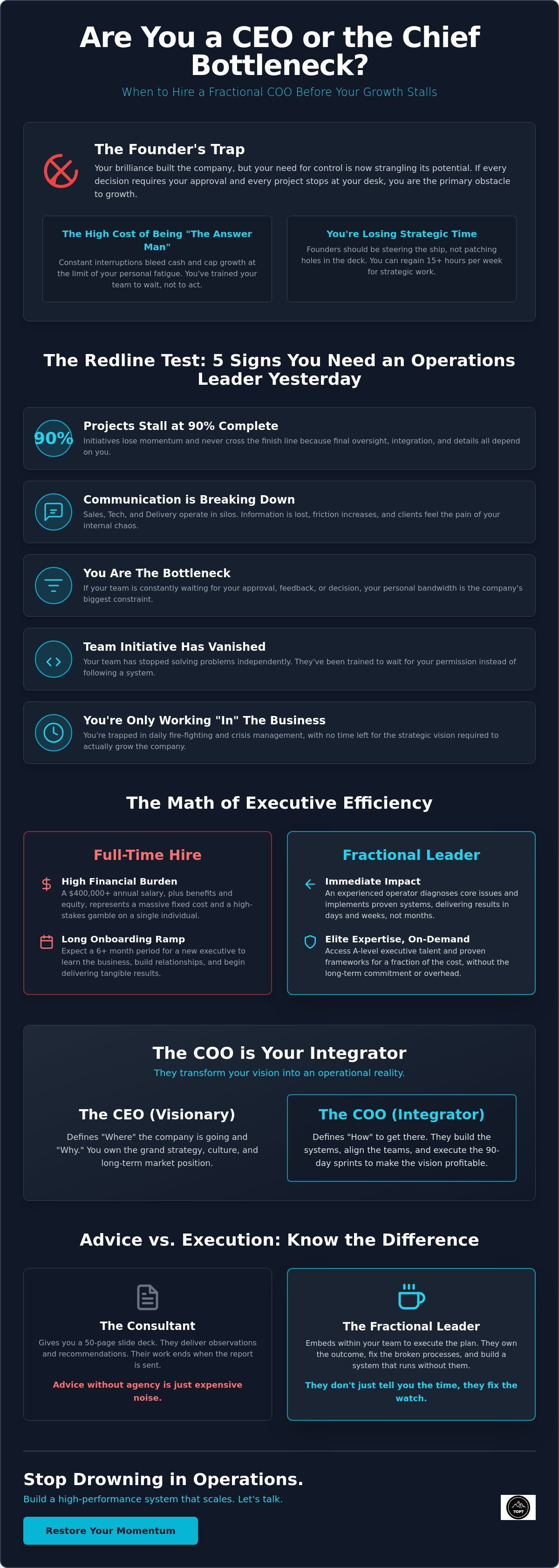
Full-Time vs. Fractional: The Math of Executive Efficiency
Stop lighting cash on fire. Hiring a full-time COO is a high-risk gamble that often costs between $400,000 and $890,000 in total loaded costs during the first year. That figure includes headhunter fees, base salary, benefits, and the inevitable "settling in" period where nothing actually changes. If you are still weighing when to hire a fractional coo, look at your cash flow. A fractional leader offers world-class expertise as a targeted investment rather than a permanent weight on your payroll. You get the surgical precision of an elite operator without diluting your cap table or committing to a six-figure severance package before they've fixed a single system.
The "Onboarding Lag" is the silent killer of growth. Traditional hires take six months to provide real value. They spend the first quarter learning names and the second quarter "assessing" the situation. A fractional leader is embedded and executing within six days. They don't need a welcome lunch; they need your login credentials and a list of your biggest fires. This flexibility allows you to scale the engagement up or down based on your 2026 growth phases, ensuring you only pay for the strategic architecture you actually use.
Why "Promoting Your Best Manager" is a Fatal Mistake
Promoting your top producer to COO is a classic blunder that leaves you with two problems: you lost your best producer and gained a mediocre architect. Managing a process is about keeping the status quo; building a system is about re-engineering that status quo for 10x growth. An external fractional leader brings an "Outside-In" perspective. They see the bottlenecks you’ve become blind to because they aren't emotionally attached to "the way we've always done it." You need a builder, not just a babysitter.
Calculating the ROI of Operational Flow
Execution friction is a tax on your EBITDA. Even a modest 10% increase in operational efficiency through automated workflows and clear accountability has a massive impact on your bottom line. But the real ROI is the value of your recovered time. If your time is worth $1,000 per hour and you spend 15 hours a week on tactical noise, you're losing $15,000 every single week. Reducing "Churn and Burn" by providing a stable leadership layer further protects your most valuable asset: your people. If you're ready to stop guessing and start scaling, view our fractional leadership models to see how elite operations pay for themselves in weeks, not years.
The Top7 Edge: Moving from Friction to Flow with Velocity-7
Knowing when to hire a fractional coo is only half the battle. The other half is ensuring you don't just hire a warm body to sit in an executive chair. You need a system that works faster than your problems. Top7 doesn't just "provide staff"; we deploy the Velocity-7 Adaptive Framework. This is Agile methodology stripped of the fluff and applied to the entire C-Suite. We embed directly into your organization to dismantle complex growth obstacles that have been rotting your margins for years. We aren't here to be your friends; we're here to be your most effective tactical asset.
Our "90-Day Transformation" is a high-stakes tactical overhaul, not a slow-burn consultation. In the first thirty days, we stabilize the chaos and identify the primary leaks. By day sixty, we've installed the core systems of the Velocity-7 framework. By day ninety, your team is operating with a level of autonomy they've never experienced. We cover the full spectrum of operational dominance, from tightening financial strategy to providing aggressive sales guidance and stabilizing technology leadership. If you're looking for someone to just "manage" the mess, look elsewhere. We're here to own the solutions.
The Velocity-7 Methodology in Action
We analyze the seven critical dimensions of your business growth to find exactly where your energy is being wasted. Most companies suffer from "Operational Friction" because their departments are silos that don't speak the same language. We transition your business to "Efficient Flow" through an agile-based transformation that prioritizes speed and profit over bureaucracy. We look at everything from your tech stack's efficiency to the critical sales-to-delivery handoff. This is how you solve the leadership gap without the dead weight of a full-time hire's salary and benefits package.
Your Next Tactical Move
Stop leaking profit through the cracks in your current workflow. If you've identified the signs, the time for "thinking about it" has passed. You need to start scaling with precision before your competitors eat your market share. Every week you wait is another week of strategic time you'll never get back. You're either building a system that scales or you're just waiting for the current one to break. Knowing when to hire a fractional coo means recognizing that "later" is the most expensive word in business.
Scheduling a diagnostic call with a Top7 executive is your first step toward operational sanity. We'll strip away the noise and tell you exactly where your systems are failing and how much it's costing you. We don't do fluff, and we don't do excuses. Audit your operations with a Top7 Fractional COO today.
Systemic Growth or Strategic Burnout: The Choice is Yours
You've seen the redline signs and you know the true cost of the Founder's Trap. Now you have a choice: keep grinding through the friction or install the systems that actually scale. Deciding when to hire a fractional coo is the exact moment you stop being an employee of your own vision and start being its architect. You don't need more hustle; you need a scalable operational backbone that survives your absence and protects your EBITDA.
Top7 brings seasoned C-Suite professionals directly into your organization to solve your most complex growth obstacles. We don't just offer advice. We embed execution using our proprietary Velocity-7 Adaptive Framework. With a proven track record in US mid-market scaling, we turn chaos into a high-performance engine in 90 days. Stop the friction. Schedule your Velocity-7 Diagnostic Call with Top7.
The market doesn't wait for you to find the "perfect time" to fix your operations. It rewards those who act with precision. Take back your strategic time and lead your company to its full potential.
Frequently Asked Questions
What is the typical cost of a Fractional COO in 2026?
The average global rate for a fractional COO currently sits at $204 per hour, with senior specialists in complex industries commanding significantly more. Monthly retainers for mid-market companies generally range from $4,000 to $18,000 depending on the scope of engagement. This investment is designed to be a fraction of the $400,000 plus loaded cost of a full-time executive hire.
How many hours a week does a Fractional COO actually work?
Most fractional engagements require between 17 and 22 hours per week to be effective. The most common model is a two-day-per-week commitment where the executive embeds into your leadership meetings and tactical sprints. This structure provides enough presence to drive the Velocity-7 framework without the unnecessary overhead of a full-time presence.
What is the difference between an Interim COO and a Fractional COO?
An interim COO is a full-time, temporary backfill usually hired to keep the seat warm during a search or a sudden departure. A fractional COO is a long-term, part-time strategic partner focused on building systems and scaling the organization. While the interim role is about maintenance, the fractional role is about transformation and architectural growth.
Can a Fractional COO help with a specific project, like a merger or ERP implementation?
Yes, they are specifically built for high-stakes execution projects that require elite operational oversight. Whether you are navigating a post-merger integration or a complex ERP rollout, a fractional leader provides the seasoned experience to avoid common failure points. They ensure these projects don't stall at the 90% mark like most founder-led initiatives do.
How do I know if my company is too small for a Fractional COO?
If your revenue is under $2 million and your team is fewer than five people, you likely need a project manager rather than an executive. However, the real trigger for when to hire a fractional coo is operational redlining. If your growth has stalled because you are the primary bottleneck for every minor decision, you aren't too small; you're just poorly structured.
Does a Fractional COO manage my existing team directly?
A fractional COO takes over the direct reports of the CEO to restore strategic flow to the founder's schedule. They manage department heads in sales, tech, and finance to ensure cross-functional alignment. This direct management is essential for taking "People Debt" off your plate and installing a culture of true accountability across the entire organization.
What KPIs should I use to measure the success of a Fractional COO?
Measure success through EBITDA growth, project completion rates, and the number of strategic hours recovered by the CEO. You should also track the reduction in "re-work" costs and improvements in employee retention. If the "Execution Gap" between a decision and its completion isn't shrinking within the first 90 days, the systems aren't working.
How long does a typical Fractional COO engagement last?
Engagement lengths typically range from 6 to 18 months, though many stay longer as the company scales through different revenue tiers. The goal is often to build the systems and team structure until the company is large enough to justify a full-time hire. Knowing when to hire a fractional coo also means knowing when the systems are stable enough for them to exit.



Comments