

The Real Risks of Hiring a Fractional Executive (And How to Eliminate Them)
- Robert Fitzgerald
- Jun 26
- 12 min read

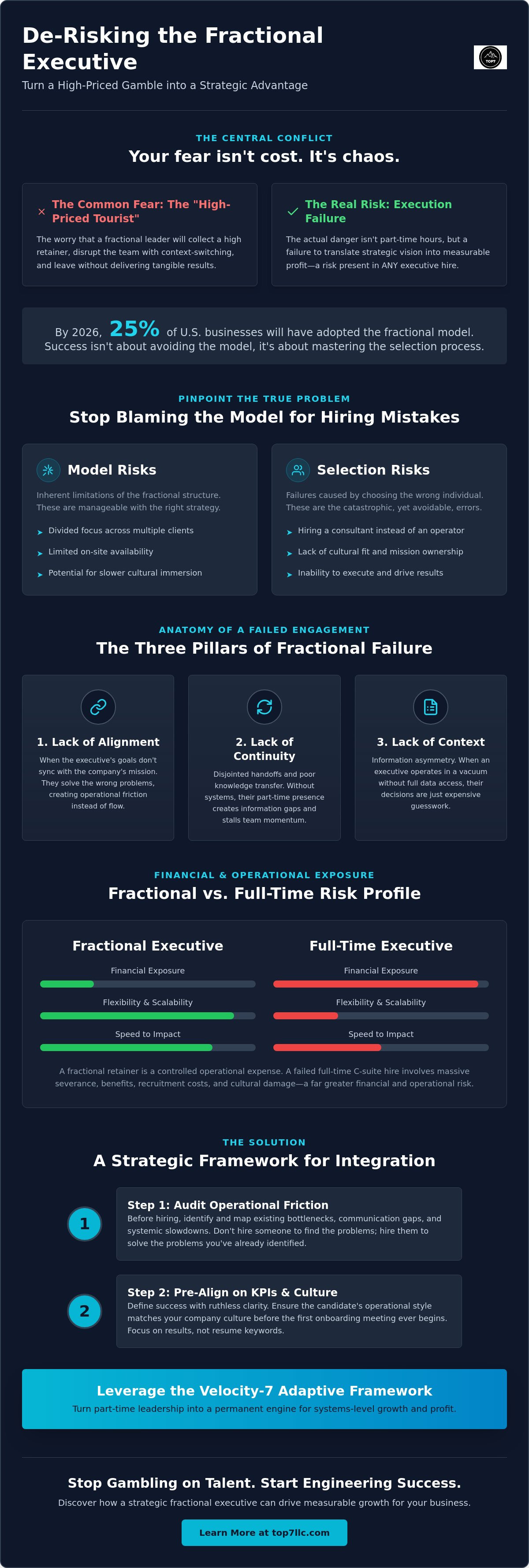
Your fear isn't that a fractional executive is expensive. Your fear is that they'll be a high-priced tourist who leaves your team in chaos. It's a valid concern. With 25% of U.S. businesses already adopting this model in 2026, the market is flooded with "experts" who can't actually execute. If you're worried about wasting high retainer fees on zero results or watching a part-timer struggle with context switching, you're right to be cautious. The risks of hiring a fractional executive are significant when you're hiring for a title instead of a result. A leader who doesn't own the mission is just an expensive distraction.
These pitfalls aren't inherent to the model. They're symptoms of a failed integration strategy. You don't need a part-time helper. You need a strategic operator who fits your culture and hits their KPIs. This article identifies the hidden traps that sink most fractional engagements and provides the specific framework you need to turn executive risks into operational flow. We'll show you how to eliminate the uncertainty and build a leadership layer that drives profit and measurable growth. Stop gambling on talent and start engineering your success.
Table of Contents
Beyond the Buzzwords: What Are the Real Risks of Hiring a Fractional Executive?
The Three Pillars of Fractional Failure: Alignment, Continuity, and Context
Comparing the Risk Profile: Fractional vs. Full-Time Executive Hires
De-Risking Your C-Suite: A Strategic Framework for Fractional Integration
Eliminating Executive Friction with the Velocity-7 Adaptive Framework
Beyond the Buzzwords: What Are the Real Risks of Hiring a Fractional Executive?
Risk isn't just a line item on a spreadsheet or a vague probability of failure. It is the measurable distance between your strategic intent and your operational reality. Most CEOs view the risks of hiring a fractional executive through a narrow lens of "part-time hours." This is a fundamental mistake. The real risk is execution failure. If your vision doesn't translate into profit, the number of hours your executive worked is entirely irrelevant. You aren't paying for presence; you're paying for progress.
You must distinguish between model risks and selection risks. Model risks are baked into the fractional executive model itself, such as divided focus or limited availability. Selection risks are about the individual. Did you hire a veteran operator or a consultant who just wants a comfortable retainer? One solves problems; the other creates them. Understanding this distinction is the difference between a scaling business and a sinking ship.
To better understand the strengths of this model and how it contrasts with traditional roles, watch this helpful video:
The primary byproduct of a bad hire is Operational Friction. This isn't just a "bad vibe" in the office. It's a systemic slowdown where decision-making stalls and team clarity evaporates. A full-time executive can hide behind a 40-hour work week while producing zero results. A fractional hire doesn't have that luxury. If they don't deliver, the friction becomes visible immediately. You have to challenge the myth that "full-time" equals "full-commitment." Commitment is measured by milestones, not by how many coffees someone drinks in your breakroom.
The Illusion of the 40-Hour Security Blanket
Many CEOs cling to the security of a full-time hire because they overvalue physical presence. They want to see a body in the office from 9 to 5. This is a legacy mindset that prioritizes "busy work" over strategic output. The hidden cost of a mediocre full-time executive is staggering. They consume resources, generate endless meetings, and often spend more time on internal politics than on profit-driving initiatives. You aren't buying an employee's time. You're buying their ability to move the needle. Shift your focus from hours logged to milestones achieved, and the fear of "part-time" disappears.
Context Switching: The Silent Performance Killer
Critics argue that managing multiple clients dilutes an executive's performance. This is the context switching trap. If a leader is over-leveraged, their focus fractures. However, the right fractional leader uses their specialized expertise to bypass the learning curve. They don't need 40 hours to understand your bottleneck because they've solved it five times this year for other firms. The risk isn't the number of clients they have. The risk is whether they have the systems to manage the transition between them without dropping the ball. True professionals bring an outside perspective that accelerates absorption, reducing the time needed to go from "onboarding" to "impact."
The Three Pillars of Fractional Failure: Alignment, Continuity, and Context
Failure in the C-suite is rarely a surprise. It is the predictable result of ignored friction points. When analyzing the risks of hiring a fractional executive, most leaders focus on the invoice. They should be looking at the structural integrity of the engagement. If your leadership strategy lacks alignment, continuity, or context, you aren't hiring a savior. You're hiring a very expensive spectator. These three pillars determine whether your new hire drives profit or simply drains your bank account.
Information asymmetry is the first silent killer. If an executive operates in a vacuum without a full data picture, their decisions are guesswork. You cannot lead a department based on hearsay or curated weekly reports. They need deep access to the operational reality. Without it, you create an accountability vacuum. When a part-time strategy fails, "I wasn't there for that meeting" is an unacceptable excuse. Accountability is binary. You either own the result or you don't. A structured Interim Leadership strategy ensures these gaps are bridged before they become craters in your balance sheet.
Culture Clash in the C-Suite
The "plug-and-play" promise is often a lie. Many fractional leaders attempt to impose one-size-fits-all playbooks on established mid-market cultures. This is organ rejection. Your company has its own language, pace, and politics. If a leader doesn't adapt, they create resistance rather than momentum. During the interview process, stop looking at their resume. Start testing their adaptability. Ask how they've pivoted their "proven" methods when faced with a culture that didn't fit their mold. If they can't answer, they'll be a foreign body in your organization.
The Continuity Trap
Crisis doesn't follow a calendar. The risks of hiring a fractional executive become painfully visible when a major operational fire breaks out on their "off-day." You cannot wait until Tuesday for a CFO to handle a liquidity crunch that happened on a Friday. Managing this requires two things: a robust middle-management layer and clear asynchronous communication protocols. Your internal team must be empowered to execute the strategy even when the leader is offline. If your business collapses the moment an executive logs out of Slack, your problem isn't the fractional model. Your problem is your lack of systems.
Protocol over Presence: Establish how decisions are made when the leader is unavailable.
Data Transparency: Ensure the executive has real-time access to KPIs, not just filtered summaries.
Mission Ownership: Demand that the leader "speaks" your company language from day one.
Comparing the Risk Profile: Fractional vs. Full-Time Executive Hires
Risk is relative. Many CEOs believe a full-time C-suite hire is the "safe" play because it implies loyalty and total control. This is a dangerous delusion. When you weigh the risks of hiring a fractional executive against a traditional W-2 hire, the math tells a different story. A fractional failure is a localized fire. A full-time failure is a total building collapse. You aren't just hiring a leader; you're signing a financial and legal contract that can take years to unwind if the performance doesn't match the resume.
The "Golden Handcuffs" risk is the most significant threat to your agility. Firing a bad full-time executive is 10x riskier than ending a fractional engagement. Between severance packages, legal disputes, and the messy clawback of equity grants, the exit cost alone can paralyze a mid-market firm. Fractional leaders operate on a results-based retainer. If the value stops, the contract ends. It's clean, professional, and keeps both parties focused on the only thing that matters: measurable ROI.
Speed to value is the primary de-risking mechanism of the fractional model. A full-time hire often spends their first 90 days "learning the culture" and attending orientation meetings. A fractional operator doesn't have that luxury. They are hired to solve a specific bottleneck, such as a failing sales pipeline or a chaotic supply chain. They hit the ground running because their reputation depends on immediate impact, not on surviving the next performance review.
The Financial Fallout of a Bad Full-Time Hire
Recruitment fees for a C-level executive typically range from 25% to 30% of their base salary. That's a sunk cost before they even walk through the door. Add in the "Dead Wood" risk; the phenomenon where a leader stops innovating but stays employed because the company is afraid of the replacement cost. A monthly retainer is a strategic hedge against this stagnation. It forces a continuous evaluation of value. You pay for the output, not the presence. If you aren't seeing systems-level growth, you pivot. No massive severance. No benefit packages. No equity dilution.
Strategic Flexibility as a Risk Mitigant
Market volatility in 2026 demands a C-suite that can scale up or down based on operational friction. Fractional roles allow you to treat high-level leadership as a trial period before making a permanent commitment. You can bridge the gap during a merger or a digital transformation without restructuring your entire organizational chart. This agility allows you to access specialized Strategic Planning expertise exactly when you need it. You get the veteran wisdom without the permanent overhead. It's the ultimate tool for de-risking your leadership layer in an uncertain economy.
Retainers vs. Severance: Capped financial exposure versus open-ended liability.
Trial Periods: Test the cultural fit before the long-term "marriage."
Pivot Speed: Change leadership direction in weeks, not months.
De-Risking Your C-Suite: A Strategic Framework for Fractional Integration
Identifying the risks of hiring a fractional executive is only the first step. Knowing that a bridge is weak won't get you across the river; you need an engineering plan. Most leadership failures aren't the result of a lack of talent. They're the result of a lack of structure. To eliminate the uncertainty, you must replace "hope" with a rigorous integration framework. Stop treating your fractional hire like a guest and start treating them like a high-precision component in your growth engine.
The first step is defining specific, measurable outcomes. If you hire a Fractional COO to "provide leadership," you've already failed. Leadership is a byproduct; profit and efficiency are the goals. You must define what success looks like in 30, 60, and 90 days. Next, audit your operational friction points before they start. If your internal data is a mess, a new executive will spend their first month cleaning spreadsheets instead of scaling your business. Establish a Single Source of Truth for all documentation. No hearsay. No "I think we have that somewhere." If it isn't in the dashboard, it doesn't exist.
Finally, integrate the leader into your core communication loops immediately. Visibility is the only antidote to the fear of the "part-timer." When an executive is visible in your Slack channels and strategic meetings, the "fractional" label disappears. They become a peer. This level of integration requires a commitment to transparency that many mid-market CEOs find uncomfortable. Get over it. Transparency is the price of speed.
The Onboarding Roadmap
The first 14 days dictate the success of the next 14 months. This isn't an orientation; it's a sprint. You must set "Velocity" targets that measure immediate impact. Within two weeks, your fractional hire should have identified three high-leverage "quick wins" that justify their retainer. This aggressive pace ensures the team views the new hire as a leader who delivers, not a consultant who talks. If you haven't seen a tactical shift in the first fortnight, your integration plan is leaking. For those who need a more structured approach to this transition, our Advanced Project Management services provide the necessary scaffolding for executive success.
Communication Protocols for Remote/Part-Time Success
Strategic momentum shouldn't stop because someone is offline. Leveraging asynchronous tools like Loom or Notion allows your fractional leader to provide direction without requiring a four-hour meeting. Establish a "Weekly Pulse" meeting. This is a high-intensity, 30-minute session focused on blockers and KPIs, not status updates. You also need a clear protocol for emergency escalations. Crisis doesn't wait for a scheduled day. Define exactly what constitutes a "red alert" and how the executive is expected to respond. When the rules of engagement are clear, the risk of a continuity gap evaporates.
Outcome-Based KPIs: Measure deliverables, not "hours of leadership."
Data Parity: Give the executive the same data access as a full-time hire.
Async Momentum: Use documentation and video updates to kill meeting fatigue.
Eliminating Executive Friction with the Velocity-7 Adaptive Framework
Identifying the risks of hiring a fractional executive is a defensive move. Implementing a system to neutralize them is an offensive one. At Top7, we don't just provide part-time help. We deploy the Velocity-7 Adaptive Framework; a proprietary methodology designed to bridge the execution gap that swallows most mid-market firms. This isn't about giving advice from the sidelines. It's about embedding seasoned operators directly into your organizational structure to solve complex growth obstacles in real time. Risk is binary. You're either engineering your success or you're hoping for it. We prefer engineering.
Our framework moves your business from operational friction to efficient flow. We don't hire portfolio careerists who are looking for a side hustle. Our executives are battle-tested professionals who've led multi-million dollar departments. They don't need a map because they've already built the territory. When you hire a Fractional CFO or COO through Top7, you're getting a leader who is accountable for the numbers, not just the hours. They own the result because they've done it before.
From Friction to Flow: The Top7 Approach
The Velocity-7 Adaptive Framework addresses the seven critical dimensions of organizational growth. Most consultants focus on a single silo. We look at the whole system. This is the fundamental difference between giving advice and executing strategy. While a standard consultant might tell you your tech stack is outdated, a Top7 Fractional CTO will restructure your development team and implement agile-based transformation to fix it. We've solved technology bottlenecks for firms that were bleeding cash due to legacy systems, turning those friction points into profit centers within a single quarter. We don't just point at the fire; we put it out and rebuild the room.
Your Next Step Toward Risk-Free Growth
Mid-market companies in innovation hubs like Boston and Austin trust Top7 because we don't play games with their ROI. We follow a strict 90-day roadmap to executive stability. Month one is about the audit and quick wins. Month two is about system implementation. Month three is about scaling the results. You're never left wondering if the investment is paying off. The data tells the story every week. It's time to stop managing the risks of hiring a fractional executive and start leveraging their strategic power to dominate your market.
Don't let operational friction stall your momentum. Success requires a system, not a miracle. Schedule a strategy audit with a Top7 Fractional Executive today and see how we turn your leadership gaps into a permanent engine for growth.
Own Your Growth by Neutralizing Executive Risk
The risks of hiring a fractional executive are only as high as your lack of a system. You've seen how cultural misalignment and continuity gaps can sink an engagement. You also know that a bad full-time hire is a far more expensive disaster. The difference between a part-time tourist and a strategic catalyst is the integration framework you choose to deploy. Stop settling for leadership theater and start demanding operational flow.
Top7 eliminates the guesswork. We don't just offer advice; we embed seasoned C-suite professionals directly into your team using our proprietary Velocity-7 Adaptive Framework. From Boston to the West Coast, we've proven that results are the only metric that matters. Your market share isn't going to win itself. It's time to build a leadership layer that actually moves the needle and drives profit. Stop guessing and start scaling, consult with a Top7 Fractional Leader today. Your next level of growth is waiting.
Frequently Asked Questions
Is a fractional executive less committed than a full-time hire?
Commitment is measured by the achievement of strategic milestones, not by how many hours someone sits at a desk. A full-time executive can hide behind "busy work" and internal politics for years. A fractional leader knows their contract depends on immediate, measurable impact. They're often more committed to the mission because their reputation is tied to the specific result you hired them to deliver.
How do I ensure a fractional leader fits our company culture?
Stop hiring for resumes and start hiring for adaptability. You ensure fit by involving them in core communication loops and demanding they speak your company's language from day one. A professional fractional leader doesn't impose a generic playbook. They audit your existing friction points and adapt their expertise to your specific mid-market environment to ensure a seamless integration.
What happens if our fractional executive takes on too many clients?
Over-leverage is a selection risk you must vet during the interview process. While context switching is one of the inherent risks of hiring a fractional executive, veterans use proven systems to manage multiple portfolios without dropping the ball. Ask about their capacity limits. If they can't explain how they compartmentalize client needs or manage their time, they aren't the right partner for your growth.
Can a fractional CTO or CFO handle a company crisis?
Yes, provided you have established clear emergency escalation protocols. Crisis doesn't follow a 9 to 5 schedule. A seasoned fractional leader has handled liquidity crunches or tech failures dozens of times. They bring a level of calm under fire that an internal team often lacks. You pay for their experience in navigating the storm, not just for their sunny-day advice.
How do we measure the ROI of a fractional executive?
You measure ROI by the delta between their retainer and the profit they unlock. Set hard KPIs in the first 14 days, such as reduced burn rates, increased sales velocity, or system automation. If the executive isn't paying for themselves through measurable efficiency or revenue gains within 90 days, your integration strategy has failed. ROI should be visible, not theoretical.
What are the most common mistakes when hiring a fractional leader?
The biggest mistake is hiring for a title instead of a specific outcome. Many CEOs also fail to provide data transparency, forcing the leader to operate in a vacuum. If you don't define what success looks like or if you hide your operational mess, you're wasting your retainer on a high-priced spectator. Clarity and transparency are the foundations of fractional success.
How does the Velocity-7 framework reduce hiring risks?
The Velocity-7 Adaptive Framework replaces hope with a rigorous integration roadmap. It addresses the seven dimensions of organizational growth to ensure the leader is an embedded operator, not just an advisor. By focusing on systems-level transformation, it eliminates the friction of onboarding and ensures the executive starts delivering value in weeks, not months. It turns the risks of hiring a fractional executive into a structured engine for profit.


Comments