
Tech Team Leadership and Mentoring: Stop Managing Code, Start Leading Velocity

Is your engineering department a profit center or just a very expensive hobby? If your release cycles are dragging and your high-cost talent can't explain how their last sprint moved the needle on revenue, you don't have a technical problem; you have a leadership crisis. Most executives treat their dev team like a black box of expensive magic, but that's exactly why 75% of tech leaders now admit their operating model must fundamentally change to deliver actual value. Effective tech team leadership and mentoring isn't about teaching your seniors a new framework or polishing their clean code skills. It's about installing a business-owner mindset that kills operational friction and turns your tech stack into a weapon for market dominance.
You're likely tired of the constant tug-of-war between technical debt and market deadlines. It's frustrating to watch top talent walk out the door because they feel like cogs in a machine instead of value creators. You'll learn how to transform your stagnant cost center into a high-velocity growth engine through strategic mentoring. We'll explore how to align your technical roadmap with your P&L, reduce turnover by building strategic thinkers, and finally achieve the rapid product iterations your sales team needs to win.
Key Takeaways
Identify the "Ticket-Taker" syndrome and understand why chronic technical debt is usually a symptom of leadership failure rather than a coding issue.
Transform your engineering culture through strategic tech team leadership and mentoring that prioritizes business context over simple syntax.
Analyze the bias problem in internal mentoring and why objective, fractional leadership is required to challenge a stagnant status quo.
Follow a structured 5-step audit to map your existing technical talent directly to revenue-generating business goals using the Velocity-7 framework.
Stop settling for high-level advice and start focusing on execution support to turn your engineering team into a high-velocity growth engine.
Table of Contents
The Tech Leadership Vacuum: Why Your Team is Stalling
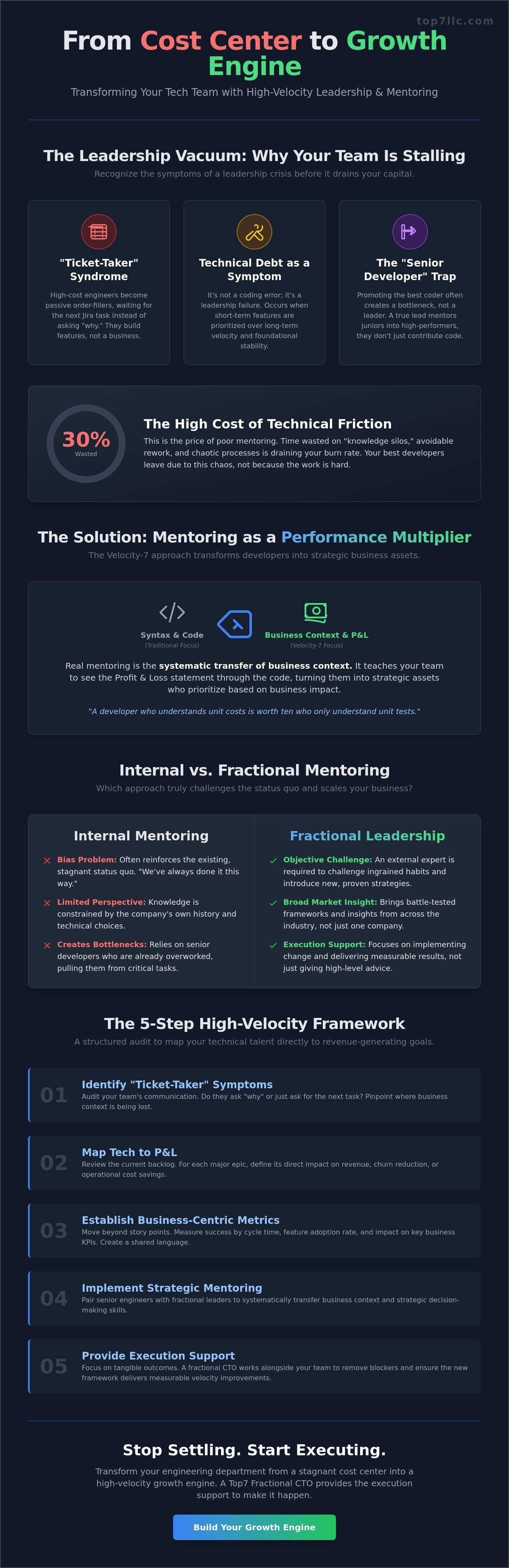
Your engineering team isn't slow because they lack talent. They're slow because you've allowed them to become "ticket-takers." When developers stop asking "why" and start waiting for the next Jira task, your innovation engine is dead. This is the "Ticket-Taker" syndrome. It turns high-cost engineers into passive order-fillers who have no skin in the game. They're building features, but they aren't building a business. If your team can't explain how their current sprint impacts your bottom line, you're looking at a leadership vacuum that's draining your capital every single day.
Technical debt is rarely a coding error; it's a leadership failure in disguise. It happens when leaders lack the backbone to prioritize long-term velocity over short-term vanity features. Without a robust framework for tech team leadership and mentoring, your seniors will always take the path of least resistance. They'll patch holes instead of fixing foundations because nobody has taught them how to align technical decisions with fundamental IT management principles. The result? A product that's too brittle to pivot and a team that's too exhausted to care. You aren't just missing deadlines; you're becoming irrelevant in a market that doesn't wait for "one more refactor."
The High Cost of Technical Friction
Calculate the burn rate of your engineering department. Now, subtract 30% for the time wasted on "knowledge silos" and avoidable friction. That's the price of poor mentoring. When information is hoarded by a few "alpha" developers, your agility vanishes. Your best developers don't leave because the work is hard. They leave because they're tired of working in a chaotic environment where leadership is absent. They want to grow, and if you aren't providing the strategic mentorship they crave, your competitors will.
The "Senior Developer" Trap
Being the best coder in the room doesn't make someone a leader. It often makes them a bottleneck. Promoting based on tenure or technical wizardry is a recipe for disaster. If your "lead" developer can't mentor a junior into a high-performer, they aren't a lead; they're just an expensive individual contributor. Toxic technical leadership trickles down faster than you think. It creates a culture of "it works on my machine" and "that's not my job." Stop managing code. You manage inventory. You lead people. If you can't tell the difference, your product will eventually pay the price.
Mentoring as a Performance Multiplier: The Velocity-7 Approach
Stop thinking of mentoring as "teaching a junior how to write a better loop." That's a waste of executive time and a misunderstanding of the role. Real tech team leadership and mentoring is the systematic transfer of business context. It's about teaching your team to see the P&L through the code. We use the Velocity-7 Adaptive Framework to turn developers into strategic assets. Why? Because a developer who understands unit costs is worth ten who only understand unit tests. If your engineers aren't thinking about the bottom line, they aren't leading; they're just typing.
Operational friction is the silent killer of tech companies. It's the "I didn't know that was a priority" or the "we built it, but sales can't sell it" excuse. Mentorship removes this by creating a shared language between the board and the IDE. Within 90 days, your mentored leaders don't just ship code; they ship velocity. They identify bottlenecks before they become blockers. They lead, they don't just manage. This transformation moves your entire department from a state of constant firefighting to a state of efficient flow where every sprint delivers measurable value.
Aligning Code with Commerce
Stop letting your engineers build "cool tech" that nobody pays for. Mentoring for ROI means every line of code must justify its existence. Does this feature drive revenue? Does it reduce churn? If the answer is "I don't know," the task shouldn't be in the backlog. We teach developers to prioritize based on business impact, killing the "tech for tech’s sake" mindset that bankrupts startups. Your backlog shouldn't be a wish list; it should be a revenue roadmap. When your team understands the "why" behind the "what," they stop building features and start building a business.
Agile Mentoring for High-Stakes Environments
Annual reviews are a relic of the 20th century. They're useless in a high-stakes tech environment where a single bad release can cost millions. Velocity-7 replaces these static meetings with real-time feedback loops. You need execution support that happens in the trenches, not in a boardroom once a year. This is how you scale a tech organization without losing your soul or your margins. High-velocity organizations don't wait for quarterly check-ins to fix performance issues. They use real-time data to drive daily execution. If you want to see how this works in practice, look at our Velocity-7 Adaptive Framework for rapid growth.
Internal vs. Fractional Mentoring: Which Scales Your Business?
Your internal "leaders" have a ceiling. It's not their fault; it's the system. When you rely solely on internal tech team leadership and mentoring, you're essentially asking people who are part of the problem to design the solution. Internal mentors are bogged down by office politics, historical biases, and the "we've always done it this way" mindset. They struggle to challenge the status quo because they have to eat lunch with the status quo every day. Do you really want your growth strategy designed by someone who is afraid to ruffle feathers?
Mid-market companies often fall into the trap of thinking they need a $300,000 full-time CTO to fix their culture. They don't. You don't need a massive salary on the books to get C-suite results. You need objective, battle-tested leadership that can bypass internal friction and focus on pure execution. A Fractional CTO brings an outside perspective that your internal team simply cannot possess. They see the patterns across dozens of organizations. They know what "good" looks like in the real world, not just in your specific office bubble. This objectivity is the fastest way to kill the politics that are currently stalling your releases.
The Limits of Internal Growth
The "Senior Developer Trap" is real and it's dangerous. Promoting your best coder to a leadership role without external guidance often results in the blind leading the blind. Just because someone can architect a microservices environment doesn't mean they can architect a high-performance culture. Most internal mentoring programs quickly devolve into "more technical training." They focus on syntax and tools rather than ROI and strategic alignment. If your mentoring doesn't move the needle on business velocity, it's just an expensive distraction.
The Fractional CTO Advantage
A Fractional CTO provides the strategic heavy lifting without the full-time overhead. At Top7, we don't just give advice; we embed directly into your team to solve complex operational problems. We provide the "how" of leadership, not just the "what." This model allows you to access elite talent that would otherwise be out of reach. Perhaps the greatest benefit is the succession plan. By mentoring your next permanent CTO, a fractional leader ensures that when they leave, they leave behind a team that actually knows how to lead. You aren't just buying a service; you're building an asset that stays with the company long after the engagement ends.
5 Steps to Building a High-Velocity Mentorship Framework
Most organizations treat culture like a soft skill. It isn't. It's an operational requirement. If you want to stop the bleeding in your engineering department, you need a repeatable system. Effective tech team leadership and mentoring requires a transition from passive observation to aggressive execution support. You don't need another "check-in" meeting; you need a framework that forces your technical talent to think like business owners. Here is how you build it.
Step 1: Conduct an organizational tech audit. Identify where the friction actually lives. Is it a lack of skill, or is it a lack of direction? You must find the bottlenecks that are killing your releases before you can fix the people.
Step 2: Map technical talent to business goals. Use the Velocity-7 Adaptive Framework to align every developer's output with a specific revenue or efficiency target. If a developer doesn't know which KPI they are moving, they are just typing.
Step 3: Establish high-intensity leadership sessions. Replace casual coffee chats with focused strategic drills. These sessions should challenge your seniors to defend their technical decisions in the context of ROI and market speed.
Step 4: Implement Agile-based transformation. Mentoring must happen at the team level. Embed leadership principles into your daily stand-ups and sprint retrospectives to ensure the new mindset sticks.
Step 5: Measure velocity, not activity. Stop counting tickets. Start counting the time from ideation to revenue. This is the only metric that matters to the board.
Auditing Your Leadership Gap
The "silent killers" in your tech team are usually the things nobody talks about: ego, knowledge hoarding, and a total lack of business context. You need to assess the maturity of your senior developers. Are they leaders, or are they just very experienced individual contributors? According to a 2026 Deloitte study, while 79% of tech leaders cite driving business outcomes as their top priority, 75% believe their operating model requires a fundamental change to deliver value. If your team is stuck in an old-school "build first, ask later" model, your leadership gap is costing you more than just time. In fact, the cost of a single bad senior executive hire can reach $1 million when you factor in lost momentum and severance.
Measuring What Matters
Lines of code are a vanity metric. They tell you nothing about the health of your business. To succeed in tech team leadership and mentoring, you must track feature velocity and the reduction of technical debt as primary leadership KPIs. When your seniors are mentored correctly, you'll see a direct correlation with improved retention and lower recruitment costs. Top talent stays where they feel they are gaining strategic mastery, not just a paycheck. If you are ready to stop the bleeding and start leading, explore our Fractional CTO services to install this framework today.
Executing the Transformation with a Top7 Fractional CTO
Most "mentors" are just retired executives looking for a paycheck. They give you a list of things to fix, hand over a generic PDF, and then disappear. Top7 is different. We don't just provide tech team leadership and mentoring; we provide execution support. We embed a Fractional CTO directly into your operations to kill the bottlenecks that are currently strangling your growth. If your tech team is a black box of expensive magic, we're the ones who turn on the lights and show you where the money is being wasted.
Our Velocity-7 Adaptive Framework isn't a collection of theoretical "best practices." It's a battle-tested roadmap from friction to flow. We've seen the same patterns across dozens of high-growth companies: technical debt that never gets paid down, missed releases that frustrate sales, and developers who don't understand how their work relates to the P&L. We solve these problems by aligning your technical roadmap with your business reality. We don't just tell your team to move faster; we build the systems that make speed inevitable.
Strategic Guidance Meets Direct Execution
Stalled growth usually starts at the top. If your tech leader isn't in the room when financial or sales strategy is discussed, you've already lost the battle for market share. A Top7 Fractional CTO bridges that gap by ensuring your engineering department acts as a strategic partner, not a service ticket center. Direct embedding means we're in your Slack channels, your stand-ups, and your board meetings. We aren't outside observers; we're in the trenches with your team. This level of involvement is the only way to bypass the internal politics that usually stall external consultants. We're provocative because the business reality demands it. We care about your profit, not your feelings. If a refactor doesn't move the needle on revenue or reduce systemic risk, it's a waste of your capital.
Your 90-Day Tech Velocity Roadmap
Transformation doesn't happen overnight, but it does happen quickly when you have the right framework. In the first 30 days of a Top7 engagement, we conduct a brutal audit of your current leadership maturity and operational friction. We identify the "silent killers" we discussed earlier: the ego, the knowledge hoarding, and the lack of business context. By day 60, we're achieving operational stability, even in periods of crisis or transition. By day 90, your team is no longer a bottleneck; they're a business asset that understands ROI. You can keep managing code, or you can start leading velocity. The choice is yours. Schedule a strategy audit with a Top7 Fractional CTO today and stop letting technical friction kill your margins.
Stop Managing Syntax, Start Scaling Profit
Your technical team is either a weight around your neck or the engine of your growth. There's no middle ground in the modern market. By now, it's clear that traditional management is dead. You don't need more "agile coaches" or code reviews; you need a radical shift in tech team leadership and mentoring that prioritizes business outcomes over lines of code. We've shown you how the Velocity-7 Adaptive Framework turns stagnant developers into high-impact leaders who understand that their real job is driving revenue, not just clearing tickets.
The choice is simple. You can keep burning capital on a department that's perpetually "almost done," or you can install battle-tested leadership that scales. Top7 doesn't give you a list of suggestions; we embed seasoned professionals directly into your team to solve mid-market growth obstacles in real time. We focus on the profit, the velocity, and the victory. It's time to stop the friction and start winning.
Stop the friction. Scale your tech team with a Top7 Fractional CTO.
The roadmap is ready. Your team has the potential. Now, give them the leadership they deserve to win.
Frequently Asked Questions
What is the difference between tech management and tech leadership?
Management is inventory control; leadership is velocity. Managers focus on tracking tickets, managing schedules, and making sure the "how" of coding is correct. Leaders focus on the "why." They ensure technical output aligns with business outcomes and strategic growth. If your team is just clearing a backlog, they're being managed. If they're actively driving revenue through code, they're being led.
How do I know if my tech team needs mentoring or just better tools?
Tools fix processes, but mentoring fixes people. If you've invested in the latest CI/CD pipelines and high-end IDEs but your release cycles are still dragging, tools aren't the problem. You have a leadership gap. Better tools on top of a stagnant culture just let you fail faster. Mentoring is required when your team builds features that don't move the needle on profit.
Can a Fractional CTO really mentor my team as well as a full-time leader?
A Fractional CTO often mentors better because they're free from internal politics and historical bias. They bring an objective, battle-tested perspective that a full-time hire often loses after six months in the same office. They focus on pure execution and strategic transfer of knowledge. You get C-suite expertise that challenges the status quo without the $300k full-time price tag.
How long does it take to see results from a tech leadership mentoring program?
You'll see operational shifts in the first 30 days and measurable velocity increases by day 90. Strategic tech team leadership and mentoring identifies and kills friction points almost immediately. If your seniors don't start talking about ROI and business impact within the first month, the program isn't working. Transformation is about rapid execution, not theoretical discussions that last for years.
What are the most important KPIs for measuring tech team velocity?
Stop counting lines of code or story points. Those are vanity metrics that don't pay the bills. Track Lead Time for Changes, Deployment Frequency, and Change Failure Rate. Most importantly, measure Feature Velocity against Revenue Growth. If your technical output doesn't have a direct correlation with your P&L, your team isn't high-velocity; they're just busy.
How does the Velocity-7 framework apply specifically to technical teams?
It forces engineers to stop viewing code as art and start viewing it as a financial asset. The Velocity-7 Adaptive Framework aligns technical output with seven specific business growth levers. It creates a roadmap that moves a team from chaotic firefighting to a state of predictable flow. It's about installing a system where every sprint is a tactical move toward market dominance.
Why is external mentoring better for mid-market companies than internal programs?
Internal programs are echo chambers. They rely on the same people who created the current bottlenecks to design the way out. External mentors have seen the same growth obstacles across dozens of companies and know the shortcuts. Mid-market firms need this objective pressure to break the status quo and scale without the massive overhead of a permanent executive hire.
What happens if my senior developers resist being mentored?
Resistance is usually a sign of ego or a total lack of business context. We solve this by showing them how leadership mastery increases their own market value and career trajectory. However, if a developer continues to prioritize their personal preferences over the company's survival, you don't have a mentoring problem. You have a hiring mistake that's costing you money every day.



Comments