

Supply Chain Optimization Consulting: Stop the Friction, Start the Flow
- Robert Fitzgerald
- Jun 28
- 12 min read

Updated: 6 days ago
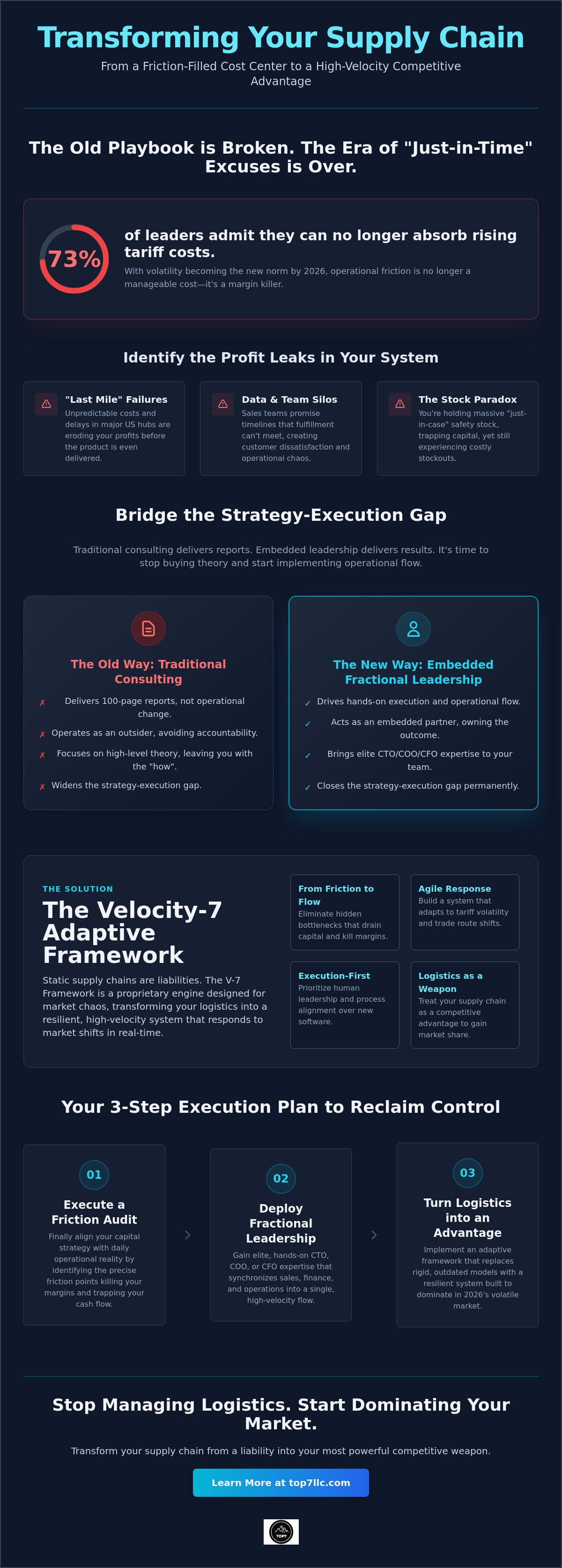
Your supply chain is currently a friction-filled cost center that's cannibalizing your margins. With 73% of leaders admitting they can no longer absorb tariff costs as of mid-2026, the era of "just-in-time" excuses is dead. You're likely hunting for how to improve supply chain efficiency because your executive team is exhausted from micromanaging "last mile" failures in major US hubs. It's a losing game, and you know it. Data silos between sales and fulfillment are not just operational hurdles; they are profit killers.
We agree that traditional consulting has failed you by delivering thick reports instead of operational flow. This article shows you how to stop the bleeding. You'll learn to transform your logistics into a high-velocity competitive advantage using embedded fractional leadership and the Velocity-7 framework. We are moving past the noise to build a scalable, predictable engine for growth. It's time to stop managing logistics and start dominating your market.
Table of Contents
What is Supply Chain Optimization Consulting (and Why Most Firms Get it Wrong)?
Supply chain optimization is not a theoretical exercise. It's the aggressive transition from operational friction to high-velocity flow. While many view Supply chain management (SCM) as a back-office necessity, market leaders treat it as a weapon. If your logistics feel like a constant battle against delays and rising costs, you don't have a supply chain problem. You have a friction problem.
Traditional consulting models are broken. They thrive on the Strategy-Execution Gap. These firms drop a 100-page report on your desk, collect their fee, and leave your team to figure out the "how." They are outsiders. They don't live with the consequences of their advice. To truly understand how to improve supply chain efficiency, you must bridge that gap with embedded leadership that owns the outcome as much as you do.
To better understand this concept, watch this helpful video:
Is your profit leaking? Look for these three red flags: your "last mile" costs in major US hubs are unpredictable; your sales team is promising timelines fulfillment can't meet; or you're holding massive safety stock yet still facing stockouts. These aren't just market fluctuations. They are symptoms of a system in gridlock. Unlike the outsider advisor model, an embedded leadership approach identifies these leaks in real-time and plugs them immediately.
The Hidden Costs of Operational Friction
Friction in your logistics doesn't just show up as a line item. It's a silent predator that eats your EBITDA before you even see the monthly report. When your supply chain is inefficient, your capital is trapped in "just-in-case" inventory while your margins shrink. Even worse is the psychological toll. Mid-market founders often find themselves forced to play "Logistics Manager," micromanaging shipments instead of scaling the business. This is bottleneck blindness. You're so close to the fire that you can't see the structural flaws in the building.
Beyond the Software: The Human Element of Optimization
Throwing a new ERP at a broken process is like putting a racing engine in a car with no wheels. It won't move you forward; it'll just burn fuel faster. Real optimization is a leadership-first initiative that synchronizes human intent with operational capability. It requires a Fractional COO or CTO who can force sales, finance, and operations into a single, unified flow. Without this alignment, you're just digitizing your dysfunction. High-velocity growth demands a framework that prioritizes execution over expensive software licenses. If you want to know how to improve supply chain efficiency, you start with the people making the decisions, not the code they use to track them.
The Velocity-7 Adaptive Framework for Supply Chain Resilience
Static supply chains are liabilities. With the USMCA review looming in July 2026 and tariff volatility hitting 72% of trade professionals, your old playbook is garbage. You need a system that breathes. The Velocity-7 Adaptive Framework is our proprietary engine for this exact chaos. It doesn't just manage logistics; it forces your entire organization into a state of high-velocity flow. It’s about moving beyond "just-in-case" inventory and into a model where your supply chain responds to market shifts in real-time.
According to the Council of Supply Chain Management Professionals (CSCMP), SCM involves the planning and management of all activities involved in sourcing and procurement. But Velocity-7 goes further by treating these activities as dynamic growth levers rather than static costs. We apply seven specific dimensions of growth to your logistics infrastructure. This ensures that every dollar spent on a warehouse or a carrier is a dollar spent on increasing your market share. In 2026, "Adaptive" isn't a buzzword; it's your only defense against a 6.75% prime rate and shifting global trade routes.
Moving from Friction to Flow
Most leaders don't know where their money is actually going. They have "bottleneck blindness." Our Velocity-7 audit looks at your operations to pin-point exactly where friction is killing your speed. Whether you're moving goods through Boston, Austin, or the West Coast, the goal is a culture of flow. Agile isn't just for software developers anymore; it's the only way to survive modern logistics. We use these principles to diagnose issues before they reach your customer's doorstep. If you want to see how to improve supply chain efficiency, you have to stop looking at spreadsheets and start looking at the velocity of your goods.
Agile Transformation in Mid-Market Logistics
Stop thinking in years. Start thinking in 90-day sprints. This is how to improve supply chain efficiency without getting bogged down in three-year digital transformation projects that never end. We break the silos between your warehouse floor and the C-suite. Information must move as fast as your products. Velocity-7 prevents the stalled growth typical of mid-market firms by ensuring every operational tweak serves a strategic profit goal. If you're tired of theoretical advice that doesn't move the needle, it's time to see how the Velocity-7 Adaptive Framework can modernize your operations. We don't just suggest changes; we embed the leadership necessary to execute them.
Fractional CTO vs. Traditional Supply Chain Consultants
Traditional consultants are professional bridesmaids. They show up, look the part, and leave before the real work begins. If you are still paying for thick binders full of "best practices" that your team never implements, you're lighting money on fire. Mid-market firms in Chicago and Florida are pivoting to a more aggressive model. They are ditching the outsider advisor in favor of a Fractional CTO or COO who actually knows how to improve supply chain efficiency by getting their hands dirty in your data.
The difference is ownership. A consultant gives advice. A fractional executive executes strategy. Success in 2026 requires more than just moving boxes faster. As established in the concept of The Triple-A Supply Chain, true competitive advantage comes from agility, adaptability, and alignment. You won't get that from a junior associate at a big-four firm. You get it from a battle-tested leader who has already solved these problems elsewhere and is now embedded in your Slack channels and board meetings.
Strategic Guidance Without the C-Suite Overhead
Why pay a $300,000 annual salary plus benefits when you only need the high-level brain for ten hours a week? Fractional leadership provides the same ROI as a full-time executive without the crushing overhead. This flexibility is vital for growing businesses that need elite expertise but aren't ready for a permanent C-suite hire. Top7’s model isn't about giving you a "to-do" list. It’s about a Fractional COO or CFO stepping in to align your capital strategy with your operational reality. You get the strategic heavy hitter on a monthly retainer, keeping your burn rate low and your velocity high.
Execution Support: When Reports Aren’t Enough
The most common objection we hear is simple: "Can a part-time leader really fix my supply chain?" The answer is that a master doesn't need 40 hours to see what a mediocre manager misses in a month. We don't just hand over a report and wish you luck. Our fractional executives "own" the project results. They bridge the gap between your technology stack and your warehouse floor. When we talk about how to improve supply chain efficiency, we are talking about solving complex technology leadership problems in real-time. If the system breaks at 2 AM, it's our problem, not just yours. That is the fundamental shift from consulting to embedded leadership.
Tactical Execution: Optimizing Your Supply Chain in 2026
Execution is where strategy goes to die. Most mid-market firms fail not because they lack a plan, but because they lack the tactical discipline to grind through the operational mess. If you want to know how to improve supply chain efficiency, stop looking for a magic pill. You need a sequence of high-precision moves that align your bank account with your warehouse floor. With the bank prime loan rate sitting at 6.75% in mid-2026, every day your inventory sits idle is a direct hit to your bottom line. You can't afford to guess.
The first step is a Friction Audit across the seven dimensions of growth. We don't just look at shipping rates; we look at the drag in your decision-making. Once the friction is mapped, we force a Fractional CFO and COO into a tactical sync. This isn't a "get to know you" meeting. It's a cold-blooded alignment of capital strategy with operational reality. We then deploy Advanced Project Management to oversee high-stakes logistics overhauls. We use the Velocity-7 framework to ensure that every technology solution you scale is actually removing a bottleneck, not just adding a new layer of digital complexity.
Regional Logistics: From the Northeast to the West Coast
Supply chain headaches aren't universal; they're regional. In Dallas and Chicago, the challenge is "last mile" density and labor volatility in the heart of the country. On the East Coast, New England businesses are fighting aging infrastructure and coastal bottlenecks that require a completely different vendor strategy than a West Coast operation. You can't manage a New York fulfillment center with a California mindset. We help you navigate these unique regional pressures by leveraging local logistics data and optimizing carrier relationships based on real-world performance, not just sales brochures. If your regional strategy is a one-size-fits-all model, you're already losing money.
Technology as an Asset, Not a Bottleneck
Global technology spending is projected to increase by 7.8% in 2026, yet most companies are just buying more expensive ways to store bad data. A Fractional CTO audits your tech stack to find the gaps where information is stalling. We integrate digital transformation without blowing up your current flow. Your technology should be a revenue-driving asset that provides real-time visibility into your margins. If your software isn't actively helping you understand how to improve supply chain efficiency, it's just an anchor. Stop settling for data storage and start demanding strategic superiority from your systems. Ready to turn your logistics into a high-velocity engine? Schedule a Friction Audit with Top7 and see where your profit is actually hiding.
The Top7 Solution: Fractional Leadership for High-Stakes Growth
You didn't build your company to fight with freight forwarders or argue over warehouse KPIs. You built it to dominate your market. But right now, your supply chain is leading you. Every hour you spend micromanaging logistics is an hour stolen from your strategic growth. Top7 exists to end this cycle. We move mid-market companies from a state of constant operational friction to a state of efficient, high-velocity flow. We don't just provide advice; we provide the engine for transformation.
That engine is the Velocity-7 Adaptive Framework. It's the core of our approach, designed to strip away the inefficiencies that traditional consultants ignore. When you work with us, you realize that how to improve supply chain efficiency isn't a mystery to be solved; it's a system to be installed. We align your tech, your capital, and your people into a single, aggressive unit. By the time we're done, you'll stop asking how to improve supply chain efficiency and start measuring the velocity of your market expansion. It's time to stop playing defense and start leading with professional precision.
Embed a Seasoned Professional in Your C-Suite
The biggest weakness in most mid-market firms is the leadership gap between the founder's vision and the team's execution. We bridge this with embedded leadership. You gain immediate access to elite Fractional CEO, CFO, COO, and CTO expertise without the long-term liability of a full-time executive salary. These aren't junior analysts. They are battle-tested professionals who embed directly into your organization to solve complex problems in real-time. Whether you need a Fractional CPO to overhaul your product strategy or Interim Leadership to manage a critical transition, we provide the strategic heavy hitters who own the results. We aren't just an Advisory Services firm; we are your tactical partners in the trenches.
Your Growth Roadmap Starts Here
Transformation doesn't happen by accident. It starts with a customized Strategic Planning session designed to expose every friction point in your current model. In the first 30 days of a Top7 engagement, we move fast. We conduct a deep audit, align your leadership team, and begin the first 90-day sprint of the Velocity-7 framework. You'll see immediate clarity in your delivery timelines and a reduction in wasted operational spend. We provide the roadmap, the leadership, and the accountability needed to scale. Ready to eliminate friction? Schedule a call with a Top7 Executive and take back control of your operations. The market isn't waiting, and neither should you.
Stop Managing Friction, Start Scaling Growth
Operational friction is a choice. You can continue micromanaging logistics while your margins shrink; or you can install a system built for the volatility of 2026. True mastery of how to improve supply chain efficiency requires moving beyond static reports and into a model of continuous, high-velocity flow. We've shown you that the gap between your strategy and your execution is where your profit disappears. It's time to bridge that gap with embedded leadership that doesn't just suggest changes but enforces them.
Our seasoned C-suite executives bring decades of experience to your team; using the proprietary Velocity-7 Adaptive Framework to turn your logistics into a competitive weapon. We don't just advise; we execute. Stop letting silos and data gaps dictate your future. You have the roadmap; now you need the engine to drive it. Stop Leaking Profit. Get Your Supply Chain Audit from Top7 Executives Today. Your path to a frictionless, scalable organization is one audit away. Let's get to work.
Frequently Asked Questions
What is the difference between supply chain consulting and fractional leadership?
Traditional consulting is advisory and external; fractional leadership is embedded and execution-focused. A consultant hands you a thick report of recommendations and leaves your team to struggle with the implementation. A fractional executive joins your C-suite to own the results and drive the project to completion. It's the difference between someone telling you how to fly a plane and someone actually sitting in the cockpit to land it.
How much does supply chain optimization consulting cost for mid-market companies?
Costs for mid-market optimization vary based on the complexity of your logistics and the depth of the friction audit required. While full-time executive hires demand six-figure salaries, benefits, and equity, fractional models operate on predictable monthly retainers. This allows you to access elite expertise without the long-term overhead of a permanent C-suite addition. You pay for strategic results, not for a body in a chair 40 hours a week.
How long does it take to see results from the Velocity-7 framework?
You'll see the first signs of operational clarity within the first 30 days during the initial friction audit. We design the Velocity-7 Adaptive Framework to move fast. Most mid-market firms achieve a measurable state of "flow" within their first 90-day sprint. We don't believe in multi-year transformation projects that never end. If you want to know how to improve supply chain efficiency, the answer starts with aggressive, short-term execution goals.
Can a Fractional CTO help with supply chain software selection?
A Fractional CTO is essential for software selection because they audit your tech stack for gaps before you spend a dime on new licenses. They ensure that any new ERP or WMS integrates perfectly with your existing sales and fulfillment data. Most firms buy software to solve a people problem. We ensure your technology actually removes bottlenecks and drives revenue rather than just becoming another expensive data silo.
Why should a Boston-based company choose a fractional executive over a local agency?
Local agencies often lack the national perspective and battle-tested experience required for high-stakes growth. A fractional executive brings a diverse toolkit from solving complex problems across multiple hubs, from the West Coast to the Northeast. Geographic proximity is irrelevant when you're fighting for market share. You need the best strategic mind for the job, not the one with the shortest commute to your Boston office.
What industries do your supply chain optimization services cover?
We focus on high-stakes industries where logistics and technology are the primary drivers of profit. This includes manufacturing, e-commerce, wholesale distribution, and specialized retail. In manufacturing, streamlining custom component production is a tactical necessity; to optimize your fabrication flow, you can visit CNC Cut to Size. If your business relies on moving physical goods through complex networks, our framework applies. We help leaders understand how to improve supply chain efficiency in any environment where operational friction is currently killing margins.
Is the Velocity-7 Adaptive Framework suitable for small businesses or just mid-market?
The framework is specifically engineered for the complexity and scaling pain points of mid-market firms. While the principles of flow are universal, small businesses often lack the operational volume to justify a full Velocity-7 deployment. We specialize in companies that have outgrown their initial systems and are now facing the "bottleneck blindness" that comes with rapid expansion. It's a precision tool for serious players.
What happens if we need full-time interim management instead of fractional leadership?
We provide Interim Leadership for organizations facing sudden executive departures or massive structural transitions that require a full-time presence. While the fractional model is ideal for ongoing strategic guidance, some crises demand 40 hours of dedicated focus per week. We can step in immediately to stabilize the ship while we build the long-term roadmap for your return to efficient flow. We adapt our involvement to the stakes of your situation.


Comments