
Stop Searching 'Near Me': Why Your Fractional COO Needs Strategy, Not Proximity

Your business is bleeding profit because you're prioritizing a local commute over global-tier strategy. Searching for a "part-time chief operating officer near me" might feel safe, but it's a legacy trap that limits your talent pool to whoever happens to live within driving distance. In 2026, proximity is a dead metric. Operational velocity is the only location that matters for your bottom line.
You're likely drowning in operational friction, spending your days firefighting instead of scaling. You realize that your processes are inconsistent and your growth has hit a wall, yet the loaded cost of a full-time executive is a weight your margins can't support. We're going to fix that. This article reveals how to secure elite operational leadership that scales your business without the payroll bloat or geographic handcuffs. You'll discover how the Velocity-7 Adaptive Framework transforms friction into flow, giving you a clear strategic roadmap and C-suite expertise at a fraction of the cost. It's time to stop looking for a neighbor and start looking for a master of execution who can actually win the market.
Table of Contents
Proximity vs. Performance: Why 'Near Me' is the Wrong Filter for Executive Leadership
Stop searching for a "part-time chief operating officer near me" like you're looking for a local dry cleaner. Proximity is a legacy metric. It's a psychological safety net that actually strangles your growth. If you're more worried about where your COO sits than how they scale your revenue, you've already lost the competitive edge. In 2026, the best operational talent isn't likely to be in your zip code, and forcing a local hire means you're settling for convenience over competence.
The fractional executive model has evolved past the need for physical presence. Modern operational leadership is about building systems that work while you sleep, not about being a visible "firefighter" in the office. You need a strategist who can diagnose friction from a thousand miles away and implement a framework that forces your team into a state of flow. If you can't manage a remote executive, you probably can't manage a modern, scalable business.
To better understand how this model functions in a high-growth environment, watch this breakdown:
The Death of the 'In-Person' Requirement
Physical offices are often just expensive stages for "performative work." A truly elite fractional COO doesn't need to see your desk to see your bottlenecks. They embed themselves into your digital infrastructure, using advanced project management tools and real-time data to drive execution. Success is measured by operational velocity and margin expansion, not by how many hours someone spent in a conference room. Remote embedding allows for a level of focus that in-person roles often lack, as every interaction becomes deliberate and result-oriented.
Accessing a National Talent Pool
Why settle for a local generalist when you can hire a national specialist? The talent gap is the primary reason businesses fail to scale. When you stop filtering for "part-time chief operating officer near me," you gain access to veterans who have already solved the exact problems you're facing. Specialized industry knowledge is far more valuable than geographic convenience. At Top7, we leverage a national network of seasoned professionals who use the Velocity-7 Adaptive Framework to ensure every department moves in sync. We don't care about your zip code; we care about your exit strategy and your ability to dominate your market.
Fractional COO Buying Guide: Mid-Market Growth Competencies
Searching for a "part-time chief operating officer near me" is a search for a person. You should be searching for a capability. Are you paying for a resume or a result? Traditional consulting is a spectator sport; the consultant watches from the sidelines and critiques your form. A fractional COO is on the field. They don't just offer advice; they take ownership of your daily execution. For mid-market companies, the fractional title means you get a leader who understands the complexity of $10M to $100M revenue cycles without the heavy burden of a full-time executive salary.
The core competency you're buying is the elimination of operational friction. Friction is anything that slows down your delivery, confuses your team, or eats your profit. If your business is stuck firefighting, you don't need another manager. You need an architect who can rebuild the system while the house is still standing. This requires a specific blend of agile transformation expertise that works in real-world, non-tech environments. It's about creating a machine that scales without breaking.
Strategic Thinking vs. Tactical Execution
Avoid the strategy-only trap. Many executives can talk about vision but can't build a workflow to save their lives. You need a leader who can both design the roadmap and drive the vehicle. A Top7 professional embeds directly into your team to ensure that strategic planning actually translates into tactical wins. If a candidate can't show you the specific frameworks they use to track operational velocity, they aren't a COO; they're a hobbyist. You need execution, not just ideas.
Cultural Alignment and Change Management
True operational flow isn't just about software; it's about people. A high-level fractional leader drives change by installing a culture of accountability. They move your organization from friction to flow by making transparency a requirement, not a suggestion. This agile-based transformation ensures your team stays lean and responsive to market shifts. If you're ready to stop the daily firefighting and start scaling, it's time to explore how Fractional COO services can redefine your business trajectory. Success isn't about finding someone local. It's about finding someone who refuses to let your business plateau.
Cost-Benefit Analysis: Fractional COO vs. Full-Time Payroll Bloat
Stop treating executive hiring like a status symbol. It's a capital allocation decision, and most mid-market founders are failing the math. Hiring a full-time executive is a massive, high-stakes gamble. Verified data from September 2026 shows that the fully loaded annual cost of a full-time COO now ranges between $308,000 and $518,000. That's a staggering amount of capital locked into a single person before they've even fixed a single broken process. If you're searching for a "part-time chief operating officer near me" because you've realized your margins can't support that weight, you're finally starting to think like a strategist.
The fractional model isn't just a "cheaper" version of a COO; it's a more efficient one. A fractional COO typically costs 60-70% less than a full-time hire while delivering the same level of C-suite expertise. You aren't paying for executive idle time or expensive office perks. You're paying for a specific outcome: the transformation from operational friction to efficient flow. It's about buying the brain without the "bloat" of benefits, equity, and a bloated base salary.
The Hidden Costs of Full-Time Hires
The sticker price of a salary is just the beginning of the drain. Recruitment fees for C-level roles often hit 25% to 30% of the first-year salary. Then consider the onboarding lag. It can take months for a full-time hire to integrate into your culture and start producing results. If you make a "bad hire" at the $250,000 level, the cost of severance and lost momentum can be terminal for a growing business. You're not just losing money; you're losing time that your competitors are using to steal your market share.
The Fractional ROI Framework
A part-time COO pays for themselves by identifying and plugging the leaks in your bucket. When you use an embedded leadership model, the ROI is immediate and measurable. Consider these direct advantages:
Zero Payroll Taxes: You eliminate the burden of social security, healthcare, and 401k matches.
No Equity Dilution: Keep your ownership while still accessing elite strategic planning.
Operational Velocity: Direct profit increases occur when processes are streamlined and departments are finally in sync.
Flexibility: Scale your executive support up during a major pivot and scale it down once your systems are stable.
Top7’s retainer model ensures that every dollar spent is focused on high-level execution. We don't sit around waiting for work; we use the Velocity-7 Adaptive Framework to hit the ground running. Your business isn't a charity for overpaid executives. It's a machine that needs to produce profit. If your current leadership structure is costing more than the value it creates, it's time to cut the dead weight and pivot to a model that actually scales.
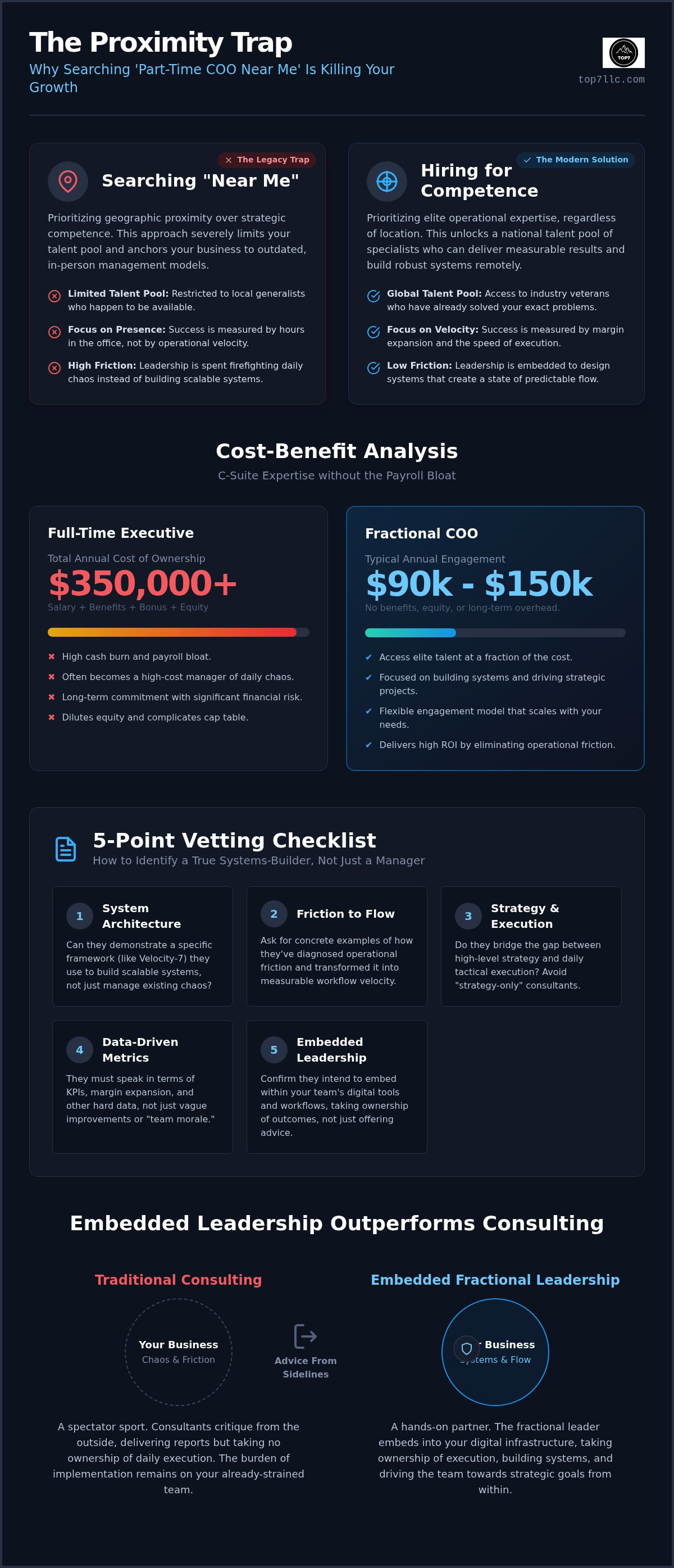
How to Vet a Part-Time COO: A 5-Point Tactical Checklist
Most executive interviews are a waste of breath. They focus on "culture fit," which is often just code for "someone I can have a beer with." If you found a candidate by searching for a "part-time chief operating officer near me," you must pivot immediately from social validation to tactical verification. You aren't looking for a friend; you're looking for a fixer who can dismantle your operational bottlenecks. Use this 5-point checklist to separate the true operators from the overpaid theorists.
Audit Transformation Track Records: Don't look at where they worked; look at what they broke and rebuilt. Demand specific examples of operational friction they eliminated and the resulting impact on the bottom line.
Test the Framework: A leader without a repeatable system is a liability. Ask if they use a proven methodology like the Velocity-7 Adaptive Framework to ensure results aren't left to chance.
Evaluate Direct Embedding: A fractional COO should be in your Slack channels and project management tools, not just on a weekly Zoom call. If they don't embed, they can't lead.
Check Agile Experience: Can they run a sprint in a non-tech environment? You need someone who can handle rapid market shifts without collapsing your internal processes.
Verify Complex Problem Solving: Test their ability to align your CRM data with your P&L. If they can't fix the friction between sales and finance, they aren't a COO.
Questioning the Methodology
Stop asking "What have you done?" and start asking "How do you do it?" High-performance leadership is about repeatable processes, not individual heroics. A proprietary framework is the only way to guarantee that success in one company can be replicated in yours. Top7’s Velocity-7 Framework is the benchmark here because it prioritizes operational velocity over mere activity. If a candidate can't explain their "how" in three minutes or less, they don't have a system; they have a series of lucky breaks.
Assessing the 'Fit' Without the 'Friction'
The first 90 days are critical. You should measure success by the increase in "flow" across your departments, not by the number of meetings attended. Beware of "executive coaches" in disguise. Coaches talk; COOs execute. A trial period or a project-based audit is a perfect vetting tool to see if they can actually move the needle before you commit to a long-term retainer. Ready to stop interviewing and start scaling? Work with a Top7 Fractional COO to bring elite operational leadership into your organization immediately.
Beyond Part-Time Help: Scaling with Top7’s Velocity-7 Framework
Stop searching for a "part-time chief operating officer near me" and start searching for a system that actually produces results. Most mid-market failures happen because founders hire personalities instead of installing processes. Top7 is the antidote to the "consultant" plague. We don't just hand you a slide deck and wish you luck; we install the Velocity-7 Adaptive Framework to move your organization from friction to flow. This isn't advisory work. It's embedded execution. Our leaders don't stand on the sidelines. They integrate into your infrastructure to drive the changes you've been too busy firefighting to implement yourself. We take full ownership of the daily execution, freeing you to focus on the high-level vision that started the company in the first place.
Searching for a "part-time chief operating officer near me" is the first mistake; settling for one is the second. You don't need a neighbor; you need a master of the Velocity-7 Adaptive Framework. This methodology isn't a theory. It's a battle-tested engine designed to strip away the operational drag that keeps your business from hitting its next revenue milestone. We don't just identify problems; we build the systems that prevent them from ever returning.
The 7 Dimensions of Growth
Business growth isn't a single lever you pull. It's the synchronization of seven distinct dimensions: Strategy, Operations, Technology, Finance, Sales, Marketing, and Talent. When these dimensions are misaligned, friction is the inevitable result. You see it every day: sales teams selling products that operations can't deliver, or a tech stack that adds complexity instead of automation. Our Velocity-7 Adaptive Framework identifies these bottlenecks with surgical precision. We shift your business from reactive chaos to proactive scaling by ensuring every dimension supports the others. This is how you win the market share your competitors are losing through pure inefficiency.
Your 90-Day Operational Transformation
The first three months with a Top7 COO are designed for ruthless execution, not polite introductions. In the first 30 days, we audit your friction points and identify exactly where your profit is leaking. By day 60, we've implemented the core phases of the Velocity-7 Adaptive Framework, restructuring your workflows for maximum output. By day 90, your organization has transitioned from friction to efficient flow. You'll experience shorter, more effective meetings, crystal-clear KPIs, and a team that finally understands what "winning" looks like in real time. If you're ready to stop being the bottleneck in your own company, it's time to stop settling for a local generalist. Schedule your strategy call with Top7 and transform your operation into a high-velocity machine today.
Stop Settling for Proximity and Demand Performance
Your business doesn't need a neighbor; it needs a system that works. Relying on a part-time chief operating officer near me is a strategy for mediocrity that limits your growth to your local zip code. We've proven that the total cost of a full-time executive is a weight your margins shouldn't carry, and that proximity bias is the fastest way to hire a generalist instead of a specialist. You don't have to choose between elite leadership and a sustainable payroll when the right framework is in place.
The solution is an embedded leadership model that prioritizes operational velocity over office presence. By leveraging our Velocity-7 Adaptive Framework, you gain access to seasoned professionals who don't just advise; they execute. We move your organization from friction to flow with a national reach that ensures you're working with the best, not just the closest. It's time to stop firefighting and start dominating your market with a structure that supports scale. Your competitors are betting on your hesitation; don't let them win.
Ready to reclaim your time and fix your processes? Scale your operations with a Top7 Fractional COO today. Your next level of growth is waiting for a leader who knows how to build it.
Frequently Asked Questions
What is the difference between a part-time COO and a fractional COO?
A part-time COO is often a tactical hire focused on checking boxes for a set number of hours. A fractional COO is a strategic partner who takes ownership of your operational results. While people searching for a "part-time chief operating officer near me" might want help with tasks, the fractional model focuses on long-term scalability and embedding high-level leadership into your team's DNA. It's the difference between buying time and buying outcomes.
Does a fractional COO need to be 'near me' to be effective?
No, proximity is a legacy filter that limits your growth potential. In 2026, the best operational talent is rarely in your backyard. Digital transformation and modern communication tools mean an elite COO can drive results from anywhere. If you prioritize a local commute over a national-tier strategy, you're settling for a convenience hire instead of a competitive advantage. Operational velocity doesn't require a physical desk in your office.
How many hours a week does a part-time COO typically work?
Most fractional COOs commit to 15 to 25 hours per week, which usually translates to two to four days of focused engagement. This isn't a rigid schedule; it's a strategic allocation of time based on your company's current friction points. The goal isn't to fill a 40-hour week with meetings. It's to deliver C-suite expertise and execution in the specific windows where it generates the highest ROI for your business.
Can a fractional COO help with my specific industry's challenges?
Yes, because elite operational frameworks like Velocity-7 are built to solve universal business friction. Whether you're in healthcare, finance, or manufacturing, the core problems are usually the same: inconsistent processes, leadership burnout, and scaling bottlenecks. A fractional leader brings a cross-industry perspective that a local specialist lacks. They apply battle-tested systems to your specific environment to ensure your operations move from chaos into a state of efficient flow.
What is the typical cost of hiring a part-time COO in 2026?
Current market data for 2026 indicates that fractional COO retainers typically range from $8,000 to $20,000 per month depending on company revenue and complexity. For mid-market firms between $5M and $100M in revenue, the range often sits between $4,000 and $12,000. This model saves you 60-70% compared to the $308,000 to $518,000 fully loaded cost of a full-time executive. You're paying for high-level strategy without the payroll bloat.
How does a fractional COO work with my existing management team?
A fractional COO acts as an embedded mentor and strategist for your existing management team. They don't replace your people; they empower them by installing clear roadmaps and accountability systems. By removing daily "firefighting" from your plate, they allow your managers to focus on their core roles. This collaborative approach ensures that the operational improvements are sustainable long after the specific transformation phase is complete.
What is the Velocity-7 framework and how does it help operations?
The Velocity-7 Adaptive Framework is Top7's proprietary methodology for moving businesses from operational friction to efficient flow. It's an agile-based transformation system that synchronizes seven key dimensions of growth, including strategy, operations, and technology. Instead of reactive patches, it provides a repeatable roadmap for proactive scaling. It's the engine that ensures your operational velocity stays high while your internal friction remains low, regardless of market volatility.
Is an interim COO better than a fractional COO for a crisis?
An interim COO is better for immediate, full-time crisis stabilization or bridging a gap between permanent hires. They work a standard 40-plus hour week to stop the bleeding. A fractional COO is a longer-term strategic play focused on sustainable growth and system building. If your house is on fire, hire an interim leader. If you want to build a fireproof mansion that scales, the fractional model is the logical choice.



Comments