
Stop Burning Cash: 7 Common Mistakes When Hiring Fractional Talent in 2026

Why are you paying five figures a month for a strategy that sits in a dead Google Doc? You thought a fractional hire would fix your scaling bottlenecks, but instead, you've just added another layer of expensive operational friction. If your new leader feels more like a consultant tourist than an embedded driver of growth, you're likely falling for the common mistakes when hiring fractional talent that drain budgets in 2026. You know the fractional model should be your competitive advantage, but right now, it's just an expensive leak in your P&L.
The 2026 landscape demands more than just a part-time advisor. With shifting Department of Labor rules on worker classification and rising salary thresholds for exempt employees, you can't afford a hiring miss. This guide identifies the seven strategic traps that turn high-level hires into operational failures. We'll show you how to stop the cash bleed and implement a framework that ensures your fractional leadership actually executes. It's time to move from friction to a high-velocity flow that delivers measurable profit.
Key Takeaways
Stop treating fractional executives like part-time advisors; learn why keeping them at arm's length guarantees a zero ROI.
Identify the common mistakes when hiring fractional talent that create operational friction and learn how to embed leaders into your core execution team.
Discover why a "Big Brand" resume is often a liability in mid-market scaling and how to vet for execution velocity instead.
Understand how the Velocity-7 Adaptive Framework eliminates leadership gaps and transforms fractional hires into high-impact growth drivers.
Transition from hiring for cost savings to hiring for strategic velocity, ensuring your leadership team executes without the full-time overhead.
Table of Contents
Why Most Fractional Hires Fail Before Day One
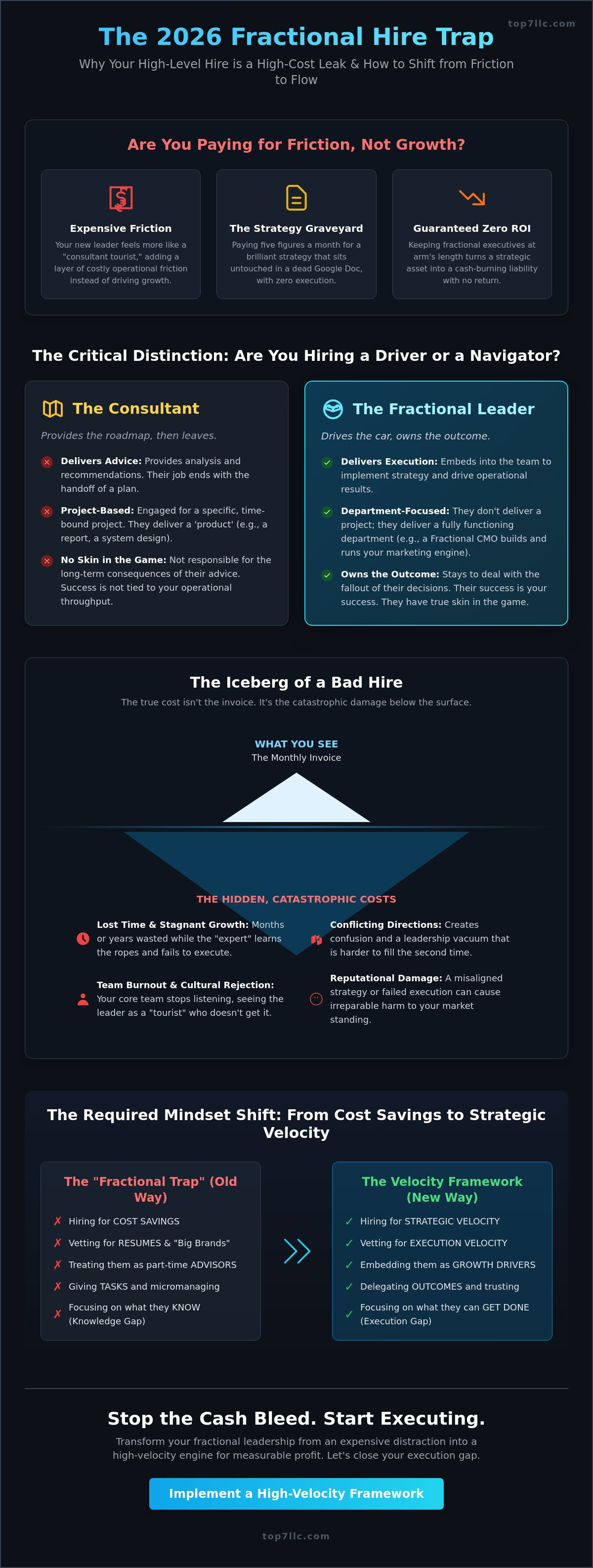
Stop treating fractional hires like a bargain bin version of a full-time C-suite. Most businesses fail because they view these roles as temporary patches rather than strategic accelerators. In 2026, the sheer complexity of the global market means you can't afford generalists. You need precision. If you're hiring purely for cost, you're falling into the "Fractional Trap." A real growth strategy prioritizes velocity over savings. You aren't just filling a seat; you're injecting senior-level execution into your operational DNA.
The shift towards contingent work models allows mid-market companies to access elite talent once reserved for the Fortune 500. However, most companies suffer from an Execution Gap, not a Knowledge Gap. They know what needs to happen, but they lack the leadership to make it happen. One of the most common mistakes when hiring fractional talent is vetting for what they know instead of what they can actually get done in your specific environment.
To better understand the pitfalls of the selection process, watch this breakdown of how talent assessment often goes wrong:
Fractional vs. Consultant: The Critical Distinction
Consultants provide a roadmap; fractional leaders drive the car. If you hire a Fractional CTO and treat them like a project-based agency, you'll end up with massive technical debt. Agencies deliver a product; fractional leaders deliver a department. The difference is ownership. A consultant gives advice and leaves. A Fractional COO or Fractional CPO stays to deal with the fallout of their decisions. They have skin in the game because their success is tied directly to your operational throughput.
The Cost of a 'Bad' Fractional Hire
The true cost of a bad hire isn't the invoice. It's the lost time. If a Fractional CFO misaligns your capital strategy, you could be digging out of that hole for years. Beyond the numbers, there's the risk of "cultural rejection." When a high-level hire doesn't embed correctly, your existing team stops listening. They see the fractional leader as a "tourist" who doesn't understand the reality of the business. This friction creates a leadership vacuum that is harder to fill the second time around. Avoiding common mistakes when hiring fractional talent requires looking past the resume to see if they can actually integrate. A failure to embed leads to:
Stagnant growth while the "expert" learns the ropes.
Team burnout from conflicting directions.
Irreparable damage to your market reputation.
Success in 2026 requires a lean, aggressive leadership structure. You don't have time for "advisory services" that don't move the needle. If your fractional hire isn't actively reducing friction and increasing profit, they're just an expensive distraction. Demand execution, not just a fancy resume.
Treating Fractional Leaders Like Consultants: The Strategic Trap
Stop keeping your fractional talent at arm's length. It's a suicide mission for your ROI. If you treat a Fractional CEO or COO like a temporary project manager, you're just burning cash on a glorified babysitter. One of the most common mistakes when hiring fractional talent is the failure to integrate them into your war room. You hired them for their brain, not their ability to follow a checklist. If they aren't in the room when high-stakes decisions are made, you aren't leading; you're just micromanaging an expensive resource.
Transparency is the only currency that matters here. Withholding "ugly" data from your Fractional CFO is like asking a surgeon to operate in the dark. In 2026, where the California exempt employee salary threshold has hit $70,304, the cost of full-time leadership is skyrocketing. You've chosen the fractional route for efficiency, so don't sabotage it by hiding your operational rot. Move from giving tasks to delegating outcomes. Tell them the result you need and get out of the way. If you can't trust them with the raw truth, you shouldn't have hired them in the first place.
The 'Hands vs. Heads' Fallacy
You aren't hiring a fractional leader to do the work. You're hiring them to build the system that does the work. Asking a Fractional CTO to spend their hours writing code is a tactical failure. You're paying for strategic leverage, not hourly output. Every hour they spend in the weeds is an hour they aren't spent optimizing your technical debt or scaling your architecture. Focus on the system, not the individual tasks. If you need more hands, hire a freelancer. If you need a head to scale the business, stick to strategic planning that prioritizes long-term velocity.
Accountability Without Authority
This is the number one reason high-level fractional talent quits. You've made them responsible for the results, but you've given them zero power to change the team. This is a recipe for operational friction. If your Fractional CRO identifies a "dead weight" sales rep but doesn't have the authority to pull the trigger, your revenue will continue to stall. Establish clear decision rights on day one. A leader without authority is just a scapegoat in waiting. To win in 2026, your fractional hires need the keys to the castle, not just a visitor's pass. Empower them to overhaul processes, reallocate budgets, and drive the transformation you're paying for.
The Integration Gap: Why Your Operational Friction Kills ROI
Hiring a high-level leader into a broken, non-agile system is an expensive form of self-sabotage. Operational friction is the resistance your existing processes exert against new leadership. If your workflows are manual and your data is siloed, even the best Fractional CEO will stall. You're paying for speed, but your infrastructure is stuck in the past. In 2026, where regulations like the California "Workplace Know Your Rights Act" (SB 294) add new layers of administrative compliance, your systems must be bulletproof. Friction doesn't just slow you down; it creates legal and financial liability that a part-time leader can't fix if they're constantly fighting fires.
One of the most common mistakes when hiring fractional talent is assuming the hire will fix the system while operating within its constraints. That's a fantasy. You need a structural cure before you can expect a return on your investment. We utilize the Velocity-7 Adaptive Framework to eliminate this friction before it drains your budget. It's about creating a plug-and-play environment where high-level expertise translates immediately into execution. If your organization isn't ready for a high-impact leader, you're just burning cash to watch a professional get frustrated.
The Velocity-7 Benchmarking
Before you sign a retainer, you must assess your readiness. The Velocity-7 Framework evaluates your organization across seven critical dimensions of growth. If your "Execution Velocity" is low because of legacy bottlenecks, your fractional hire will spend 80% of their time doing administrative cleanup instead of building the future. Benchmarking ensures you aren't just hiring talent, but preparing the soil for them to actually grow the business. Without this diagnostic step, you're just adding a high-level name to a sinking ship and hoping for a miracle.
Overcoming Internal Resistance
Your full-time team is likely terrified. They see a fractional leader and think "replacement" or "outsourcing." This fear creates a wall of passive-aggressive non-compliance that kills momentum. One of the most common mistakes when hiring fractional talent is failing to communicate the "Why" to your staff. Stop the rot by being transparent from day one. Position the fractional leader as a mentor who is there to elevate the team, not replace it. When you create a flow state between part-time strategic leadership and full-time tactical execution, the entire organization moves faster. It's about strategic leverage, not headcount reduction. If your team sees the hire as a threat, they'll ensure the project fails to protect their own territory.
Vetting for Resumes Instead of Execution Velocity
Stop falling in love with logos. A former Google VP or Amazon Director sounds impressive on a pitch deck, but they're often a liability in a lean mid-market environment. One of the common mistakes when hiring fractional talent is assuming big-brand experience translates to small-team execution. In a massive corporation, those leaders had armies of analysts and unlimited budgets to hide their inefficiencies. In your business, they'll spend three months "assessing" while your burn rate explodes. You don't need a name. You need a builder who knows how to operate without a safety net.
Mid-market fluency is the only metric that matters in 2026. The market is too volatile for process-heavy leaders who can't pivot. You need someone who knows how to do more with less. If a candidate can't explain how they'll drive measurable impact within the first 90 days, show them the door. Vetting for "what they know" is a legacy tactic that leads to stagnation. You must vet for "how they execute" in high-pressure, resource-constrained environments. If they can't get their hands dirty, they aren't a fractional leader; they're an expensive passenger.
The Interview Red Flags
Listen to their pronouns. If they constantly talk about what "we" did at their old firm, it means their team did the work while they sat in meetings. You need someone who says "I built," "I solved," and "I implemented." A massive red flag is a candidate who doesn't ask about your current operational friction. If they aren't digging into your bottlenecks during the interview, they're planning to apply a cookie-cutter template to your unique problems. They focus on their "proven process" rather than your specific outcomes. That's not leadership. That's a consultant in disguise who will leave you with a deck and no results.
Execution Velocity: The New Metric
Execution velocity is the speed at which a leader turns strategy into reality. In a world of shifting regulations and AI-driven disruption, a Fractional CTO must be an execution specialist, not just a visionary. They need to be adaptive and ready to ship. Test them. Ask for a 30-60-90 day plan during the final round. If it's full of vague "discovery" phases and lacks hard KPIs, they'll fail you. You're hiring for a "Flow" state where leadership and execution are inseparable. Vetting for adaptive skills ensures your leadership can survive a volatile market without constant hand-holding.
Don't settle for a resume that looks good on LinkedIn but fails in the boardroom. The 2026 economy rewards speed and precision, not pedigree. If you want to stop burning cash on high-level advice that never hits the ground, you need to change your vetting criteria immediately. Ready to stop guessing and start scaling? Work with leaders who prioritize execution velocity over empty credentials.
The Top7 Approach: Moving from Friction to Flow
Most agencies operate like glorified headhunters. They match a resume to a job description and walk away with a fee. That's a legacy model that fails in a high-velocity market. Top7 doesn't just provide talent. We embed transformation. Our approach eliminates the common mistakes when hiring fractional talent by ensuring every leader is backed by a rigorous execution system. We don't believe in part-time advice. We believe in fractional ownership. Whether it's a Fractional CFO stabilizing your margins or a Fractional CRO overhauling your pipeline, our leaders solve complex, interdepartmental problems that others ignore.
The secret weapon in our arsenal is the Velocity-7 Adaptive Framework. It's designed to move your organization from operational friction to a state of efficient flow. We measure success through measurable growth and system resilience, not just the completion of a project. If your leadership team isn't executing at the speed of the market, you're losing ground every day. We provide the strategic guidance and the execution support necessary to bridge that gap. Stop paying for high-level theories and start investing in a system that delivers results.
Direct Embedding: Not a Tourist, a Partner
A Top7 professional isn't a consultant sitting on the sidelines. They're a partner in the trenches. They integrate into your culture, align with your goals, and take responsibility for the outcomes. This is the fundamental shift from "consulting fees" to value-based leadership. You aren't buying hours. You're buying the removal of bottlenecks. See how a Fractional COO can fix your broken ops by embedding directly into your workflow and driving the change your business needs to scale.
Your 90-Day Transformation Roadmap
Execution requires a timeline, not an open-ended retainer. Our 90-day roadmap is a disciplined battle plan designed to eliminate growth obstacles. In the first 30 days, we conduct a deep-dive audit to triage your most critical friction points. By day 60, we're in full implementation mode, executing the strategic pivots required to stabilize and grow. By day 90, we transition your organization into a flow state where systems run with precision and leadership is scalable. Don't leave your growth to chance. Schedule your Velocity-7 Audit with a Top7 Executive Today and stop the cash bleed once and for all.
Execute or Evaporate: Your 2026 Leadership Mandate
The era of the "tourist consultant" is over. In 2026, mid-market companies don't need more advice; they need leaders who drive transformation while the ink is still wet on the contract. Avoiding common mistakes when hiring fractional talent starts with shifting your mindset from cost saving to execution velocity. You must embed your hires, empower them with real authority, and clear the operational friction that kills ROI before it starts. If you aren't building a system that allows for rapid integration, you're just paying for a front-row seat to your own stagnation.
Top7 provides the antidote to leadership gaps. Our proprietary Velocity-7 Adaptive Framework ensures that our seasoned professionals from Boston to Austin don't just fill a seat; they build a legacy. We specialize in agile-based transformation that turns mid-market bottlenecks into scalable growth engines. It's time to stop treating leadership like an overhead expense and start treating it like a strategic weapon.
Stop making hiring mistakes. Get a Top7 Fractional Executive who actually executes.
The market won't wait for you to find the perfect resume. Take the keys, empower your team, and start winning today.
Frequently Asked Questions
What is the biggest mistake companies make when hiring a fractional CTO?
The most expensive error is hiring a Fractional CTO to write code instead of building your technical architecture. You're paying for strategic leverage and system scalability, not hourly development. If they're stuck in a sprint, they aren't managing your technical debt or aligning your tech stack with your business goals. This is one of the most common mistakes when hiring fractional talent. You need an architect, not a glorified freelancer.
How do I know if I need a fractional executive or just a consultant?
Consultants provide a roadmap and leave; fractional executives stay to drive the car. If you need a one-time strategy or a specific audit, hire a consultant. If you need someone to manage the team, own the P&L, and take responsibility for the outcome, you need a fractional leader. It's the fundamental difference between buying a map and hiring a navigator who owns the journey.
Can a fractional leader really understand my business culture?
They can, but only if you grant them the access to do so. Fractional leaders are experts at rapid integration because they focus on the operational reality that drives your culture. They don't need years to "get" it because they've seen these patterns before. If you keep them at arm's length, they'll always be outsiders. Treat them like a partner and they'll improve your culture from the inside.
How much should I expect to pay for a fractional C-suite leader in 2026?
Costs in 2026 are driven by the executive's experience and the complexity of your scaling bottlenecks. While industry data shows various ranges for part-time leadership, you shouldn't shop for a C-suite role based on the lowest retainer. Focus on the value of the problems they solve. A high-level leader often saves a company more in avoided strategic blunders than their entire annual fee costs.
What happens if my team doesn't listen to the fractional hire?
This is a leadership failure on your part. If your team ignores the hire, it's because you haven't empowered them with real authority. This is a classic integration gap that kills ROI. You must communicate the "why" to your staff on day one. Position the hire as a mentor who elevates the team's success. If the staff sees them as a threat, your momentum will stall instantly.
How do I measure the ROI of a fractional COO?
Measure success through operational throughput and the reduction of friction. A Fractional COO should be judged on how much faster your team executes and how many bottlenecks disappear. If your execution velocity hasn't increased within 90 days, the hire is failing. Look at your profit margins and project completion rates. These are the hard, measurable metrics that define COO success in a lean environment.
Is fractional leadership a long-term solution or a temporary bridge?
Fractional leadership is a scalable long-term strategy, not just a temporary fix. Many mid-market companies use fractional roles for years to maintain elite expertise without full-time overhead. It allows you to adapt your leadership structure as your business evolves. You can swap specialized roles as your challenges change, ensuring you always have the right expert for the current market battle.
What is the Velocity-7 framework and why does it matter for hiring?
The Velocity-7 Adaptive Framework is our proprietary system for ensuring every hire delivers immediate impact. It evaluates your organization across seven dimensions of growth to eliminate common mistakes when hiring fractional talent before they happen. It turns a risky hiring process into a precision operation. Without a framework, you're just hoping a hire works out. With it, you're installing an execution engine designed for victory.



Comments