
Stop Asking Technical Trivia: 27 Fractional CTO Interview Questions That Actually De-Risk Your Growth
- Robert Fitzgerald
- May 26
- 12 min read

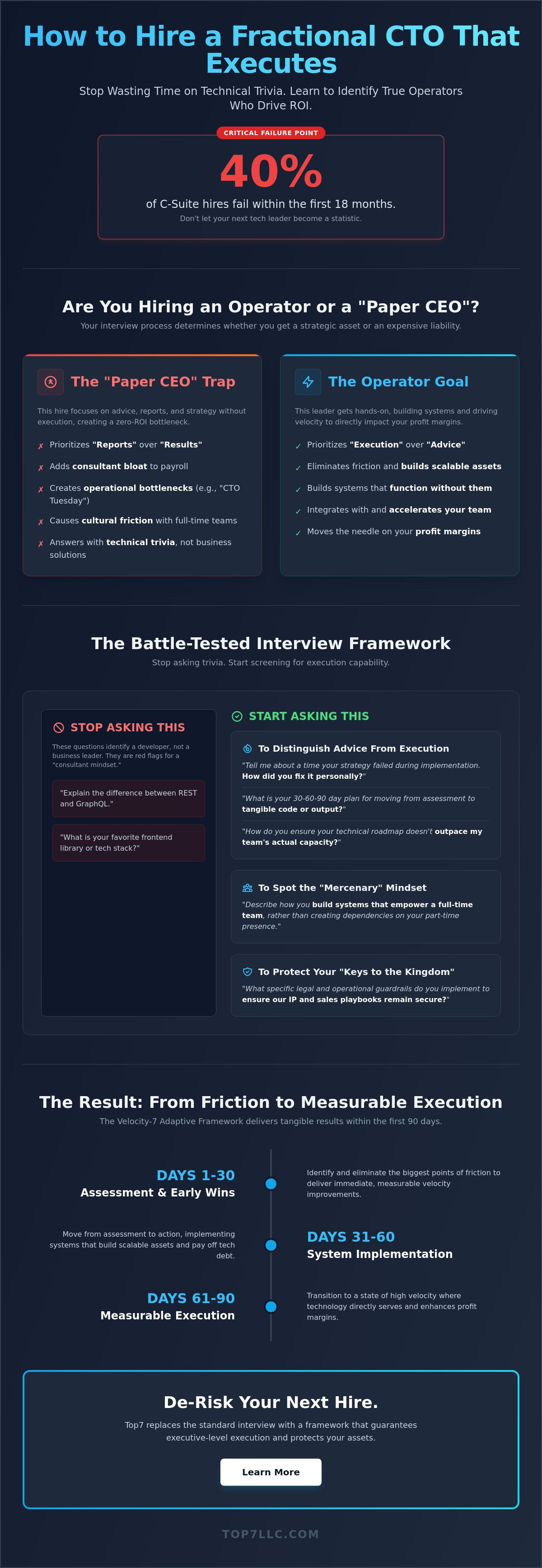
If you're still asking potential tech leaders to explain the difference between REST and GraphQL, you aren't hiring a leader. You're hiring a senior developer who charges four times the market rate. With 40% of C-suite hires failing within the first 18 months, you can't afford to waste time on technical trivia that doesn't move the needle on your ROI. You need a kiler operator who eliminates friction, not a consultant who adds another layer of bloat to your payroll.
It's natural to worry about cultural misalignment or the security of your intellectual property when bringing in external leadership. You want someone who integrates with your team and protects your data while accelerating your roadmap. This article provides a battle-tested framework of 27 fractional cto interview questions that strip away the jargon to reveal true execution capability. You'll learn how to spot a real operator who can implement our Velocity-7 Adaptive Framework versus a paper CEO who only offers expensive advice. We'll cover the legal guardrails and strategic questions you need to de-risk your growth and ensure your technology serves your profit margins, not the other way around.
Key Takeaways
Stop wasting time on technical trivia and learn how to identify operators who build scalable assets instead of operational bottlenecks.
Neutralize the "mercenary" risk by screening for leaders who integrate with your full-time team rather than causing internal friction.
Implement a battle-tested framework of fractional cto interview questions that prioritize execution and velocity over generic technical advice.
Protect your "keys to the kingdom" with rigorous compliance screening that ensures your IP and sales playbooks stay under your control.
Discover how the Velocity-7 Adaptive Framework moves your organization from friction to measurable execution within the first 90 days.
Table of Contents
The 'Part-Time' Trap: Interview Questions to Identify High-Risk Hires
Cultural Friction: Questions to Spot the 'Mercenary' Mindset
The Velocity-7 Interview: Assessing Strategic and Operational Alignment
The Compliance Interview: Questions for Legal and IP Security
De-Risking the Hire: How Top7 Replaces the Standard Interview
The 'Part-Time' Trap: Interview Questions to Identify High-Risk Hires
Most founders fall straight into the "Part-Time Trap" during their search for leadership. They hire a name, a flashy resume, or a veteran who worked at a FAANG company a decade ago. They expect this Chief Technology Officer (CTO) to solve their scaling issues, but they end up with a consultant who just points at problems. Strategy without execution is a zero-ROI investment. It's a liability. You don't need another person to tell you your tech debt is high; you need an operator to build the assets that pay off that debt.
Standard fractional cto interview questions often focus on the wrong metrics. Competitors often suggest asking about favorite frontend libraries or tech stacks. That's a mistake. Technical trivia doesn't predict business leadership; it identifies a developer, not an executive. You are looking for a multiplier, not a high-priced advisor who delivers a "strategic roadmap" and then disappears when the servers melt. You need to distinguish the "Paper CEO" from the real operator before you hand over the keys to your kingdom.
To better understand how to vet these leaders effectively, watch this breakdown of the essential questions:
Questions to Distinguish Advice from Execution
You must determine if a candidate can get their hands dirty or if they simply delegate and disappear. Use these specific fractional cto interview questions to probe their operational history:
"Tell me about a time your strategy failed during implementation. How did you fix it personally?" If they can't describe a hands-on recovery, they aren't an operator.
"What is your 30-60-90 day plan for moving from assessment to tangible code or output?" A real leader focuses on early wins and measurable velocity.
"How do you ensure your technical roadmap doesn't outpace my team's actual capacity?" This reveals if they understand the balance between ambition and operational reality.
Spotting the 'Consultant Bloat' Red Flags
Consultant bloat is the silent killer of growth-stage companies. These candidates prioritize "reports" over "results" and use jargon to mask a lack of action. If a candidate is juggling too many clients, your business becomes a line item, not a priority. Ask them directly about their current load and how they define "Flow." If they can't explain how they improve system velocity in a business context, they are a high-risk hire. Real leaders focus on moving the needle on your profit margins, not just checking boxes on a Jira board. They build systems that function without them, rather than creating a bottleneck where every decision requires their "part-time" input.
Cultural Friction: Questions to Spot the 'Mercenary' Mindset
Hiring a fractional leader is a psychological minefield. Your full-time VPs and engineers are watching. They see a high-paid outsider who works two days a week while they're in the trenches daily. If that hire acts like a mercenary, your culture will reject them like a bad organ transplant. This isn't just about "feeling good." It's about preventing a total collapse of internal authority. When you use the right fractional cto interview questions, you aren't just checking boxes. You're testing for an ego that can fit through the door without knocking over your existing leads.
The real danger isn't just the cost. It's the bottleneck. If every major decision waits for "CTO Tuesday," your velocity dies. You need a leader who builds systems, not dependencies. Strategic alignment starts with understanding The Hiring Process at an executive level, where the goal is to find a cultural fit that accelerates, not disrupts. If you want to avoid these friction points entirely, our Interim Leadership services are designed to embed operators who align with your existing team from day one.
Testing for Team Buy-In
You can't lead from a vacuum. If the candidate can't win over the people actually writing the code, their "strategy" is worthless. Use these questions to probe their interpersonal mechanics:
"How will you win over a Lead Engineer who wanted your job?" Look for empathy paired with firm boundaries. If they dismiss the concern, they'll create a toxic environment.
"Describe your process for empowering mid-level managers when you aren't in the building." A real operator creates a decision-making framework, not a line of people waiting for approval.
"What is your strategy for handling emergency technical debt on your 'off-days'?" They need a protocol for availability that doesn't involve them being the single point of failure.
Identifying the 'Executive Rejection' Risk
Many fractional hires suffer from "Google-lite" syndrome. They try to force big-tech processes onto a lean, five-person startup. This is a recipe for expensive failure. You need to know if they can adapt to your specific reality or if they're just reciting a playbook from a previous decade. Humility is the best indicator of long-term success. Ask them: "What's the least 'executive' task you've done in the last month?" If they struggle to answer, they're a paper CEO who will look down on your team's daily struggles instead of solving them.
The goal of these fractional cto interview questions is to ensure the candidate frames themselves as a multiplier. They aren't there to replace your talent; they're there to sharpen it. If they talk more about their past titles than your current problems, show them the door. You're paying for progress, not a history lesson.
The Velocity-7 Interview: Assessing Strategic and Operational Alignment
Most tech leaders focus on building features. That's a fundamental mistake. Features are often just expenses; assets are investments that generate long-term value. If your potential hire can't distinguish between the two, they'll burn through your runway without building a foundation for scale. You need a leader who looks through the lens of our Velocity-7 Adaptive Framework. This isn't about "moving fast and breaking things." It's about moving from operational friction to efficient flow where every technical decision serves the profit margin.
Over-optimization is another silent killer of mid-market companies. We call it "Growth Whiplash." It happens when a CTO implements enterprise-grade architecture for a company that needs agility, effectively crushing margins under the weight of unnecessary complexity. Your fractional cto interview questions must determine if the candidate is a one-trick pony or if they truly understand the Seven Dimensions of Growth. If they can't balance technical purity with business reality, they're a liability, not an asset.
Interview Questions for Strategic Flow
A strategic leader identifies bottlenecks before they become catastrophes. They don't just manage; they clear the path for execution. Use these questions to test their vision:
"How do you identify the single biggest technical bottleneck in a growth-stalled company?" Look for an answer that prioritizes business outcomes over code quality.
"What is your framework for deciding when to 'buy' vs. 'build' to maintain velocity?" A real operator knows that custom builds are often an ego-driven waste of capital.
"How do you translate our revenue goals into a specific technical sprint cycle?" If they can't link a sprint to a revenue target, they aren't a business leader.
Effective Strategic Planning requires a leader who can map technology directly to the P&L. If they talk about "clean code" without mentioning "customer acquisition cost" or "churn," they've already failed the test.
Operational Friction Analysis
Technical decisions don't happen in a vacuum. They affect every department, especially sales and marketing. If your tech stack makes it harder for your sales team to close deals or your customer success team to resolve tickets, your CTO is creating drag. You need to know how they plan to eliminate that friction. Ask them: "How do you measure the 'drag' your technical decisions have on the sales team?" and "When have you removed a process specifically to speed up a team?"
Operational friction destroys fractional ROI by turning every strategic initiative into a bureaucratic nightmare. Real operators simplify. They don't add more meetings; they automate the workflows that make meetings unnecessary. Your goal is to find a leader who views "process" as a tool for speed, not a safety net for mediocrity.
The Compliance Interview: Questions for Legal and IP Security
Handing over "root access" to your company technology is the ultimate trust exercise. Most founders think a generic NDA protects them. It doesn't. If your hire has access to your proprietary sales playbook and source code, a piece of paper signed years ago won't stop them from leaking your competitive edge. You need to ask fractional cto interview questions that probe their understanding of legal and strategic boundaries. It's about protecting your assets while maintaining the velocity we established in the previous sections. Trust is earned through rigorous compliance, not just a handshake.
The legal landscape for contractors is more volatile than ever. On February 27, 2026, the U.S. Department of Labor published a new rule simplifying worker classification under the FLSA. This rule focuses on "control over work" and "chance to make profits" as the primary determinants of a 1099 relationship. If you treat your fractional leader like a micromanaged employee, you're courting a misclassification disaster. You need a partner who operates with professional independence and brings their own strategic guardrails to the table. Ignoring these nuances can lead to massive back-tax liabilities and legal friction that stalls your growth.
Intellectual Property Guardrails
Ownership isn't a "nice to have." It's the foundation of your company valuation. If you don't own the code, you don't own the business. Use these questions to ensure your IP stays within your walls:
"Explain your understanding of 'Work Made for Hire' in the context of our agreement." If they hesitate, they aren't a professional. They should know exactly how ownership transfers to you upon payment.
"How do you handle proprietary knowledge gained here when working with other clients?" You want to hear about strict data silo protocols and encrypted environments, not just "I'm a trustworthy person."
"What is your offboarding process for ensuring all IP remains with us?" A real operator has a documented checklist for revoking access and handing over final documentation.
The Security and Compliance Checklist
Liability is a cold reality. If your fractional hire causes a data breach, you need to know who is on the hook. Ask about their personal data security protocols for multi-client work. Do they use dedicated, encrypted hardware for each client? Testing for liability is equally critical. Ask: "Do you carry your own D&O or professional liability insurance?" These aren't just details; they are de-risking mechanisms that separate a professional leader from a hobbyist consultant.
Finally, ask the "Conflict" question: "List your current clients. Which ones could be perceived as competitors?" Transparency is non-negotiable. If they are evasive about their client list, they're a risk you can't afford to take. Don't leave your security to chance. Our Fractional CTO services include built-in compliance and IP protection frameworks to ensure your growth remains secure and your assets remain yours.
De-Risking the Hire: How Top7 Replaces the Standard Interview
Stop treating your tech leadership like a dating app. Most platforms brag about vetting the "top 3%" of talent based on resumes. That is a vanity metric. A resume doesn't tell you if a leader can handle your specific technical debt or win over a skeptical engineering team. When you rely solely on fractional cto interview questions, you're still gambling on an individual's charisma. Top7 eliminates that risk by embedding executives who are part of a larger, battle-tested leadership system. We don't just "place" a person and hope they work out; we install an operational engine designed for mid-market scale.
Every leader we provide is trained in our Velocity-7 Adaptive Framework. This ensures they arrive with a pre-built playbook for identifying bottlenecks and generating immediate ROI. You aren't just hiring a person. You're hiring a system. While other consultants are still trying to find your Slack channel, our executives are already auditing your flow and identifying the friction points that kill your margins. We move from assessment to execution with a precision that standard hiring processes can't match.
The Top7 Embedding Process
We identify operational friction before the first meeting even happens. Our process is built specifically for mid-market companies in high-velocity hubs like Austin, Boston, and Chicago. We combine high-level Strategic Planning with Advanced Project Management to ensure that the CTO's vision actually becomes reality. Most consultants leave you with a PDF and a bill. We leave you with a functioning system that builds assets instead of technical debt. We focus on the "Seven Dimensions of Growth" to ensure your technology supports your revenue, not just your ego.
Your Next Step
You've spent enough time worrying about IP security and "consultant bloat." It's time to stop guessing and start scaling. Our 90-Day Flow Promise guarantees that we move from initial assessment to measurable execution before the honeymoon period ends. If you want a leader who builds assets instead of bottlenecks, you need more than just a list of fractional cto interview questions. You need a partner who has already done the heavy lifting for dozens of companies just like yours. Stop gambling with your tech leadership and get a system that works.
Stop Hiring for Potential and Start Hiring for Profit
Technical trivia is an expensive distraction that costs you market share. You've seen how the right fractional cto interview questions can expose mercenaries and identify true operators who build assets instead of bottlenecks. From securing your IP to aligning technical sprints with revenue targets, every decision must serve your bottom line. The era of the "paper CEO" is over. Your business deserves a leader who understands that technology is a tool for profit, not a playground for code purity.
Top7 doesn't just place consultants. We embed seasoned professionals directly into your team using our proprietary Velocity-7 Adaptive Framework. Whether you're scaling in Boston or dominating the West Coast, our focus remains on US mid-market growth and precision execution. The market doesn't reward those who wait for the perfect resume. It rewards those who install systems designed to win. Don't gamble with your leadership-get a battle-tested Fractional Executive from Top7. Take control of your velocity today and turn your technology into a kiler weapon for growth.
Frequently Asked Questions
What is the biggest risk of hiring a fractional CTO?
The biggest risk is strategic bloat without execution. You might end up paying for expensive advice from a "paper CEO" who identifies problems but doesn't build the assets to solve them. This creates a bottleneck where your internal team feels ignored and your development velocity stalls while your payroll costs climb.
How do I ensure a fractional CTO actually executes and doesn't just advise?
Demand a 30-60-90 day plan that focuses on tangible system flow improvements rather than just reports. A real operator will talk about removing friction and increasing velocity. During the screening, use specific fractional cto interview questions to probe their history of hands-on implementation failures and how they personally fixed them.
Can a fractional CTO be classified as an independent contractor (1099) in 2026?
Yes, provided the engagement follows the U.S. Department of Labor rule published on February 27, 2026. This rule simplifies classification by focusing on the contractor's control over their work and their opportunity for profit or loss. You must treat them as a strategic partner with professional independence to avoid misclassification risks.
How do I protect my company's IP when working with a part-time leader?
Protection requires ironclad "Work Made for Hire" clauses and dedicated security protocols. Don't rely on a generic NDA. You need a documented offboarding process that revokes all access and ensures every line of code and sales playbook remains your exclusive property. A professional leader will bring their own encrypted environment to keep your data siloed.
What happens if a fractional CTO is working for a competitor?
Conflicts of interest must be disclosed immediately or the relationship should be terminated. Transparency is the price of admission for fractional leadership. You must ask about their current client list during the interview process to identify overlaps. If they're evasive about who they work for on their "other days," they are a liability you can't afford.
How do I measure the ROI of a fractional executive hire?
ROI is measured by implementation speed and cost efficiency. Organizations with fractional technology leadership implement new tech 2.3 times faster than those without it. You should also see a 50-70% cost reduction compared to a full-time C-suite hire. If your success rate in complex projects like AI implementation doesn't improve, the hire isn't working.
Is a fractional CTO better than a full-time junior tech lead for a mid-market company?
Senior leadership is always superior to junior management when your goal is scalable growth. A junior lead can manage tickets, but they lack the strategic vision to bridge technology and revenue. A fractional CTO provides veteran experience at a fraction of the cost, ensuring your tech stack serves your profit margins instead of just your ego.
What are the red flags to watch for in a fractional CTO interview?
Red flags include excessive jargon and an inability to link technical decisions to business outcomes. If a candidate can't define "Velocity" or "Flow" in a profit-driven context, they are a risk. Pay attention to how they answer your fractional cto interview questions; if they focus more on their past titles than your current bottlenecks, they are a consultant, not an operator.


Comments