
Scaling Operations Without Breaking Them: The Mid-Market Leader’s Survival Guide

Why does your business feel like it's grinding to a halt the moment you finally start to win? Most mid-market leaders mistake rapid growth for progress, but without the right systems, growth is just a faster way to go bankrupt. You've felt the friction. Delivery is slowing down, departments have stopped talking, and you've become the primary bottleneck for every minor decision. It's exhausting to watch the culture you built start to crack under the weight of its own success.
The problem isn't your ambition; it's your architecture. You're likely trying to force agile methodologies for operational scaling into a rigid, legacy structure that wasn't built for this velocity. This guide is your exit strategy from the chaos. You'll learn how to stop the bleeding and transition from operational friction to a state of efficient flow. We're breaking down the proprietary Velocity-7 framework and showing you why fractional executive leadership is the surgical tool you need to scale. Stop wasting $300,000 on full-time C-suite overhead when you can buy the results you actually need for a fraction of the cost.
Table of Contents
Scaling is a Suicide Mission Without Operational Flow
Growth isn't a badge of honor if it's killing your margins. Most founders think hitting $10M or $20M will magically fix their messy processes. It won't. In reality, scaling without a system is a suicide mission. Every small crack you ignored when you were a $5M shop becomes a gaping canyon once you add more clients and more bodies. You aren't just growing; you're accelerating toward a wall. If your current strategy is "work harder," you've already lost the war.
This is where agile methodologies for operational scaling become non-negotiable. Without a framework that prioritizes flow over brute force, you're just paying a "friction tax." This silent tax eats your profits, burns out your best people, and turns your promising mid-market firm into a slow-moving dinosaur. Winging it worked when you were a five-person team in a garage. Now? It's a strategy with a 100% failure rate. You need to stop being a hero and start being an architect.
To better understand how these principles apply outside of a coding environment, watch this helpful video:
Friction vs. Flow: The Only Metric That Matters
Look at your remote teams in Dallas or Austin. Are they actually producing, or are they stuck in "meeting hell" trying to figure out what to do? If your culture relies on "hustle" and founder-led heroics to get projects over the finish line, you don't have an operation. You have a bottleneck. This friction leads to talent churn and brand erosion that costs more than any recruitment fee. While many look toward the Scaled Agile Framework (SAFe) for enterprise-level answers, mid-market leaders need something leaner that actually moves the needle without the corporate bloat.
The Mid-Market Death Valley
The $10M to $50M range is the most dangerous stage for any business. It's the "Death Valley" where complexity triples but efficiency halves. You add more people, but things get slower. This is the Complexity Trap. You're hiring for capacity, but you're actually creating communication debt. Every new hire adds a new layer of noise if you don't have a system to filter it. You must transition from founder-led chaos to a systems-led flow where the business runs on logic, not your personal adrenaline.
Operational Flow is the state where strategy meets execution without friction.
The Velocity-7 Adaptive Framework: Engineering Growth That Doesn’t Snap
Most businesses are built like glass. They look solid and impressive until you apply the pressure of rapid growth. Then they shatter. If your operation depends on a rigid hierarchy where every decision flows through a single point of failure, you aren't scaling; you're just building a bigger cage. Real growth requires an engine that bends without breaking. It requires a system that prioritizes speed and precision over tradition and ego.
The Velocity-7 Adaptive Framework is our proprietary engine for this transition. It moves mid-market firms away from the slow, clunky structures of the past and into a state of high-velocity execution. Successfully implementing agile methodologies for operational scaling isn't about adopting tech-sector buzzwords or holding more meetings. It's about re-engineering your business across seven critical dimensions to ensure your infrastructure supports your ambition rather than suffocating it. If you're tired of guessing your next move, explore how our Velocity-7 Adaptive Framework can stabilize your operations today.
From Friction to Flow: The 7-Step Logic
Friction is the hidden tax on your balance sheet. It shows up as missed sales targets, bloated tech stacks, and financial guidance that's always three weeks too late. Our framework identifies these leaks by looking at your entire ecosystem, not just isolated departments. We bring high-level technology leadership into the fold to ensure your tools are assets, not liabilities. This isn't just for software startups in Silicon Valley or Boston. Mid-market firms across the US are using these agile methodologies for operational scaling to outmaneuver larger, slower competitors who are still stuck in 2015.
Why Traditional Strategic Planning Fails
The "Dusty Binder Syndrome" is a terminal illness for mid-market growth. In 2026, a 12-month strategic plan is dead on arrival. The market moves too fast for fixed roadmaps. If your strategy can't survive a sudden shift in interest rates or a new competitor, it isn't a strategy; it's a wish. Velocity-7 replaces these static plans with adaptive frameworks that embed directly into your daily operations. We don't give you a map that's already out of date; we give you a compass and a faster engine. Adaptive frameworks survive market shifts because they are designed to pivot without crashing the entire system. Stop paying for plans that gather dust and start building a business that actually moves.
Why Your Full-Time Hiring Strategy is Breaking Your Operations
Stop throwing bodies at a systems problem. Most mid-market leaders think a new hire is the cure, but it's often the poison. Hiring a full-time executive before you have a functional framework is just paying someone six figures to manage your chaos. You don't need more headcount; you need more precision. If your infrastructure is broken, a new COO will just help you fail at a higher salary point.
Research from 2026 indicates the average cost per hire for an executive in the US is approximately $28,329. That is just the entry fee. When you factor in salary, payroll taxes, and benefits, the total cost of a full-time C-suite hire can be 1.25 to 2.5 times their base salary. For a $200,000 executive, you are actually betting nearly half a million dollars on a single person. If they spend their first six months "learning the ropes" because you lack agile methodologies for operational scaling, your margins are already dead. You are bleeding cash to fund a learning curve you can't afford.
The Fractional Revolution is about strategic efficiency, not temp work. A Fractional CTO or Fractional COO provides the same strategic weight as a full-time hire but without the permanent weight on your balance sheet. They bring battle-tested playbooks, not gut feelings. You get Tier-1 talent that has seen your specific problems ten times before, and they start solving them on day one.
Fractional Leadership vs. Traditional Consulting
Consultants give you a map; Fractional Leaders drive the car. Traditional consulting firms charge you to tell you what's wrong, then leave you with a 50-page slide deck you'll never open. Fractional leadership involves embedding experts who actually fix the technology bottlenecks and financial leaks. This is the only way to solve complex operational problems in high-growth environments. Whether you are a non-tech firm in the Midwest or a logistics company on the East Coast, the ROI of an embedded leader is immediate because they focus on execution, not just advice.
The High Cost of Executive Burnout
Your current leadership team is likely failing because they are doing two jobs and failing at both. They are trying to innovate while being buried in administrative friction. This leads to burnout and high-stakes turnover that can cost your business over $100,000 in lost revenue for every month a senior role stays vacant. Fractional leadership is a strategic investment in stability, not a temporary fix. It protects your core team by offloading the heavy lifting of system design to an expert. Stop asking your VPs to be architects when they are already struggling to be builders. Implementing agile methodologies for operational scaling requires a level of focus that your exhausted full-time staff simply cannot provide.
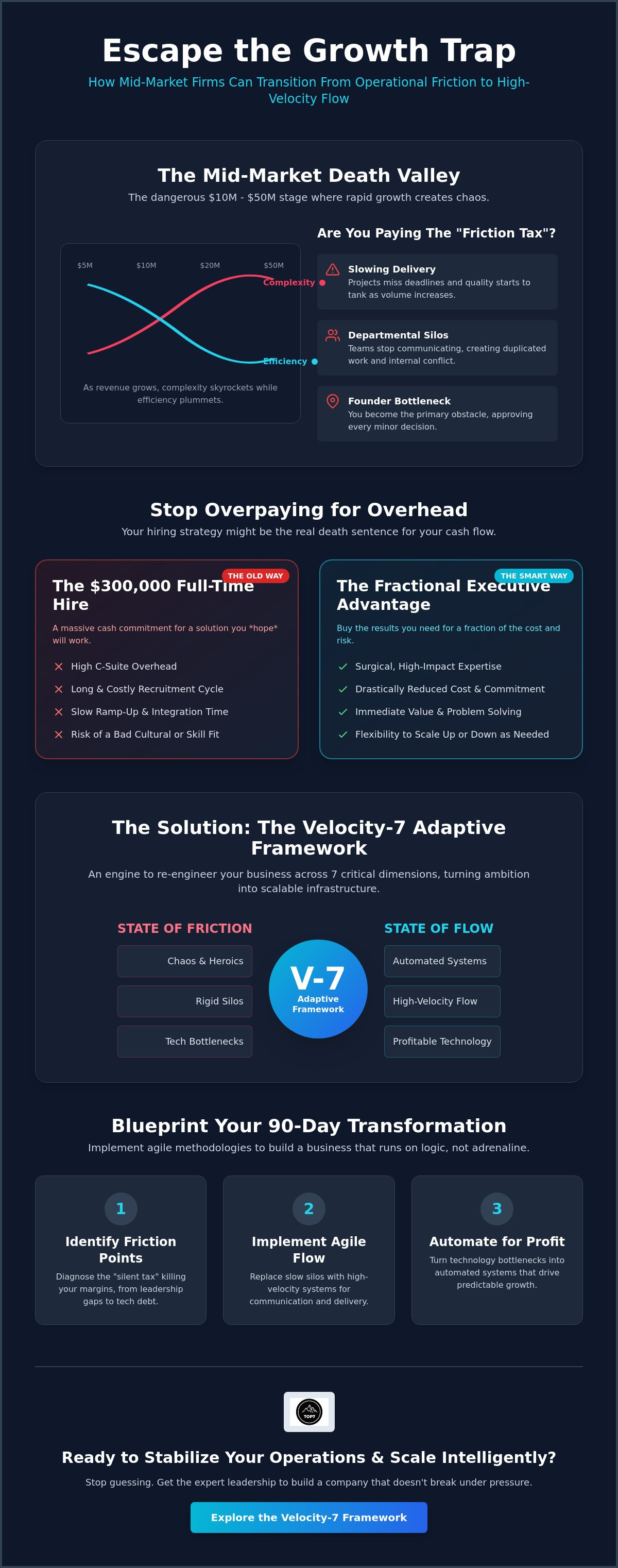
Identifying the 3 Deadly Friction Points in Mid-Market Scaling
Scaling doesn't just multiply your success. It multiplies your inefficiency. If you have a leaky bucket at $5M, you'll have a flood at $20M. Most mid-market firms suffer from a "profitable bankruptcy" where revenue climbs while the actual bank balance stagnates. This paradox happens because of three specific friction points that traditional management often ignores. If you aren't looking for them, they are already eating your margins.
Applying agile methodologies for operational scaling allows you to spot these points before they become terminal. It isn't just about software; it's about identifying where the energy is being sucked out of your organization. When you remove these bottlenecks, growth stops feeling like a struggle and starts feeling like a predictable outcome.
The Technology Strategy Audit
Your tech stack is likely a liability, not an asset. If your team spends more time "fixing bugs" or manually moving data between apps than executing strategy, your architecture is broken. A true Fractional CTO doesn't just manage IT tickets. They align your digital infrastructure with your business goals. For legacy businesses on the East Coast, digital transformation is no longer optional. It is a survival requirement. Signs of terminal tech debt include fragmented data and manual workarounds that bypass your supposedly automated systems.
Sales and Financial Guidance Alignment
High sales volume can actually kill your business if your margins are calculated incorrectly. Scaling revenue without a corresponding financial strategy is the fastest way to a cash flow crisis. You need a Fractional CFO who provides predictive guidance, not just historical reporting. They ensure that sales incentives are aligned with operational capacity. If your sales team is selling faster than your operations can deliver, you're just accelerating the destruction of your reputation.
Finally, look in the mirror. The "Founder Filter" is the most common execution gap. If every decision still requires your approval, you are the friction. A vacant senior leadership role can cost over $112,500 in lost revenue in just 45 days, according to TuraHire data from February 2026. Don't let your ego or a lack of systems create a six-figure hole in your balance sheet. If you're ready to remove the bottlenecks and stop being the primary obstacle to your own growth, it's time to engage with our Fractional C-suite experts and start scaling for real.
Scaling Without the Overhead: The Fractional Executive Advantage
You've identified the friction. You've seen the leaks in your financial guidance and the tech debt breaking your delivery. Now, you have a choice. You can continue to play hero, or you can build a machine that works while you sleep. Real scaling isn't about working more hours; it's about increasing the velocity of your systems. By integrating the Velocity-7 Adaptive Framework with fractional leadership, you gain the strategic weight of a C-suite veteran without the catastrophic overhead of a full-time salary package.
Think about the math. The total employer cost for a full-time C-suite hire in the US currently sits between $270,000 and $320,000 per year, according to March 2026 data from Fractionus. For a mid-market firm, that is a massive gamble on a single point of failure. Our agile methodologies for operational scaling allow you to bypass this risk. You get the same Tier-1 expertise for a variable cost, allowing you to reinvest that saved capital into the very growth systems our executives are building for you.
The Top7 Fractional CTO & COO Model
Whether you are running a high-stakes firm in Chicago or a logistics powerhouse in Florida, our model is built for immediate impact. We solve complex problems from the inside out. Don't confuse this with interim leadership. An interim leader is a band-aid for a crisis; a fractional executive is an architect for your future. Our seasoned professionals don't just "manage" your current mess. They use the Velocity-7 Framework to install permanent, automated processes that turn your operational chaos into a repeatable, profitable flow.
Your Roadmap to Frictionless Growth
Stop winging it and start executing. Our 90-day transformation is a tactical strike on your inefficiency. Within the first 30 days, we conduct a deep-tissue audit to map every friction point in your stack and your staff. By day 60, we are embedding agile methodologies for operational scaling directly into your workflows. By day 90, your business isn't just bigger; it's better. You'll see the results in your margins, your delivery speed, and your team's morale.
The Audit: Identify the specific tech and financial leaks draining your cash.
The Integration: Deploy the Velocity-7 Framework to replace manual bottlenecks with automated systems.
The Optimization: Fine-tune the engine to ensure strategy meets execution every single day.
The cracks in your foundation won't fix themselves. If you are ready to see exactly where your scaling strategy is snapping, it's time to book a strategic audit with Top7. Stop being the bottleneck and start being the architect.
Stop Surviving and Start Dominating Your Scale
Scaling is a choice between controlled growth and self-inflicted chaos. You've seen the friction points. You know that your current hiring strategy is likely burning cash while founder-led bottlenecks stifle your best talent. The difference between a $10M firm that plateaus and a $100M powerhouse is the architecture of their operations. By implementing agile methodologies for operational scaling, you move from a state of constant firefighting to a state of predictable, high-velocity flow.
The Velocity-7 Adaptive Framework wasn't built for theory; it was built for the raw reality of the mid-market. Our seasoned professionals embed themselves in your organization to fix the tech debt, financial leaks, and execution gaps holding you back. You don't need a bloated payroll to get enterprise-level results. You need precision leadership that understands how to bridge the gap between strategy and the boots on the ground. It's time to stop being the primary obstacle to your own success. Get the C-Suite Results You Need Without the Full-Time Payroll-Talk to Top7. Your next stage of growth starts with a single decision to build a better machine.
Frequently Asked Questions
What is the most common reason mid-market operations break during scaling?
Operations break because founders refuse to stop being the primary decision-maker. At the mid-market level, your personal hustle becomes a liability that creates massive communication debt. Without a system to replace your gut feeling, the business can't move faster than you can think. You end up with a profitable bankruptcy where revenue grows but hidden inefficiencies drain every cent of profit before it hits the bank.
How does a Fractional CTO differ from a traditional IT consultant?
A Fractional CTO is an embedded leader who owns the outcome, while an IT consultant just hands you a bill and a list of suggestions. Consultants tell you what's wrong; Fractional CTOs fix the architecture from the inside. They align your technology strategy with your business goals, ensuring your stack is a profit-driving asset rather than a bug-ridden liability that requires constant manual workarounds to function.
Can the Velocity-7 Adaptive Framework work for non-tech industries?
Absolutely. The Velocity-7 Adaptive Framework is built for any complex operation that requires precision execution. Whether you're in logistics, manufacturing, or professional services, the principles of flow, financial guidance, and leadership alignment remain the same. We use agile methodologies for operational scaling to strip away the friction tax that kills margins in legacy businesses, regardless of the specific industry or vertical you occupy.
How much does it cost to hire a Fractional COO versus a full-time executive?
Hiring a full-time executive is a massive gamble involving high fixed overhead, payroll taxes, and benefits that can double the base salary. Fractional leadership offers a variable cost structure that provides Tier-1 expertise without the long-term financial weight. You pay for the strategic results you need right now. This allows you to scale your leadership team as your revenue grows rather than betting the farm on a single hire.
What are the first signs that our operations are reaching a breaking point?
Look for delivery delays, rising talent churn, and departments that have stopped talking to each other. When your best people start burning out because they're doing two jobs, you're already in the red. Another red flag is meeting hell, where your team spends more time talking about work than actually executing it. If you're still the one approving every minor expense, your operation is already broken.
How long does it take to see results from an agile-based transformation?
You'll see immediate visibility into your friction points within the first 30 days. However, a full-scale transformation usually takes about 90 days to embed deeply into your culture. During this window, we replace manual bottlenecks with automated systems and align your team with the Velocity-7 Framework. By the end of three months, your operation should be running on logic and data rather than adrenaline and heroics.
Is fractional leadership suitable for companies based on the West Coast or East Coast?
Fractional leadership is perfectly suited for firms across the United States, from legacy East Coast industries to high-growth West Coast hubs. Our model is designed for the modern, often remote-first, business environment. We provide seasoned professionals who navigate the specific market pressures of your region while implementing agile methodologies for operational scaling to ensure you stay competitive in a national or global market.
What happens if we scale too fast without an operational framework?
You'll face a death by a thousand cuts where your reputation is destroyed by poor quality and late deliveries. Scaling revenue without an operational framework leads to margin collapse because you're forced to throw expensive, unoptimized resources at every new problem. You might grow your top line, but your bottom line will vanish as the friction tax of a broken system eats every dollar of your new revenue.



Comments