
Part-Time CTO for Fintech Startups in Austin: Scale Without the Equity Burn

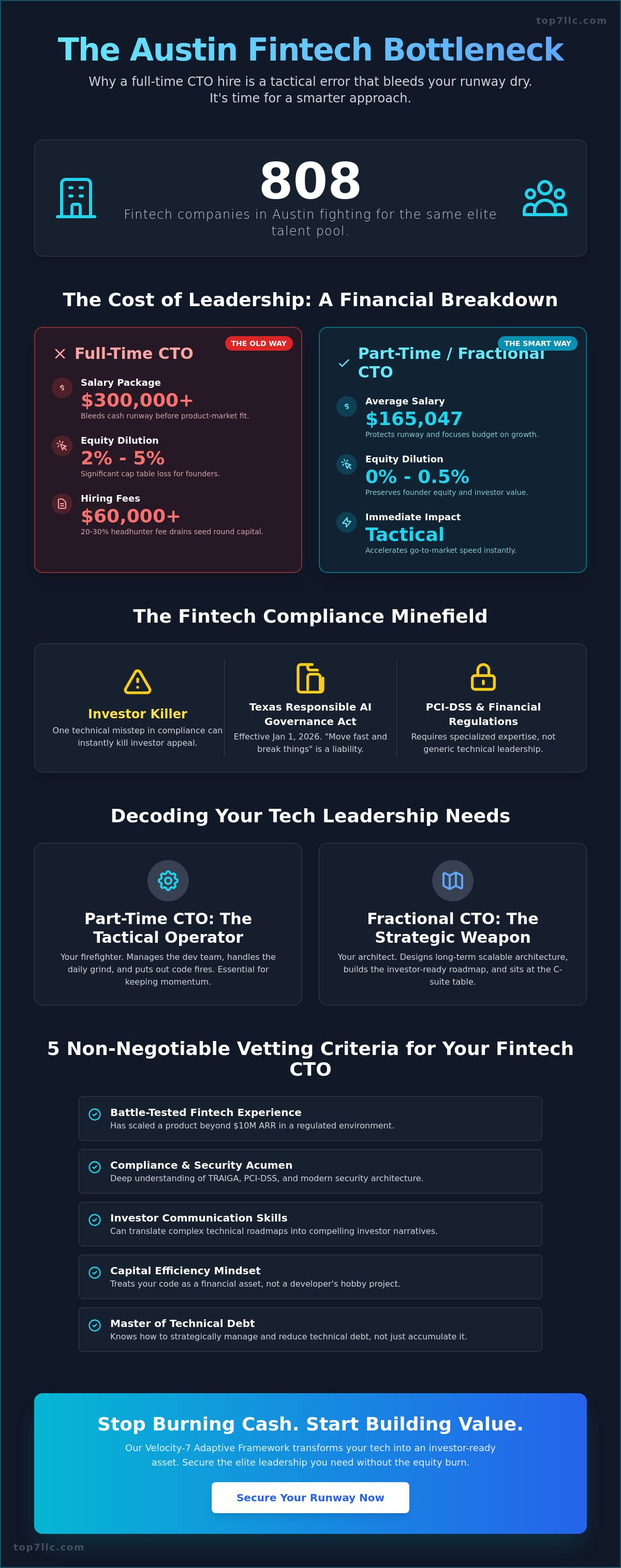
Why are you handing over 2% of your cap table and a $300,000 salary package when the Austin fintech bottleneck is already strangling your margins? With 808 fintech companies in this city fighting for the same elite talent, hiring a full-time executive is often a slow suicide for your runway. You need a part-time cto for fintech startups austin who treats your code as a cold, hard financial asset rather than a developer's hobby project. The average fractional CTO salary in Austin now sits at $165,047, yet many founders still bleed cash for full-time roles that fail to move the needle.
You know the pressure of the Texas Responsible AI Governance Act (TRAIGA) that took effect on January 1, 2026, and the mounting anxiety over PCI-DSS compliance. One technical misstep in this regulatory minefield will kill your investor appeal instantly. I will show you how to secure elite technical leadership that clears development bottlenecks and builds a scalable architecture without the equity burn. We are diving into the tactical roadmap that turns your tech stack into a high-performance conversion engine while keeping your burn rate under control.
Key Takeaways
Stop bleeding cash on full-time hires when a tactical leader can protect your runway and accelerate your go-to-market speed immediately.
Learn the critical distinction between a tactical part-time cto for fintech startups austin and a strategic fractional leader to choose the right weapon for your current stage.
Avoid the "Fintech Compliance Trap" by understanding why generic technical leadership is a liability under the 2026 Texas AI regulations.
Identify the five non-negotiable vetting criteria to ensure your leadership has the battle-tested experience to scale a product beyond $10M ARR.
Discover how the Velocity-7 Adaptive Framework transforms technical debt into a scalable, investor-ready roadmap that dominates the Austin market.
Table of Contents The Austin Fintech Bottleneck: Why Your Search for a Full-Time CTO is Killing Your Runway Fractional vs. Part-Time CTO: Decoding the Tech Leadership Model for Austin Founders The Fintech Compliance Trap: Why a Generic CTO is a Liability in the Lone Star State The Austin Fintech CTO Buying Guide: 5 Non-Negotiable Vetting Criteria Beyond Code: How Top7’s Velocity-7 Framework Weaponizes Your Austin Fintech Stack
The Austin Fintech Bottleneck: Why Your Search for a Full-Time CTO is Killing Your Runway
Austin isn't just a tech hub anymore; it's a battlefield. With 808 fintech companies fighting for oxygen in the Silicon Hills as of January 2026, the talent war has reached a fever pitch. You aren't just competing with other startups for leadership. You're fighting Tesla, Oracle, and Apple. These giants have the capital to swallow top tier talent whole, leaving you with a choice: pay a $250,000 base salary plus a massive equity chunk, or settle for a "B-player" who will break your architecture. Choosing a part-time cto for fintech startups austin isn't just a cost saving measure. It's a survival strategy for your cap table.
The traditional Chief Technology Officer role is changing. You don't need a full time executive to sit in meetings for 40 hours a week. You need tactical execution and a roadmap that satisfies both investors and regulators. Waiting six months to find a "Unicorn" CTO stalls your product launch while your competitors, who raised $247 million in Austin equity funding last year, sprint past you. Every day your seat remains empty is a day your go-to-market strategy rots.
To better understand how this leadership model works for your growth, watch this helpful video:
The Hidden Costs of the Traditional CTO Search
Hiring a full time CTO is an expensive gamble. Beyond the salary, you're likely giving away 1% to 5% of your cap table before you've even hit Product-Market Fit. Austin headhunters often charge 20% to 30% of the first year's salary, which can instantly drain $60,000 from your Seed round. When the CEO tries to play part-time cto for fintech startups austin to save money, operational friction spikes. You stop selling because you're busy debugging, and that's a fast track to failure.
Fintech-Specific Urgency in 2026
The "Move Fast and Break Things" era died when the Texas Responsible AI Governance Act (TRAIGA) took effect on January 1, 2026. In fintech, breaking things means legal trouble and lost licenses. You need immediate technical credibility to survive the 2026 legislative session's focus on cryptocurrency and open banking. Investors won't touch a startup that can't explain its compliance architecture. Austin fintech startups fail at the seed stage because they prioritize rapid feature deployment over the structural integrity required to survive a 2026 regulatory audit.
Fractional vs. Part-Time CTO: Decoding the Tech Leadership Model for Austin Founders
Stop confusing a firefighter with an architect. Many Austin founders fall into the trap of hiring a "part-time" developer and calling them a CTO. A part-time cto for fintech startups austin is your tactical operator. They handle the daily grind, manage your local Austin dev shop, and put out fires in the codebase. A fractional CTO is a strategic weapon. They sit at the C-suite table, design the long-term scaling architecture, and prepare your technical roadmap for a Series A exit. Most fintechs in the Silicon Hills don't need a full-time executive; they need a hybrid leader who can code-review at 9 AM and present to VCs at 2 PM.
The fractional model is the only sustainable path for a startup raising capital in 2026. Austin is a Tier 2 market where fractional talent commands hourly rates between $200 and $275. If you are hiring a part-time cto for fintech startups austin, you are likely looking for tactical oversight to keep your offshore team from drifting. However, if your goal is long-term market dominance, you need strategic integration. This model allows you to scale leadership hours as your funding grows, ensuring you never pay for more "executive time" than your current stage requires.
Engagement Levels: Finding Your "Goldilocks" Zone
Advisory-only engagement works if you have a rockstar lead developer but need a sanity check on your PCI-DSS compliance or SOC2 roadmap. Tactical-embedded leadership is for founders whose development team is currently spinning wheels or missing deadlines. For those facing deep technical debt or a stalled product, the strategic-transformation level uses the Velocity-7 framework to gut inefficient processes and replace them with a high-velocity delivery machine that actually converts.
The Decision Matrix: When to Pull the Trigger
You've outgrown your "Technical Founder" or "Lead Dev" the moment they spend more time fixing legacy bugs than planning the next two quarters. Look at the ROI. A common monthly retainer for an embedded fractional CTO in Austin, providing 10 to 15 hours of high-level work per week, ranges between $5,000 and $10,000. Compare that to the $165,047 average annual salary for a full-time role in this city. You gain 100% of the elite expertise for less than 40% of the cost. This isn't just about saving money; it's about buying speed. If you want to see how this leadership model crushes the competition, explore our approach to strategic tech leadership to see why specialized expertise beats a generic dev shop every time.
The Fintech Compliance Trap: Why a Generic CTO is a Liability in the Lone Star State
Stop treating your codebase like a sandbox. In the world of finance, your code isn't just a product; it's a financial liability. A generic CTO who spent their career building e-commerce sites or social apps is a walking disaster for your runway. They don't understand that every line of code must be written with an auditor looking over their shoulder. When you hire a part-time cto for fintech startups austin, you aren't just buying developer management. You're buying a shield against the regulatory minefield that is the 2026 Texas legislative landscape. If your architecture doesn't prioritize immutable audit trails and double-entry ledgering from day one, you're building on sand.
The stakes changed on January 1, 2026, when the Texas Responsible Artificial Intelligence Governance Act (TRAIGA) took effect. This law mandates clear disclosures for any AI used in financial decisioning, a core component for most modern fintechs. Simultaneously, the Texas Senate placed cryptocurrency regulation on the main agenda for its 2026 session. A generalist leader won't know how to navigate these state-level shifts while also preparing for the CFPB’s "open banking" mandate finalized earlier this year. You need a specialist who understands that security isn't a feature you "bolt on" later; it's the foundation of your entire technical stack.
Regulatory Readiness for Austin Fintechs
Investors in the Silicon Hills have grown cynical. They've seen too many startups fail due to "technical debt" that was actually "compliance debt." During a Seed or Series A due diligence phase, VCs will gut your tech stack to see how you handle PCI-DSS, SOC2, and BaaS integrations. If your part-time cto for fintech startups austin hasn't built for "Banking-as-a-Service" before, your integration costs will spiral. Hiring a CTO without deep fintech roots is like putting a general contractor in charge of a nuclear power plant; the structure might look fine, but the invisible leaks will eventually destroy the entire foundation.
Security as a Competitive Advantage
Robust technical leadership does more than keep you out of jail. It reduces your insurance premiums and slashes the time spent on third-party vendor risk assessments. In 2026, Texas-based data sovereignty is becoming a talking point for local institutional partners who want to ensure their data stays within the state's jurisdiction. Your CTO must manage these vendor risks with precision, turning your security posture into a sales tool rather than a bottleneck. This level of professional dominance is what separates a market leader from another failed experiment in the Austin fintech scene.
The Austin Fintech CTO Buying Guide: 5 Non-Negotiable Vetting Criteria
Stop hiring for "coding skills" and start hiring for business dominance. In a city with 808 fintech companies as of January 2026, the margin for error is zero. You don't need a developer with an executive title. You need a part-time cto for fintech startups austin who has battle scars from scaling products to at least $10M ARR. If they haven't managed the technical weight of millions in transaction volume, they'll buckle when your growth spikes. Vetting is your only defense against a technical disaster that could wipe out your Seed funding.
Proven Fintech Scaling: Have they actually built a ledger system that survived a SOC2 audit? Scaling to $10M+ ARR requires a different level of architectural discipline than building a simple MVP.
The Velocity-7 Mindset: Can they identify the specific bottlenecks slowing your deployment? Your CTO should move your tech from friction to efficient flow, not just manage Jira tickets.
Austin Market Connectivity: Do they know the local dev talent and vendors? In the Silicon Hills, a CTO's rolodex is as valuable as their GitHub profile.
Strategic ROI Communication: Can they explain to your board why a technical infrastructure investment will yield a 3x return in processing speed? If they can't translate API calls into ROI, they don't belong in your C-suite.
The "Replacement" Clause: A true fractional leader prepares for their own exit. They should help you build the culture and eventually hire the full-time replacement once you hit Series B.
The Interview Framework: Questions You Must Ask
Don't let candidates hide behind technical jargon. Ask them: "How did you pivot your tech stack to comply with the Texas Responsible AI Governance Act (TRAIGA) that took effect on January 1, 2026?" This tests their local regulatory awareness. Ask how they balance technical debt with the pressure of Austin's 149% increase in local fintech equity funding. Finally, demand to know their specific framework for managing a hybrid team of local Austin talent and offshore resources without losing 30% of productivity to communication gaps.
Red Flags to Avoid in a Fractional Leader
Avoid the "Advice-only" consultant. If they won't touch your roadmap or get into the weeds of your architecture, they are a professional talker, not a leader. Watch out for the "Dev-Heavy" CTO who can't speak the language of investors. If they lack a proprietary execution framework like Velocity-7, they are just making it up as they go. You need a system, not a suggestion. To stop wasting time and get the elite technical leadership your startup deserves, you must prioritize execution over theory.
Beyond Code: How Top7’s Velocity-7 Framework Weaponizes Your Austin Fintech Stack
Stop looking for a technician and start looking for a commander. Most fractional CTO services in Austin give you a list of resumes and wish you luck. They offer advice, not execution. At Top7, we provide a part-time cto for fintech startups austin who uses the Velocity-7 Adaptive Framework to turn your technical debt into a high-octane profit center. We don't sit on the sidelines; we embed directly into your local team to ensure your architecture isn't just functional, but actively weaponized to crush the 807 other fintechs fighting for dominance in the Silicon Hills.
Your tech stack should be a conversion engine, not a cost center. In a market where Austin fintech funding saw a 149% increase in 2025, you can't afford to let technical friction slow your growth. We align your technology with your financial strategy and sales guidance. This means every sprint and every line of code serves a single purpose: increasing your valuation and protecting your cap table. We don't just manage developers; we manage your path to a Series A exit.
The Velocity-7 Difference in Fintech
Dimension 1 of our framework is Strategic Alignment. We ask the hard questions: Does your current code serve your revenue goals? If your team is building features that don't move the needle toward your $10M ARR target, they're burning your runway. Dimension 4 focuses on Operational Flow. We identify and gut the bottlenecks in your dev sprints that prevent you from hitting your GTM milestones. Whether you need to Unlock Growth: The Velocity-7 Framework for Philly Businesses or apply those same high-velocity principles to the Austin market, the goal remains total market dominance. We replace chaos with a precision-engineered delivery machine.
Ready to Stop Guessing and Start Scaling?
Top7 eliminates the executive leadership gap that kills most startups at the seed stage. We offer a "Marketing-Commando" approach to technical leadership, where the objective is clear: win the market. Our 90-day roadmap takes you from a technical audit to scalable execution without the $300,000 salary burn.
Days 1-30: Technical and Regulatory Audit. We verify your compliance with the Texas Responsible AI Governance Act (TRAIGA) and prepare your stack for federal "open banking" mandates.
Days 31-60: Operational Optimization. We remove the friction in your dev team and install the Velocity-7 framework to ensure consistent, high-speed output.
Days 61-90: Scalable Execution. Your stack is now an investor-ready asset, capable of handling the transaction volume required for your next massive funding round.
You don't have time for a "learning curve." You need a part-time cto for fintech startups austin who has already won these battles. It's time to stop settling for average dev management and start demanding elite technical leadership. Book your Velocity-7 Audit with a Top7 CTO today and secure your strategic advantage before your competitors do.
Stop Bleeding Equity and Start Dominating the Silicon Hills
You've seen the data. Austin's fintech scene is a high-stakes war zone where over 800 companies fight for a shrinking pool of elite talent. Handing over 5% of your company and a massive salary for a full-time executive is a legacy mistake you can't afford in 2026. Whether it's navigating the complexities of the Texas Responsible AI Governance Act or crushing your next VC due diligence, you need a part-time cto for fintech startups austin who understands that code is a financial asset, not a hobby. Waiting for a unicorn hire only stalls your product while your competitors sprint ahead.
Top7 doesn't just offer advice; we provide seasoned executives who embed directly into your team to drive results. Our proprietary Velocity-7 Adaptive Framework is designed to gut operational friction and replace it with a precision-engineered delivery machine. You have the vision to disrupt the market. We have the technical firepower to make it happen without burning your runway through unnecessary dilution. Stop Burning Runway—Get Your Top7 Fractional CTO Roadmap Now. Your move to the top of the Austin fintech market starts today.
Frequently Asked Questions
How much does a part-time CTO cost for a fintech startup in Austin?
A part-time CTO in Austin typically costs between $5,000 and $10,000 per month on a retainer basis for 10 to 15 hours of work per week. This is a strategic steal compared to the $165,047 average annual salary for a full-time executive in this city. Hourly rates for elite fractional talent in the Austin market currently range from $200 to $275 depending on their specific fintech specialization.
What is the difference between a fractional CTO and a technical consultant?
Consultants give you a slide deck and leave; a fractional CTO owns your technical outcomes. While a consultant offers outside advice, a fractional leader is an embedded executive with decision-making authority over your roadmap and team. They don't just identify bottlenecks. They gut the friction and install the systems needed to hit your $10M ARR targets.
Can a part-time CTO help with fintech fundraising and VC due diligence?
Securing a part-time cto for fintech startups austin is often the difference between a successful seed round and a rejection. VCs in 2026 demand technical credibility, specifically regarding SOC2 compliance and immutable audit trails. Your CTO prepares the data room, defends your architecture during technical deep dives, and proves to investors that your stack is a scalable asset rather than a liability.
How many hours a week does a fractional CTO typically work?
Most fractional engagements for Austin fintechs require 10 to 20 hours per week. The exact volume depends on your current stage and the severity of your development bottlenecks. High-intensity periods like a product launch or a regulatory audit might see those hours spike, but the model remains flexible to protect your runway from unnecessary burn.
Do I need a local Austin CTO, or can they work remotely?
Local expertise is a massive advantage in the "Silicon Hills" ecosystem. While remote work is possible, a local part-time cto for fintech startups austin brings a network of 808 local fintech peers and vendors. They also have first-hand experience with the Texas Responsible AI Governance Act (TRAIGA) that took effect on January 1, 2026, ensuring your startup stays compliant with state-specific mandates.
What fintech-specific certifications should a part-time CTO have?
Certifications like CISSP or CISM are baseline requirements, but real-world experience with PCI-DSS Level 1 and BaaS integrations matters more. Your leader must be fluent in the 2026 regulatory landscape, including the latest Texas cryptocurrency regulations. If they can't explain how your architecture handles real-time payment settlements or data sovereignty, they aren't qualified for your C-suite.
How does a fractional CTO manage my existing development team?
They use a "marketing-commando" approach to management by installing high-velocity frameworks like Velocity-7. They act as the bridge between your business goals and the dev team's output. By removing technical debt and clarifying the roadmap, they ensure your local or offshore developers are building features that actually drive revenue rather than just spinning their wheels on low-impact tasks.
What happens when my fintech startup is ready for a full-time CTO?
A professional fractional CTO builds the culture and documentation so they can eventually hire their own replacement. They help you transition to a full-time leader once you hit Series B or achieve enough scale to justify the $300,000+ total compensation package. This ensures a seamless handoff without the typical 6-month productivity dip that kills most growing startups.



Comments