

Measuring ROI of a Fractional Executive: The Hard Metrics of High-Velocity Growth
- Robert Fitzgerald
- May 19
- 12 min read

Are you actually buying market dominance, or are you just subsidizing an expensive consultant's lifestyle? Most CEOs treat leadership spend like a gut feeling investment, but in a market where 25% of U.S. businesses have already pivoted to flexible leadership, guessing is a luxury you can't afford. Measuring roi of a fractional executive isn't about tracking hours logged or slide decks produced. It's about the delta between your current operational friction and your future execution velocity.
You've likely felt the sting of burning cash on advisors who offer theories without execution, leaving your sales cycles stuck in neutral. It's frustrating to see your overhead climb while your revenue stays flat. This article ends the ambiguity. We'll show you the exact frameworks, including the Velocity-7 Adaptive Framework, to quantify the impact of high-level leadership on your bottom line. You're about to learn how to transform your leadership tier into a measurable engine of profit and scale. It's time to look at the hard numbers that separate the winners from the talkers.
Key Takeaways
Stop treating leadership as a sunk cost and start viewing it as a high-velocity accelerator for your bottom line. You'll learn why simple salary-avoidance metrics are a trap for stagnant businesses.
Discover how the Velocity-7 Adaptive Framework identifies hidden friction points in your tech and sales cycles. This system turns operational drag into measurable revenue growth.
Master role-specific scorecards that hold your Fractional CTO, COO, or CFO accountable for hard business outcomes. Don't pay for "advice" when you can pay for precision execution.
Follow a aggressive 90-day roadmap designed to deliver quick wins within the first month. Measuring roi of a fractional executive becomes simple when you track the shift from friction to flow.
Learn why the "advisory-only" model fails and how embedded execution ensures your strategic plan actually hits the market. It's the difference between a consultant's report and a leader's result.
Table of Contents
Why Most Founders Fail to Measure Fractional ROI Correctly
Most founders treat leadership like a line item on a tax return. They look at the monthly retainer, compare it to a full-time C-suite salary, and pat themselves on the back for "saving" money. This is the cost-saving trap. It's a loser's game played by those who don't understand how high-velocity growth actually works. If you're only focused on salary avoidance while your execution stays stagnant, you're just dying more slowly. Real growth isn't about what you spend; it's about what that spend unlocks.
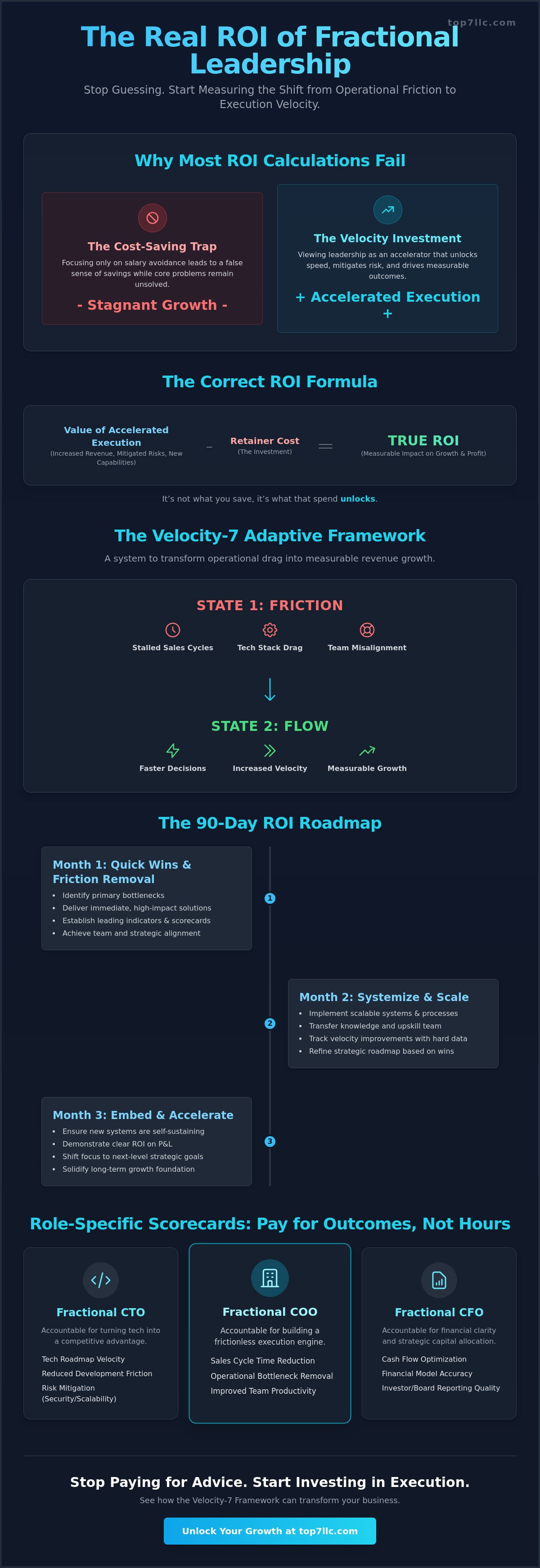
The true formula for measuring roi of a fractional executive is the Value of Accelerated Execution minus the Retainer Cost. Every day your product team waits for a technical roadmap or your sales cycle stalls due to poor operations, you're paying an invisible tax. We call this Operational Friction. It's the silent killer of startups and mid-market firms alike. When you hire a Top7 executive, you aren't just buying hours. You're buying the elimination of that friction through Strategic Lift, Risk Mitigation, and Capability Transfer.
To better understand how these roles are reshaping the modern business landscape, watch this helpful video:
The ROI Formula: Beyond the Spreadsheet
Standard Return on Investment (ROI) calculations often ignore the most critical variable in growth: Outcome Velocity. This is the speed at which a project moves from a whiteboard idea to a profit-generating asset. Hard ROI is easy to track through direct revenue or cost reduction, but Soft ROI, like improved team morale and cultural alignment, creates the foundation for long-term dominance. Ask yourself: is your current leadership gap costing you more in missed opportunities than a high-tier fractional partner would cost in fees? For most, the answer is a resounding yes.
Leading vs. Lagging Indicators of Success
Waiting for the year-end P&L to judge your Fractional CTO or COO is a strategic blunder. Revenue is a lagging indicator; it tells you what happened six months ago. To truly master measuring roi of a fractional executive, you must track leading indicators. Are decisions being made faster? Have you identified and cleared the primary bottlenecks in your sales funnel? Is your team finally aligned on a single source of truth? ROI is the measurable acceleration of your strategic goals. If the needle isn't moving within the first 30 days, you don't have a leadership problem; you have an execution problem.
The Velocity-7 Metric: Measuring the Shift from Friction to Flow
Why are you still measuring success with 20th-century yardsticks? Traditional KPIs tell you where you've been, not how fast you're going. If you want to master measuring roi of a fractional executive, you need to stop looking at static revenue and start looking at velocity. At Top7, we deploy the proprietary Velocity-7 Adaptive Framework to dismantle the invisible walls slowing your growth. Most firms are bleeding cash because of friction in their tech stacks, sales cycles, or financial reporting. In high-pressure markets like Austin or Boston, where the tech talent war is a bloodbath, you can't afford a slow leadership response. You need a system that turns drag into momentum.
The transition from "Friction" to "Flow" is a quantifiable event. It’s the moment your team stops asking "what do we do?" and starts asking "how fast can we ship?" Standard methods for calculating fractional executive ROI often miss the mark by ignoring this organizational flow. When a fractional leader identifies a bottleneck in your sales funnel and clears it, the ROI isn't just the immediate sale. It's the increased capacity for every future sale. If your current leadership can't define their impact in terms of flow, you're just paying for a title. You can evaluate your own organizational speed through our Strategic Planning services to see where the gears are grinding.
The Seven Dimensions of Growth Impact
The Velocity-7 Framework audits seven critical dimensions: Strategy, Leadership, Operations, Finance, Technology, Sales, and Product. We assign a "Friction Score" from 1 to 10 to each area before an engagement begins. This creates a baseline for measuring roi of a fractional executive that is rooted in hard data. Consider this: a 20% reduction in operational friction doesn't just save a few hours. It often translates to a 15-25% increase in bottom-line margin by reclaiming lost productivity and reducing time-to-market. That's the difference between surviving and dominating.
Agile Transformation as an ROI Driver
Agile leadership isn't just a buzzword for software developers; it's a survival requirement for modern organizations. We measure success through "Pivot Speed." This is the time it takes for your company to react to a market shift or a competitor's move. A high-tier fractional leader ensures your business isn't a tanker ship trying to turn in a canal. In 2026, adaptability is the highest form of executive ROI. If you can't pivot in days instead of months, your ROI is already negative. Precision execution beats broad advice every single time.
Role-Specific Scorecards: Measuring the CTO, COO, and CFO
Stop measuring your C-suite by their presence and start measuring them by their impact. A title is worthless if it doesn't move the needle. When you're measuring roi of a fractional executive, you must abandon tactical checklists. Competitors will tell you to track a CTO's uptime or a COO's meeting attendance. That's amateur hour. Real ROI comes from business outcomes, not completed tasks. At Top7, we don't believe in advisory fluff. We embed our leaders directly into your team to ensure Capability Transfer happens in real-time. This creates a Multiplier Effect where one high-tier leader raises the performance ceiling of your entire permanent staff.
The difference between a consultant and an embedded leader is skin in the game. If your executive isn't driving the strategy and owning the results, you're just paying for an expensive second opinion. You need a scorecard that reflects the raw business reality of your market. Whether it's tech, ops, or finance, every role must justify its retainer through measurable acceleration.
The Fractional CTO: Tech as a Profit Center
A Fractional CTO isn't a glorified lead developer. If they're spending 40 hours a week writing code, you've failed the ROI test. You measure a CTO by their ability to turn technology into a profit center. Key metrics include the reduction in technical debt that's currently strangling your speed and the execution velocity of your product roadmap. Did they make the right "Build vs. Buy" decisions? A single bad tech investment can cost you hundreds of thousands; avoiding that mistake is immediate ROI. We also track the "Security Delta," which quantifies the value of avoided breaches and compliance fines through proactive architecture.
The Fractional COO & CFO: Operations and Capital
Operations and finance are the lungs of your business. If they're shallow, you'll suffocate during a growth spurt. When measuring roi of a fractional executive in these roles, focus on Flow Efficiency and capital strategy. A COO's success is visible in process automation rates and the direct reduction of customer churn. If they aren't clearing bottlenecks, they aren't doing their job. For the CFO, we look at runway extension and forecast accuracy. Are you optimizing your capital strategy or just burning through cash? Our Velocity-7 framework unifies these metrics, ensuring that your operations and finance teams aren't working in silos but are sprinting toward the same profit goals. Precision execution beats broad advice every single time.
The 90-Day ROI Roadmap: What to Expect and When
If your new leadership hire spends the first thirty days "learning the culture," you've already lost. High-velocity growth doesn't have a honeymoon period. Competitors often suggest a passive 30-60-90 day ramp-up, but that's a recipe for stagnation. At Top7, our executives embed with an aggressive execution mandate from day one. We don't just consult from the sidelines; we solve problems in the trenches. Measuring roi of a fractional executive requires a timeline that prioritizes speed and structural change over vague observations.
Our roadmap is built on three distinct phases of impact. From day 1 to 30, we focus on Friction Identification. This is the "Quick Wins" phase where we stop the bleeding. From day 31 to 60, we move into Systems Building to create "Structural ROI." Finally, from day 61 to 90, we focus on Optimization and Capability Transfer. By the end of three months, your business shouldn't just be performing better; it should be fundamentally different. If you're ready to stop the leaks and start scaling, you can explore our Interim Leadership solutions to see how we hit the ground running.
Month 1: Stopping the Bleeding
Month one isn't for coffee chats. It's about identifying the immediate "holes" where your money, time, or talent is leaking. We measure ROI in this initial phase by the value of "Decisions Made." Think about the strategic pivots or technical choices that have been stalled for months. A Top7 leader forces these to a resolution. This aggressive pace does more than just fix problems; it establishes executive trust. When the team sees roadblocks disappearing, alignment follows. You aren't paying for a report; you're paying for the removal of the obstacles that were killing your momentum.
Month 3 and Beyond: Scaling the Multiplier
By the third month, the focus shifts to sustainability. Real measuring roi of a fractional executive looks at Capability Transfer. Is your permanent team more capable than they were 90 days ago? A true leader creates ROI by making themselves replaceable, not by building a dependency. We build the systems, document the processes, and train your staff to maintain the new standard of excellence. Long-term ROI is the permanent elevation of your company’s "Floor." Even after the engagement ends, the higher baseline of execution remains, ensuring that your growth isn't a temporary spike but a new operational reality.
Beyond the Retainer: Why Top7’s Velocity-7 Framework Guarantees Results
Most businesses are tired of paying for advice that sits on a shelf. If you wanted a lecture, you'd go back to business school. If you want results, you need the "Navy SEALs" of fractional leadership. The market is flooded with consultants who offer an "advisory-only" model, keeping their hands clean while your team struggles to execute. Top7 is different. We don't just point at the mountain; we lead the climb. When measuring roi of a fractional executive, the ultimate metric is the transition from organizational friction to high-velocity flow.
Our Velocity-7 Adaptive Framework isn't a suggestion; it's a precision instrument for growth. It moves beyond the tactical checklists of our competitors to address the systemic drag that keeps mid-market companies from scaling. By embedding directly into your operations, our leaders ensure that every strategic initiative is backed by Advanced Project Management. We don't let strategies die on the vine. We push them through to the profit-generating finish line. This level of commitment is why we don't just talk about ROI; we guarantee the systems that produce it.
The Velocity-7 Advantage
The US mid-market is a unique battlefield. Scaling a $20 million company to $100 million requires more than just "more of the same"; it requires a cross-functional synchronicity that most firms lack. Our framework provides access to a unified front of expertise, whether you need a Fractional CTO, COO, or CFO. Because these roles operate under the same Velocity-7 methodology, you eliminate the inter-departmental friction that usually kills growth. This unified approach is why measuring roi of a fractional executive from Top7 is so straightforward. The results are visible in every department simultaneously, creating a cohesive engine of execution.
Ready for High-Velocity Growth?
The highest ROI you'll ever achieve is the one you haven't captured yet. It's the profit locked behind inefficient processes, technical debt, and stagnant capital strategies. You can't fix these problems with part-time oversight. You fix them with a growth engine. It's time to stop guessing and start auditing. Use our methodology to identify exactly where your leadership gap is costing you market share. Precision execution is the only way forward in a 2026 economy that doesn't forgive hesitation. Don't settle for a consultant when you can hire a leader who owns the outcome.
Schedule a strategy call with a Top7 executive to audit your Velocity-7 dimensions.
Stop Subsidizing Stagnation and Start Owning the Market
Leadership spend is only a liability if you're paying for opinions instead of outcomes. You now have the framework to stop guessing and start measuring roi of a fractional executive through the lens of pure execution velocity. True ROI isn't found in a spreadsheet comparison of salaries; it's found in the friction you remove and the market share you capture while your competitors are still debating their next move.
Top7 brings seasoned C-suite professionals with decades of experience directly into your trenches. Our proprietary Velocity-7 Adaptive Framework is specifically engineered for mid-market companies across the US Northeast, Midwest, and West Coast that demand precision over fluff. We've laid out the 90-day roadmap. We've defined the role-specific scorecards. Now, the only variable left is your willingness to act. Stop settling for advisory models and start demanding the embedded execution that shifts your business from friction to flow.
Stop leaking revenue and start scaling with a Top7 Fractional Executive.
The growth you want is waiting on the other side of the leadership gap you've been ignoring. Let's close it.
Frequently Asked Questions
Is the ROI of a fractional executive higher than a full-time hire?
Yes, because you're buying elite talent without the $300,000+ total compensation package of a full-time C-suite hire. You eliminate the costs of benefits, equity, and long-term severance while gaining the same strategic horsepower. The ROI is inherently higher because you're paying for pure execution rather than administrative overhead or office politics.
How soon should I see a return on investment from a fractional CTO or COO?
You should see a measurable return within the first 30 days. If your fractional leader doesn't identify a major friction point or clear a stalled decision in the first month, they're just an expensive passenger. Month one is about "Stopping the Bleeding," and any seasoned leader will find enough quick wins to justify their initial retainer immediately.
What are the top 3 KPIs for a fractional CFO in a mid-market company?
Focus on runway extension, capital strategy optimization, and forecast accuracy. These aren't just accounting tasks; they're the metrics that directly impact your valuation and ability to scale. A high-tier CFO ensures your capital is working for you, not just sitting in a bank account or leaking through inefficient spend.
How does the Velocity-7 Framework measure "intangible" leadership value?
We don't believe in intangibles. The Velocity-7 Framework assigns "Friction Scores" to dimensions like Strategy and Leadership, turning gut feelings into hard data. If a leader improves team alignment, we measure it by the increased speed of project completion. Leadership value is only real if it results in faster execution and higher profit margins.
Can I measure the ROI of a fractional executive if my revenue is currently flat?
Absolutely. When revenue is flat, measuring roi of a fractional executive focuses on cost reduction, operational efficiency, and the identification of growth bottlenecks. ROI in this context is the delta between your current stagnation and the scalable foundation the leader builds. You're paying to fix the engine so it can actually handle the fuel of new marketing spend.
What happens to ROI if the fractional executive leaves after 6 months?
The ROI is preserved through "Capability Transfer." A Top7 leader doesn't create a dependency; they build systems and train your permanent team to maintain the new standard. If they've done their job, the company's operational "floor" is permanently elevated. The ROI continues long after the engagement ends because the improved processes remain in place.
How do I justify the cost of a fractional executive to my board of directors?
Present it as a risk mitigation and speed-to-market play. Contrast the monthly retainer against the massive opportunity cost of leaving a leadership seat vacant or making a bad full-time hire. Boards value the flexibility of the fractional model and the fact that you're hiring a growth engine rather than a long-term liability.
Does a fractional executive provide better ROI than a traditional consulting firm?
Yes, because of "Embedded Execution." Traditional consultants deliver a slide deck and an invoice, then leave the implementation to your already overworked team. measuring roi of a fractional executive is easier because they are part of the team, owning the results and driving the strategy through to completion. You aren't paying for advice; you're paying for someone to do the work.


Comments