
Managing Technical Debt Strategy: A CEO’s Guide to Reclaiming Market Velocity
- Robert Fitzgerald
- Jun 1
- 12 min read

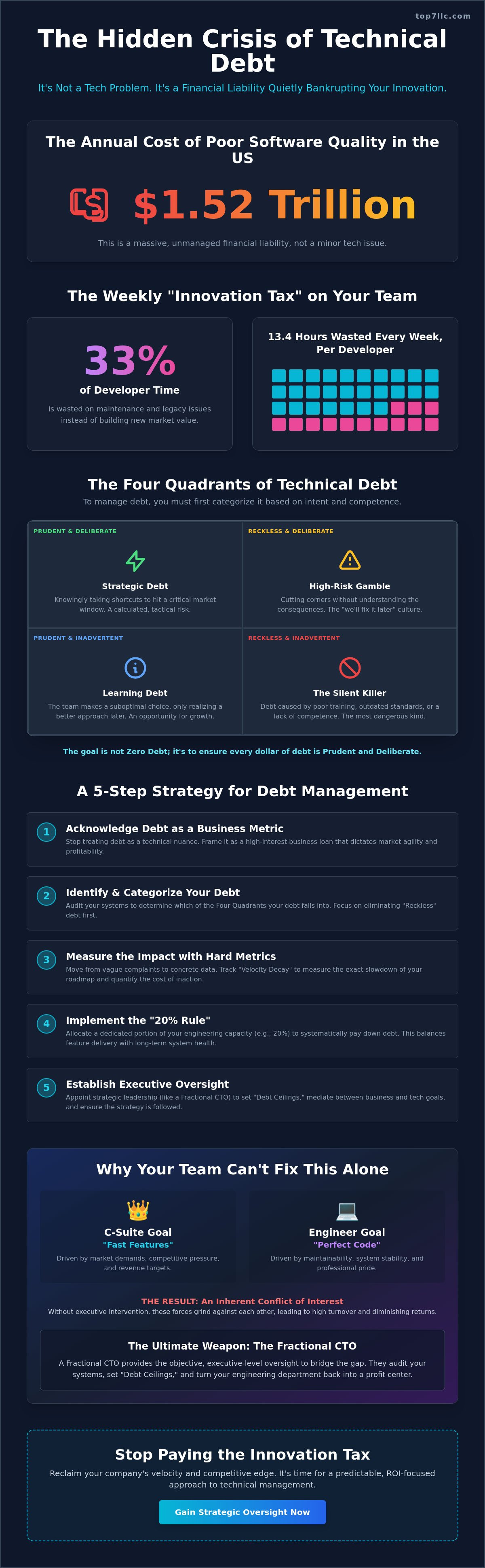
Did you know that $1.52 trillion of the annual cost of poor software quality in the US is tied directly to technical debt? It's not a coding nuance or a minor tech issue. It's a massive, unmanaged financial liability sitting on your balance sheet, quietly bankrupting your company's ability to innovate. If you aren't aggressively managing technical debt strategy, you're essentially paying a 33 percent "innovation tax" every single week. That's over 13 hours per developer, every week, wasted on maintenance instead of building market value.
You're likely seeing the symptoms already. Your product roadmap is slipping, your best engineers are quitting out of frustration, and your IT costs are ballooning while your output stalls. It's a cycle that kills market leaders. We're going to stop treating this like a back-office problem and start treating it like the strategic crisis it is. This guide provides a clear framework to balance aggressive feature delivery with system health. You'll learn how to turn your engineering department back into a profit center by implementing a predictable, ROI-focused approach to technical management. It's time to reclaim your velocity and stop letting legacy baggage dictate your future.
Key Takeaways
Stop viewing code quality as a technical nuance and start treating it as a high-interest business loan that dictates your market agility.
Implement a high-performance managing technical debt strategy by applying the "20% Rule" to balance aggressive feature delivery with long-term system health.
Shift from vague engineering complaints to hard business metrics by tracking "Velocity Decay" to measure the exact slowdown of your product roadmap.
Identify which of the four quadrants of debt is siphoning your profits and learn why "Zero Debt" is actually a dangerous business goal.
Leverage a Fractional CTO to gain the objective, executive-level oversight required to audit your systems and reclaim your competitive edge.
Table of Contents
Technical Debt: The High-Interest Business Loan Siphoning Your Profits
Stop pretending your developers are just "slow" or that your roadmap delays are bad luck. Technical debt isn't a coding nuance; it's a high-interest business loan that you've likely been co-signing for years. At its core, a foundational understanding of technical debt reveals it as the implied cost of choosing an easy, inferior solution today over a robust approach that takes longer. It’s a trade-off. You trade future engineering capacity for present-day speed. The problem? Most CEOs don't realize they're paying 33% interest on that trade every single week.
Research confirms that developers spend an average of 13.4 hours per week dealing with maintenance and legacy issues instead of building new value. That is your "interest" payment. If you only pay the minimum by ignoring the underlying rot, your market velocity will eventually hit zero. However, aiming for "Zero Debt" is a fool's errand and a terrible business goal. A company with no debt is likely a company that moves too slowly to survive. The goal isn't to eliminate debt; it's managing technical debt strategy so the interest doesn't swallow your EBITDA.
To better understand how this siphons your profits, watch this breakdown of the hidden costs:
The Difference Between Intentional and Unintentional Debt
Not all debt is created equal. Intentional debt is a tactical weapon. Think of a Boston-based startup rushing an MVP to hit a specific trade show deadline; they take shortcuts knowingly to capture a market window. That's a calculated risk. Unintentional debt, however, is the silent killer. It’s caused by poor training, outdated standards, or shifting requirements that leave old code irrelevant. For mid-market firms, this accidental complexity is what causes 81% of executives to report that technical debt is the primary constraint on their AI initiatives and modernization efforts.
Why Your Engineering Team Can’t Fix This Alone
There's an inherent conflict of interest at play. Your engineers want "perfect" code because they have to live in it. You want "fast" features because you have to live in the market. Without executive intervention, these two forces just grind against each other, resulting in high developer turnover and diminishing returns on IT spend. Managing technical debt strategy requires a bridge between the C-suite and the IDE. You need strategic leadership to set "Debt Ceilings" that define exactly how much friction the business is willing to tolerate before feature work stops and refactoring begins. This isn't a technical task; it's an operational mandate.
The Four Quadrants of Technical Debt: Which One Is Killing Your Growth?
Most CEOs treat technical debt like a single, messy pile of bad code. That's a fundamental misunderstanding. To succeed in managing technical debt strategy, you have to categorize your liabilities based on intent and competence. Think of it as a 2x2 matrix. On one side, you have Prudent vs. Reckless. On the other, Deliberate vs. Inadvertent. If your team is taking shortcuts because they don't know any better, that's Inadvertent debt. It's the most dangerous kind because you don't even know you're borrowing. But if you're taking a shortcut to hit a market window, that's Deliberate. The goal isn't to be debt-free. It's to ensure every dollar of debt is Prudent and Deliberate.
Where does your company currently reside? If you can't answer that, you're likely drifting toward the Reckless quadrants. This is where growth dies. Identifying your position requires a cold, hard look at your engineering output versus your original estimates. When the gap between "what we planned" and "what we shipped" grows every quarter, you've lost control of the matrix.
The Reckless Debt Trap in High-Growth Markets
In competitive tech hubs like Austin or the West Coast, the "move fast and break things" mantra has become an excuse for "Amateur Hour" engineering. Firms rush for Series B or C funding by duct-taping features together, ignoring architectural integrity. This Reckless debt doesn't just slow down your releases; it poisons your culture. Senior developers, the ones you can't afford to lose, will quit when they realize 50% of their sprint is spent on basic bug fixes caused by sloppy shortcuts. If your team is drowning in Reckless debt, you aren't scaling. You're just vibrating in place while your burn rate explodes.
The Prudent Path: Strategic Debt as a Competitive Advantage
Sometimes, taking on debt is the only way to win. If capturing a specific market window requires a dirty hack today, you do it. But there's a condition: you need a "Debt Repayment Plan" signed off before the first line of code is written. You treat it like a bridge loan, not a permanent lifestyle. Following expert recommendations for managing technical debt means you must embed governance into your daily operations. You need to know exactly when and how you'll refactor that shortcut.
Most full-time CTOs are too close to the code to be objective about these trade-offs. They either demand perfection and miss the market window, or they've become blind to the mess. This is where Advisory Services from an outside perspective become a force multiplier. A Fractional CTO acts as a strategic arbiter, ensuring that every piece of debt you take on is a conscious choice aimed at profit, not a byproduct of incompetence. They provide the "outside-in" audit required to keep your engineering team focused on high-velocity, prudent growth.
Measuring the Impact: Moving From Vague Frustrations to Hard Metrics
"How much debt do we have?" is a question for the basement. For the boardroom, the only question that matters is: "How much is this debt siphoning from our EBITDA?" You must stop tolerating vague engineering complaints and start demanding hard financial data. The most effective way to quantify this is through Velocity Decay. If your team delivered 10 features per month last year and only six this year with the same headcount, you have 40% Velocity Decay. That is a 40% drop in ROI on your engineering spend. You are paying for a Ferrari but getting the speed of a tractor.
Another critical metric is your Debt-to-Innovation Ratio. Look at your payroll. If 40% of your IT budget is diverted to resolving issues related to technical debt, you aren't a tech-forward company; you're a high-priced maintenance shop. Aligning your internal reporting with SEI's recommendations for managing technical debt allows you to transform these invisible costs into a line item that can be managed, audited, and reduced. When you treat managing technical debt strategy as a financial discipline, you gain the leverage needed to reclaim your market position.
The CEO Dashboard for Technical Health
You don't need to read code to understand system health. You need to track three non-technical KPIs: Lead Time (concept to cash), Deployment Frequency (market agility), and Change Failure Rate (quality). If your Lead Time is stretching from weeks into months, your debt is reaching critical mass. These numbers provide the objective reality you need to justify "Debt Sprints" to stakeholders. If the Change Failure Rate is climbing, your system is fragile. High fragility means you can't pivot. If you can't pivot, you lose to the competitor who can.
The Human Cost: Developer Burnout and Turnover
Top-tier engineers in competitive markets like Chicago or Boston don't leave for an extra $10k. They leave because they're tired of being "digital janitors." High debt creates a "Legacy Code Tax" that makes every new hire less productive and every veteran more likely to quit. When a senior developer who "knows where the bodies are buried" leaves, you lose more than just a headcount; you lose institutional knowledge that can take six months to replace. Recruiting costs explode when your tech stack is a mess. You aren't just paying for the code; you're paying for the frustration it causes your most valuable assets.
A 5-Step Strategy for Systematic Technical Debt Management
Stop treating your technology stack like a black box that only engineers can open. To reclaim your market velocity, you must transition from reactive firefighting to a disciplined, operational cadence. Successful leaders don't just "clean up code"; they implement a managing technical debt strategy that treats every shortcut as a high-interest business loan. This requires a shift in how you allocate your most expensive resource: engineering hours. If you don't dictate the terms of your debt repayment, the debt will eventually dictate your company's survival.
Step 1 & 2: Auditing and Categorizing the Mess
Execution begins with a "no-blame" audit of your technology estate. If your developers fear punishment for past shortcuts, they will hide the rot until it causes a system-wide collapse. You must incentivize transparency. Categorize every identified issue by Business Risk rather than technical complexity. A piece of "ugly" code that stays in a stable, rarely touched module is a low priority. However, brittle code in your core revenue-generating engine is a critical liability that demands immediate attention. The Debt Registry is a living financial ledger where every shortcut is documented, priced by its impact on velocity, and tracked until repayment.
Step 3-5: Execution and Cultural Shift
The "Feature vs. Fix" argument is a false dichotomy that kills mid-market firms. You must train your Product Owners to understand that refactoring is an investment in future capacity, not a distraction from it. Implement the 20% Rule: mandate that 20% of every sprint is dedicated to debt repayment and system health. This ensures you never hit technical bankruptcy. Furthermore, use your CI/CD pipeline to automate guardrails, preventing reckless new debt from entering the system in the first place.
Finally, avoid the "Big Rewrite" trap at all costs. Scrapping everything to start from scratch is a strategic gamble that usually results in two years of zero feature delivery and a new system that eventually develops the same problems. Instead, use an incremental approach. Focus on value-based prioritization, fixing only the debt that directly blocks revenue or slows down high-priority roadmaps. This disciplined, operational flow is a core component of the Strategic Planning required to maintain a competitive edge.
To ensure this strategy sticks, conduct a Quarterly Tech Audit using a "Velocity-7" approach. This isn't a deep dive into the code itself; it's an executive review of your delivery metrics. Are you moving faster or slower than last quarter? If the trend is downward, your debt registry is growing too heavy. You don't need to be a coder to see the numbers. You just need the backbone to enforce the repayment schedule before your innovation budget is completely consumed by interest.
Why a Fractional CTO is the Ultimate Weapon Against Technical Bankruptcy
Mid-market CEOs face a brutal dilemma. You're too big to let your lead developer wing it, but too small to drop $300,000 on a full-time executive. This leadership gap is where innovation dies and technical debt thrives. Without a high-level managing technical debt strategy, your engineering team is effectively operating without a CFO. They're spending your most valuable capital on maintenance and "clean code" fantasies instead of market-winning features. You need someone to bridge the gap between the boardroom and the IDE.
A Fractional CTO solves this by providing the objective, outside perspective required to audit your systems without internal bias. We don't just point at problems; we implement the Velocity-7 Adaptive Framework to transform your friction into efficient flow. This isn't theoretical. Our approach helps US-based companies reclaim 30% or more of their development capacity. That's like getting four months of free engineering work every year just by fixing your operational leaks.
Fractional Leadership vs. Traditional Consulting
Consultants are famous for handing over a 50 page report and then disappearing before the hard work starts. A Fractional CTO is different. We embed into your C-suite and execute the repayment strategy. In high-stakes markets like Dallas, Austin, or the Northeast, the cost-benefit is undeniable. You get battle-tested leadership for a fraction of the full-time cost. Having a peer-level executive managing the tech team changes the dynamic from "us vs. them" to a unified, profit-driven machine. It's about accountability, not just advice.
Getting Started: The 90-Day Velocity Recovery Roadmap
Recovery doesn't happen overnight, but it starts with a 90-Day Velocity Recovery Roadmap. The first 30 days are about transparency. We conduct a deep-dive audit using the Velocity-7 framework to find exactly where your budget is leaking. We identify "Quick Wins"—high-impact, low-effort fixes that restore faith in the engineering team and prove immediate ROI. By day 90, your team isn't just shipping code; they're shipping value at a predictable, accelerated pace. Stop letting tech debt kill your growth—schedule a Velocity-7 audit today.
Stop Paying the Innovation Tax and Start Dominating the Market
Technical debt isn't a "tech problem" your developers will eventually get around to fixing. It's a boardroom crisis that's currently siphoning your profits and stalling your roadmap. If you don't take command of managing technical debt strategy, the interest on your legacy systems will eventually consume your entire innovation budget. You've seen the metrics and you've seen the quadrants. Now, you have to decide if you're going to keep paying the minimum or if you're going to liquidate your liabilities and reclaim your market velocity.
Top7 provides the seasoned executives you need to lead this charge. We don't just offer advice; we embed directly into your leadership team to execute. Using our proprietary Velocity-7 Adaptive Framework, we help mid-market firms purge the friction that kills growth. It's time to stop guessing and start measuring. Reclaim Your Engineering Velocity with a Top7 Fractional CTO and turn your engineering department back into a high-performance profit center. The market is moving fast. It's time you did too.
Frequently Asked Questions
How do I know if my company has a technical debt problem?
Look at your velocity decay and change failure rate over the last 12 months. If simple feature requests that used to take one week now take three, you're drowning in debt. High developer turnover and a growing percentage of "invisible" maintenance work are clear indicators that your system is reaching technical bankruptcy. When your team spends more time fixing bugs than shipping value, the debt has already won.
What is a healthy percentage of time to spend on technical debt?
The gold standard for high-growth companies is 20 percent of every sprint dedicated to system health. This isn't "extra" work; it's a mandatory reinvestment in your engineering capacity. A disciplined managing technical debt strategy ensures you never hit the wall where innovation stops entirely. Think of it as an insurance policy that keeps your market velocity predictable and your team productive.
Should we stop all new feature development to fix our tech debt?
No, that's a strategic suicide mission that hands your market share to competitors. You cannot afford a six month feature blackout while you "clean things up." The solution is incremental repayment. You must bake debt reduction into your daily operations. This allows you to maintain a steady stream of revenue generating features while slowly liquidating the liabilities that slow you down.
How do I explain the need for debt repayment to non-technical board members?
Stop using technical jargon and start using financial metaphors. Frame it as a high-interest bridge loan that is currently siphoning 33 percent of your engineering payroll into "interest payments" (maintenance). Explain that ignoring this debt is a direct hit to EBITDA and future valuation. When the board understands that debt repayment is a strategy for profit maximization, the budget conversation changes instantly.
Is it better to refactor existing code or rewrite the entire system?
Refactoring is almost always the superior choice for mid-market firms. A total rewrite is a high-risk gamble that usually results in two years of zero output and a new system with the same old problems. Incremental refactoring provides immediate ROI and allows you to keep shipping value. Only consider a rewrite if the underlying technology is truly obsolete and unsupportable.
How does a Fractional CTO differ from a Project Manager in managing debt?
A Project Manager tracks the "when," but a Fractional CTO manages the "why" and the "how much." You need executive level managing technical debt strategy to align engineering output with your business goals. While a PM handles the schedule, a Fractional CTO audits the architectural integrity and ensures your tech spend is actually building equity instead of just covering interest.
Can AI tools actually solve our technical debt for us?
AI is a tactical tool, not a strategic savior. While AI powered assistants can accelerate refactoring, they're also creating a new wave of "AI-driven technical debt" through subtle architectural misalignments. Use AI to speed up the execution of your debt repayment plan. Don't expect it to replace the high level governance and strategic decision making required to keep your systems healthy.
What are the first steps to take if our development velocity has hit a wall?
Conduct a "no-blame" audit and establish a Debt Registry immediately. You can't manage what you haven't measured. Identify the specific bottlenecks that are blocking the most revenue and prioritize those for the next three sprints. Once you've identified the rot, you can implement a structured repayment plan that restores faith in your engineering team and gets your roadmap moving again.


Comments