
Managing Finances During Rapid Growth: Why Most Mid-Market Companies Fail at the Finish Line

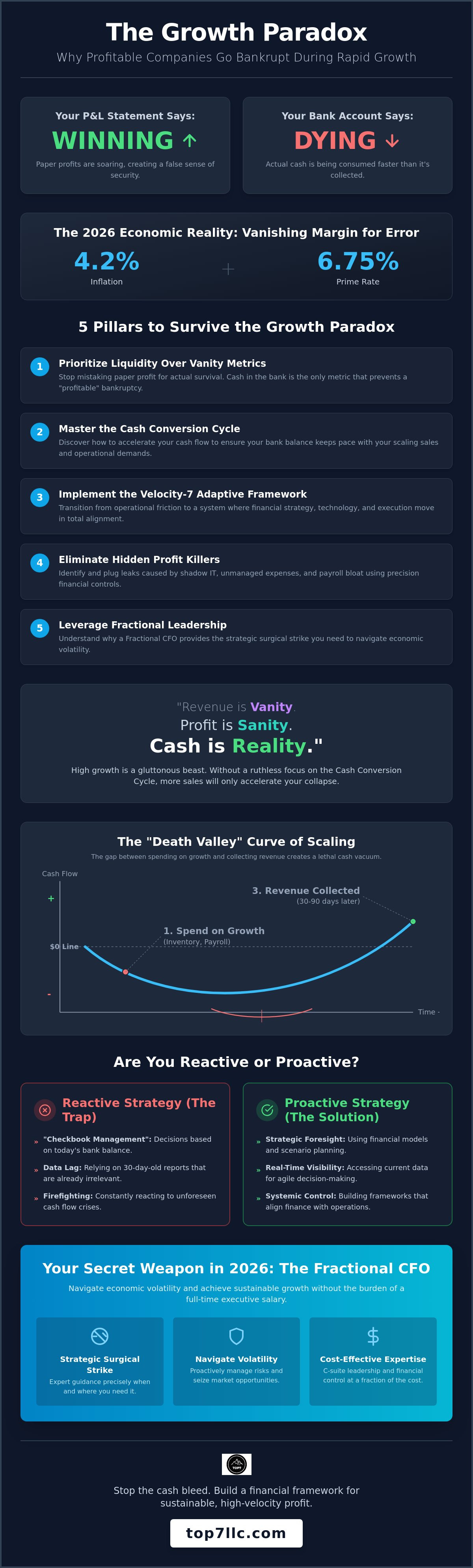
Your P&L statement says you're winning, but your bank account says you're dying. It's a brutal paradox: you're profitable on paper, yet you have zero cash to fund the next move. This isn't just a simple growing pain. It's a structural failure that sends mid-market companies into a death spiral right when they should be dominant. You're likely exhausted from being the sole gatekeeper for every dollar spent while staring at financial data that's already thirty days irrelevant. If you're tired of managing finances during rapid growth by gut feeling and guesswork, you're in the right place.
We're stripping away the accounting jargon to focus on the raw business reality of 2026. With inflation sitting at 4.2 percent and the prime rate at 6.75 percent, your margin for error has evaporated. You need more than a bookkeeper; you need a strategic offensive. This article promises to help you stop the cash bleed and master the financial frameworks required to turn chaotic expansion into sustainable, high-velocity profit. We'll preview the shift from reactive reporting to real-time visibility and show you how to build a strategic roadmap that finally aligns your finance department with your operational goals.
Table of Contents
The Lethal Growth Paradox: Why Being Profitable Does Not Mean You Are Safe
Cash Flow vs. Revenue: The Only Metric That Prevents a Growth Implosion
The Velocity-7 Approach to Financial Scaling: 5 Pillars of Stability
Plugging the Leaks: Financial Controls and Automation for High-Speed Scaling
Scaling the C-Suite: Why a Fractional CFO is Your Secret Weapon in 2026
The Lethal Growth Paradox: Why Being Profitable Does Not Mean You Are Safe
Most founders treat a rising sales graph like a green light. It isn't. It's often a warning flare. The Growth Paradox is a cold, mathematical reality: as your sales volume explodes, your liquidity often implodes. You're paying for inventory, scaling your team, and funding infrastructure today, but your customers might not pay you for 30, 60, or 90 days. This creates a cash vacuum that can swallow a company whole. Mastering the fundamentals of corporate finance is no longer an academic exercise; it's your only shield against a "profitable" bankruptcy.
To better understand how high-level players manage these financial dynamics, watch this helpful video:
Paper profit is a vanity metric. It's an accounting fiction that looks great on a slide deck but won't pay your vendors. Real-world scaling hits three lethal friction points: inventory lag, immediate payroll spikes, and the 21 percent federal corporate tax liability that arrives regardless of your bank balance. Traditional accounting tells you what happened last month. Strategic finance tells you what's going to kill you next month. If you aren't looking forward, you're just waiting for the crash.
The "Death Valley" Curve of Scaling
The Death Valley curve is the brutal gap between spending on growth and actually collecting revenue. In the 2026 labor market, rapid hiring creates immediate, massive cash pressure. Mid-market companies in the US are uniquely vulnerable to this gap. You don't have the bottomless credit lines of enterprise giants, yet you've outgrown the lean agility of a startup. You're caught in the middle. Without precise control, that's where you'll stay.
Signs Your Financial Strategy is Reactive, Not Proactive
Are you trapped in "Checkbook Management"? If you have to check your bank balance before making a spending decision, your strategy is already broken. Managing finances during rapid growth requires foresight, not just reaction. Receiving last month's data on the 15th is useless when you're moving at high velocity. Without scenario planning for regional market shifts on the West Coast or the Northeast, you aren't leading a company. You're just reacting to a crisis you didn't see coming.
Cash Flow vs. Revenue: The Only Metric That Prevents a Growth Implosion
Revenue is vanity. Profit is sanity. Cash is reality. If you're popping champagne over a fifty percent revenue spike while your operating account is bone dry, you're celebrating your own funeral. High growth is a gluttonous beast that eats cash for breakfast, lunch, and dinner. Many founders fall into the trap of thinking more sales will solve a liquidity crisis. It won't. In fact, without a ruthless focus on the Cash Conversion Cycle, more sales will only accelerate your collapse. You aren't just managing finances during rapid growth; you're managing the very survival of your entity.
The most common objection heard in boardrooms is "We have plenty of sales, we just need a larger line of credit." This is a fundamental misunderstanding of the problem. In June 2026, with the prime rate holding at 6.75 percent and SBA 7(a) loans for mid-market amounts carrying an APR near 9.0 percent, debt is an expensive bandage, not a cure. You cannot borrow your way out of a broken operational model. Relying on credit to bridge a widening gap between spending and collection is a high-stakes gamble that most companies lose. Real leadership involves building financial controls that generate internal liquidity rather than chasing external debt.
Operational friction in the US supply chain further complicates your cash position. With annual inflation at 4.2 percent, the cost of your inputs is likely rising faster than your ability to adjust customer pricing. This lag creates a silent leak. If your team isn't optimized, you're paying for inefficiencies with the cash you need for scaling. If you're ready to stop the bleeding, a Fractional CFO can provide the surgical precision needed to fix these systemic leaks before they become terminal.
Optimizing Your Cash Conversion Cycle
To shorten your cycle, you must be aggressive. Accelerate your Accounts Receivable by offering small incentives for early payment or implementing automated collections. Turn your Accounts Payable into a strategic lever by negotiating longer terms with vendors who value your growth volume. Most importantly, kill the "just in case" inventory mentality. Hoarding stock is just burying your cash in a warehouse where it can't work for you.
Scenario Planning for 2026 Economic Volatility
The 1.6 percent GDP growth rate in Q1 2026 suggests a cooling environment where efficiency beats raw volume every time. You need a "War Chest" that covers at least three to six months of operating expenses, regardless of your projected sales. Working capital is the oxygen of a scaling business. Without it, your growth engine will seize up the moment the market shifts or interest rates tick upward again. Plan for the worst so you can capitalize on the best opportunities.
The Velocity-7 Approach to Financial Scaling: 5 Pillars of Stability
Stop treating your finance department like a back-office utility. If your accounting team is just recording history, they're useless for a company scaling at fifty percent year-over-year. Static spreadsheets and annual budgets are relics. They can't keep up with the speed of a high-velocity business. Successfully managing finances during rapid growth requires a shift from reactive bookkeeping to a strategic offensive. At Top7, we use the Velocity-7 Adaptive Framework to turn operational friction into precision flow. This isn't a generic academic theory. It's a proprietary roadmap designed to integrate financial strategy directly into your technology and operations.
The framework rests on five pillars: Visibility, Control, Agility, Capital Strategy, and Leadership. Most mid-market firms collapse because they excel at one but ignore the rest. You might have great sales leadership, but if your capital strategy is non-existent, you'll hit a ceiling you can't break. Velocity-7 forces these elements into alignment. It ensures that every dollar spent is an investment in further scaling, not just a cost of doing business. This is how you move from surviving the growth to dominating your market share.
Pillar 1 & 2: Visibility and Control
You cannot lead what you cannot see. Establishing a "Single Source of Truth" is the first step. This means your financial data and operational metrics must live in the same ecosystem. If your sales team is looking at one set of numbers while finance looks at another, you're flying blind. We replace dead-on-arrival annual budgets with rolling 13-week forecasts. This provides the clarity needed to make decisions in real-time. Rigid internal controls are then implemented, not to slow down your sales team, but to act as guardrails that prevent reckless spending from eroding your margins.
Pillar 3 & 4: Agility and Capital Strategy
Agility is the ability to reallocate resources dynamically. If a marketing channel shows a massive real-time ROI, you need the systems to shift capital there instantly, not next quarter. This requires a sophisticated capital strategy. In a 2026 environment where the Prime Rate sits at 6.75 percent, the cost of "bad" debt is lethal. We help you identify the right mix of debt and equity for your specific phase. The Velocity-7 framework prevents the common trap of over-leveraging during a boom, ensuring you have the "War Chest" mentioned earlier to survive the inevitable market shifts on the West Coast or the Northeast.
Plugging the Leaks: Financial Controls and Automation for High-Speed Scaling
Growth is a permission slip for sloppiness. When your revenue is climbing, it's easy to ignore the parasites draining your liquidity. Shadow IT, unmanaged expenses, and payroll bloat aren't just minor annoyances; they're the primary reasons mid-market companies fail at the finish line. If you don't have Advanced Project Management keeping your financial initiatives on track, you're just throwing money at chaos. Realizing that managing finances during rapid growth requires ruthless efficiency is the difference between becoming a market leader or a cautionary tale.
Most founders avoid "process" because they fear it will turn them into a slow-moving bureaucracy. This is a false choice. Process isn't red tape. It's the armor that protects your profit. Automation should handle the mundane tasks so your team can focus on strategic execution. If you're still manually approving every five-hundred-dollar expense, you aren't a CEO; you're a bottleneck. You need to automate the predictable to dominate the unpredictable. If your current systems are failing you, it's time to deploy a Fractional COO to rebuild your operational backbone and stop the bleed.
Modernizing the Finance Stack
Your tech stack needs to scale from $10M to $100M without a total teardown. Selecting the right ERP and FP&A tools is critical, but they're useless if they don't talk to your CRM. You need accurate revenue forecasting based on real-time sales data, not optimistic guesses. This is where the synergy between a Fractional CTO and a Fractional CFO becomes your greatest advantage. They ensure your technology supports your financial goals instead of creating more technical debt that drains your resources.
Institutionalizing Financial Discipline
Discipline must be decentralized. You need to set rigid "Guardrails" that allow department heads to manage their own P&Ls without needing your signature for every stapler purchase. We recommend regular "Friction Audits" to identify exactly where money is being wasted in your workflows. Automated controls within your finance stack significantly reduce fraud risk and human error in distributed or remote teams. When managing finances during rapid growth, you cannot afford to wait for a monthly report to catch a discrepancy. By the time you notice a leak manually, the damage is already done. Stop reacting and start building a system that enforces discipline for you.
Scaling the C-Suite: Why a Fractional CFO is Your Secret Weapon in 2026
You are the bottleneck. It's called the "Founder Trap." If every spending decision still requires your signature, you aren't leading; you're obstructing. At this stage, your business has outgrown your gut feeling. Managing finances during rapid growth is a specialized discipline that requires a level of precision your in-house accountant simply doesn't possess. You don't need a placeholder, and you certainly don't need a record-keeper. You need a strategic architect who embeds directly into your operations to drive liquidity and protect your margins.
Fractional leadership is the only way to access elite C-suite expertise without the bloated overhead of a full-time executive. While an interim CFO just keeps the seat warm, a Fractional CFO from Top7 re-engineers your entire financial engine. Industry research indicates that 72 percent of companies with revenues between $3 million and $15 million are now leveraging fractional services. Why? Because it provides a tactical advantage that traditional hiring can't match. You get the strategic firepower of a veteran executive at a fraction of the cost, typically 40 to 60 percent less than a full-time hire.
The Fractional Advantage for Mid-Market Firms
Hiring a full-time CFO with a massive six-figure salary is often a lethal mistake for a company in transition. These executives are usually built for steady-state corporate environments, not the high-velocity chaos of a scale-up. They want to build empires; you need to build cash flow. A fractional leader delivers a speed of impact that is impossible for a traditional hire, often stabilizing turbulent finances within 30 to 90 days. This model gives you total flexibility. You can scale your executive support up or down based on the actual velocity of your growth, ensuring you never pay for capacity you don't use.
The Top7 Difference: Beyond Consulting
We don't just sell advice. Advice is cheap. We sell execution. The Top7 team utilizes the Velocity-7 Adaptive Framework to move your business from friction to flow. Our fractional leaders don't sit on the sidelines; they embed with your team to institutionalize financial discipline. The real power comes from the "Fractional Suite." When our Fractional CFO, Fractional CTO, and Fractional COO work in unison, your technology, operations, and finance become a single, high-performance machine. Profit isn't an accident. It's the result of strategic dominance.
Stop the friction and start the flow with Top7 Fractional Leadership
Master Your Momentum or Become a Statistic
Rapid growth isn't a victory lap. It's a high-stakes stress test that exposes every structural weakness in your operational model. You now understand that paper profits are an accounting fiction and that your cash conversion cycle is the only metric that guarantees survival. Managing finances during rapid growth requires a fundamental shift from recording history to architecting the future. You've outgrown "checkbook management" and reactive bookkeeping. Now, you need a system built for speed.
You can't scale an empire with a bookkeeper's mindset. Our seasoned C-suite professionals bring over 20 years of battle-tested experience to your leadership team. We use our proprietary Velocity-7 Adaptive Framework to move your organization from friction to flow, delivering proven results where others only offer theories. We don't just consult from the sidelines; we embed the strategic controls necessary to turn your current momentum into a permanent market advantage.
Schedule a Velocity-7 Growth Audit with a Top7 Executive to secure your margins and stabilize your trajectory. Your market dominance is within reach. It's time to lead.
Frequently Asked Questions
What is the most common financial mistake companies make during rapid growth?
The most common mistake is scaling sales without scaling liquidity. Most founders ignore the cash conversion cycle and assume more revenue solves a cash crunch. It doesn't. It actually accelerates the drain on your working capital, leading to the "Growth Paradox" where you go broke while becoming more profitable on paper.
How do I know if I need a Fractional CFO or just a better accountant?
An accountant reports what happened; a Fractional CFO tells you what's going to happen. If you're only seeing financial data 30 days after the month ends, you have an accounting function. If you need a strategic roadmap for managing finances during rapid growth, you need a CFO who can provide real-time visibility and forward-looking strategy.
How does the Velocity-7 framework help with cash flow management?
The Velocity-7 Adaptive Framework removes operational friction by aligning your financial strategy with your tech stack and operations. It transitions your business from "checkbook management" to rolling 13-week forecasts. This ensures your cash flow supports your expansion instead of strangling your engine right when you need to accelerate.
Can a Fractional CFO help my business secure growth capital or loans?
Yes, a Fractional CFO is critical for securing capital in the current high-interest environment. With the prime rate holding at 6.75 percent in June 2026, lenders and investors are looking for surgical precision in your financial models. We build the capital strategy and clean up your reporting to make you a low-risk, high-reward target for funding.
What is the difference between an Interim CFO and a Fractional CFO?
An Interim CFO is a full-time placeholder who keeps the engine running until you hire a permanent replacement. A Fractional CFO is a long-term strategic partner. They provide high-level execution on a flexible, part-time schedule, giving you elite C-suite expertise without the massive overhead of a $300k full-time executive salary.
How much time does a Fractional CFO typically spend with a client each month?
The time commitment depends entirely on the "velocity" of your scaling and the complexity of your systems. Most mid-market firms require a few hours of high-impact strategic work each week rather than a full-time presence. This flexibility allows you to scale your executive support up or down as your operational needs shift.
What financial KPIs should I be tracking daily during a growth phase?
You must track your Cash Conversion Cycle (CCC), Days Sales Outstanding (DSO), and net burn rate. In a rapid growth phase, these are your vital signs. If your DSO is creeping up while you're hiring fast, you're heading for a liquidity trap. Managing finances during rapid growth requires watching these metrics with total obsession.
How do you manage financial strategy across multiple US locations like Dallas, Chicago, and Boston?
Managing finances across multiple hubs requires a unified, cloud-based ERP and a single source of truth for all data. We eliminate regional silos by integrating your finance stack across all locations. This allows for localized scenario planning while maintaining centralized control over your global capital strategy and operational flow.
When managing growth across multiple hubs, consistency in branding is just as important as consistency in financial data. For companies expanding into the DFW area, you can learn more about BRAND NEW Promotions | Top Promo Supplier in North Texas to see how specialized promotional materials can support your regional scaling efforts.



Comments