

Is Your Business Actually Healthy? A No-B.S. Financial Health Check for 2026
- Robert Fitzgerald
- Jun 22
- 12 min read

Updated: Jul 1
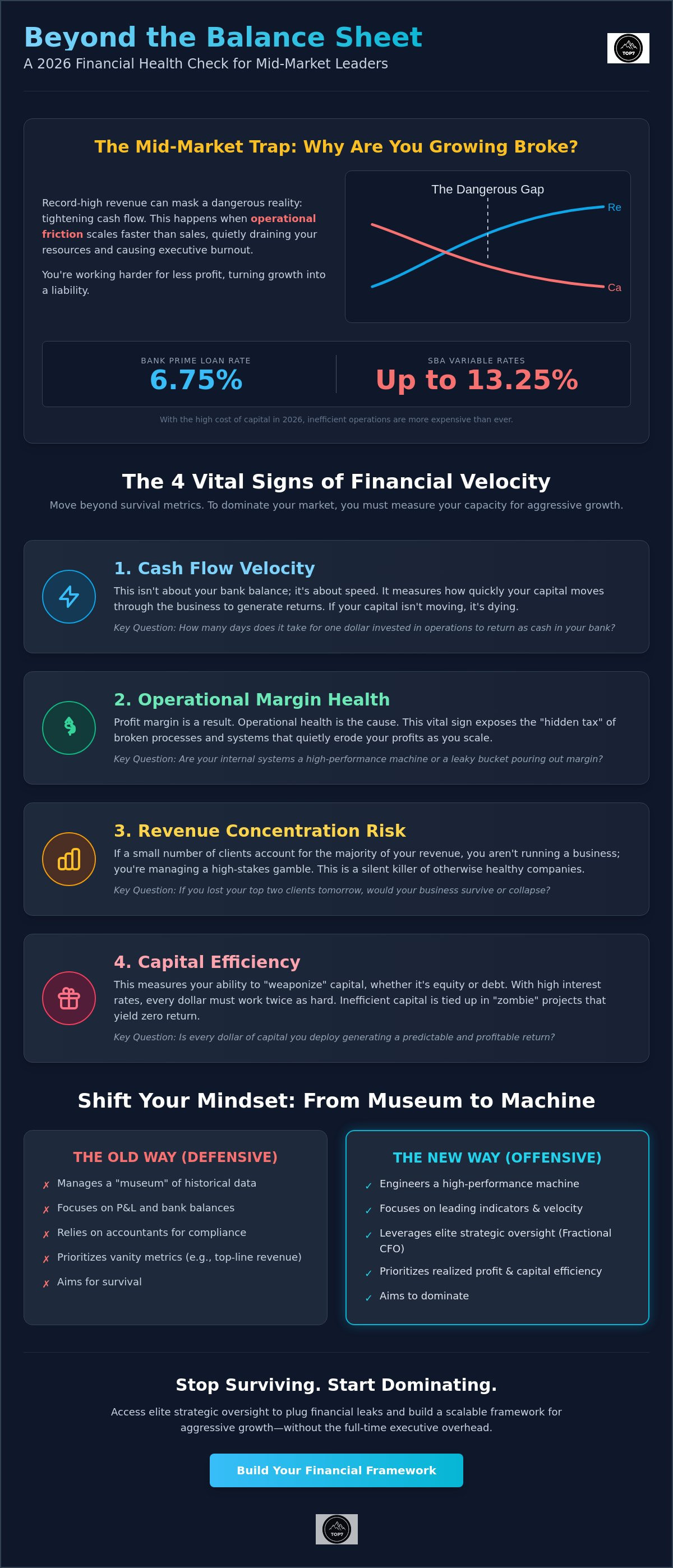
Why is your revenue hitting record highs while your bank account feels like it's on life support? It's a brutal reality for mid-market leaders in 2026. Top-line growth is often just a mask for deep-seated operational friction. With the bank prime loan rate sitting at 6.75% and SBA variable rates climbing as high as 13.25%, the cost of being wrong is higher than ever. You've worked too hard to let hidden costs and a lack of strategy stall your momentum. Performing a rigorous business financial health check isn't just a recommendation. It's the difference between scaling and suffocating under the weight of your own success.
You likely feel the pressure of inflation and labor shortages every single day. We agree that the traditional way of managing finances is dead. This guide is a no-B.S. look at identifying the financial leaks that are quietly draining your resources and causing executive burnout. We'll show you how to move past revenue plateaus by building a scalable financial framework that actually works. We're breaking down how to leverage elite C-suite expertise, from Fractional CFO strategies to the Velocity-7 Adaptive Framework, without the bloated overhead of a full-time executive. Stop surviving. Start dominating.
Table of Contents
Beyond the Spreadsheet: Why Your Current Financial Health Check is Failing You
Most leaders treat their finances like a history lesson. They wait for the accountant to hand over a report that's already thirty days old. By then, the opportunity to pivot has vanished. If your business financial health check consists of just looking at bank balances and tax returns, you aren't managing a company; you're managing a museum. True health isn't about having enough cash to pay the bills. It's the capacity to fund aggressive growth without operational friction. It's about being ready to strike when the market shifts.
Traditional financial statement analysis is useful for compliance, but it's a defensive tool. You need an offensive strategy. In high-growth hubs like Boston or Austin, the speed of the market doesn't wait for your bookkeeper to catch up. With the bank prime loan rate at 6.75% as of June 2026, the cost of capital is too high to waste on stagnant strategies. You need to know if your business is a high-performance machine or a leaky bucket before you try to pour more revenue into it.
To better understand how to evaluate your current standing, watch this helpful video:
The Mid-Market Trap: Revenue vs. Realized Profit
Scaling from $10M to $50M is the most dangerous phase of business. Many firms "grow broke" because they prioritize vanity metrics over liquidity. You might see 30% year-over-year revenue growth while your actual cash flow tightens. This happens when operational friction scales faster than your sales. You're working harder for less. Realized Profit is the only metric that funds your next move. If your growth isn't generating immediate, usable capital, you're just building a bigger problem for tomorrow.
Historical Data vs. Predictive Strategy
Looking at last quarter's P&L is like driving by looking in the rearview mirror. It tells you what happened, but it doesn't tell you what's possible. A strategic business financial health check focuses on leading indicators. Are your systems ready for a 2x surge in volume? Is your capital tied up in "zombie" projects that yield no return? Fractional leadership, specifically a Fractional CFO, shifts the focus from recording the past to engineering the future. Don't confuse a bookkeeping error with a strategic bottleneck. One requires a pen; the other requires a complete overhaul of your financial framework.
The 4 Vital Signs of Mid-Market Financial Velocity
Standard bank ratios are a comfort blanket for the risk-averse. They tell you if you can survive a rainy day, but they don't tell you if you can win the war. Most legacy institutions focus on liquidity and solvency, which are defensive metrics. To dominate your market, you need to shift your perspective. A proper business financial health check in 2026 must prioritize velocity over static balances. If your capital isn't moving, it's dying. You need to evaluate your business through four aggressive lenses: Cash Flow Velocity, Operational Margin Health, Revenue Concentration Risk, and Capital Efficiency.
Revenue concentration is a silent killer. If 80% of your health depends on 20% of your clients, you aren't a business; you're a high-stakes gamble. Similarly, capital efficiency determines your ability to weaponize debt. With the bank prime loan rate at 6.75% as of June 2026, every dollar you borrow must work twice as hard. For those looking to master these fundamentals, the FDIC offers a curriculum through Money Smart for Small Business that covers basic risk management, but mid-market leaders require a more tactical approach to stay ahead of the competition.
Measuring Cash Flow Velocity in 2026
Stop looking at your Cash Flow Statement as a post-mortem report. In 2026, cash flow is no longer a report; it is a real-time pulse of your operational efficiency. You need to know how fast a dollar spent on labor or materials returns to your account as two. Automation is your primary weapon here. By reducing the "cash gap" between delivery and payment, you unlock liquidity that was previously trapped in inefficient workflows. If your payment cycles are lagging, your growth will eventually outpace your cash, leading to the "growing broke" phenomenon that kills promising firms. Real-time monitoring allows you to spot these bottlenecks before they become crises.
The Margin Leak: Where Mid-Market Companies Lose 15%
Mid-market companies scaling across regions like the East Coast or Midwest often fall victim to the "Cost of Complexity." As you expand, your systems naturally become more convoluted. This friction manifests as "zombie projects" that drain resources without providing a measurable ROI. These projects survive because of departmental silos or executive burnout. When you're too exhausted to audit the small details, sloppy financial oversight becomes the norm. You might be losing 15% of your potential margin simply because your internal processes haven't evolved with your headcount. Identifying these leaks requires a disciplined, advanced project management approach that treats every operational expense as a strategic investment. If it doesn't contribute to velocity, kill it immediately.
Operational Friction: The Hidden Tax Killing Your Profit Margins
Most executives view taxes as a mandatory payment to the government. They're wrong. The most expensive tax you pay is the one you impose on yourself through operational friction. It's the silent killer of velocity. It’s the hidden cost you incur every time a broken process forces your team to repeat a task or wait for a decision that should have been automated months ago. When you perform a business financial health check, you shouldn't just look at what you spent. You must look at what you wasted. Unexplained costs are rarely accidents. They are the direct result of systems that can't keep up with your ambition.
Friction doesn't just eat your margins; it creates "Executive Drag." This occurs when your highest-paid leadership spends forty percent of their week solving $20-an-hour problems. If your CEO is stuck in the weeds of daily operations, your strategic planning is non-existent. You aren't leading; you're firefighting. Your finance department needs an agile transformation. It must move from a passive recording unit to a proactive strike team that identifies bottlenecks before they drain your capital. Business isn't a game of luck. It's an uncompromising struggle for market share where only the most efficient survive.
Friction vs. Flow: The Velocity-7 Perspective
The Velocity-7 Adaptive Framework is designed to align the seven dimensions of growth with your financial outcomes. When these dimensions are out of sync, money leaks through the cracks. For example, a lack of synergy between your tech stack and your financial goals often leads to massive tech-driven waste. This is where the combined power of a Fractional CTO and CFO becomes a force multiplier. They don't just manage departments. They eliminate the friction that keeps your capital stagnant. By integrating Fractional CFO services, you gain the strategic oversight needed to turn operational flow into measurable profit.
The Cost of "Good Enough" Leadership
Settling for "good enough" in your C-suite is a recipe for stagnation. A mediocre full-time hire costs you more than just their salary. They cost you the opportunity of what could have been. In contrast, an interim COO or CFO provides elite expertise without the long-term liability of a bloated payroll. They specialize in high-stakes pivots. Consider the impact of identifying a single bottleneck in a scaling firm. In cities like Dallas or Austin, removing a strategic hurdle can save hundreds of thousands in less than ninety days. Strategic planning isn't a luxury for when you have time. It's the tool you use to buy that time back. Don't let your growth be capped by the limits of your current leadership structure.
The 2026 Strategic Financial Audit: A 5-Step Execution Plan
Most business owners treat an audit like a dental checkup. They hope everything is fine and change nothing. In 2026, hope is a liability. Your business financial health check must be an offensive maneuver. It is about reallocating resources to where they generate the highest velocity. If you aren't willing to cut the dead weight, you aren't ready to scale. This execution plan moves beyond passive analysis into hard-hitting strategic action. Don't just report on the past; engineer the future.
The process starts with a "Clean Slate" Expense Audit. You must justify every single dollar spent from zero. If a cost doesn't directly contribute to revenue or operational efficiency, it’s a "zombie" cost. Kill it immediately. From there, we move into the Velocity-7 Friction Map. This identifies exactly where your internal systems are eating your profit. Is it a tech bottleneck or a leadership vacuum? We map these process failures to financial outcomes. Once the friction is identified, we move to Strategic Capital Allocation. This isn't about saving for a rainy day. It's about weaponizing your capital to fund your next 10x move. With bank prime loan rates at 6.75% as of June 2026, you cannot afford to have capital sitting idle in low-yield activities.
Step 2: Stress-Testing Your Revenue
Stop looking at total revenue. It’s a vanity metric that often hides underlying rot. You need to perform a unit economics deep dive on your top three services. How much does it actually cost to deliver, including the "hidden tax" of management overhead? You will likely find high-maintenance, low-margin clients that are effectively stealing from your future growth. Fire them. We define your Revenue Quality Score as the weighted ratio of net profit margin to client management hours. This score determines if a revenue stream is a growth engine or a resource drain. If the score is low, the stream is a liability that must be restructured or eliminated.
Step 5: The Execution Layer
Most financial plans fail in the first thirty days because they lack an execution layer. Leadership gets busy with daily fires, and the old, inefficient habits return. This is where Advanced Project Management becomes your secret weapon. You don't need a static document; you need a dynamic 90-day roadmap that drives accountability. This is about more than just numbers. It’s about tactical execution. Our team embeds with your staff to drive the transformation, ensuring every strategic pivot is actually implemented. We turn your financial health from a spreadsheet status into a competitive advantage that your competitors cannot replicate. Stop guessing and start measuring with a partner who cares about your terminal velocity.
Plugging the Leaks: Why a Fractional CFO Outperforms a Standard Audit
A standard audit is a post-mortem. It tells you exactly how your business died or where it got hurt last year. It’s a coroner’s report when what you really need is a tactical navigator. In high-stakes markets like Chicago or Austin, the overhead of a full-time C-suite executive can often become the very friction that slows you down. You need the strategic firepower of a seasoned veteran without the $300,000 price tag and the long-term liability. A Fractional CFO provides this precision. They don't just find the leaks; they build the systems that prevent them from ever returning. This is how you transform a business financial health check from a passive chore into a competitive weapon.
For many organizations, partnering with CTC Tax & Accounting provides the essential foundation of bookkeeping and tax compliance that allows a Fractional CFO to focus on high-level strategy rather than cleaning up historical data.
Interim Leadership is the stabilizer your company needs during a high-velocity pivot. When you're restructuring for the realities of 2026, you can't afford a leadership vacuum. Our Velocity-7 Adaptive Framework ensures that your finance department isn't an island. We integrate your financial strategy with your tech and operations leadership, eliminating the silos that naturally create waste. This holistic approach is why we outperform standard consulting firms. We don't just give advice. We embed with your team to drive the execution. Your finances are leaking. We have the plugs.
Fractional CFO vs. Traditional Accountant
Most business owners confuse bookkeeping with strategy. It’s a fatal mistake. Accountants look back; they manage your compliance and keep your records straight. That’s a defensive necessity. CFOs look forward; they manage your capital, your risk, and your growth. That’s an offensive strategy. If your current financial oversight only tells you what happened last quarter, you're flying blind. You need a forward-looking perspective that connects every dollar spent to a future return. Understanding the nuances of Fractional leadership vs consulting is the first step toward reclaiming your profit margins and your sanity.
Next Steps: From Audit to Action
Stop letting your profit margin evaporate through indecision. A financial plan is worthless if it stays on a spreadsheet. The first thirty days of a Top7 engagement are focused on aggressive stabilization and identifying immediate wins. We don't deliver long-winded reports that collect dust. We deliver a dynamic 90-day roadmap and the leadership required to see it through. We move fast because the market moves faster. You've spent enough time guessing if your business is healthy. It’s time to know for sure. Schedule your Strategic Financial Discovery Call with Top7 and let’s start engineering your market dominance. Only the serious and the hungry need apply.
Stop Managing History and Start Engineering Growth
The days of relying on a standard accountant's rearview mirror are over. If you want to dominate 2026, you have to treat your finances as a tactical weapon, not a compliance chore. We've shown you that true health is measured by your capacity for aggressive growth and the elimination of operational friction. Performing a rigorous business financial health check is the first step toward reclaiming your profit margins. You now have the execution plan. The only question left is whether you have the stomach to implement it before your competitors do.
Don't let your revenue gains be erased by "zombie" costs and inefficient systems. Our seasoned C-suite professionals use the proprietary Velocity-7 Adaptive Framework to turn stagnant capital into market-leading velocity. We've spent decades driving mid-market strategic transformations that deliver measurable results. It's time to stop guessing and start winning with a partner who understands that marketing and finance are two sides of the same hard-hitting battle for market share. Your potential is waiting. Go claim it.
Stop the leaks. Get your Velocity-7 Financial Roadmap now.
Frequently Asked Questions
What is a business financial health check for mid-market companies?
A mid-market business financial health check is a tactical assessment of your company’s ability to fund aggressive expansion while maintaining liquidity. It goes beyond standard accounting by analyzing how well your capital is weaponized for market dominance. This process identifies the operational friction that quietly erodes your profit margins, ensuring your growth is sustainable rather than just a mask for underlying cash flow issues.
How often should a CEO perform a financial health audit?
You should perform a strategic audit at least quarterly to stay ahead of market volatility. Waiting for an annual report in 2026 is a recipe for stagnation, especially with bank prime rates at 6.75%. Real-time monitoring of liquidity is essential for daily operations, but a deep-dive business financial health check every ninety days allows you to pivot your capital allocation before small leaks become catastrophic failures.
What is the difference between a Fractional CFO and a CPA?
The difference lies in direction and purpose. A CPA is a defensive player focused on historical data, tax compliance, and regulatory accuracy. A Fractional CFO is an offensive strategist who manages capital, optimizes cash flow velocity, and engineers future growth. While the CPA keeps you out of trouble with the IRS, the Fractional CFO ensures you have the financial firepower to crush your competition.
How does operational friction affect my company’s financial health?
Operational friction acts as a silent tax on your bottom line. Every broken process or manual workaround requires labor that could be automated or spent on high-value tasks. This friction manifests as unexplained costs and executive burnout. When your leadership spends time on $20-an-hour problems, your strategic growth halts. Eliminating this friction is the fastest way to increase your realized profit and terminal velocity.
Can a business financial health check help with scaling to new markets like Florida or the West Coast?
Expansion into markets like Florida or the West Coast requires precise capital efficiency and a clear understanding of the cost of complexity. A health check stress-tests your unit economics to ensure your model is actually profitable at scale. It prevents the growing broke trap by identifying if your current infrastructure can handle a 2x or 5x surge in regional volume without collapsing under its own weight.
What are the most critical financial KPIs for 2026?
For 2026, you must prioritize cash flow velocity, realized profit, and revenue quality. Forget vanity metrics like total revenue. You need to know how fast a dollar spent returns as two and which clients are actually contributing to your net margin. High-maintenance, low-margin accounts are a liability. Focus on metrics that measure the absence of friction and the speed of your capital deployment.
How long does a strategic financial transformation take with Top7?
We drive immediate results. You can expect to see stabilized cash flow and identified zombie costs within the first thirty days of a Top7 engagement. The full strategic roadmap and the implementation of the Velocity-7 Adaptive Framework typically take ninety days to execute. We don't deal in long-term fluff. We deliver a tactical execution layer that turns your financial data into a measurable competitive advantage.


Comments