
Improving Business Profitability: Why Your Strategy is Leaking Cash in 2026
- Robert Fitzgerald
- Aug 1
- 13 min read

Your revenue is up. Your team is working harder than ever. So why isn't improving business profitability getting any easier? If that question keeps you up at night, you're not alone, and you're not imagining it. The problem almost certainly isn't your sales effort. It's the operational friction quietly bleeding your margins dry before the money ever reaches your bottom line.
Most business leaders already sense this. They know something is structurally wrong, but they keep pushing harder on the accelerator instead of fixing the leak in the fuel line. That instinct is expensive.
This article will show you exactly where that friction hides, how bloated executive overhead and broken delivery processes erode profit faster than any market downturn, and what a smarter leadership model looks like in 2026. You'll get a clear framework for building scalable, efficient growth without adding full-time C-suite payroll to do it. By the end, you'll know precisely which levers to pull, and which ones to stop pulling altogether.
Table of Contents
The Profitability Trap: Why Traditional Cost-Cutting is Killing Your Growth
Eliminating Operational Friction: The Velocity-7 Approach to Flow
Fractional Leadership ROI: C-Suite Results Without the Payroll
Plugging the Leaks: Strategic Levers in Tech, Finance, and Sales
Executing the Turnaround: How Top7 Drives Mid-Market Profitability
The Profitability Trap: Why Traditional Cost-Cutting is Killing Your Growth
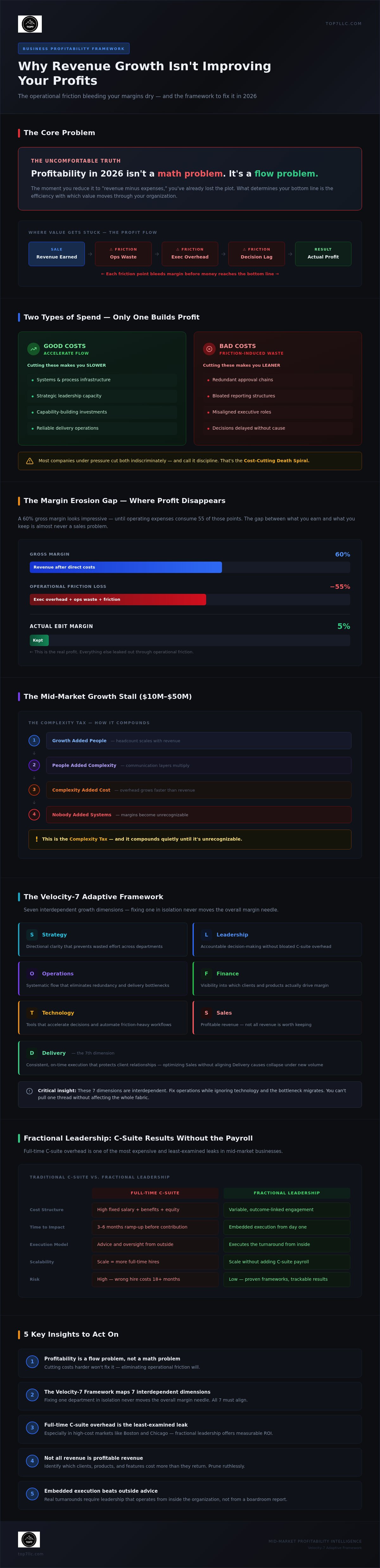
Profitability in 2026 isn't a math problem. It's a flow problem. The moment you reduce it to "revenue minus expenses," you've already lost the plot. What actually determines your bottom line is the efficiency with which value moves through your organization: from sale to delivery, from decision to execution, from strategy to result. Friction anywhere in that flow is profit leaving through a hole you haven't found yet.
The instinct to cut costs when margins compress is understandable. It's also dangerous. When companies slash "overhead," they rarely cut waste first. They cut the people and systems that were holding everything together. Your best operations manager leaves. Your delivery process starts missing deadlines. Your clients notice before your P&L does. That's the Cost-Cutting Death Spiral, and it's killed more mid-market growth stories than any recession.
The real discipline is learning to distinguish between two fundamentally different categories of spend:
Good Costs: Investments that accelerate flow. Systems, leadership, process infrastructure, and capability-building that make your organization faster and more reliable.
Bad Costs: Friction-induced waste. Redundant approvals, bloated reporting chains, misaligned executive roles, and the invisible tax of decisions that never get made on time.
Cutting bad costs makes you leaner. Cutting good costs makes you slower. Most companies, under pressure, cut both indiscriminately and call it discipline.
EBIT vs. Gross Margin: Where the Real Leaks Occur
A 60% gross margin looks impressive until your operating expenses consume 55 of those points. Operational friction, the accumulation of inefficiencies between your gross revenue and your actual earnings, is the primary profit killer in mid-market firms. It hides in executive burnout, in decisions that require four sign-offs when one would do, and in leadership gaps that force senior people to manage tasks instead of strategy. Improving business profitability means closing the gap between what you earn at the top line and what you actually keep, and that gap is almost never a sales problem.
The Mid-Market Growth Stall
Companies crossing the $10M to $50M revenue threshold hit a wall that feels like a market problem but is actually a structural one. Growth added people. People added complexity. Complexity added cost. Nobody added systems to manage any of it. That's the Complexity Tax, and it compounds quietly until your margins are unrecognizable. The path forward isn't hustle. It's the deliberate shift to systematic flow: defined processes, accountable leadership, and a model where scale doesn't automatically mean more headcount at the top.
Mid-market businesses in high-cost hubs like Boston and Chicago feel this acutely. Full-time C-suite salaries in these markets carry significant overhead burdens that smaller, leaner competitors in lower-cost regions simply don't face. The leadership model has to evolve before the business can.
Eliminating Operational Friction: The Velocity-7 Approach to Flow
Most profitability frameworks start with a spreadsheet. The Velocity-7 Adaptive Framework starts with a different question: where is value getting stuck? That shift in perspective is the difference between an accounting exercise and an operational transformation. Improving business profitability isn't about reading your P&L more carefully. It's about engineering the path value takes from sale to delivery so that nothing leaks out along the way.
The Velocity-7 framework maps your organization across seven growth dimensions: strategy, leadership, operations, finance, technology, sales, and delivery. The critical insight is that these dimensions are interdependent. Fix operations while ignoring technology, and the bottleneck migrates. Optimize sales while leadership is misaligned, and your delivery collapses under the new volume. You can't pull one thread without affecting the whole fabric. That's why single-department fixes almost never move the overall margin needle.
This is also where agile thinking stops being a tech-sector concept and becomes a C-suite execution tool. Agile isn't about sprints and standups. It's about shortening the feedback loop between decision and result, eliminating approval layers that exist out of habit rather than necessity, and creating organizational structures that can adapt faster than the market shifts. When you apply that discipline to executive operations rather than software development, the speed gains are substantial.
Mapping Your Friction Points
Before you can fix friction, you have to find it. A Velocity-7 organizational audit examines three recurring problem zones: communication silos that trap decisions inside departments, legacy technology that forces manual workarounds, and the absence of a coherent financial strategy that connects daily operational choices to long-term margin targets. The audit isn't a theoretical exercise. It produces a ranked friction map showing exactly where cash is being trapped and what it's costing you per quarter to leave it there.
From Operational Friction to Efficient Flow
Flow is the operational state where value reaches the customer with zero wasted effort. Every handoff is clean. Every decision has a clear owner. Every process step either adds value or gets cut. When an organization reaches flow, something measurable happens: customer acquisition costs drop because delivery becomes more reliable and referrals increase, while service delivery costs fall because rework, escalation, and exception handling shrink dramatically. Both lines move simultaneously, which is why flow has an outsized impact on net margin compared to any single cost-reduction initiative.
Consider a mid-market professional services firm where a single approval bottleneck, a CFO sign-off required on every client contract regardless of value, was adding an average of eleven days to each sales cycle. Removing that one friction point, by implementing a tiered authorization model, compressed the cycle and freed senior leadership to focus on strategy rather than administration. The operational change didn't require new headcount. It required a decision.
That's the kind of structural clarity a fractional leadership engagement delivers: not advice from the outside, but execution from the inside, using a proven framework built for exactly this kind of turnaround.
Fractional Leadership ROI: C-Suite Results Without the Payroll
Here's a structural problem most mid-market CEOs won't admit out loud: their leadership team is full of generalists wearing specialist hats. The VP of Operations who also handles vendor contracts. The CFO who doubles as the de facto IT strategist. The COO who's really just a very expensive project manager. Generalist leadership isn't a culture problem. It's a margin problem. And it compounds every quarter you leave it unaddressed.
Deep functional expertise at the executive level isn't a luxury. It's the difference between a leadership team that drives decisions and one that delays them. When your CFO doesn't have capital strategy fluency, or your technology leadership is being handled by someone whose last serious tech role was in 2014, you're not just missing upside. You're actively generating the kind of operational friction that bleeds your bottom line before revenue ever reaches it.
The fractional model solves this with a logic that's almost embarrassingly simple: you get the expertise without the full-time overhead. A seasoned CTO who commands a significant full-time compensation package, inclusive of salary, benefits, equity, and employer-side taxes, is accessible to a mid-market firm on a fractional retainer at a fraction of that annual cost. Same caliber of thinking. Same depth of execution. Structured around the hours your business actually needs, not a full-time seat that spends half its week in meetings that don't move the needle.
The other advantage is speed. Fractional leaders don't spend their first ninety days learning what a business does. They embed, assess, and execute from day one. That's the Speed to Impact advantage, and for a business where improving business profitability is urgent, not aspirational, it matters enormously.
The Fractional CTO: Plugging Tech Leaks
Technical debt is one of the most expensive invisible costs in a growing business. It's the accumulation of short-term technology decisions that seemed efficient at the time and are now slowing every product release, every integration, and every attempt to scale. A Fractional CTO doesn't just audit your stack. They prioritize the debt that's actively costing you revenue, build a roadmap aligned to your 2026 commercial goals, and turn your technology infrastructure from a drag on delivery into a competitive advantage. That's strategic technology leadership, not IT management.
The Fractional CFO and COO: Strategic Efficiency
A Fractional CFO moves well beyond bookkeeping. Cash flow modeling, capital allocation strategy, unit economics clarity, and the financial architecture that connects daily decisions to long-term margin targets: these are the outputs that actually shift profitability. The Fractional COO complements this by designing the operating systems that let your team execute consistently without requiring your direct intervention on every decision. Together, they address the two root causes of the mid-market growth stall: financial opacity and operational dependency on the founder.
If you're questioning whether a full-time CEO structure still makes sense for your stage of growth, that question deserves a direct answer. Is a Full-Time CEO a Mistake for Your Business? explores exactly that. Improving business profitability sometimes starts at the very top of the org chart.
Plugging the Leaks: Strategic Levers in Tech, Finance, and Sales
Not all revenue is created equal. Some clients cost you more to serve than they pay you to serve them. Some product features consume engineering cycles that could be building something customers actually pay a premium for. Some sales teams are closing deals that look great on a pipeline report and quietly destroy your margins by Q3. Identifying the leak is step one. Knowing which lever to pull is what actually fixes it.
Start with your revenue streams. Run a true cost-to-serve analysis across your client portfolio. When you factor in support overhead, exception handling, contract complexity, and the senior time consumed by difficult accounts, some of your "best" clients are running at negative contribution margin. Improving business profitability often begins with the uncomfortable decision to fire a client, not acquire a new one.
Product is the same story. Features that were built to win a deal two years ago are now consuming CPO bandwidth, engineering capacity, and QA cycles without generating measurable revenue. Product-Market Fit 2.0 isn't about adding more. It's about ruthless subtraction: cutting the roadmap back to the features that drive retention, expansion, and margin, then executing those with precision. A Fractional CPO brings exactly this discipline, aligning product development decisions directly to financial targets rather than internal momentum.
Sales is where the leverage compounds. An order-taking sales team fills the pipeline. A high-margin sales team qualifies it. The difference is whether your reps understand unit economics well enough to walk away from low-margin volume and close harder on the deals that actually move your bottom line. That's a coaching and structure problem, not a headcount problem.
On technology: buying more software isn't a digital transformation strategy. It's a procurement habit. Real tech flow means auditing what you already have, eliminating the stack redundancies that create integration debt, and building a coherent architecture where data moves cleanly between systems instead of requiring manual intervention at every handoff. That's the difference between software spending and technology ROI.
Financial Strategy and Cash Flow Management
Your P&L tells you what happened. It doesn't tell you why, or what's coming. Cash flow is the operational oxygen your P&L doesn't show until it's already gone. Growth-induced cash crunches are common precisely because revenue and cash timing diverge as you scale. A Fractional CFO builds the forward-looking financial architecture that connects daily operational choices to margin targets, turning your budget from a historical document into a live decision-making tool.
Advanced Project Management as a Margin Booster
Projects fail to deliver ROI for one consistent reason: they're managed for completion, not for value. Velocity-driven execution shortens the feedback loop between project milestones and commercial outcomes, ensuring that time-to-market is measured against revenue impact, not just delivery dates. When your Fractional CPO owns this alignment, product development stops being a cost center and starts being a margin driver.
If your current leadership model isn't built to execute at this level of precision, that's the structural gap worth closing first. Talk to Top7 about embedding fractional leadership into your growth strategy before the next quarter's numbers make the decision for you.
Executing the Turnaround: How Top7 Drives Mid-Market Profitability
Consulting is a slow death for a business that needs results now. You pay for a deck. You get a roadmap. Then the consultant leaves, and your team is left holding a document nobody knows how to execute. That model is finished. The firms winning in 2026 aren't hiring advisors. They're embedding operators.
That's the core distinction with Top7. The fractional leaders who come into your organization don't sit in a conference room and ask questions for six weeks. They take ownership of a function, identify the structural problems, and fix them. The difference between advice and execution is the difference between knowing you have a leak and actually closing it.
The 90-Day Roadmap to Flow
Ninety days is enough time to move a mid-market business from operational friction to measurable flow, if you know exactly where to cut. The Velocity-7 Adaptive Framework structures this in three phases:
Phase 1: Friction Audit. The first thirty days are diagnostic. Every friction point across your tech stack, sales process, and operational infrastructure gets mapped, ranked by cost, and prioritized by impact. No assumptions. No generic benchmarks. Your business, your leaks, your numbers.
Phase 2: Fractional Integration. Once the friction map is clear, the right C-suite expertise gets deployed against the highest-priority problems. That might be a Fractional CFO building the cash flow architecture your growth requires, a Fractional CTO retiring the technical debt that's slowing every delivery cycle, or a Fractional COO designing the operating systems that eliminate founder dependency on daily decisions.
Phase 3: Velocity Execution. Systems get built, not just recommended. Processes are documented, owned, and measured. By day ninety, improving business profitability isn't a goal on a slide; it's a structural reality embedded in how your organization runs.
Direct Action for CEOs
Here's the uncomfortable truth: if every significant decision in your company still routes through you, you're not running a business. You're running a job with a lot of employees. The bottleneck isn't your market, your team, or your product. It's the org structure that was never designed to scale without you at the center of it.
Top7's fractional model breaks that dependency by installing the executive layer your business actually needs, without the full-time overhead that makes it prohibitive. The question isn't whether you can afford fractional C-suite leadership. It's whether you can afford another quarter of margin erosion without it.
If you're ready to stop diagnosing and start executing, the first step is a strategic conversation with someone who's fixed this exact problem before. Scale your profitability with Top7 Fractional Leadership and find out precisely where your business is leaking cash and what it takes to close it for good.
Your Margins Won't Fix Themselves. Start Here.
Improving business profitability in 2026 isn't about squeezing harder. It's about building smarter. The friction bleeding your margins isn't hiding in your sales numbers or your headcount. It's embedded in the structural gaps your current leadership model was never designed to close.
Three things separate the businesses that scale profitably from those that stall: a clear map of where value is getting trapped, the right executive expertise deployed against the highest-priority problems, and a framework built for execution, not just diagnosis. That's exactly what the Velocity-7 Adaptive Framework delivers, and it's what sets Top7's fractional leadership model apart from every advisory engagement that ends with a slide deck and a handshake.
You don't need more headcount at the top. You need sharper thinking, faster execution, and a leadership structure that scales without the full-time overhead. That combination exists. It's proven. And it's available right now.
Scale your profitability without the C-suite payroll. Contact Top7 today and find out exactly where your business is leaking cash.
Frequently Asked Questions About Improving Business Profitability
What is the fastest way to improve business profitability?
The fastest path to improving business profitability is eliminating your highest-cost friction points first, not cutting headcount across the board. Start with a cost-to-serve analysis on your client portfolio and a review of your approval chains. You'll almost always find decisions that are taking days when they should take hours, and accounts that are consuming resources faster than they're generating returns. Fix those two things before you touch anything else.
How does a Fractional CTO help with business profit?
A Fractional CTO targets the technical debt that's quietly slowing every delivery cycle and integration your team attempts. They audit your existing stack, eliminate redundant tools creating integration drag, and build a technology roadmap aligned to your commercial goals rather than internal momentum. The result is a technology infrastructure that accelerates delivery instead of taxing it. That's the difference between software spending and technology ROI.
What is the difference between a business consultant and a fractional executive?
A consultant diagnoses the problem and hands you a document. A fractional executive takes ownership of a function and fixes it from the inside. That distinction matters enormously when your business needs results on a timeline, not a roadmap that sits in a shared drive. Fractional leaders embed into your organization, make decisions, build systems, and are accountable for outcomes in a way no advisory engagement ever is.
Can a mid-market company afford a Fractional CFO?
The more accurate question is whether a mid-market company can afford not to have one. A Fractional CFO delivers capital strategy, cash flow architecture, and unit economics clarity at a fraction of the cost of a full-time hire, without the benefits, equity, and employer-side tax burden that comes with a permanent seat. For companies between $10M and $50M in revenue, where financial opacity is one of the primary growth killers, the ROI case is straightforward.
What are the 7 dimensions of the Velocity-7 framework?
The Velocity-7 Adaptive Framework maps your organization across strategy, leadership, operations, finance, technology, sales, and delivery. These dimensions aren't independent checkboxes; they're interdependent systems. A bottleneck in one migrates to another the moment you fix it in isolation. That's precisely why the framework examines all seven simultaneously, producing a ranked friction map that shows where cash is being trapped and what it costs per quarter to leave it there.
Why is my company's profitability declining while revenue increases?
This is the Complexity Tax in action. Growth adds people, people add process layers, and process layers add cost that nobody systematically manages. Your gross margin looks healthy until operating expenses consume most of it. The gap between what you earn at the top line and what you actually keep widens because the operational infrastructure never scaled alongside the revenue. More sales volume through a broken delivery system doesn't fix margins; it accelerates the erosion.
How do I identify operational friction in my business?
Start by mapping three things: how long decisions take from initiation to execution, how many handoffs occur between sale and delivery, and where your senior leaders are spending time on tasks rather than strategy. Every approval layer that exists out of habit rather than necessity, every manual workaround your team has normalized, and every escalation that lands on a founder's desk is a friction point with a measurable cost. Those are your starting coordinates.
Is fractional leadership better than hiring a full-time executive?
It depends on your stage and your actual need. If you require a specific functional capability for a defined period, or if full-time C-suite overhead would compress the margins you're trying to protect, fractional leadership is the sharper tool. You get the same depth of expertise, faster time to impact, and none of the fixed overhead. For mid-market businesses where improving business profitability is the immediate priority, deploying targeted expertise against your highest-cost problems beats adding a permanent salary to the org chart.


Comments