
How to Scale a Tech-Enabled Service Business Without Breaking Delivery

What if more customers expose the cracks in your delivery instead of increasing profit? Learning how to scale a tech-enabled service business isn’t about adding people or buying another platform. It’s about standardizing the work before you automate it, so growth doesn’t make service slower, less consistent, or harder to manage.
You already know demand creates pressure. Manual handoffs, uneven processes, and disconnected team information can turn each new client into more operational friction. Technology won’t fix a broken process. It can simply help you repeat the problem faster.
This article shows you how to build a repeatable delivery model that protects customer outcomes while improving capacity and margins. You’ll learn how to identify the real constraint on growth, standardize core workflows, choose technology based on measurable business needs, and track service quality as volume rises. Then you’ll see how to sequence process, technology, and leadership improvements into a practical scaling plan. Build the system first. Then make it bigger.
Table of Contents
How to scale a tech-enabled service business: identify what is actually limiting growth
A tech-enabled service business uses technology to deliver, coordinate, or improve work performed for clients. Its value comes from the service and the outcome, not from selling software as a standalone product. Put simply: technology-enabled services use tools to make client work more effective; software businesses sell a product customers use themselves.
That distinction matters because more demand doesn’t automatically create more delivery capacity. If every new client adds similar labor, oversight, and cost, you’re growing, not scaling. A business can operate in the broader service-based economy and still depend on manual work that limits its ability to deliver consistently and profitably.
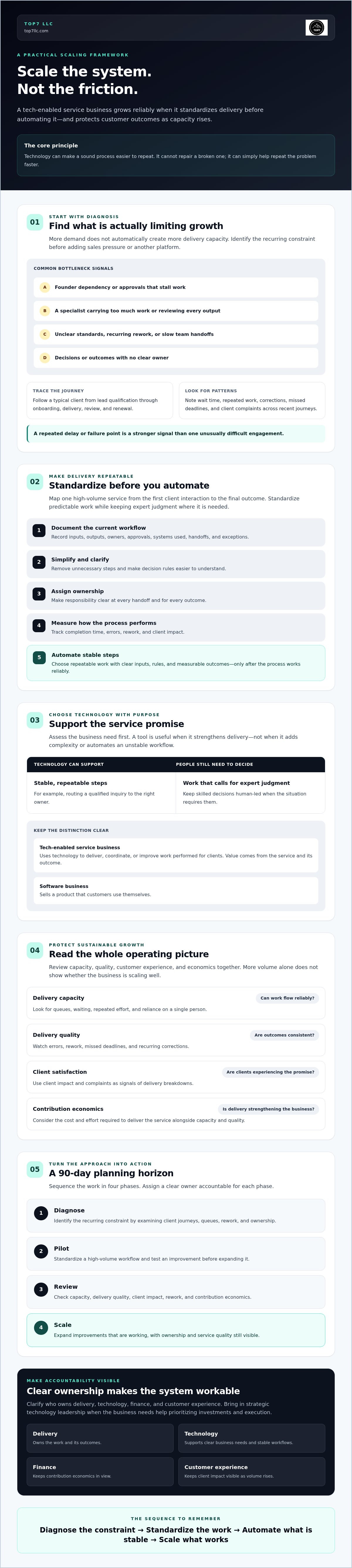
Before investing in another platform or pushing for more sales, find the constraint. The real blocker might be founder dependency, a specialist with too much work, rework caused by unclear standards, slow handoffs between teams, or decisions with no clear owner. Fixing the wrong problem just makes the wrong process more expensive.
Which growth bottleneck is slowing the business?
Trace a typical client journey from lead qualification through onboarding, delivery, review, and renewal. At each stage, note how long work waits, how often it gets repeated, and where it returns for correction. If proposals stall until the founder approves them, a leadership bottleneck may be slowing sales. If delivery pauses while one specialist reviews every output, adding demand will deepen the queue.
Use evidence, not assumptions. Customer complaints, missed deadlines, and recurring rework can point to breakdowns in communication, capacity, or ownership. Compare several recent client journeys and look for the same delay or failure point. A repeated pattern is a stronger signal than one unusually difficult engagement.
What should be true before scaling?
Get specific about who the service is for, what outcome you promise, what delivery includes, and what falls outside scope. Then examine recent engagements: do they share a repeatable core process, or does each one rely on custom decisions and individual memory? Expert judgment can remain human-led. The goal is to standardize the predictable work around it.
Separate a temporary workload spike from a persistent operating constraint. A short-term rush may call for scheduling adjustments; recurring delays, quality problems, or dependence on one person suggest the operating model needs attention. When you ask how to scale a tech-enabled service business, start with that diagnosis. Scale a process that works, not a queue of unresolved problems.
Standardize service delivery before automating the workflow
Automation is an amplifier, not a repair crew. Automating a broken workflow can reproduce its errors faster, across more clients. Before choosing tools, map one high-volume service from the first client interaction to the final outcome. The aim isn’t to turn expert work into a script. It’s to make the repeatable parts reliable and give skilled judgment room to do its job.
Map the client journey and operational handoffs
Follow one engagement stage by stage. At each step, record what information comes in, what must be produced, who owns the work, which decisions need approval, and which systems are used. Include transitions between teams, where details often disappear or get entered twice.
Mark approval queues, unclear responsibilities, duplicate data entry, and rework. Then check the map with the employees doing the work and, where practical, clients who experience the process. A workflow that looks clean in a leadership meeting may feel very different in actual delivery.
Use what you find to sequence improvements:
Document the current workflow, including exceptions.
Simplify unnecessary steps and clarify decision rules.
Assign ownership for each handoff and outcome.
Measure completion time, errors, rework, and client impact.
Automate stable steps only after the process works reliably.
Choose automation that supports the service promise
Prioritize tasks with clear inputs, repeatable rules, and an outcome you can measure. For example, routing a qualified inquiry to the right owner may be suitable for automation. Deciding how to handle a complex client concern may require human context and accountability.
Assess CRM, project management, billing, and communication tools against the workflow you’ve documented. Can information move between stages without repeated entry? Can the owner see what’s waiting and where work stands? Will the tool make delivery clearer, or create another place employees must check? Broader operations guidance from McKinsey also emphasizes the connection between scaling activity and protecting service quality and margins.
Keep sensitive decisions and nuanced client conversations appropriately supervised. Technology can prepare information, flag exceptions, or route work; a responsible person should remain accountable for consequential judgment and the client relationship. If your team needs support aligning technology choices with operating priorities, explore strategic planning and execution support. Standardize first. Automate with purpose.
Protect service quality and margins as technology expands capacity
Buying technology doesn’t automatically create scalable service operations. A tool may help your team handle more work, but if it also creates extra review, rework, or client support, capacity can rise while delivery quality and margins fall. To understand whether a change is working, measure these outcomes together, not in separate dashboards.
Which measures reveal sustainable service growth?
Start with a baseline, then track the same measures before and after a workflow or technology change. Define each metric consistently. For example, decide when delivery time starts and ends, what counts as rework, and how you calculate utilization. Otherwise, a change in the numbers may reflect a change in reporting rather than a real operational gain.
Track delivery time, utilization, rework, on-time completion, retention, and performance against service-level commitments. Then connect those measures to the economics of the engagement: compare revenue per engagement with the direct delivery effort and support it requires. If a process handles more clients but needs more corrective work, the extra throughput may not improve contribution economics. Set targets from your own baseline and business model, not a universal benchmark.
Activity counts show what the team did. Outcome measures show whether clients received the promised service and whether the work remains economically sound. Neither view is enough on its own.
How can standardization avoid making service impersonal?
Standardize dependable steps, such as collecting intake information or confirming deliverables. Preserve tailored expertise where a client’s context calls for judgment. A consistent process should make the service promise more reliable, not force every client through an identical path.
Keep track of exceptions and feedback. If a workflow repeatedly fails for a particular client need, treat that as evidence to review the process, not as a reason to make staff work around it indefinitely. After each significant change, review throughput alongside rework, on-time completion, client feedback, and support effort. That’s how to scale a tech-enabled service business without confusing “more work processed” with “better service delivered.”
Build a practical 90-day plan to scale a tech-enabled service business
A 90-day plan gives your team a focused planning horizon, not a promise that the whole business will transform in three months. Use it to test one service line or workflow, learn from real delivery, and make a clear decision about what comes next. Assign a named owner who can coordinate the work and raise blockers. Without ownership, even a sound plan becomes a list of intentions.
Phase one: establish the baseline and select a pilot
Choose a workflow based on three factors: its impact on clients, the friction it repeatedly creates, and its strategic importance to the business. Capture how it works now, including completion time, errors, handoffs, and available client feedback. Don’t wait for perfect data; record what you can measure consistently and note the gaps.
Before changing anything, write down the pilot’s scope, owner, intended outcome, and review date. For example, the goal might be to reduce avoidable delays in onboarding without increasing corrections or client confusion. A clear outcome keeps the team focused on results, not just launching a new tool or process.
Phase two: test, learn, and expand deliberately
Train the employees affected by the change, then document the revised workflow so they know what to do, when to do it, and where exceptions go. Run the pilot on the selected workflow rather than changing several service lines at once. That limits disruption and makes it easier to understand what caused a result.
At the review point, compare pilot evidence with the baseline. Check whether the intended improvement occurred, and look for unintended effects such as extra support work, missed handoffs, or worse client feedback. If results are unclear, investigate before expanding. A rollout isn’t a win just because the new process is live.
Use the remaining planning horizon to make a deliberate decision:
Diagnose: Select the workflow, establish the baseline, and name the owner.
Pilot: Train the team and test the documented change within a defined scope.
Review: Compare results, quality signals, and unexpected effects against the baseline.
Scale: Expand only when ownership is clear, quality holds, and the supporting systems can handle the next step.
If the pilot exposes a gap in prioritization or execution capacity, connect the next step to a defined leadership need. Top7’s strategic planning and advanced project management can support disciplined planning and implementation. Keep the decision gate firm: prove the workflow works before you multiply it.
Add the leadership and execution capacity needed to scale reliably
Scaling breaks down when responsibility is scattered. Service delivery owns the client outcome. Technology owns the systems and priorities that support it. Finance tracks the economics. Customer experience spots the friction clients feel. These areas need accountable owners who share information and resolve trade-offs, not separate dashboards and conflicting priorities.
That doesn’t mean every growing firm needs a full executive team. Match leadership capacity to the decisions the business actually faces. If technology choices affect delivery, cost, and client experience, but no one can set priorities across those areas, the gap is executive ownership, not necessarily a shortage of software vendors.
When does a growing service company need technology leadership?
Look for recurring signals: disconnected systems, unclear investment priorities, repeated delivery friction, or technology risks without an accountable decision-maker. A vendor can explain a platform’s features, but leadership must decide whether it supports the business model, fits the service promise, and deserves attention ahead of other work.
Ask whether someone can connect technology decisions to business objectives, weigh competing needs, and take responsibility for progress. If those calls repeatedly fall to an overloaded founder or stall between departments, more leadership capacity may be needed. The right structure depends on the company’s scale, operating model, and current challenges.
How can an external leader support execution?
A Fractional CTO can provide strategic technology leadership when the business needs experienced guidance but isn’t ready to add a full-time executive. The role is to help prioritize technology decisions and align them with business objectives, not to build custom software. That distinction matters: strategy and accountability guide the work; they aren’t the same as software development.
Leadership also has to turn priorities into owned work. Strategic planning clarifies what matters and why. Advanced project management can help make responsibilities, milestones, and progress visible so initiatives don’t disappear into a backlog. Pair that execution discipline with clear owners in service delivery, finance, and customer experience, and technology decisions become part of how the business operates, not a disconnected IT project.
If leadership capacity is the constraint, Explore Top7's Fractional CTO support to consider how fractional technology leadership and strategic support could fit your needs. The goal is straightforward: put the right decisions in the right hands, then make execution accountable.
Build the operating foundation for your next stage of growth
Scaling isn’t about adding tools or people and hoping delivery keeps up. It’s about finding the constraint, making the core service repeatable, and judging progress by client outcomes and business performance, not activity alone. A focused plan and clear owners turn those priorities into work your team can execute.
If you’re deciding how to scale a tech-enabled service business, the next move is to match leadership and execution capacity to the challenges in front of you. Top7 offers Fractional CTO leadership, strategic planning, advanced project management, and its Velocity-7 Adaptive Framework to support that work.
Explore how Top7's Fractional CTO support can help you scale with focus. Build on what works, make progress visible, and give your team a stronger foundation for growth.
Frequently Asked Questions
What is a tech-enabled service business?
A tech-enabled service business uses technology to deliver, coordinate, or improve work for clients, while the core value still comes from a service. Tools might support scheduling, communication, analysis, project delivery, or billing. For example, a consulting firm may use software to coordinate client work, but clients pay for the expertise and outcome, not the software itself. Scaling means improving the operating model as well as the tools.
How do you scale a service business without hiring more people?
Start by identifying work that can be completed reliably without adding more expert judgment. Simplify and standardize that work, improve handoffs, remove duplicate data entry, and automate suitable repeatable tasks. Then monitor whether delivery quality and capacity hold up as the changes take effect. Growth may still require additional expertise or staff. The goal isn’t to avoid hiring at all costs, but to make existing capacity more effective before adding resources.
Can automation hurt customer experience in a service business?
Yes. Automation can frustrate clients if it removes necessary human judgment, creates confusing handoffs, or makes it difficult to get help. Begin with stable tasks, such as routing complete intake information, and keep people responsible for nuanced situations. Test changes with a limited pilot. Gather feedback from clients and employees, then compare service quality and resolution outcomes with the previous process before deciding whether to expand.
What technology does a service business need to scale?
There’s no universal technology stack. Start with the process that’s constraining delivery, then assess whether your existing CRM, project management, communications, billing, or analytics tools can support it. Look for clear ownership, useful integrations, reliable information, and tools employees can adopt. For example, if teams repeatedly re-enter client details, evaluate how current systems exchange information before buying another platform. Choose technology to address a defined operating need.
How do you measure whether a service business is scaling successfully?
Use a balanced set of measures, including delivery time, on-time completion, rework, client feedback, retention, capacity, and contribution economics. Define each metric consistently and record a baseline before changing a workflow. More volume alone doesn’t prove healthy scaling. If quality falls, delivery becomes unpredictable, or the effort and support needed per client rise, increased activity may be hiding a weaker operating model.
Should a service business standardize its processes before scaling?
Yes, standardize the repeatable parts of delivery before expanding them, but don’t force every client into a rigid script. Document the steps, responsibilities, and decision points that reliably support good outcomes. Keep expert judgment where client needs differ. Then use exceptions and feedback to improve the process. Scaling the version that works can make delivery more consistent without stripping away the expertise clients value.
When should a service business consider a Fractional CTO?
Consider a Fractional CTO when technology decisions, disconnected systems, technology risk, or unclear execution ownership are holding back progress, but the business may not need a full-time CTO. First identify which decisions require executive-level guidance and what outcomes matter. Top7 offers Fractional CTO leadership alongside strategic planning and advanced project management. This is strategic leadership and execution support, not custom software development.


Comments